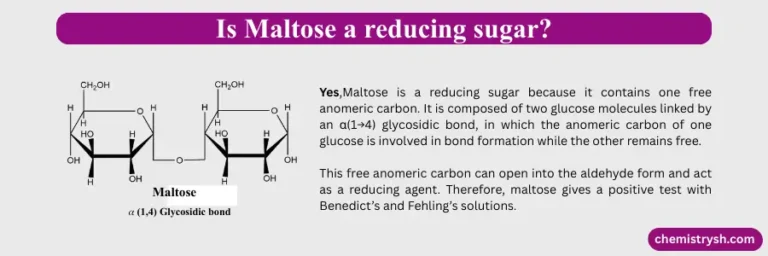
Reducing and Non-Reducing Sugars
Reducing and Non-Reducing Sugars belong to the major biomolecule carbohydrates and are distinguished by whether they can act as reducing agents. To better understand them, we will elaborate on what carbohydrates are, what reducing sugars and non-reducing sugars are, discuss their examples, and explain how they are identified using the tests specific to reducing and non-reducing sugars
What Are Carbohydrates?
Carbohydrates are organic biomolecules composed of carbon, hydrogen, and oxygen and are chemically defined as polyhydroxy aldehydes or ketones. They are classified into monosaccharides, disaccharides, and polysaccharides, with the term sugar commonly referring to simple carbohydrates.
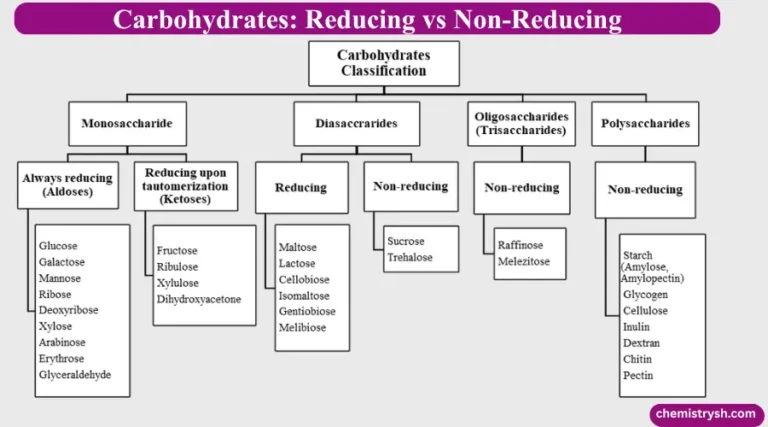
Based on their chemical behavior, carbohydrates—whether mono-, di-, or polysaccharides—can be further classified as reducing sugars or non-reducing sugars, forming the basis of reducing and non-reducing sugars.
Reducing Sugar
A reducing sugar is a carbohydrate that contains a free aldehyde or ketone group, enabling it to act as a reducing agent in chemical reactions. or
A reducing sugar is a carbohydrate that contains a free aldehyde or ketone group, either in the open-chain form or as a hemiacetal/hemiketal in the cyclic form, which allows it to reduce mild oxidizing agents such as Benedict’s solution, Fehling’s solution, or Tollens’ reagent.
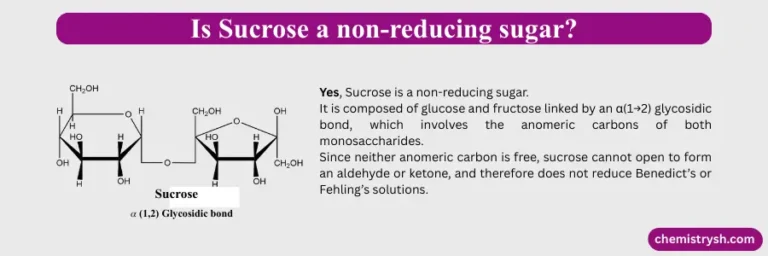
Most sugars we eat are reducing sugars, because their anomeric carbon is free or can open, allowing them to undergo oxidation in redox reactions. Only a few, like sucrose, are non-reducing, as their anomeric carbons are locked in glycosidic bonds.
All reducing sugars give a positive result in Benedict’s, Fehling’s, or Tollen’s tests.
Properties of Reducing Sugars
- Presence of a free anomeric carbon
- Exist in open-chain form in solution
- Give positive Benedict’s and Fehling’s tests
- Chemically reactive in nature
Examples of Reducing Sugars
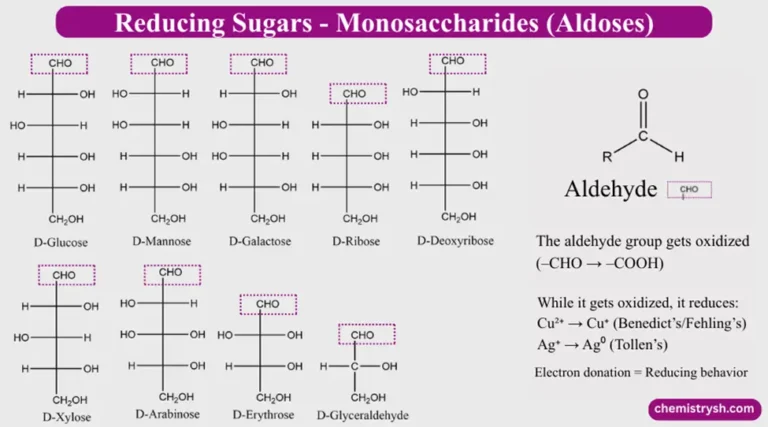
1. Monosaccharides (All of them)
All simple sugars are reducing sugars because they can easily open up their ring structure to reveal a reactive aldehyde or ketone group.
- Glucose
- Galactose
- Mannose
- Ribose
- Deoxyribose
- Xylose
- Arabinose
- Erythrose
- Glyceraldehyde
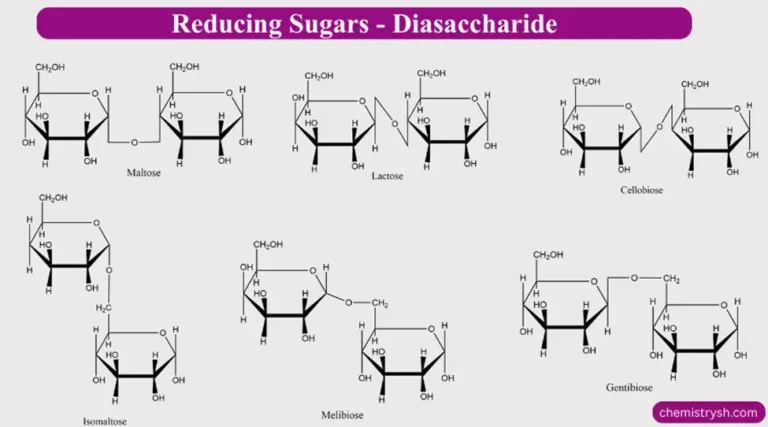
2. Disaccharides (Some of them)
These are reducing because one of the two sugar units still has a “free” reactive end.
- Maltose
- Lactose
- Cellobiose
- Isomaltose
- Gentiobiose
- Melibiose
3) Polysaccharides (rarely)
These are reducing because one of the two sugar units still has a “free” reactive end.
- Dextran
- Some oligosaccharides
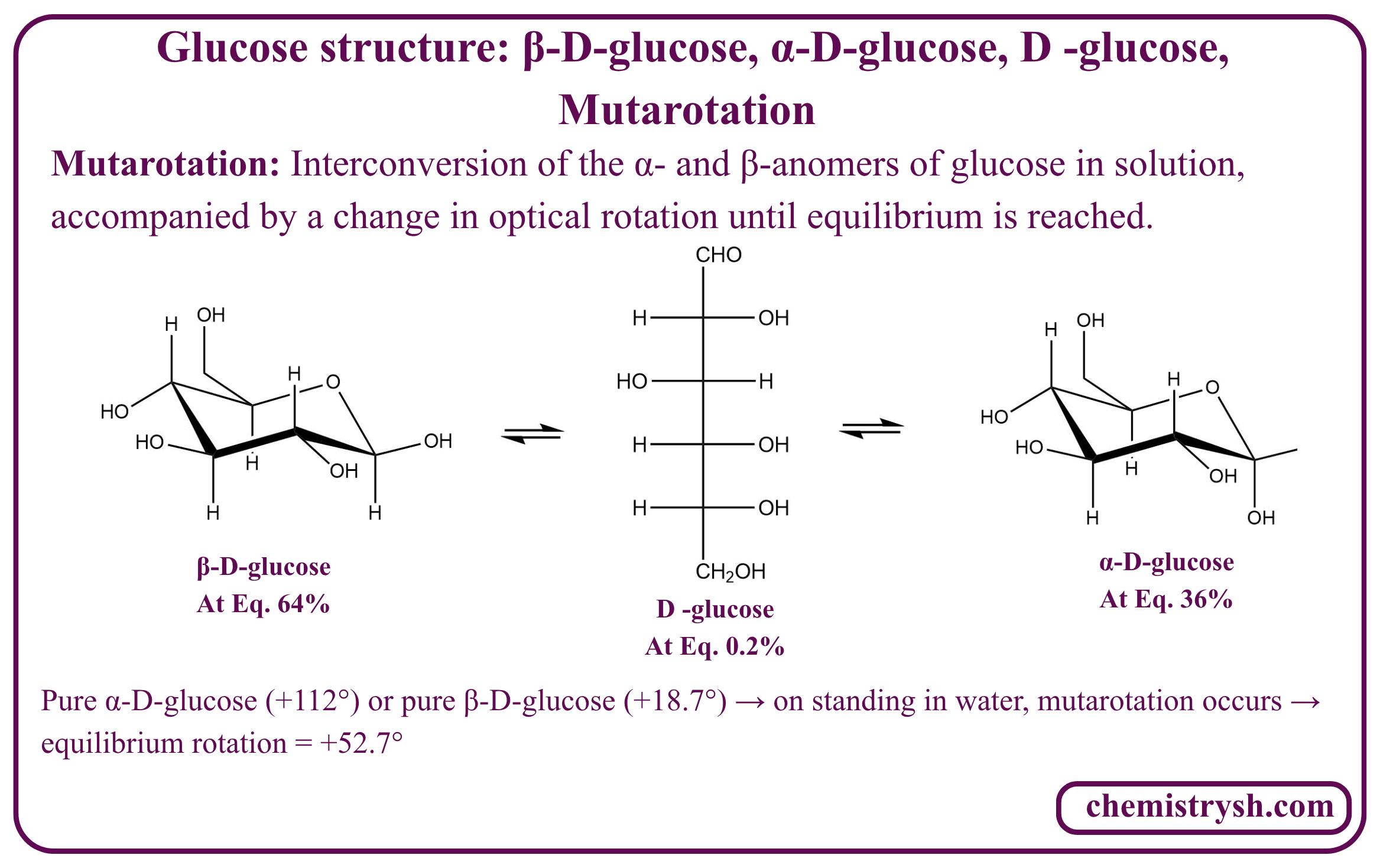
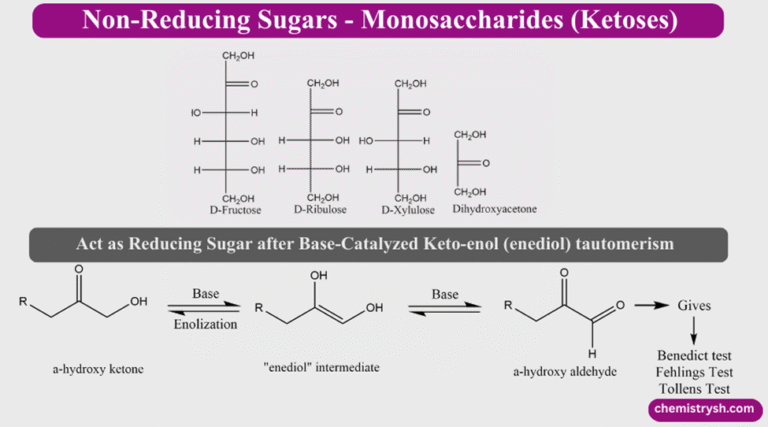
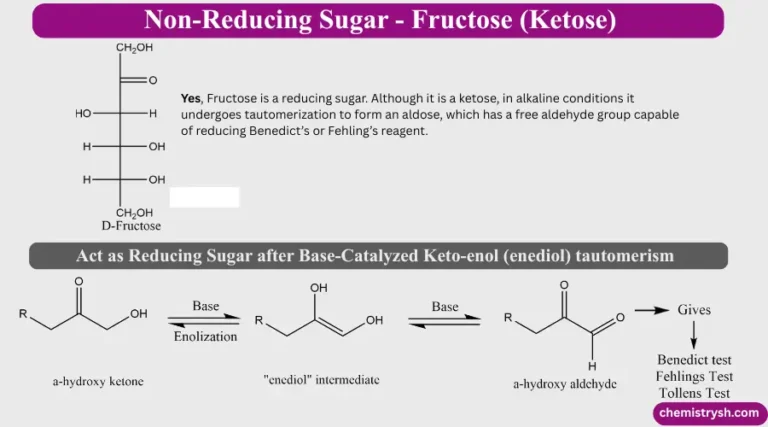
Note: Fructose is a ketose but acts as a reducing sugar due to tautomerization in alkaline conditions. Tautomerization and Reducing Sugar Behavior of Fructose
Non-Reducing Sugars
A non-reducing sugar is a carbohydrate in which all anomeric carbons are involved in glycosidic bonds, forming full acetal or ketal structures, so the sugar cannot act as a reducing agent in chemical tests.
Properties of Non-Reducing Sugars
- No free aldehyde or ketone group
- Do not give Benedict’s or Fehling’s test
- Chemically more stable
- Show reducing behavior only after hydrolysis
Non-Reducing Sugars Examples
These sugars do not have a free reactive group because the “reducing ends” of the molecules are locked away in the bond (glycosidic linkage) between the sugar units.
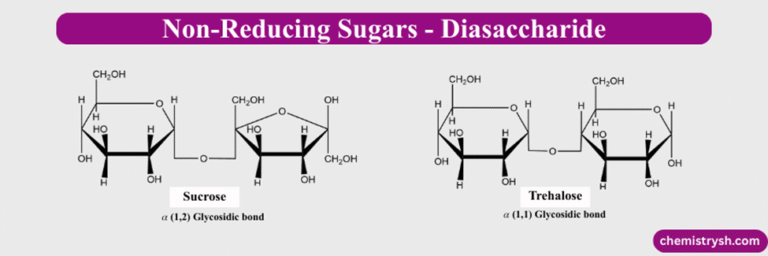
1) Disaccharides
Both anomeric carbons are involved in the glycosidic bond, so no free aldehyde/ketone group is available.
- Sucrose
- Trehalose
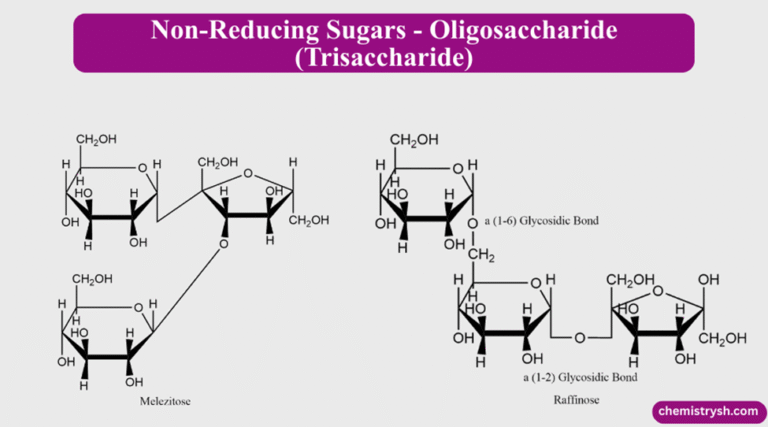
2) Oligosaccharides
All anomeric carbons are engaged in glycosidic linkages
- Raffinose
- Melezitose
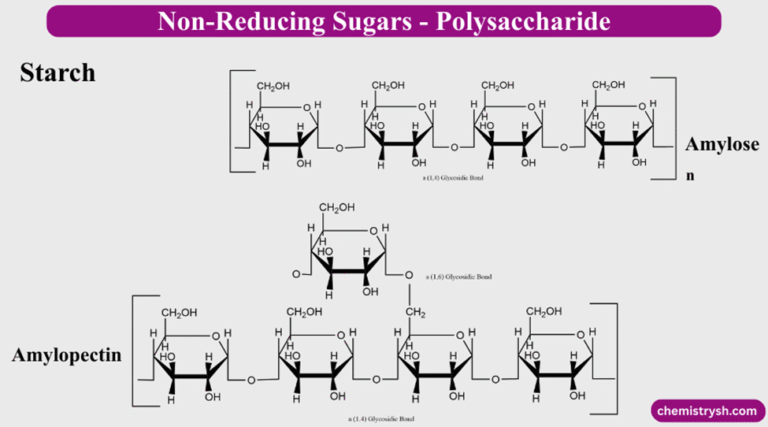
3)Polysaccharides
Starch, Glycogen, and Cellulose are generally considered non-reducing because their reactive ends are negligible compared to their massive size
- Starch (Amylose, Amylopectin)
- Glycogen
- Cellulose
- Inulin
- Dextran
- Chitin
- Pectin
Tests for Reducing and Non-Reducing Sugars
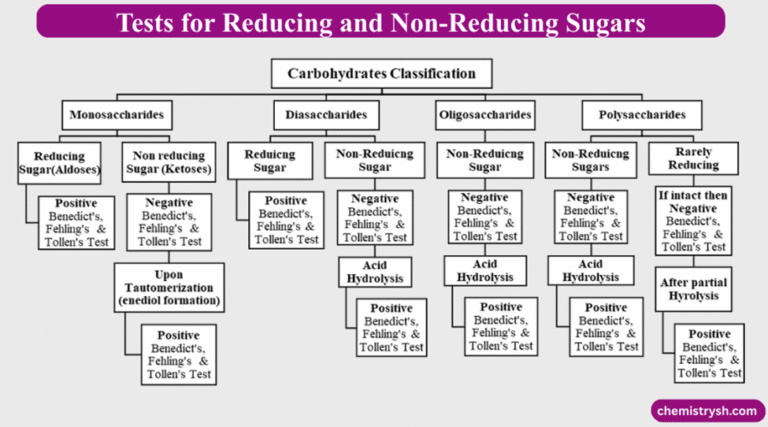
1)Tests for Reducing Sugars:
Reducing sugars contain a free aldehyde or ketone group and can reduce mild oxidizing agents.
- Benedict’s Test: Reducing sugars reduce Cu²⁺ to Cu⁺, forming a brick-red precipitate. (e.g., Glucose, Lactose)
- Fehling’s Test: Reducing sugars reduce Fehling’s solution to red cuprous oxide. (e.g., Glucose, Maltose)
- Tollens’ Test: Reducing sugars reduce Ag⁺ to metallic silver, forming a silver mirror. (e.g., Glucose, Fructose)
2)Tests for Non-Reducing Sugars:
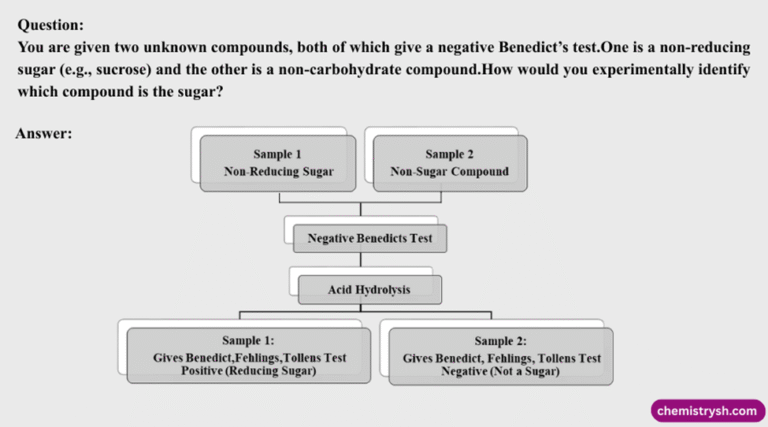
Non-reducing sugars do not react with Benedict’s, Fehling’s, or Tollens’ tests due to the absence of a free functional group.
- Acid Hydrolysis Test: Non-reducing sugars are hydrolyzed into monosaccharides, which then give a positive Benedict’s or Fehling’s test. (e.g., Sucrose → Glucose + Fructose)
Reducing vs Non-Reducing Sugars
The main difference between reducing and non-reducing sugars lies in the presence of a free functional group. Reducing sugars can donate electrons and reduce oxidizing agents, while non-reducing sugars cannot due to glycosidic bonding.
|
Parameter |
|
|
|||
|---|---|---|---|---|---|
|
|
|
|||
|
|
|
|||
|
|
|
|||
|
|
|
|||
|
|
|
|||
|
|
|
|||
|
|
Sucrose. Trehalose |
Frequently Asked Questions
The anomeric carbon is the carbon atom in a sugar that was originally the carbonyl carbon (C=O) in the open-chain form and becomes a new chiral center after the sugar cyclizes (forms a ring).
- In aldoses (like Glucose), the anomeric carbon is Carbon 1 (C1).
- In ketoses (like Fructose), the anomeric carbon is Carbon 2 (C2).