
The haloform reaction is a powerful analytical tool used to identify methyl ketones (such as acetone and acetophenone), acetaldehyde, and specific alcohols (including ethanol, 2-propanol, 2-butanol, and 2-pentanol). This process occurs when a methyl carbonyl compound reacts with halogens—I₂, Br₂, or Cl₂—in the presence of a strong base like NaOH (sodium hydroxide).
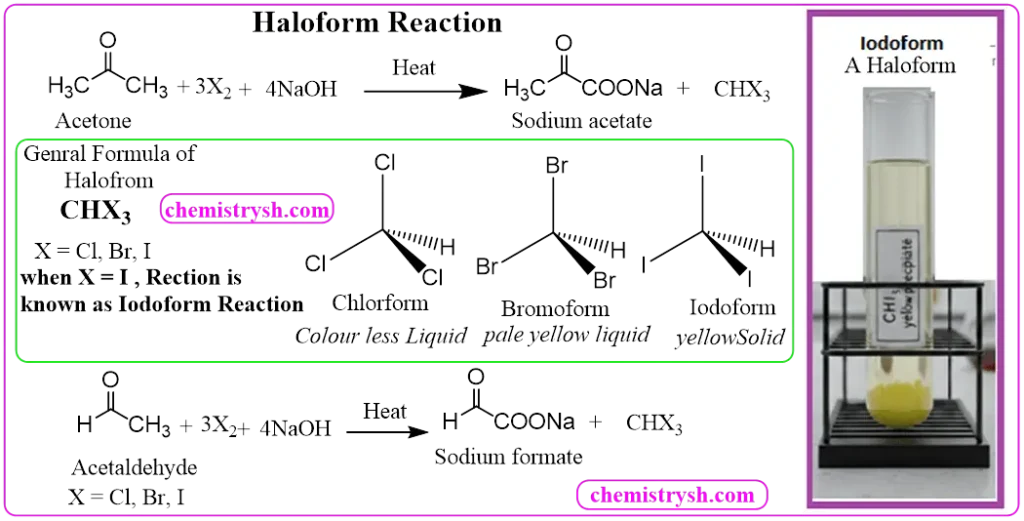
The reaction produces carboxylate salts and trihalomethanes (CHX₃). Depending on the halogen source used, the reaction yields one of the following haloforms:
We must first ask: What is a haloform?
Learning Outcomes of the Haloform Test
By the end of this topic, you should be able to:
- Identify Reactive Substrates: Recognize the specific structural features required for a positive Haloform test, specifically the methyl ketone group (CH₃-C=O) and methyl secondary alcohols (CH₃-CH(OH)-).
- Explain the Reaction Mechanism: Describe the step-by-step mechanism, including the base-catalyzed halogenation of the alpha-carbon followed by nucleophilic acyl substitution and bond cleavage.
- Interpret Experimental Results: Correlate the formation of a yellow precipitate (iodoform) with the presence of the target functional groups, distinguishing positive results from negative ones.
- Apply Synthetic Utility: Demonstrate how the reaction can be used synthetically to convert methyl ketones into carboxylic acids with one fewer carbon atom.
- Differentiate Organic Compounds: Use the Haloform test (specifically the Iodoform test) to distinguish between pairs of similar compounds, such as Ethanol vs. Methanol or Acetone vs. Diethyl Ketone.
- Analyze Environmental Impact: Explain the formation of chloroform and other trihalomethanes (THMs) as unintentional byproducts during the chlorination of water containing organic matter.
What is the Haloform Test?
A haloform is a type of trihalomethane with the general formula CHX₃, where X represents a halogen atom such as chlorine, bromine, or iodine. Its structure consists of one carbon atom bonded to one hydrogen atom and three identical halogen atoms. Common examples of haloforms include chloroform (CHCl₃), bromoform (CHBr₃), and iodoform (CHI₃), each possessing distinct physical and chemical properties.

Depending on which halogen is present, this structure creates the building blocks for well-known substances:
The Three Primary Haloforms
Haloforms are a specialized class of trihalomethanes identified by the general formula CHX₃. Their molecular structure is simple yet distinct: a single central carbon atom is bonded to one hydrogen atom and three identical halogen atoms (X).
Depending on which halogen is present, this structure creates the building blocks for the three most significant compounds used in the haloform reaction:
- Chlorine (Cl): Forms Chloroform (Trichloromethane) — CHCl₃
- Bromine (Br): Forms Bromoform (Tribromomethane) — CHBr₃
- Iodine (I): Forms Iodoform (Triiodomethane) — CHI₃
These compounds are the primary players in the haloform reaction, a staple of organic chemistry laboratories worldwide for both molecular synthesis and diagnostic testing.
Characteristics and Uses of Major Haloform Compounds: Chloroform (CHCl₃), Bromoform (CHBr₃) and Iodoform (CHI₃).
|
Haloform |
Chemical Formula |
Physical Appearance |
Common Use / Significance |
Interesting / Notable Feature |
|---|---|---|---|---|
|
Chloroform |
CHCl3 |
Colorless liquid |
Commonly used as an organic solvent |
Has a sweet smell and was historically used as an anesthetic. |
|
Bromoform |
CHBr3 |
Heavy, pale yellow liquid |
Used in geological and mineral testing |
Much denser than water; contributes to the smell of seawater. |
|
Iodoform |
CHI3 |
Bright yellow crystalline solid |
Primary indicator of a positive haloform test |
Produces a distinctive antiseptic odor and yellow crystals. |
Comparison: Haloform Reaction vs. Iodoform Reaction
It is important to understand that the Iodoform reaction is simply a specific type of Haloform reaction. They follow the exact same chemical mechanism, but they use different halogens and serve different purposes.
- Haloform Reaction: The general term for the reaction using any halogen (Chlorine, Bromine, or Iodine).
- Iodoform Reaction: The specific case where Iodine is used, primarily for laboratory testing.
|
Feature |
Haloform Reaction (General) |
Iodoform Reaction (Specific) |
|---|---|---|
|
Halogen Used |
Any Halogen: Chlorine (Cl₂), Bromine (Br₂), or Iodine (I₂). |
Only Iodine (I₂) is used. |
|
Main Product |
A generic “Haloform” (CHX₃): Chloroform (CHCl₃), Bromoform (CHBr₃), or Iodoform (CHI₃). |
Iodoform (CHI₃) specifically. |
|
Visual Result |
Often produces colorless liquids (Chloroform and Bromoform are liquids). Hard to see visually. |
Produces a Yellow Solid Precipitate. Very easy to see. |
|
Primary Application |
Industrial Synthesis: Used to make solvents or reagents. Also occurs in water treatment. |
Lab Identification: Used as a diagnostic test to identify methyl ketones or methyl alcohols. |
|
Safety |
Chloroform is a suspected carcinogen; Bromoform is toxic. |
Iodoform is a mild antiseptic (historically used on wounds). |
Chemical Equations
1. General Haloform Equation (using ‘X’ for any halogen):
R-CO-CH₃ + 3X₂ + 4NaOH → R-COONa + CHX₃ (Haloform) + 3NaX + 3H₂O

2. Specific Iodoform Equation (using Iodine):
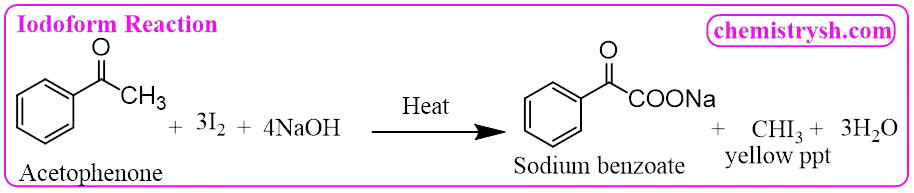
R-CO-CH₃ + 3I₂ + 4NaOH → R-COONa + CHI₃ (Yellow Precipitate) + 3NaI + 3H₂O
Summary about Haloform Reaction for Students:
Think of “Haloform” as the Category (like “Fruit”) and “Iodoform” as the Specific Item (like “Banana”). In the lab, we almost always use the Iodoform version because the yellow solid proves the reaction happened instantly.
oratory Procedure: Performing the Iodoform Test
This procedure describes how to test an unknown organic compound for the presence of a methyl ketone or methyl secondary alcohol.
Materials Required for Haloform Reaction
- Test Compound: The liquid or solid you are analyzing.
- 10% Sodium Hydroxide (NaOH): Or Potassium Hydroxide (KOH).
- Iodine-Potassium Iodide Solution: (Often called Iodine/KI reagent).
- Water Bath: Heated to roughly 60°C.
Step-by-Step Procedure for Haloform Reaction (Iodoform Reaction)
1. Prepare Sample: Place 5 drops liquid (or 0.1 g solid) in a tube; dissolve in dioxane if insoluble (avoid ethanol).
2. Add Base: Add 2 mL 10% NaOH and shake gently.
3. Add Iodine: Add Iodine-KI dropwise until a dark brown color persists.
4. Heat: Warm in 60°C water bath for 2 mins; replenish iodine if color fades.
5. Decolorize: If still dark brown, add dilute NaOH drops until clear or light yellow.
6. Observe: Cool and dilute with water; Positive = Yellow precipitate; Negative = No solid.
The Iodoform Test: A Diagnostic Tool in Organic Chemistry
Iodoform Test is the specific form of the haloform reaction that is used as a diagnostic tool in organic chemistry. The Iodoform Reaction (utilizing I2 and NaOH) is a highly specific diagnostic tool used to identify particular structural units in organic compounds. A positive test is unmistakable, resulting in the formation of iodoform (CHI3), which appears as a bright yellow, crystalline precipitate.
This visual indicator is essential for identifying the methyl carbonyl group. Specifically, it allows chemists to distinguish acetaldehyde (CH3CHO) and ethanol (CH3CH2OH) from other organic substances that lack this specific molecular structure.
Haloform Reaction Conditions
ISuccessful transformation depends on maintaining specific haloform reaction conditions. Without the correct environment, the sequential halogenation required for the reaction mechanism will not occur.
- The Base: Typically an aqueous solution of Sodium Hydroxide (NaOH) or Potassium Hydroxide (KOH) at 10-20% concentration.
- The Halogen Source: Iodine (I₂), Bromine (Br₂), or Chlorine (Cl₂).
- Temperature: Usually performed at room temperature or with gentle warming (20–60°C).
- pH Levels: The medium must be strongly basic (pH 13–14) to facilitate enolate formation.
A popular modern variation involves the haloform reaction with sodium hypochlorite (NaOCl). Common household bleach can serve as both the halogen source and the base, making it a safer and more convenient reagent for synthesizing chloroform (CHCl₃).
Compounds Giving Positive and Negative Haloform Test
Only certain compounds give a positive haloform (or iodoform) test. To pass the test, a molecule must contain—or be able to form—a “Methyl End” attached to the carbonyl group.
1. Compounds That Respond Positively
These compounds either contain a methyl ketone group (CH₃-C=O) directly or contain a structure that can be oxidized into one during the reaction (specifically the CH₃-CH(OH)- group).
- Methyl Ketones: (The carbonyl group is attached to at least one methyl group) Examples: Acetone (Propanone), 2-Butanone (Methyl ethyl ketone), 2-Pentanone, Acetophenone.
- Acetaldehyde: Note: This is the only aldehyde that gives a positive test.
- Ethanol: Note: This is the only primary alcohol that gives a positive test.
- Methyl Secondary Alcohols: (Alcohols where the -OH is on the second carbon of a chain)Examples: Isopropyl alcohol (Propan-2-ol), 2-Butanol, 2-Pentanol.
2. Compounds That Give a Negative Test
The absence of the required methyl group adjacent to the carbonyl or hydroxyl group prevents the reaction from occurring.
Non-Methyl Ketones: (Ketones with larger alkyl groups on both sides) Examples: 3-Pentanone (Diethyl ketone), Benzophenone, Cyclohexanone.
Haloform Chemical reactions
Important Note: While the general reaction is called the Haloform Reaction, when Iodine (I₂) is used as the halogen instead of Chlorine or Bromine, the reaction is specifically known as the Iodoform Reaction. This is because it produces Iodoform (CHI₃), the only haloform that is a solid at room temperature.
Chemical Reactions of the Haloform Test (Iodoform Reaction)
The haloform reaction is a powerful diagnostic tool used in organic chemistry to identify the presence of methyl ketones and secondary methyl alcohols. When these compounds are treated with a halogen in a basic solution (like NaOH), they undergo a specific oxidative cleavage. This process results in the formation of a carboxylate salt and a trihalomethane.
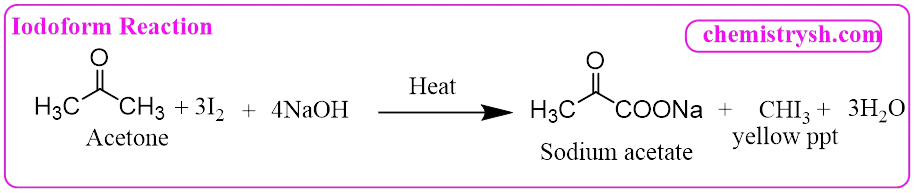
1. Haloform Reaction of Acetone (Iodoform Reaction)
Acetone is the simplest methyl ketone. It reacts with iodine and sodium hydroxide to produce sodium acetate and the characteristic yellow solid precipitate of iodoform.
CH₃COCH₃ + 3I₂ + 4NaOH → CH₃COONa + CHI₃(s) + 3NaI + 3H₂O
2. Haloform Reaction of Acetaldehyde (Iodoform Reaction)
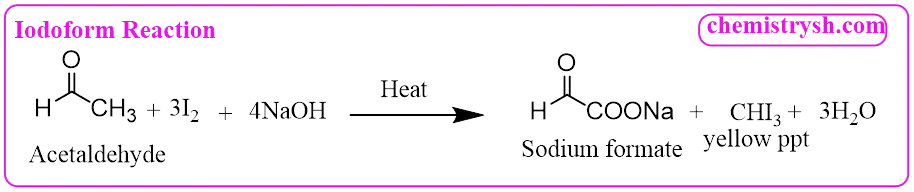
Acetaldehyde is the only aldehyde that gives a positive result in this test. It is converted into sodium formate and iodoform crystals.
CH₃CHO + 3I₂ + 4NaOH → HCOONa + CHI₃(s) + 3NaI + 3H₂O
3. Haloform Reaction of Ethanol (Iodoform Reaction)
Ethanol is a primary alcohol that is first oxidized to acetaldehyde. Once oxidized, it follows the standard haloform pathway to yield the yellow solid.
CH₃CH₂OH + 4I₂ + 6NaOH → HCOONa + CHI₃(s) + 5NaI + 5H₂O

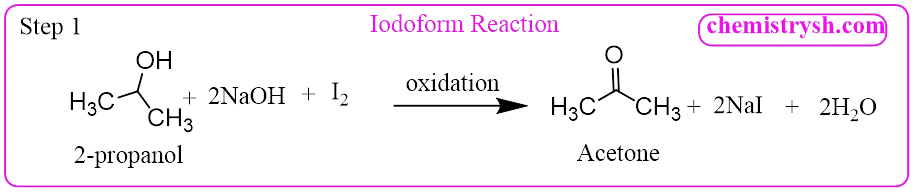
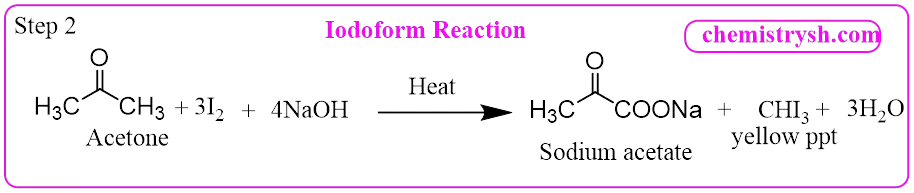
4. Haloform Reaction of 2-Propanol (Iodoform Reaction)
As a secondary alcohol with a methyl group at the alpha position, 2-propanol is oxidized to acetone by the reaction mixture before the iodoform is produced.
CH₃CH(OH)CH₃ + 4I₂ + 6NaOH → CH₃COONa + CHI₃(s) + 5NaI + 5H₂O
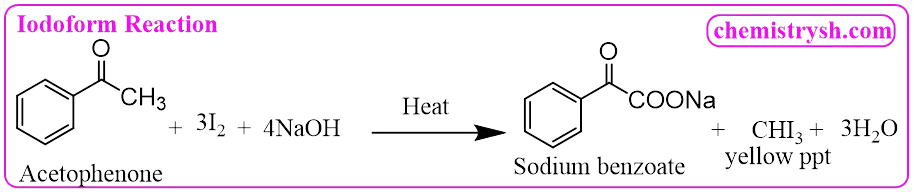
5. Haloform Reaction of Acetophenone (Iodoform Reaction)
Acetophenone is an aromatic methyl ketone. The reaction cleaves the methyl group to form sodium benzoate and the yellow iodoform precipitate.
C₆H₅COCH₃ + 3I₂ + 4NaOH → C₆H₅COONa + CHI₃(s) + 3NaI + 3H₂O
Haloform Reaction: Starting Compounds, Salts Formed, and Carbon Change
|
|
|
|
|
|||||
|---|---|---|---|---|---|---|---|---|---|
|
Acetone |
|
|
|
|
|||||
|
Acetaldehyde |
|
HCOONa |
|
|
|||||
|
Ethanol |
|
HCOONa |
|
|
|||||
|
|
|
|
|
|||||
|
|
|
|
|
|||||
|
|
|
|
|
|||||
|
|
|
|
|
|||||
|
|
|
|
|
Detailed Haloform Reaction Mechanism
Dual Role of Hydroxide Ion (OH⁻)
The haloform reaction proceeds under strongly basic conditions and involves sequential α-halogenation followed by carbon–carbon bond cleavage. A key conceptual feature of this mechanism is that the hydroxide ion (OH⁻) plays two distinct roles:
- As a base in α-hydrogen abstraction
- As a nucleophile in carbonyl attack
Other Key Concept Related To Haloform Reaction Mechanism:
- α-Hydrogens are acidic due to resonance stabilization of the enolate
- In the 1st three steps OH⁻ functions purely as a base, not as a nucleophile,
- Halogen atoms are strongly electron-withdrawing
- Each substitution increases α-hydrogen acidity, accelerating the reaction
- The –CX₃ group stabilizes negative charge and behaves as an excellent leaving group
- Last step represents a nucleophilic acyl substitution
Applications of the Haloform Reaction
Synthesis of Carboxylic Acids: Converts methyl ketones into carboxylic acids, effectively shortening the carbon chain by one carbon atom.
Production of Haloforms: Industrially manufactures useful compounds like chloroform (solvent), bromoform (reagent), and iodoform (antiseptic).
Geological Mineral Separation: Bromoform is used as a “heavy liquid” due to its exceptionally high density 2.89 g/cm³it allows geologists to separate minerals by density, as lighter minerals float on top while heavier ones sink.
Qualitative Analysis (Iodoform Test): Detects the presence of methyl ketones or specific secondary alcohols by producing a visible yellow precipitate
Chemical Tests Related to the Haloform Reaction
- 2,4-DNP Test (Brady’s Reagent): Confirms the presence of a carbonyl group (aldehyde or ketone), distinguishing methyl ketones from methyl secondary alcohols.
- Tollens’ Test (Silver Mirror): Distinguishes acetaldehyde (the only aldehyde that gives a positive Haloform test) from methyl ketones by forming a silver mirror on the reaction vessel.
- Fehling’s Solution Test: Similar to Tollens’, this distinguishes aliphatic aldehydes (like acetaldehyde) from ketones by forming a brick-red precipitate of copper(I) oxide.
- Benedict’s Solution Test: Another test for aldehydes that forms a brick-red precipitate, used to differentiate them from ketones which do not react (remain blue).
- Schiff’s Reagent Test: Restores a pink or magenta color in the presence of aldehydes, whereas methyl ketones generally show no immediate color change.
- Lucas Test: Differentiates between ethanol (a primary alcohol) and other methyl alcohols (secondary alcohols), both of which react in the Haloform test.
- Iodoform Test: The primary test for this topic. It detects methyl ketones (CH₃-C=O) or methyl secondary alcohols (CH₃-CH(OH)-) by producing a yellow precipitate of iodoform (CHI₃).
Further Reading and Suggestion
- The Haloform Reaction (Reynold C. Fuson &
Benton A. Bull) - Iodoform Reaction at Chemistrysh.com
- Clayden, J., Greeves, N., & Warren, S. (2012). Organic Chemistry (2nd ed., p. 483). Oxford University Press.
- Fuson, R. C., & Bull, B. A. (1934). The haloform reaction. Chemical Reviews, 15(3), 275–309.
- Morrison, R. T., & Boyd, R. N. (2010). Organic Chemistry (7th ed., pp. 703–704). Prentice Hall.
- Royal Society of Chemistry. (n.d.). The iodoform reaction. Learn Chemistry. Retrieved from https://edu.rsc.org
- Vogel, A. I. (1989). Vogel’s Textbook of Practical Organic Chemistry (5th ed., pp. 1220–1221). Longman Scientific & Technical.
FAQ’s
Multiple Choice Questions
MCQ 1
1. Which of the following alcohols is the only primary alcohol to give a positive haloform test?
A. Methanol
B. Ethanol
C. 1-Propanol
D. Benzyl Alcohol
MCQ 2
2. What specific structural unit must a ketone possess to undergo a positive haloform reaction?
A. A phenyl group attached to the carbonyl
B. A methyl group directly attached to the carbonyl carbon
C. An ethyl group attached to the carbonyl carbon
D. A hydrogen atom attached to the carbonyl carbon
MCQ 3
3. What is the visible result that confirms a positive Iodoform test ?
A. Formation of a silver mirror
B. Solution turns dark blue
C. Formation of a yellow precipitate
D. Cellobiose
MCQ 4
Why do tertiary (3°) alcohols fail to give a positive haloform test?
A. They react too violently with the halogen
B. They cannot be oxidized to a ketone under test conditions
C. They are not soluble in the sodium hydroxide solution
D. They form a stable complex with iodine instead
MCQ 5
5. Which of the following compounds will NOT give a positive haloform test?
A. Acetone
B. 2-Butanol
C. Diethyl Ketone (3-Pentanone)
D. Acetophenone
MCQ 6
6. In the reaction of Acetone with Iodine and NaOH, what are the final organic products?
A. Acetic Acid and Methyl Iodide
B. Sodium Acetate and Iodoform
C. Ethanol and Carbon Dioxide
D. Sodium Formate and Ethyl Iodide