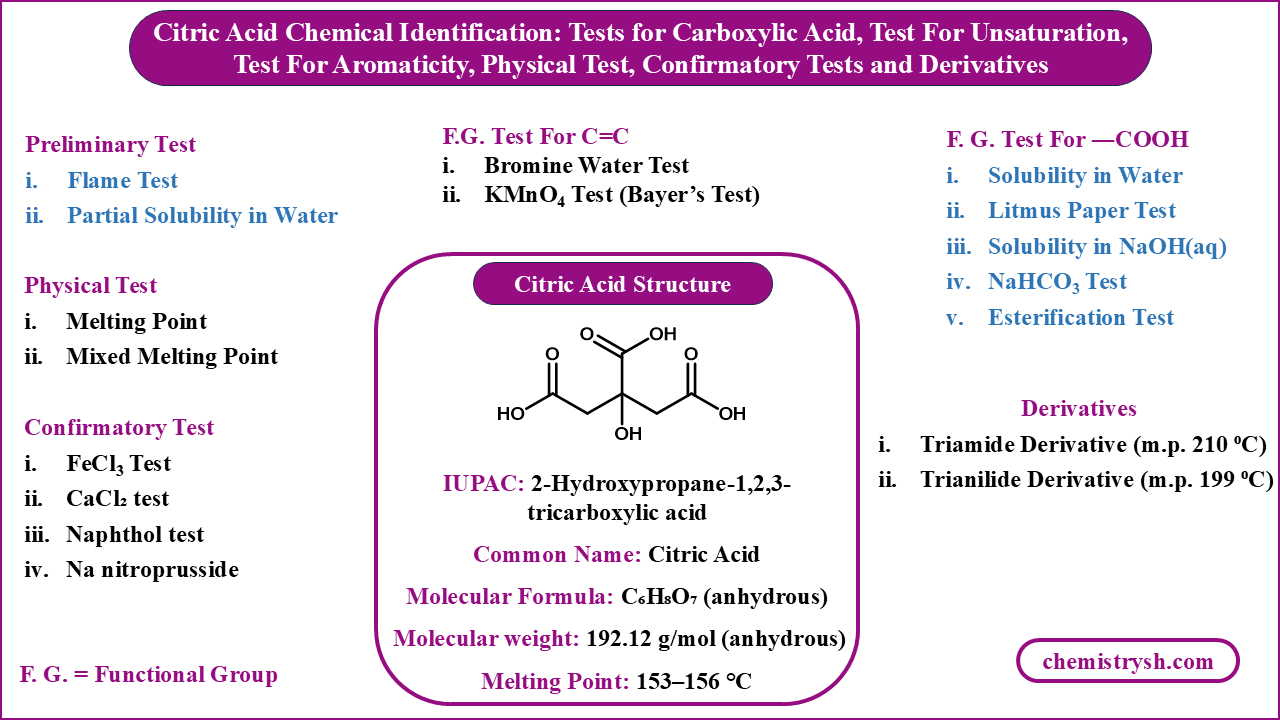

Esters are responsible for the pleasant aromas of fruits, flowers, and perfumes. This unique property is central to esterification (Fischer-Speier esterification), a chemical process involving the condensation of an acid and an alcohol. This reaction occurs in the presence of a strong acid catalyst (Conc. sulfuric acid) and leads to the formation of ester compounds. Because this reaction reliably produces characteristic odours. it is widely utilized as the ester test for identification of carboxylic acid and alcohols in qualitative analysis.
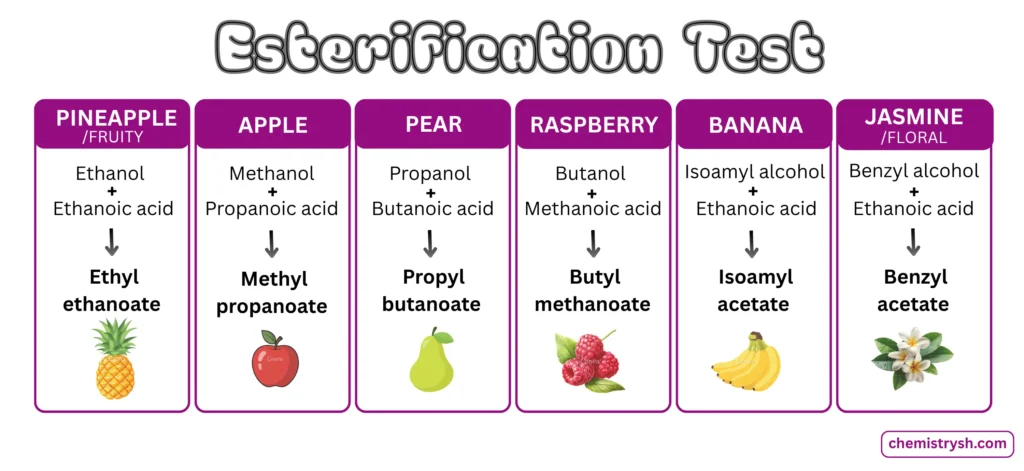
Beyond its role in the lab, Fischer-Speier esterification is vital for the food and perfume industries. Manufacturers use this esterification reaction to synthesize specific esters, producing the signature scents of pineapple, apple, pear, raspberry, and banana, as well as delicate jasmine floral notes.
Esterification Reaction (or Ester Test)
The Esterification Test (or Ester Test) is a qualitative analysis technique used to detect the presence of the Carboxylic Acid functional group (-COOH) or the Alcohol functional group (-OH).
The esterification reaction is an acid-catalyzed chemical process in which a carboxylic acid reacts with an alcohol to form an ester and water.
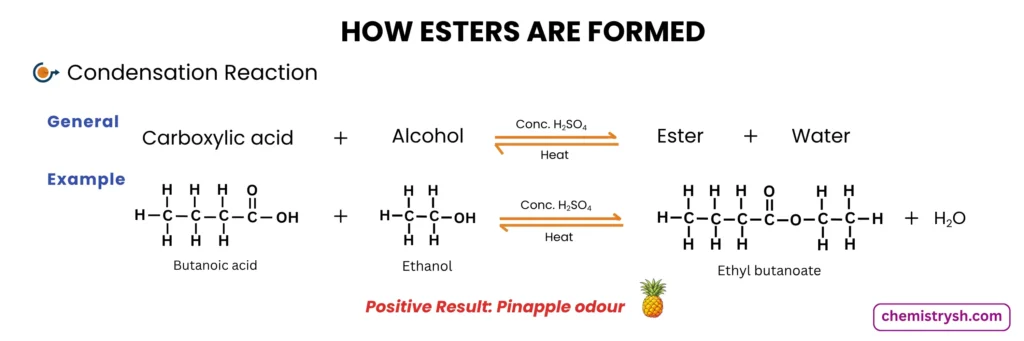
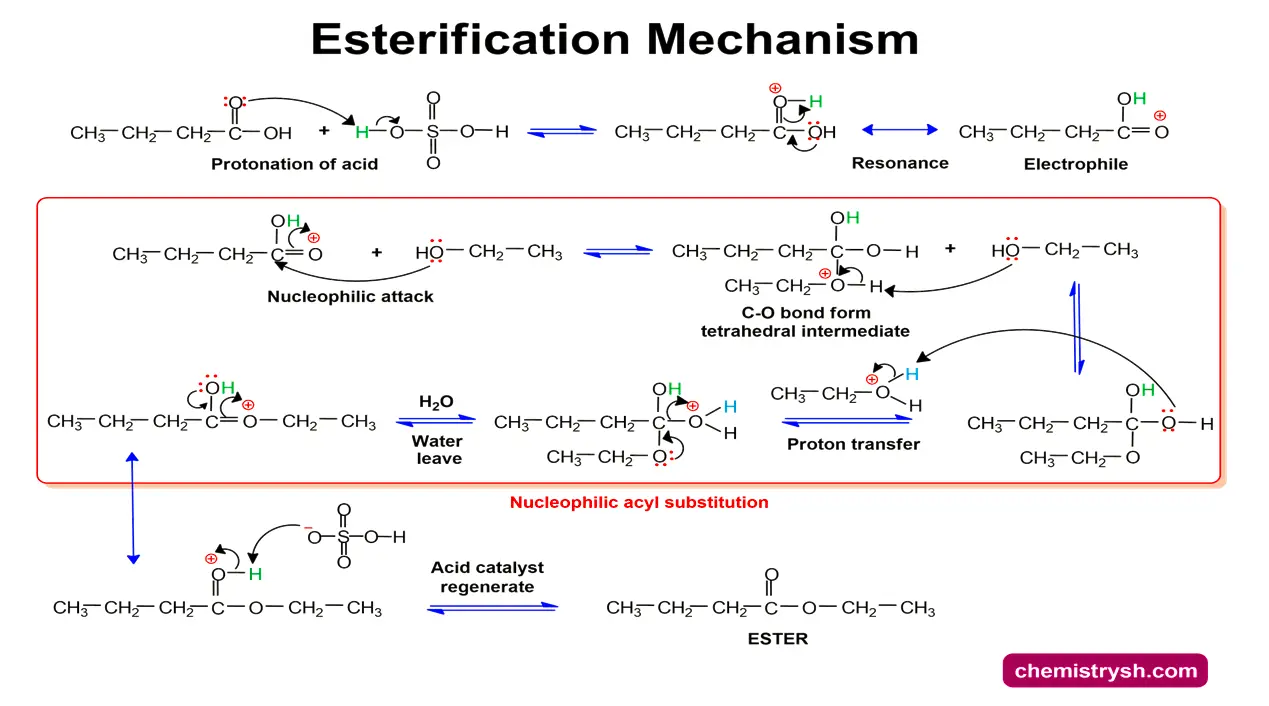
Mechanistically, esterification proceeds through nucleophilic acyl substitution, where the alcohol acts as a nucleophile and replaces the hydroxyl group of the acid after protonation. Esterification is classified as a condensation reaction because two reactant molecules combine to form a larger ester molecule with the elimination of water.
Esterification Reaction Mechanism (Fischer-Speier esterification):
The esterification mechanism, commonly studied in esterification test class 12 or grade 12 chemistry, describes the reversible esterification reaction between a carboxylic acid and an alcohol forming an ester and water. The esterification formula R-COOH + R’-OH ⇌ R-COOR’ + H₂O represents the esterification test equation showing equilibrium. The esterification catalyst, typically concentrated sulfuric acid (conc. H₂SO₄), protonates the carbonyl oxygen enabling nucleophilic attack. Esterification conditions require heating under reflux with conc. H₂SO₄ to achieve appreciable yields.
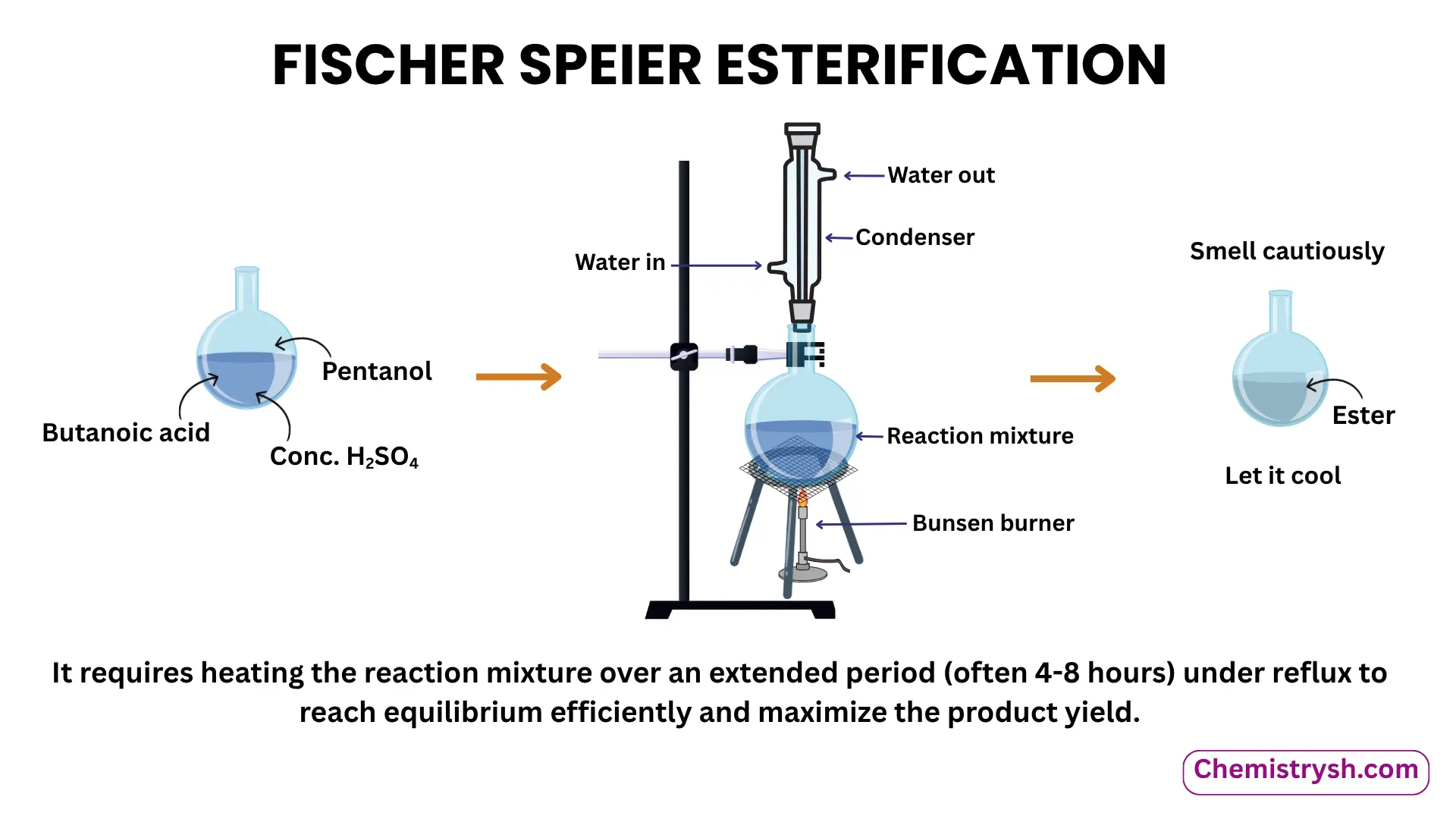
A classic esterification reaction example is the esterification test of ethanol with acetic acid in presence of conc. H₂SO₄ producing ethyl acetate. The esterification test of carboxylic acid with alcohols serves as an ester test chemical reaction and ester test for alcoholic group functionality. The ester detection test involves warming reactants with conc. H₂SO₄ as acid catalyst and identifying the characteristic fruity odor. How long does esterification take depends on temperature, catalyst concentration, and steric hindrance, typically requiring 30 minutes to several hours under reflux, though completion can be achieved by removing water or using excess reactant.
Esterification Mechanism Step-by-Step
The mechanism involves:
- Protonation of the carbonyl oxygen of the carboxylic acid
- Nucleophilic attack by the alcohol
- Formation of a tetrahedral intermediate
- Elimination of water
- Regeneration of the acid catalyst
The Ester Test (Esterification test): General vs. Specific Analysis
In qualitative analysis, we use the physical property of Ester smells to identify unknown compounds. We divide this into two types of tests to determine the Class of Organic Compound and to confirm the Specific compounds like Benzoic acid, Salicylic acid, butanoic acid etc.
1) The General Ester Test for class of Carboxylic acids
When to perform Esterification test?
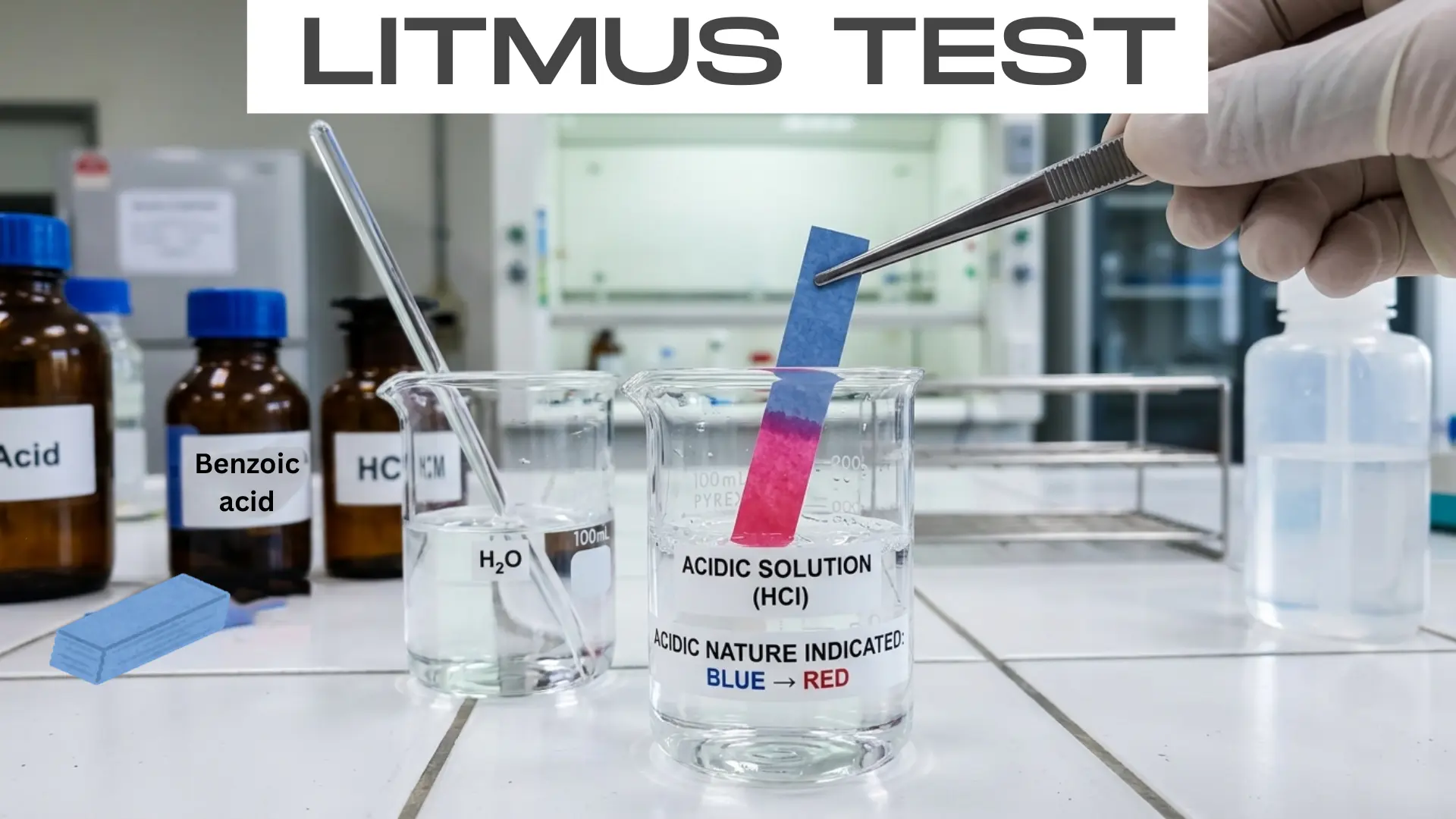
Before performing the ester test, the identity of the organic compound is narrowed down to the acidic compound by using the Litmus Test and Sodium Bicarbonate Test.
- Litmus Test: The compound turns blue litmus red. This indicates acidic nature.
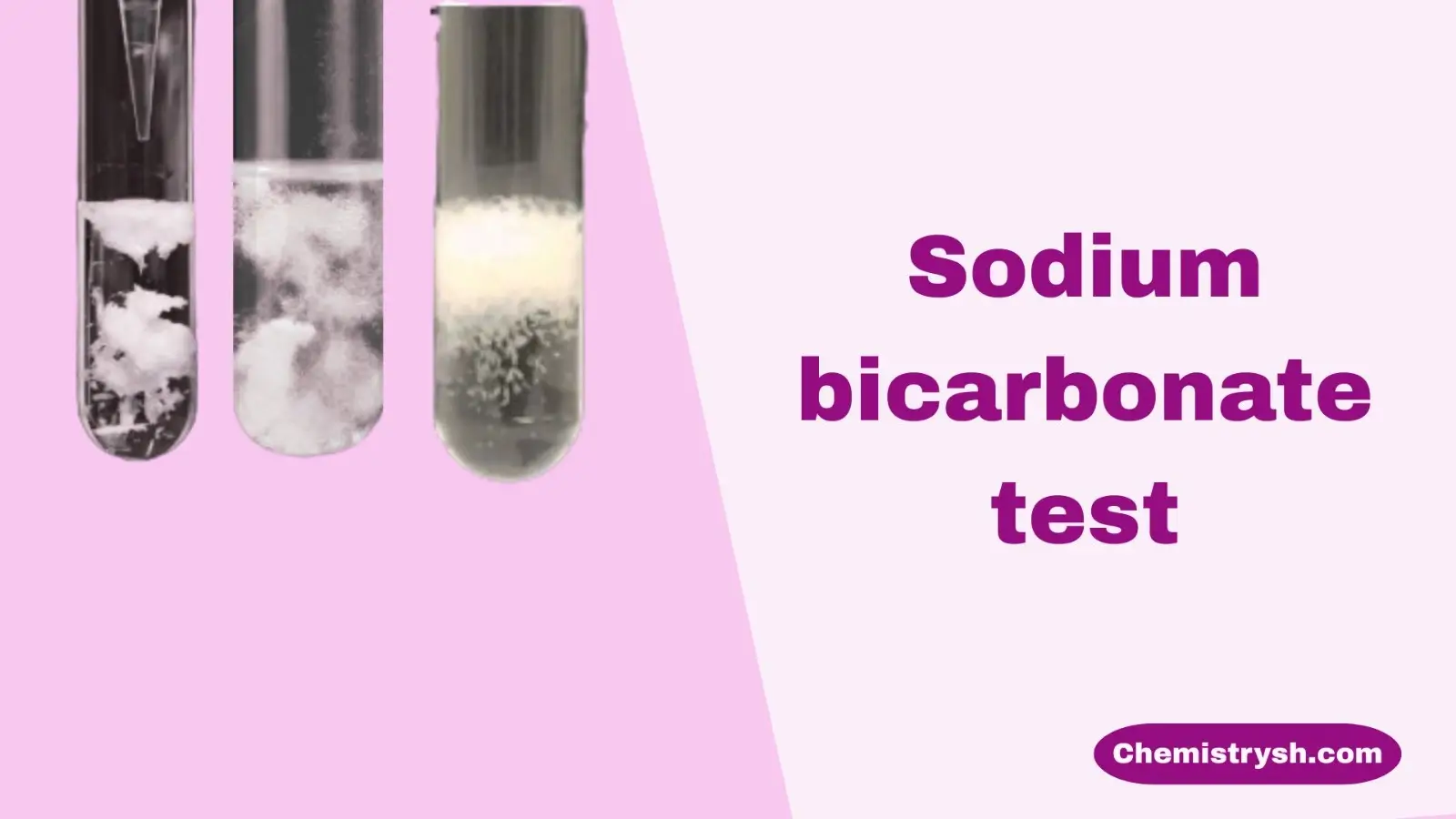
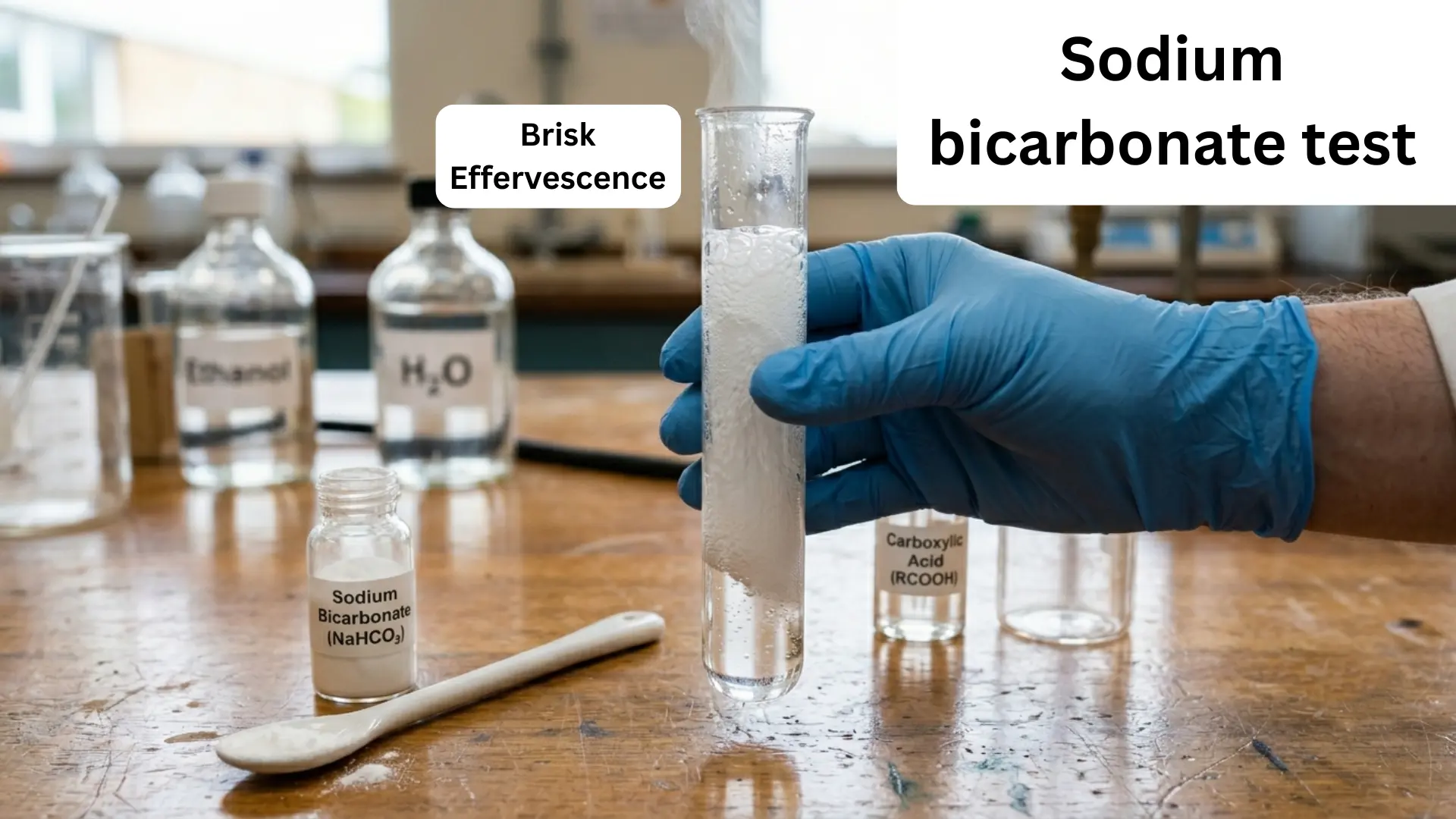
- Sodium Bicarbonate Test: When the compound reacts with sodium bicarbonate NaHCO₃ with brisk effervescence due to the release of carbon dioxide CO₂. This indicates the presence of a carboxylic acid (RCOOH) or sulphonic acid and absence of week acids such as phenols.
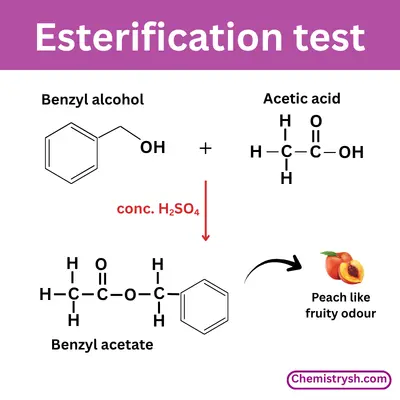
- Esterification test: Carboxylic acids react with alcohols in the presence of concentrated sulfuric acid H₂SO₄ to form esters. The fruity odor of the ester is used for the class of Carboxylic acids (any carboxylic acid, when treated with a low boiling alcohol, produces a fruity smell)
2) The Specific Confirmatory Test (Identification)
The esterification test is used to identify
- Carboxylic acids
- Alcohols
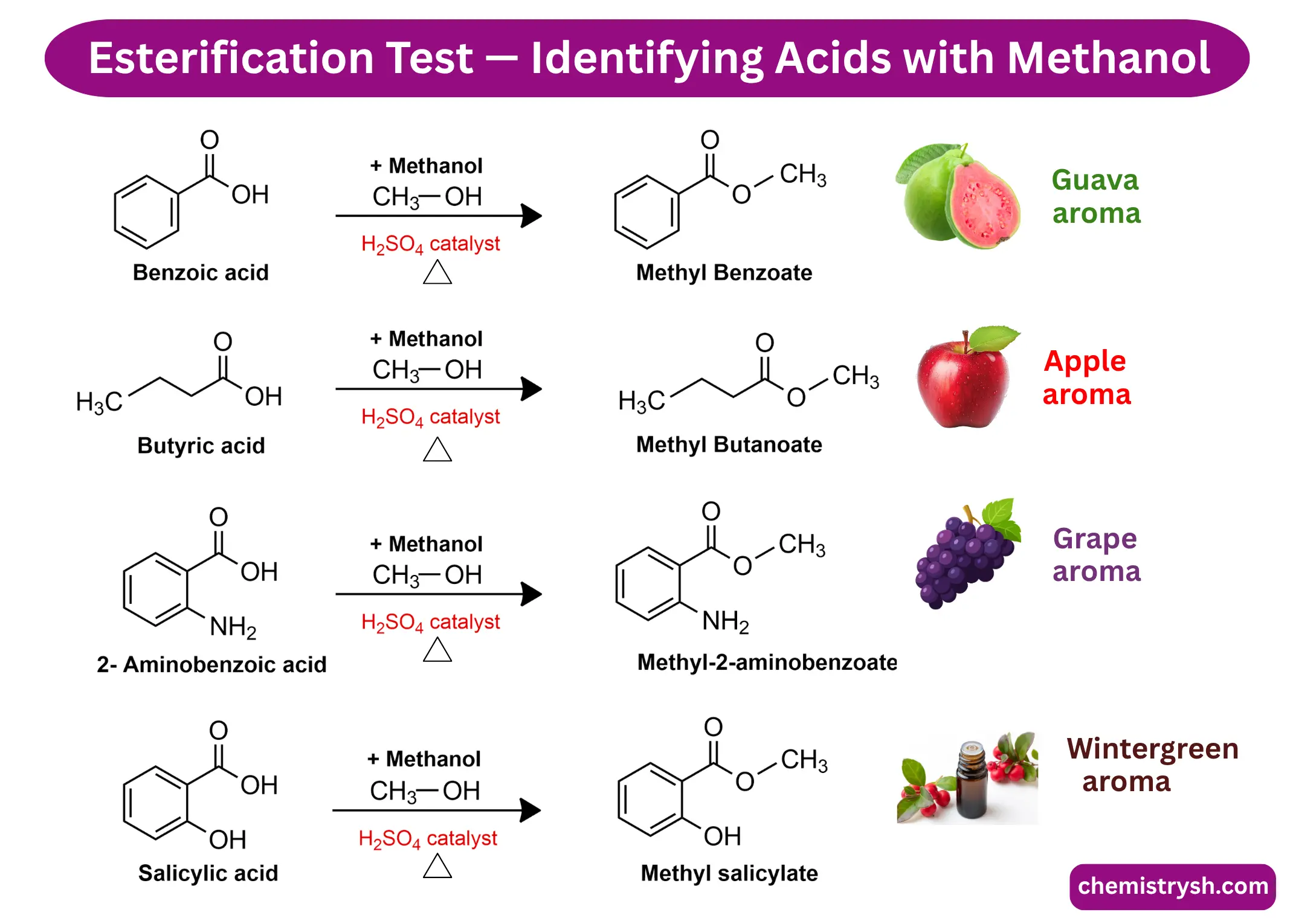
I. Esterification test for carboxylic acid /Confirmatory Test for carboxylic acids (Using Methnol)
When Benzoic acid, Butyric acid, and 2-Aminobenzoic acid are treated with Methanol in the presence of concentrated Sulphuric Acid, different esters are produced like Methyl Benzoate (C₆H₅COOCH₃) Methyl Butanoate (C₃H₇COOCH₃) Methyl 2-aminobenzoate (C₈H₉NO₂) which give the fragrances of Guava, Apple, and Grape are produced respectively. Therefore, this reaction (Esterification) can be used as the confirmatory test for these carboxylic acids.
|
Acid Reagent |
Alcohol |
Ester Formed |
Aroma |
|---|---|---|---|
|
Benzoic Acid (C₆H₅COOH) |
Methanol (CH₃OH) |
Methyl Benzoate (C₆H₅COOCH₃) |
🍈 Guava |
|
Butyric Acid (C₃H₇COOH) |
Methanol (CH₃OH) |
Methyl Butanoate (C₃H₇COOCH₃) |
🍎 Apple |
|
2-Aminobenzoic (C₇H₇NO₂) |
Methanol (CH₃OH) |
Methyl 2-aminobenzoate (C₈H₉NO₂) |
🍇 Grape |
|
Salicylic Acid 2-Hydroxybenzoic acid |
Methanol (CH₃OH) |
Methyl Salicylate |
🌿 Wintergreen |
II. Ester test for alcohol /Confirmatory Test for Alcohols (Using Butanoic Acid)
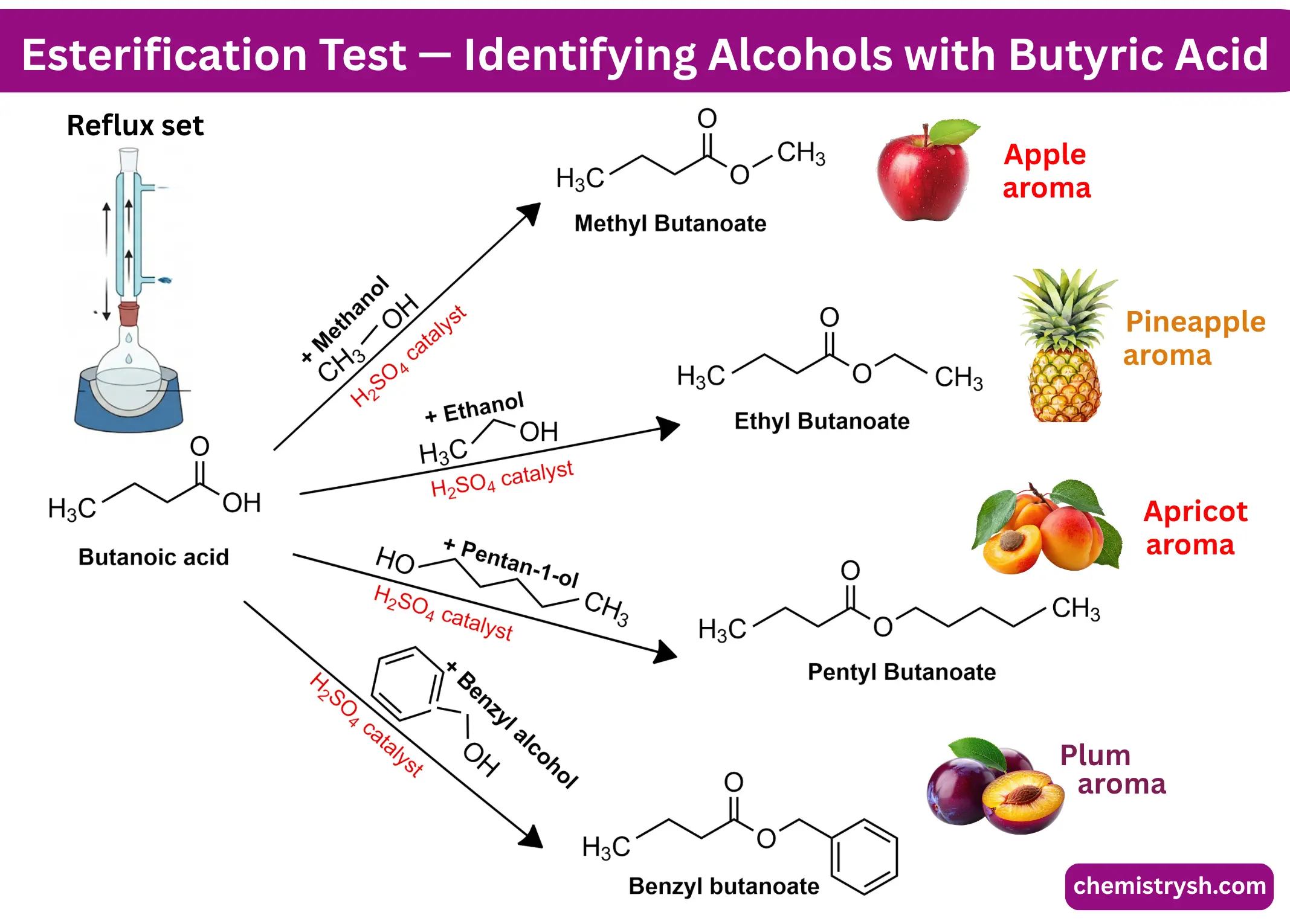
When Methanol, Ethanol, Pentan-1-ol, and Benzyl Alcohol are treated with Butanoic Acid in the presence of concentrated Sulphuric Acid, different esters like Methyl butanoate (CH₃CH₂CH₂COOCH₃), Ethyl butanoate (CH₃CH₂CH₂COOCH₂CH₃), Pentyl butanoate (CH₃CH₂CH₂COO(CH₂)₄CH₃), Benzyl butanoate (CH₃CH₂CH₂COOCH₂C₆H₅) are produced which give the distinct fragrances of Apple, Pineapple, Apricot, and Plum respectively. Therefore, this reaction can be used as a confirmatory test for these alcohols.
|
Alcohol Tested |
Reagent |
Ester Produced |
Aroma |
|---|---|---|---|
|
Methanol (CH₃OH) |
Butanoic acid |
Methyl butanoate (CH₃CH₂CH₂COOCH₃) |
🍎 Apple |
|
Ethanol (CH₃CH₂OH) |
Butanoic acid |
Ethyl butanoate (CH₃CH₂CH₂COOCH₂CH₃) |
🍍 Pineapple |
|
Pentan-1-ol (CH₃(CH₂)₄OH) |
Butanoic acid |
Pentyl butanoate (CH₃CH₂CH₂COO(CH₂)₄CH₃) |
🍑 Apricot |
|
Benzyl alcohol (C₆H₅CH₂OH) |
Butanoic acid |
Benzyl butanoate (CH₃CH₂CH₂COOCH₂C₆H₅) |
🟣 Plum |
III. Ester test for alcohol /Confirmatory Test for Alcohols (Using Ethanoic Acid)
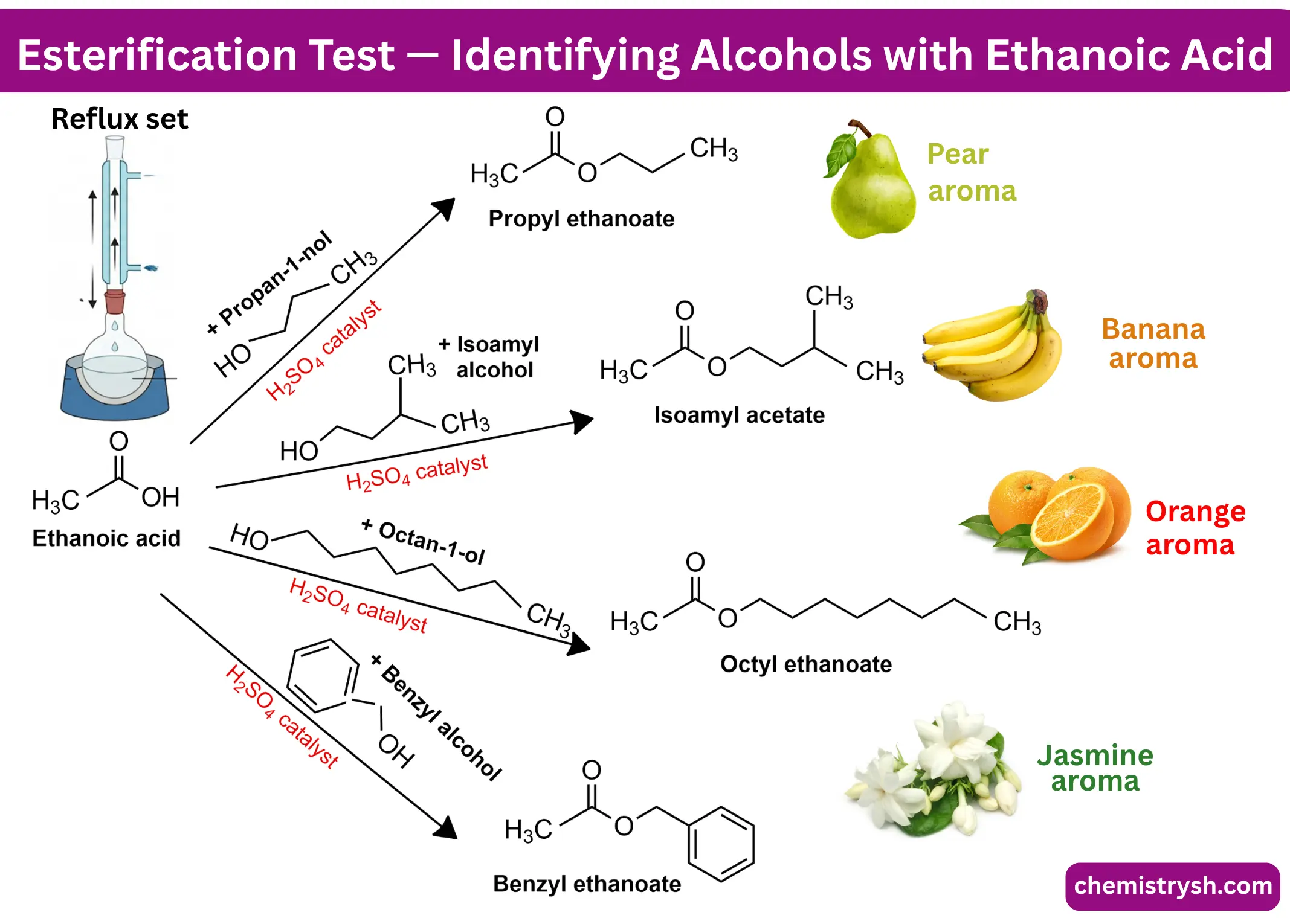
When Propan-1-ol (CH₃CH₂CH₂OH), Isoamyl alcohol (C₅H₁₁OH), Octan-1-ol (CH₃(CH₂)₇OH), Benzyl alcohol (C₆H₅CH₂OH) are treated with Ethanoic acid (Acetic acid)in the presence of concentrated Sulphuric Acid, different esters like Propyl ethanoate (CH₃COOCH₂CH₂CH₃), Isoamyl acetate (CH₃COOC₅H₁₁), Octyl ethanoate (CH₃COO(CH₂)₇CH₃), Benzyl acetate (CH₃COOCH₂C₆H₅) are produced which give the distinct fragrances of Pear, Banana, Orange and Jasmine respectively. Therefore, this reaction can be used as a confirmatory test for these alcohols.
|
Acid |
Alcohol |
Ester Formed |
Aroma |
|---|---|---|---|
|
Ethanoic acid (CH₃COOH) |
Propan-1-ol (CH₃CH₂CH₂OH) |
Propyl ethanoate (CH₃COOCH₂CH₂CH₃) |
🍐 Pear |
|
Ethanoic acid (CH₃COOH) |
Isoamyl alcohol (C₅H₁₁OH) |
Isoamyl acetate (CH₃COOC₅H₁₁) |
🍌 Banana |
|
Ethanoic acid (CH₃COOH) |
Octan-1-ol (CH₃(CH₂)₇OH) |
Octyl ethanoate (CH₃COO(CH₂)₇CH₃) |
🍊 Orange |
|
Ethanoic acid (CH₃COOH) |
Benzyl alcohol (C₆H₅CH₂OH) |
Benzyl acetate (CH₃COOCH₂C₆H₅) |
🌸 Jasmine |
Reagents Required for Esterification
- The suspected carboxylic acid
- Ethyl alcohol or ethanol C₂H₅OH
- Concentrated sulfuric acid H₂SO₄
- Sodium carbonate solution Na₂CO₃ or cold water
Procedure for Esterification
- Important note: Use dry apparatus
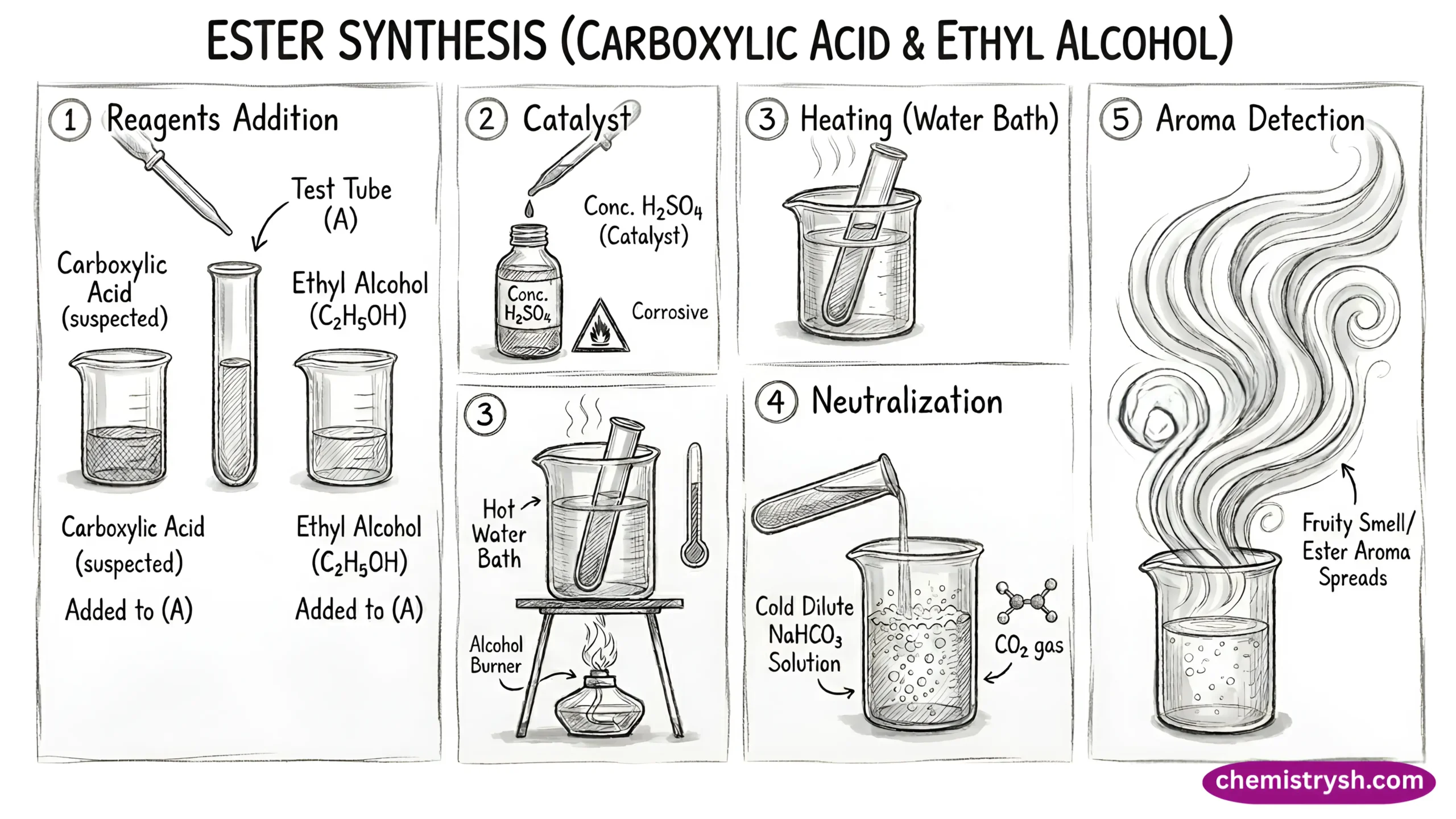
- Take about 0.5 g or 1 mL of the suspected carboxylic acid in a clean, dry test tube.
- Add 1 mL of ethyl alcohol C₂H₅OH to the test tube.
- Carefully add two to three drops of concentrated sulfuric acid H₂SO₄ along the side of the test tube.
- Warm the mixture gently in a hot water bath for two to three minutes. Avoid direct flame heating because alcohol is flammable.
- Neutralization: Carefully pour the hot reaction mixture into a beaker containing a cold and dilute solution of Sodium Bicarbonate (NaHCO₃). This step neutralizes the concentrated sulfuric acid and any unreacted organic acid.
- Detection of Aroma: You will observe fizzing (effervescence). The distinct fruity smell of the ester will rise and spread throughout the laboratory.
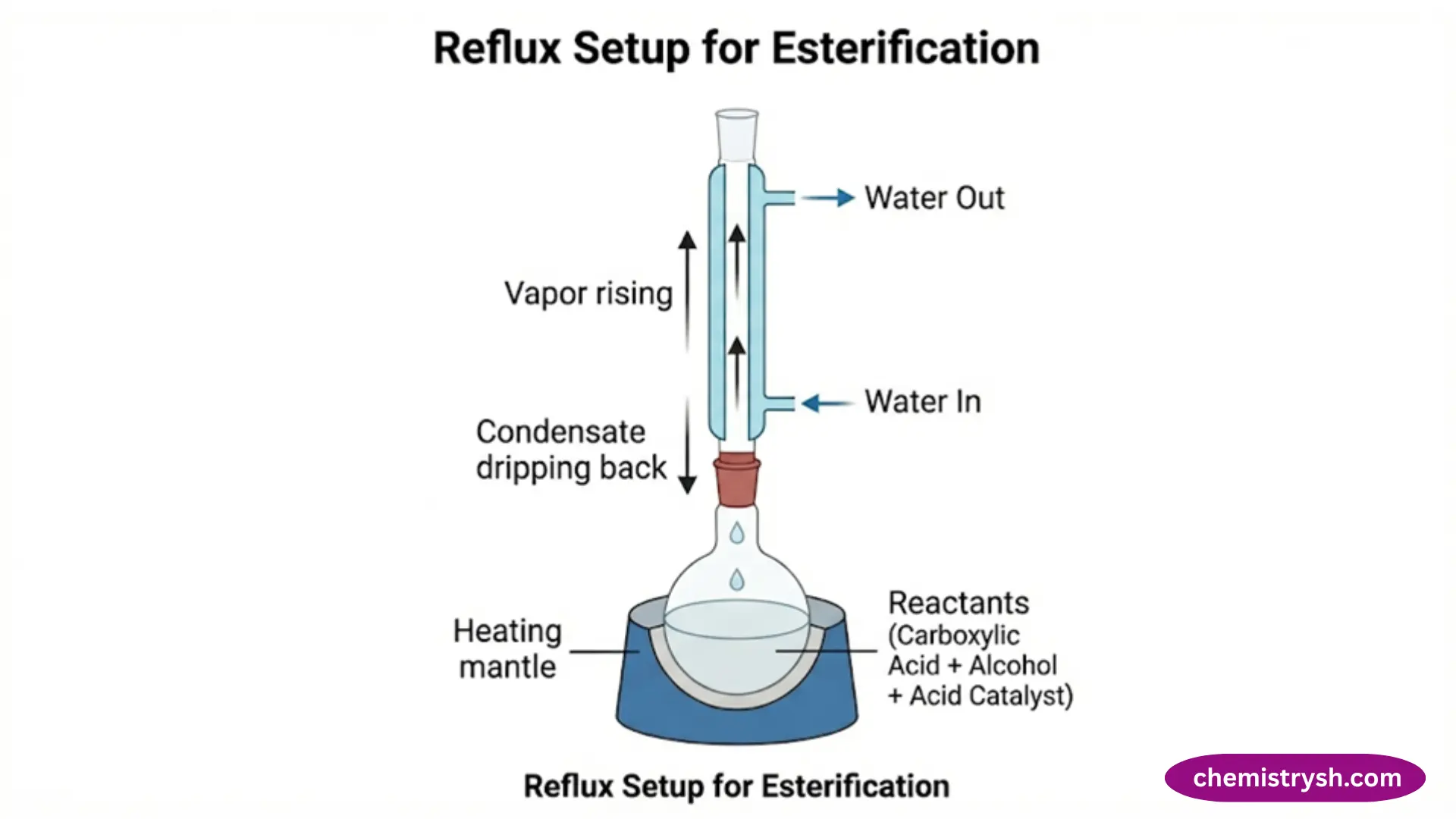
Why Use Sulfuric Acid in Esterification?
Sulfuric acid (H₂SO₄) plays two critical roles in the Fischer-Speier esterification reaction. Without it, the reaction would be extremely slow and would not produce a significant amount of ester.
1. Sulfuric acid (H₂SO₄) as a Catalyst
Esterification is a very slow reaction at room temperature. Concentrated sulfuric acid acts as a strong acid catalyst to speed up the process.
- The Mechanism: The acid donates a proton to the carbonyl oxygen of the carboxylic acid.
- The Result: This makes the carbon atom much more positive (electrophilic), which makes it easier for the alcohol (a weak nucleophile) to attack it and form a bond.
2. Sulfuric acid (H₂SO₄) as a Dehydrating Agent
The esterification reaction is reversible, meaning it can go backward (hydrolysis) just as easily as it goes forward.
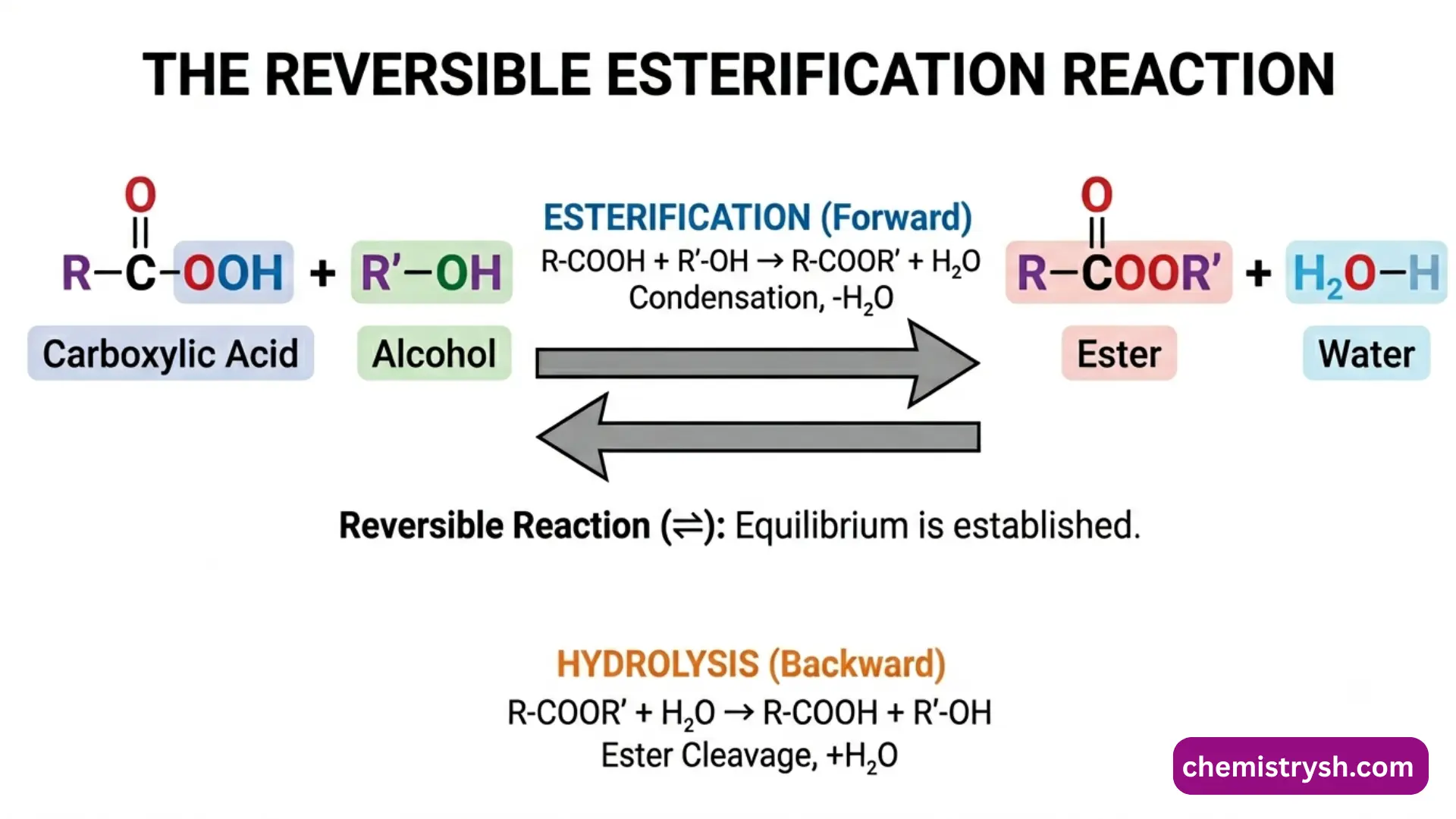
- The Problem during Esterification Reaction: As water builds up, the reaction starts moving backward, breaking the ester back down into acid and alcohol.
- The Solution (Le Chatelier’s Principle) for Esterification reaction: Concentrated sulfuric acid is a powerful dehydrating agent, it “absorbs” the water produced during the reaction. By removing the water, the equilibrium is forced to shift to the right, producing more ester to replace the lost water.
The Dual Role of Sulfuric Acid in Esterification
|
Role |
Function |
|---|---|
|
Catalyst |
Lowers activation energy to speed up the reaction rate. |
|
Dehydrating Agent |
Removes water to shift equilibrium toward a higher ester yield. |
Factors Affecting Esterification
Limitations of Esterification Test
Safety Precautions for the Esterification Test
- Avoid Direct Flame: Alcohols and esters are highly flammable. Never heat the test tube directly over a flame. Always use a hot water bath.
- Handle Acid with Care: Concentrated Sulfuric Acid (H₂SO₄) is extremely corrosive and causes severe skin burns. Handle the dropper carefully.
- Correct Smelling Technique: Do not inhale vapours directly from the test tube. Use the wafting method (gently waving fumes toward your nose).
- Tube Orientation: Keep the mouth of the test tube pointed away from your face and others while heating to prevent hot liquid from splashing on you.
Applications of Esters and Esterification test
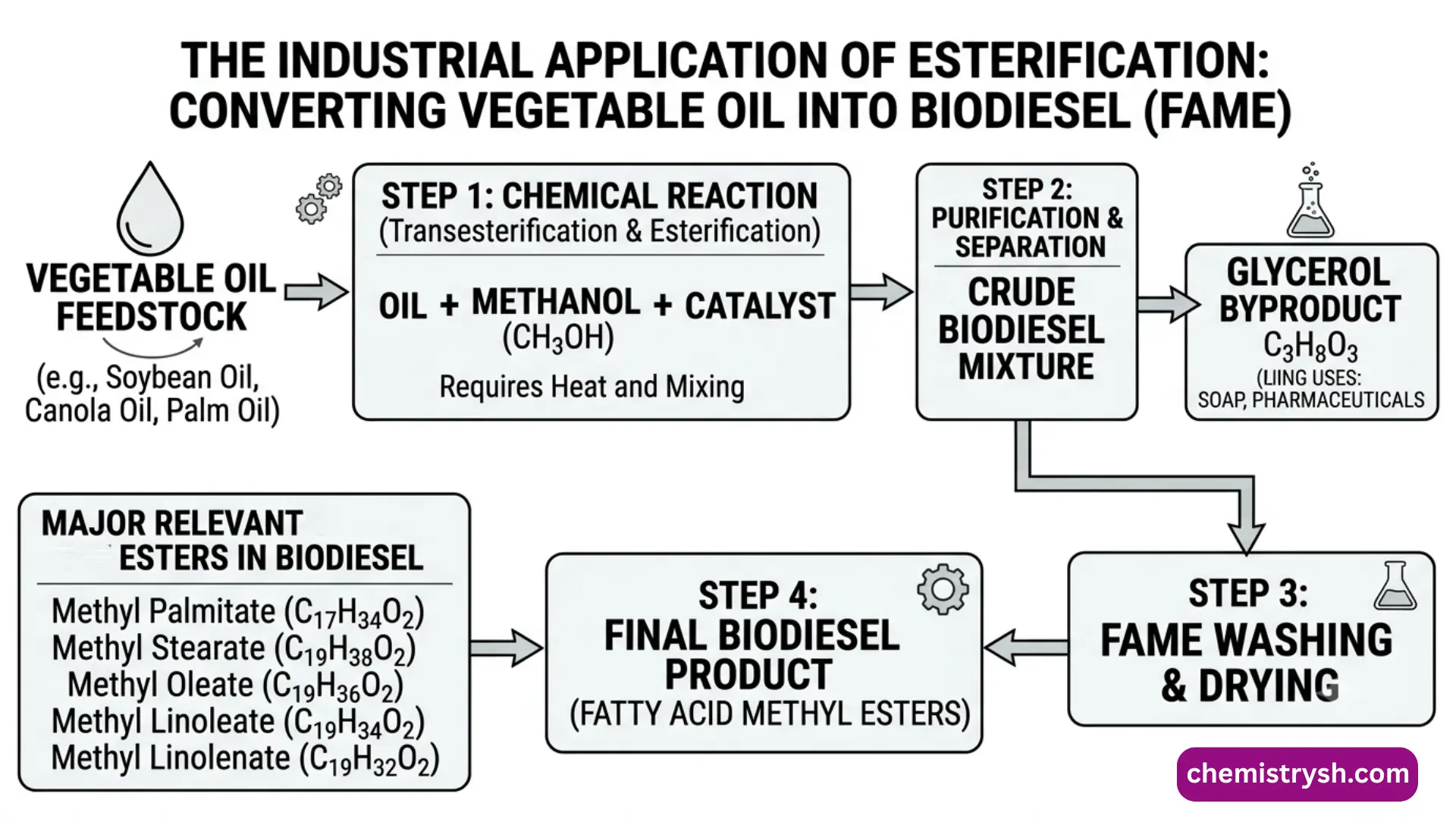
Esterification is essential for modern industry, creating everything from medicines to renewable fuels.
- Flavors & Fragrances: Esters like Isoamyl Acetate (banana) are synthesized for perfumes and food flavorings.
- Pharmaceuticals: It is used to synthesize drugs like Aspirin (pain relief) and Benzocaine (anesthetics).
- Polymers: Manufacturers react acids and alcohols to create Polyesters (PET) for clothing and plastic bottles.
- Solvents: Volatile esters like Ethyl Acetate are used in glues, paints, and nail polish removers.
- Biodiesel: Fatty Acid Methyl Esters (FAME) are produced from vegetable oils to create green fuel.
FAQs
Viva Questions
Multiple Choice Questions
MCQ 1
1. What is the primary role of concentrated sulfuric acid in the esterification process?
A. It acts solely as a dehydrating agent to remove water.
B. It acts as a catalyst to speed up the reaction and a dehydrating agent to shift equilibrium.
C. It neutralizes the carboxylic acid to allow the alcohol to react.
D. It oxidizes the alcohol into a carboxylic acid.
Correct Answer: B. Sulfuric acid provides protons to catalyze the reaction and absorbs water, shifting the equilibrium forward according to Le Chatelier’s principle.
MCQ 2
2. In the reaction between ethanoic acid and ethanol, which specific atoms combine to form the water molecule?
A. The –OH group from the alcohol and the H from the carboxylic acid.
B. The –OH group from the carboxylic acid and the H from the alcohol.
C. The oxygen from the carboxyl group and hydrogen from the alcohol’s alkyl group.
D. The carbonyl oxygen from the acid and two hydrogens from the alcohol.
Correct Answer: B. Isotopic labeling studies show that the –OH group is removed from the acid and the hydrogen comes from the alcohol.
MCQ 3
3. Why is the technique of reflux essential when synthesizing esters in the laboratory?
A. To increase pressure inside the flask to force the molecules together.
B. To distill the ester specifically as soon as it is formed.
C. To heat the reaction mixture without losing volatile reactants or products
D. To keep the reaction mixture cool to prevent decomposition.
Correct Answer: C. Reflux condenses vapors back into the reaction flask, allowing prolonged heating without loss of volatile substances.
MCQ 4
4. Which of the following creates a significant safety hazard during a reflux setup?
A. Using a water bath instead of a Bunsen burner.
B. Leaving the top of the condenser open to the air.
C. Stoppering the top of the condenser completely.
D. Adding boiling chips to the flask.
Correct Answer: C. A closed system causes pressure buildup from heated vapors, which may lead to an explosion.
MCQ 5
5. According to Le Chatelier’s principle, how can the yield of ester be increased in the equilibrium
Acid + Alcohol ⇌ Ester + Water
A. By adding more water to the mixture.
B. By using a large excess of alcohol.
C. By cooling the reaction immediately.
D. By removing the acid catalyst
Correct Answer: B. Increasing the concentration of alcohol shifts the equilibrium toward ester formation.
MCQ 6
6. Which of the following alcohols would undergo esterification the fastest due to least steric hindrance?
A. Methanol
B. Isopropanol (2-propanol)
C. tert-Butanol
D. Phenol
Correct Answer: A. Methanol has the smallest molecular size and least steric hindrance, allowing faster ester formation.
MCQ 7
7. If an unknown organic liquid has a sweet, fruity smell like pear drops, which compound is it likely to be?
A. Ethanoic acid
B. Ethyl ethanoate
C. Ethanol
D. Acetyl chloride
Correct Answer: B. Ethyl ethanoate is a typical ester known for its fruity, pear-like odor.
MCQ 8
8. What is the name of the reverse reaction in which an ester reacts with water to form an acid and an alcohol?
A. Condensation
B. Saponification
C. Hydrolysis
D. Dehydration
Correct Answer: C. Hydrolysis means breaking a compound using water.
MCQ 9
9. Triglycerides (fats and oils) are biologically important esters formed from which components?
A. Fatty acids and ethanol
B. Amino acids and glycerol
C. Fatty acids and glycerol
D. Glucose and fatty acids
Correct Answer: C. Triglycerides are triesters formed from three fatty acid molecules and one glycerol molecule.
MCQ 10
10. After an esterification experiment, the reaction mixture is often poured into cold water. What is the primary purpose of this step?
A. To crystallize the ester
B. To separate the ester layer so it can be identified by smell
C. To neutralize the sulfuric acid catalyst
D. To reverse the reaction instantly
Esters are generally insoluble in water and form a separate oily layer that can be easily identified.