
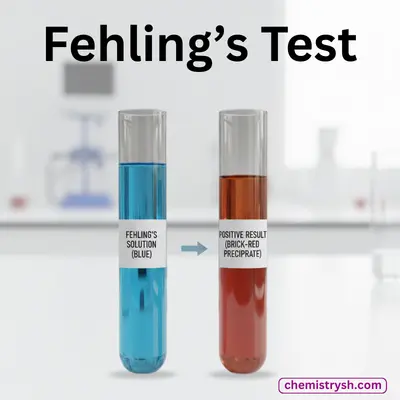
The Fehling’s test is a chemical test used to detect the presence of aldehydes and reducing sugars. When substances such as glucose, maltose, fructose, lactose, galactose, and aliphatic aldehydes (like formaldehyde and acetaldehyde) react with Fehling’s solution, they produce a brick-red precipitate of cuprous oxide (Cu₂O), indicating a positive result.
Substances that yield positive results in the Fehling solution test include monosaccharides (such as glucose, fructose, and galactose), as well as disaccharides (like maltose and lactose). However, non-reducing sugars (like sucrose) do not give a positive Fehling solution test unless they are first hydrolyzed into their reducing sugar components.
Learning Outcomes of Fehling’s Solution Test
After performing and studying the Fehling’s solution test, students or chemists should be able to:
- Identify Aldehydes: Recognize compounds containing the aldehyde functional group based on a positive reaction with Fehling solution (e.g., formaldehyde, acetaldehyde).
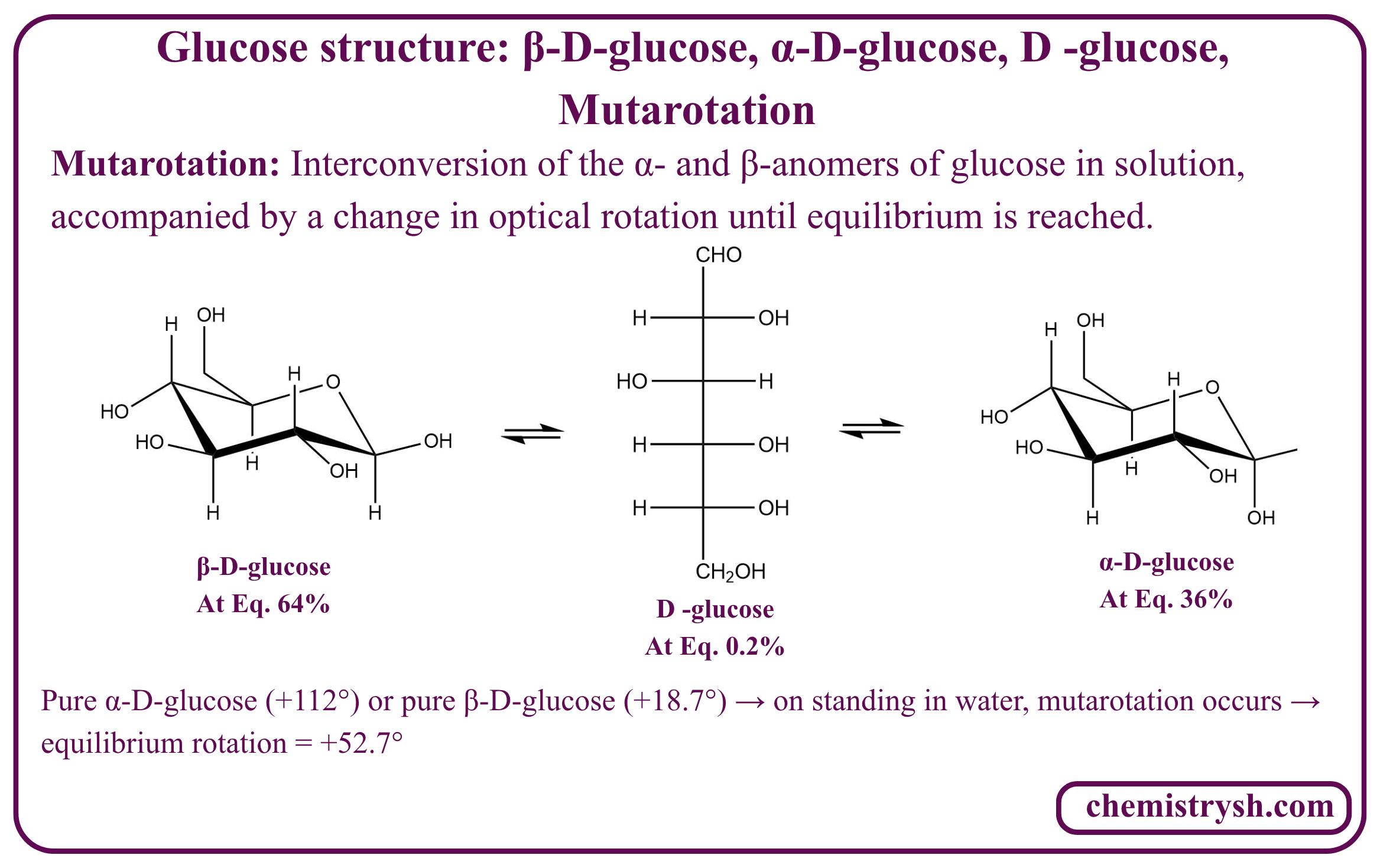
- Detect Reducing Sugars: Understand how reducing carbohydrates like glucose and maltose produce a brick-red precipitate, distinguishing them from non-reducing sugars (e.g., sucrose).
- Understand Redox Reactions: Comprehend the oxidation of aldehydes to carboxylates and the reduction of Cu²⁺ ions to Cu₂O (e.g., application of redox principles).
- Role of Rochelle Salt: Know that Fehling Solution B contains sodium potassium tartrate (Rochelle salt), which stabilizes Cu²⁺ ions and prevents premature precipitation.
- Perform Laboratory Procedures: Apply proper stepwise procedures, including mixing solutions, heating, and safe handling of chemicals.
- Interpret Results and Exceptions: Analyze color changes correctly, differentiating positive and negative results, and recognize exceptions like α-hydroxy ketones.
- Compare with Complementary Tests: Understand the relationship of Fehling’s test with Benedict’s, Schiff’s, DNPH, and Iodoform tests for confirming aldehydes and sugars.
- Appreciate Historical Significance: Recognize Hermann von Fehling’s contribution and the importance of this classical test in organic chemistry.
What is the Is Fehling Solution and Fehling’s Test?
Fehling solution is a chemical reagent prepared by mixing Fehling’s A (copper (II) sulfate solution) and Fehling’s B (alkaline tartrate solution) immediately before use. It appears as a deep blue solution that acts as an oxidizing agent for aldehydes. Fehling’s test is the practical application of this reagent to detect the presence of aldehyde & reducing sugars.
The Fehling test is used for identifying aldehydes, distinguishing them from ketones, and differentiating reducing sugars (glucose, maltose) from non-reducing sugars (sucrose). A positive reaction produces a brick-red precipitate of cuprous oxide (Cu₂O).
The Fehling test is given by German chemist Hermann von Fehling, who developed this method in the 19th century, making it one of the classical tests in organic chemistry.
Fehling Solution Formula and Composition
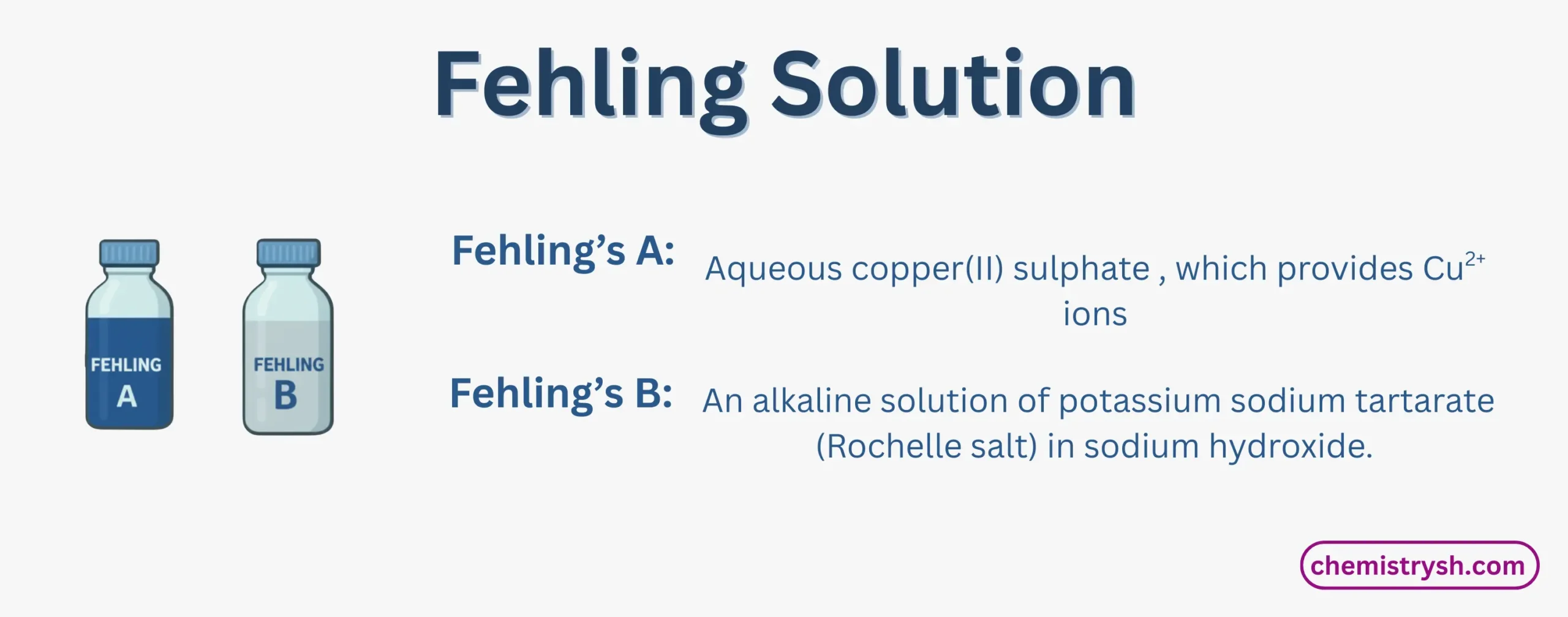
The Fehling solution formula consists of two separate solutions, Fehling Solution A and Fehling Solution B, which are mixed in equal parts immediately before performing Fehling’s test. Together, these solutions form the Fehling’s test reagent ( Fehling’s solution reagent) used to detect aldehydes and reducing sugars.
Fehling Solution A contains copper (II) sulfate (CuSO₄), which provides the blue copper ions responsible for the test’s characteristic color.
Fehling Solution B consists of an alkaline solution of sodium potassium tartrate (Rochelle salt) and sodium hydroxide (NaOH). The tartrate acts as a complexing agent that keeps Cu²⁺ ions in solution by forming a complex, preventing premature precipitation of Cu(OH)₂. This ensures the copper remains available to be reduced to Cu₂O during the test.
When Fehling Solution A and Fehling Solution B are combined, the resulting Fehling solution is ready to detect aldehydes and reducing sugars, producing a brick-red precipitate in the presence of these compounds.
Principle of Fehling Solution Test
The Fehling’s test principle is based on a redox reaction in which an aldehyde is oxidized to carboxylate ion while the copper(II) ions are reduced to Cu⁺ ions in Fehling solution test. Specifically, the Fehling test is used for detecting aldehydes and reducing sugars that contain a free aldehyde group (–CHO) capable of undergoing oxidation.
In this reaction, the aldehyde is oxidized to a carboxylate ion, and the blue Cu²⁺ ions from the Fehling solution are reduced to Cu⁺ ions, which form a brick-red precipitate of cuprous oxide (Cu₂O). This color change from blue to red provides clear visual confirmation of a positive result. The redox nature of the reaction makes Fehling’s test highly specific for aldehydes and reducing carbohydrates, while ketones generally do not react unless they are α-hydroxy ketones.
Procedure of Fehling’s Solution Test
The Fehling’s test procedure is straightforward and can be performed in a few simple steps:
- Preparation of Fehling Solution: Mix equal volumes of Fehling Solution A (copper sulfate) and Fehling Solution B (alkaline sodium potassium tartrate solution) immediately before testing.
- Sample Addition: Add 1–2 mL of the test solution (containing the suspected aldehyde or reducing sugar) to a clean test tube.
- Addition of Fehling Solution: Add an equal volume of the freshly prepared Fehling solution to the test tube containing the sample.
- Heating: Heat the mixture gently in a boiling water bath for 2–5 minutes.
- Observation: Observe the color change. A positive result is indicated by the formation of a brick-red precipitate of Cu₂O. If the solution remains blue with no precipitate, the test is negative.
- Recording Results: Document the observations for analysis and comparison with known standards.
Fehling’s Test Reaction, Observation, and Equation
The Fehling test reaction occurs when an aldehyde or reducing sugar is heated with freshly prepared Fehling solution. The Fehling’s test reaction is a redox process in which the aldehyde group is oxidized while the copper(II) ions in the solution are reduced, confirming the presence of an aldehyde functional group.
During the reaction, the Fehling solution colour changes noticeably. The initial blue color is due to Cu²⁺ ions. As the reaction proceeds, these ions are reduced to copper(I) oxide, forming a brick-red precipitate. This visible change represents the Fehling’s test result and indicates a positive test. If no aldehyde is present, the solution remains blue, indicating a negative result.
Fehling’s Test Equation
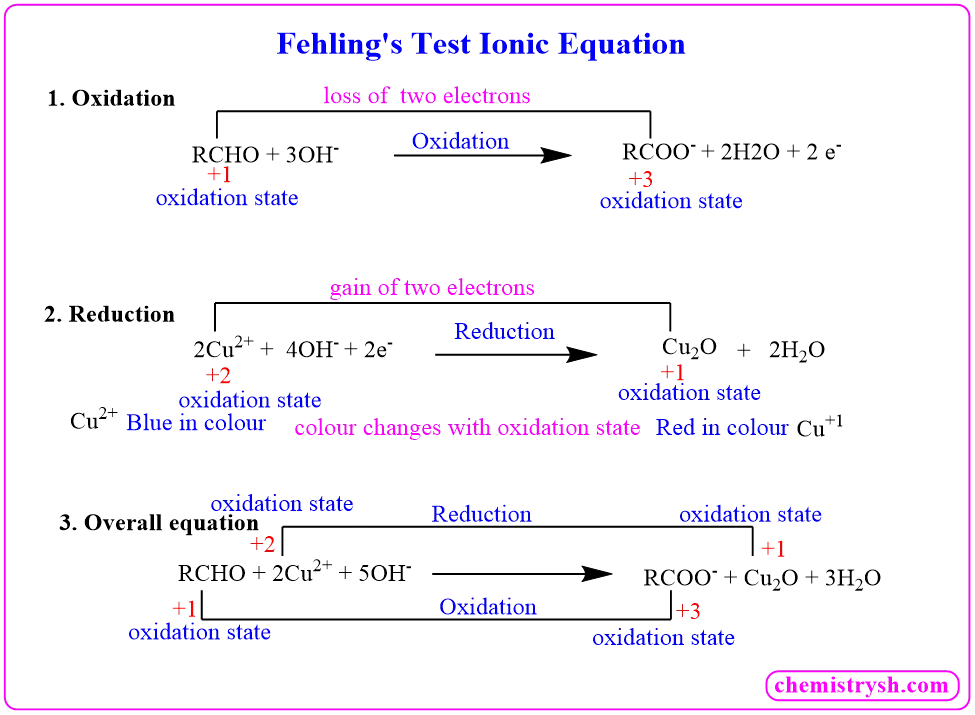
The Fehling’s test equation can be written in simplified form:
RCHO + 2Cu²⁺ + 5OH⁻ → RCOO⁻ + Cu₂O ↓ + 3H₂O
This equation shows the formation of brick-red copper(I) oxide precipitate, which confirms a positive Fehling solution test.
Fehling’s Test Reaction Mechanism
The Fehling test reaction mechanism can be summarized as a redox reaction where the aldehyde acts as a reducing agent, donating electrons to Cu²⁺ ions, which are reduced to Cu⁺ and subsequently form Cu₂O precipitate. The tartrate complex facilitates this electron transfer by keeping the copper ions available in solution throughout the reaction.
- Formation of Copper-Tartrate Complex: When Fehling Solution A and Fehling Solution B are mixed, Cu²⁺ ions form a stable complex with tartrate ions in alkaline medium, preventing Cu(OH)₂ precipitation.
insert fig - Oxidation of Aldehyde: The aldehyde group (–CHO) is oxidized to a carboxylate ion (–COO⁻), donating electrons in the process.
insert fig? - Reduction of Copper(II) to Copper(I): Cu²⁺ ions accept the electrons and are reduced to Cu⁺.
Formation of Cuprous Oxide Precipitate: Cu⁺ ions combine to form cuprous oxide (Cu₂O), which precipitates as a brick-red solid.
Fehling Test for Aldehydes
The Fehling test for aldehyde is a classical qualitative test used to identify aldehydes and distinguish them from ketones. When aldehydes or compounds with free aldehyde groups (–CHO) are tested with Fehling solution, they produce a brick-red precipitate of Cu₂O, indicating a positive result.
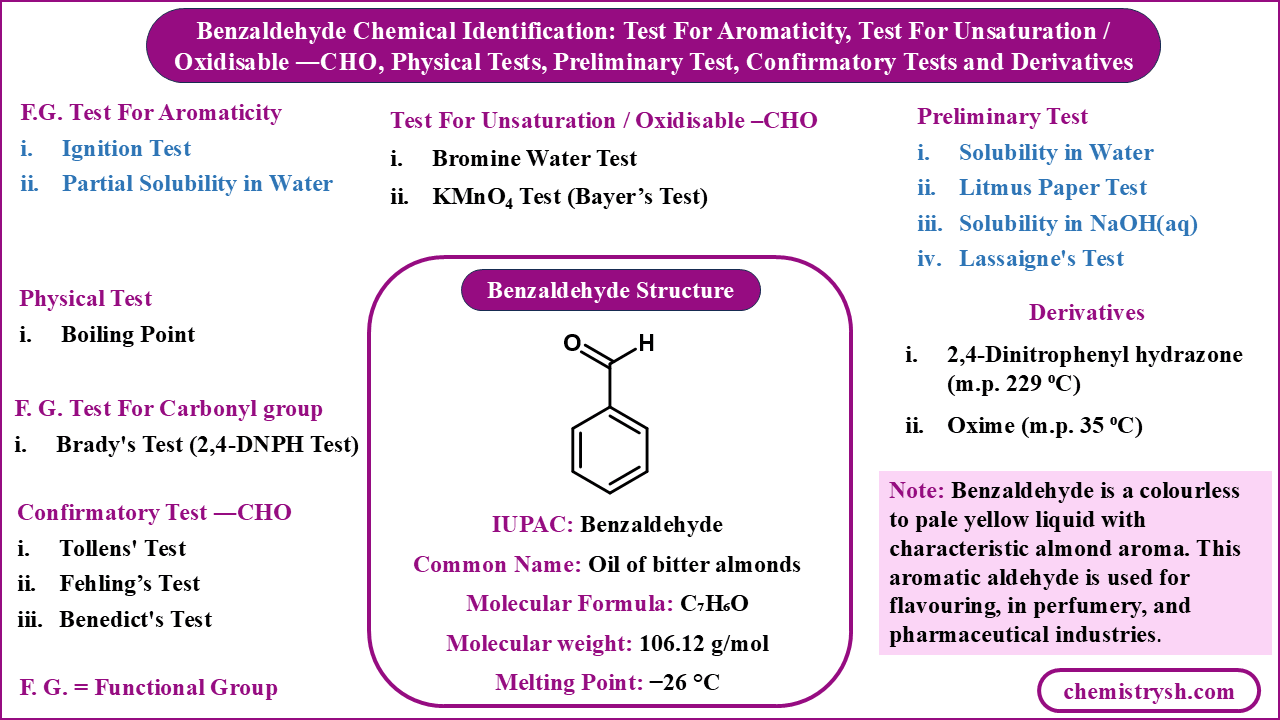
Most ketones do not react and remain blue, except α-hydroxy ketones like fructose, which also give a positive test. Common examples of aldehydes that give positive results include acetaldehyde and glucose, while aromatic aldehydes like benzaldehyde react slowly. Ketones such as acetone and acetophenone give negative results.
Does Fehling’s Test Give Result for Ketones?
A common question in organic chemistry is: does Fehling’s test for ketones give a positive result?
Generally, Fehling’s test is not given by simple ketones because they lack the hydrogen atom directly attached to the carbonyl carbon required for oxidation. Most ketones, such as acetone (CH₃COCH₃) and acetophenone (C₆H₅COCH₃), do not react with Fehling solution and the solution remains blue, indicating a negative result.
However, α-hydroxy ketones like fructose are an exception—in basic medium, they are converted to aldehydes, which then give a positive test with a brick-red precipitate of Cu₂O.
Fehling’s Test for reducing sugars (carbohydrates)
The Fehling’s test for carbohydrates is used to identify reducing sugars. These sugars contain a free aldehyde group that can be oxidized. Reducing monosaccharides such as glucose and fructose give a positive result with Fehling solution. Reducing disaccharides like maltose and lactose also respond positively. In contrast, non reducing sugars such as sucrose do not give the Fehling test.
If a non reducing sugar is present, how can it be confirmed?
A non reducing sugar is confirmed by first hydrolyzing it with dilute hydrochloric acid or sulfuric acid. This breaks the glycosidic bond and forms monosaccharides. After hydrolysis, the solution is neutralized by adding sodium carbonate. The neutralized solution is then tested again with Fehling solution. The appearance of a brick red precipitate confirms that a non reducing sugar was originally present.
Fehling’s Test Is Given By:
A common question in organic chemistry is: Fehling test given by which compounds?
The Fehling’s test is given by compounds that contain a free aldehyde group or functional groups capable of reducing Cu²⁺ ions in Fehling solution.
Main classes of compounds that give a positive Fehling’s test:
- Aldehydes – Aliphatic aldehydes (such as acetaldehyde) react readily and are oxidized to carboxylate ions, while aromatic aldehydes (like benzaldehyde) react more slowly.
- Reducing sugars – Monosaccharides (glucose, fructose, galactose) and disaccharides (maltose, lactose) that contain a free or potentially free aldehyde group.
- α-Hydroxy ketones – Ketones with a hydroxyl group adjacent to the carbonyl (such as fructose) are converted to aldehydes in basic medium and give a positive test.
Fehling’s Test for Aldehydes and Ketones
The Fehling’s solution test for aldehydes and ketones helps distinguish between these two classes of carbonyl compounds based on their reactivity with Fehling solution.
This simple comparison demonstrates why the Fehling’s solution test for aldehydes and ketones is widely used in organic chemistry to identify aldehydes and reducing sugars while generally excluding most ketones.
Applications of Fehling Solution Test
The Fehling test is used for several important applications in organic chemistry and biochemistry:
- Identification of Aldehydes: It is used in the laboratory to detect and confirm the presence of aldehyde functional groups in unknown compounds.
- Testing Reducing Sugars: The test is widely applied to analyze carbohydrates, especially reducing sugars like glucose, maltose, and lactose, which produce a brick-red precipitate when positive.
- Qualitative Analysis: The Fehling solution test serves as a simple qualitative method to distinguish aldehydes from ketones, as most ketones do not react under normal conditions.
- Educational Demonstrations: Due to its clear color change from blue to red, the test is often used in teaching laboratories to demonstrate redox reactions and the chemical behavior of aldehydes and sugars.
These applications highlight why the Fehling test is used for both analytical and educational purposes, making it a fundamental tool for detecting aldehydes and reducing carbohydrates.
Complementary Tests to Fehling’s Solution Test
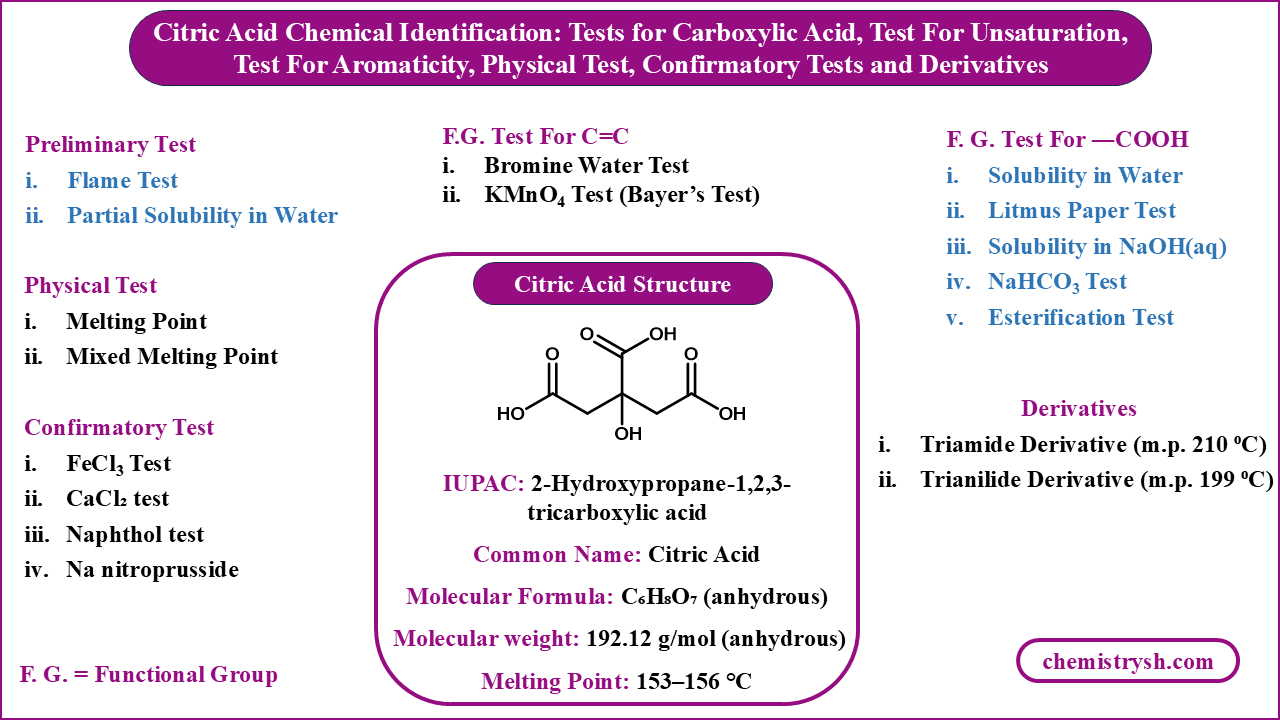
- Benedict’s Test: Detects reducing sugars similar to Fehling’s test, producing a brick-red precipitate of Cu₂O.
- Tollen’s Test: Specifically identifies aldehydes by forming a silver mirror with [Ag(NH₃)₂]⁺ ions.
- 2,4-Dinitrophenylhydrazine (2,4-DNPH) Test: Confirms the presence of carbonyl compounds (aldehydes and ketones) via yellow/orange hydrazone formation.
- Schiff’s Test: Detects aldehydes through a magenta color change using fuchsin-sulfurous acid.
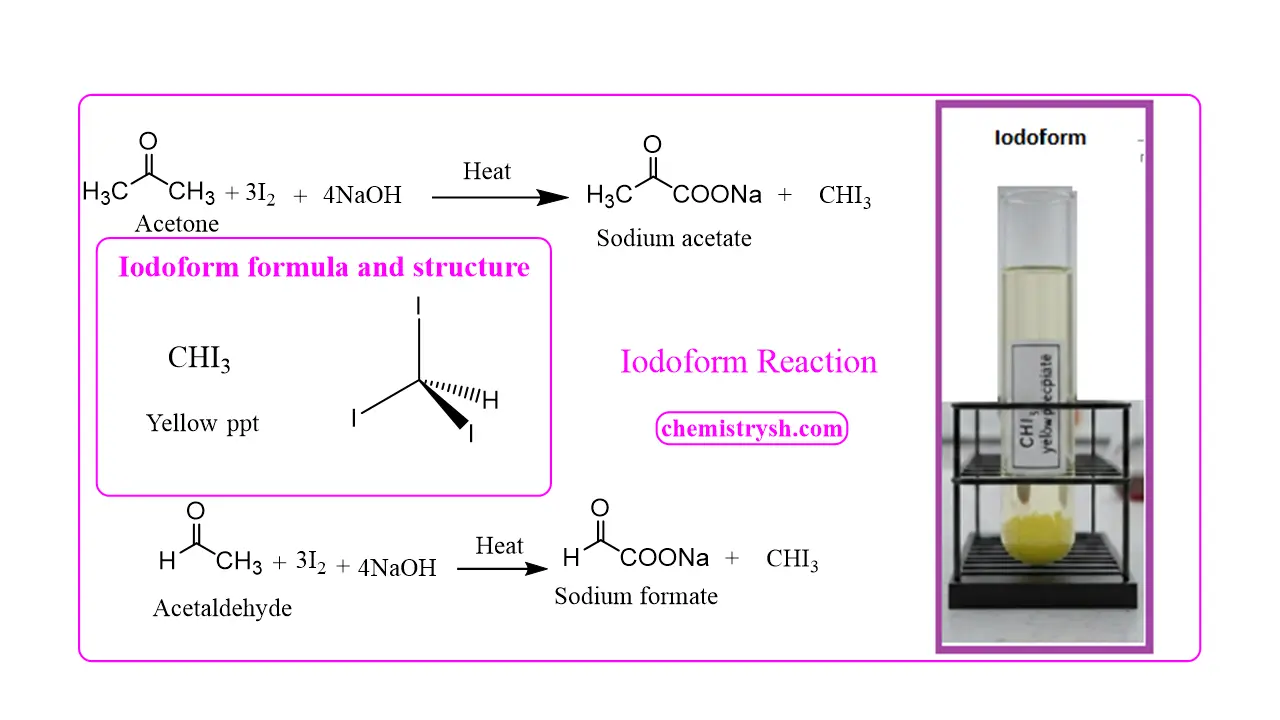
- Iodoform Test: Identifies methyl ketones and secondary alcohols oxidizable to methyl ketones by producing a yellow CHI₃ precipitate.
Comparison of Fehling Solution Test and Benedict’s Test
|
Feature |
Fehling Solution Test |
Benedict’s Test |
|---|---|---|
|
Purpose |
Detects aldehydes and reducing sugars |
Detects reducing sugars (aldehydes) |
|
Reagent Composition |
Fehling Solution A (CuSO₄) + Fehling Solution B (alkaline sodium potassium tartrate |
Benedict’s reagent (CuSO₄ in alkaline citrate solution) |
|
Procedure |
Solutions A & B mixed before use, heated with sample |
Reagent added directly to sample and heated |
|
Observation (Positive Result) |
Brick-red precipitate of Cu₂O |
Brick-red precipitate of Cu₂O |
|
Specificity |
Slightly less stable; mainly for aldehydes & reducing sugars |
More stable; often preferred for reducing sugars |
|
Historical Context |
Developed by Hermann von Fehling in 1849 |
Modified from Fehling’s test by Stanley Ross Benedict in early 20th century |
|
Ease of Use |
Requires fresh preparation of two solutions |
Ready-to-use single solution; convenient for routine testing |
Conclusion
The Fehling test is a classical and reliable qualitative method for the identification of reducing sugars and aldehydes in organic and biochemical analysis. Using Fehling’s solution (also known as Fehling’s reagent), prepared by mixing Fehling solution A and B, the test is based on the reduction of alkaline copper(II) ions to copper(I) oxide, producing a characteristic brick-red precipitate. This color change provides clear visual evidence of the presence of compounds such as acetaldehyde and other reducing agents. Owing to its simplicity, specificity, and educational value, the Fehling’s test remains an important laboratory technique for understanding redox reactions and for the preliminary identification of functional groups in chemistry and biochemistry.
References:
- Reducing and Non-Reducing Sugars
- Molisch Test
- Vogel, A. I. (1989). Vogel’s textbook of practical organic chemistry (5th ed.). Longman Scientific and Technical.
- Mann, F. G., & Saunders, B. C. (1970). Practical organic chemistry (4th ed.). Pearson Education.
- Morrison, R. T., & Boyd, R. N. (2011). Organic chemistry (6th ed.). Pearson Education.
- Furniss, B. S., Hannaford, A. J., Smith, P. W. G., & Tatchell, A. R. (1989). Vogel’s textbook of practical organic chemistry (5th ed.). Longman Group UK.
- NCERT. (2023). Laboratory manual chemistry: Class XII. National Council of Educational Research and Training.
- Feigl, F. (1949). Spot tests in organic analysis. Analytical Chemistry, 21(10), 1298–1302. https://doi.org/10.1021/ac60034a017
- pmc.ncbi.nlm.nih.gov/articles/PMC1276126/