
What Is Cinnamic Acid? — Introduction and Background
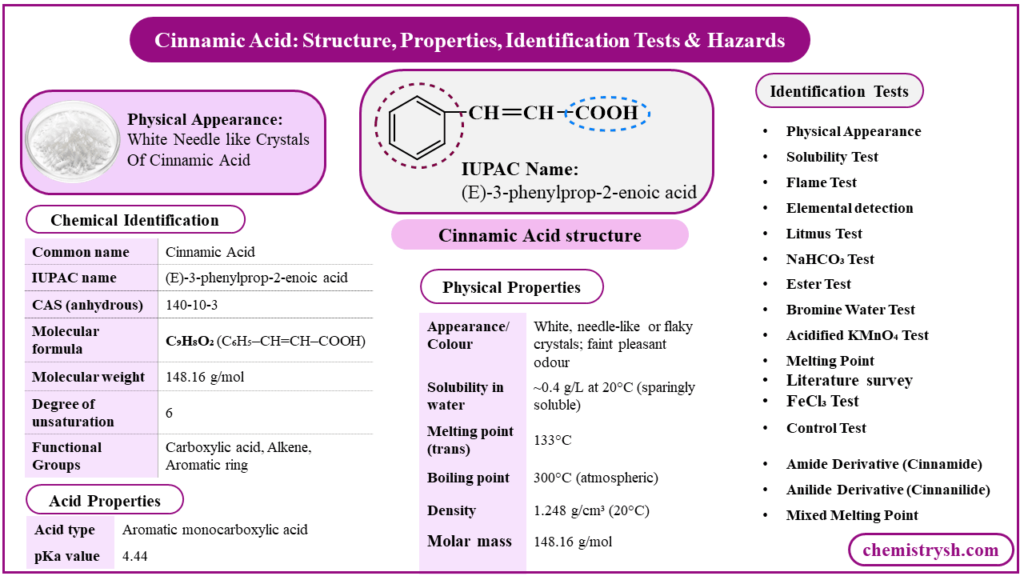
Cinnamic acid is a naturally occurring aromatic α,β-unsaturated carboxylic acid with the molecular formula C₉H₈O₂ and a molecular weight of 148.16 g/mol. Its IUPAC name is (E)-3-phenylprop-2-enoic acid, where the prefix E (from the German entgegen, meaning ‘opposite’) specifies the trans configuration of the double bond. It is most commonly encountered as the white crystalline trans isomer that melts sharply at 133°C.
The compound occurs widely in nature. It is found in the bark of Cinnamomum verum (true cinnamon) and Cinnamomum cassia, in Styrax resins, in honey, and at trace levels in many fruits including strawberries and blueberries. Biosynthetically, cinnamic acid is produced in plants from the amino acid phenylalanine by the enzyme phenylalanine ammonia-lyase (PAL) — making it a key branch-point intermediate in the phenylpropanoid biosynthetic pathway.
Key Physical and Chemical Properties at a Glance
|
Property |
Value |
Significance of Identification |
|---|---|---|
|
Molecular formula |
C₉H₈O₂ (C₆H₅–CH=CH–COOH) |
Three functional regions: ring, C=C, –COOH |
|
CAS Number |
140-10-3 |
Chemical identity |
|
Molecular weight |
148.16 g/mol |
Used to calculate neutralisation equivalent in titrimetric analysis |
|
IUPAC name |
(E)-3-phenylprop-2-enoic acid |
E = trans configuration at C=C ketones or methyl alcohols. |
|
Melting point (trans) |
133°C |
Sharp m.p. = purity indicator; cis isomer melts at ~68°C |
|
Boiling point |
300°C (atmospheric) |
High b.p. due to H-bonding between –COOH groups |
|
Density |
1.248 g/cm³ (20°C) |
Denser than water |
|
pKa |
4.44 (trans isomer) |
Reacts with NaHCO₃; stronger than phenol (pKa ≈10) |
|
Solubility in water |
~0.4–0.5 g/L at 20°C (sparingly soluble) |
Increases on warming; freely soluble in NaOH |
|
Solubility in EtOH |
Freely soluble |
Used in ester test and derivative preparation |
|
Colour / Appearance |
White, needle-like or flaky crystals; faint pleasant odour |
Colourless → no chromophore; crystalline → pure solid |
|
Degree of unsaturation |
6 (4 from benzene ring + 1 from C=C + 1 from C=O) |
High DoU consistent with bromine water and KMnO₄ reactions |
|
Geometrical isomers |
trans (E), m.p. 133°C — naturally occurring; cis (Z), m.p. ~68°C |
Melting point distinguishes isomers |
Planning the Identification: Think Like a Chemical Detective 🔍
The mechanism of the Molisch test is based on the acid-catalyzed dehydration of Before picking up a single test tube, every good chemist asks one question: “What clues does this molecule already give me?”
Look closely at the structure of cinnamic acid (C₆H₅–CH=CH–COOH) in Figure 1 — it’s like a map with three highlighted zones, and each one tells us exactly which tests to run.
Step 1: Identify the Functional Groups in Cinnamic Acid
- 🔵 Benzene ring → aromatic character
- 🟠 C=C double bond → unsaturation
- 🟣 –COOH group → carboxylic acid
Step 2: Match Each Structural Clue to Its Confirmatory Test
|
Structural Clue |
Tests to Confirm It |
|
🔵 Benzene ring (aromatic system) |
Flame Test — sooty, smoky luminous yellow flame |
|
🟠 C=C double bond (unsaturation) |
Bromine Water Test • KMnO₄ Test (Baeyer’s reagent) cold dilute alkaline or neutral KMnO₄ solution to detect carbon–carbon double bonds |
|
🟣 –COOH (carboxylic acid group) |
Litmus Paper Test • NaHCO₃ Test • Ester Test |
|
⚪ Whole compound (cinnamic acid) |
FeCl₃ Test (light yellow precipitate) |
Step 3: Begin with Preliminary Observations — Do Not Skip
Before any chemical test is run, three preliminary observations narrow down the compound class: physical appearance, solubility in water, and the flame test. A white crystalline solid that is sparingly soluble in cold water and burns with a sooty yellow flame is already pointing clearly toward an aromatic carboxylic acid. The chemical tests then confirm what the physical observations already suggest.
The Testing Sequence: Step-by-Step Flow
Note: The table summarises only what each test establishes and why it matters for the identification of cinnamic acid. Full procedural details — quantities, conditions, safety notes, and interpretation of borderline results — are provided on the page dedicated to each test. Readers are strongly encouraged to study the relevant page before attempting any procedure in the laboratory.
|
# |
Test |
What It Establishes |
|
1 |
Physical Appearance |
No chromophore; crystalline pure solid |
|
2 |
Solubility |
Aromatic acid profile; confirms –COOH ionises in base |
|
3 |
Flame Test |
Benzene ring present (sooty flame = high C:H ratio) |
|
4 |
Elemental detection |
To check the presence of N, S, Cl, Br, & I |
|
5 |
Litmus Test |
Compound is acidic |
|
6 |
NaHCO₃ Test |
Specifically a carboxylic acid, not phenol (pKa argument) |
|
7 |
Ester Test |
Final –COOH confirmation; rules out sulfonic acid |
|
8 |
Bromine Water Test |
C=C double bond confirmed (electrophilic addition) |
|
9 |
KMnO₄ Test (Baeyer’s test) |
C=C confirmed independently (oxidation / Baeyer’s test) |
|
10 |
Melting Point |
Purity check; identity against literature (133°C) |
|
11 |
FeCl₃ Test |
Whole-compound fingerprint (light yellow precipitate) |
|
12 |
Literature survey |
|
|
13 |
Control Test |
Validates FeCl₃ result against authentic standard |
|
14 |
Amide Derivative (Cinnamide) |
Independent physical checkpoint (m.p. 147°C) |
|
15 |
Anilide Derivative (Cinnanilide) |
Second independent physical checkpoint (m.p. 153°C) |
|
16 |
Mixed Melting Point |
Gold-standard definitive proof of identity |
This is the real skill of qualitative organic analysis: it is not about running every test in the textbook, but about reading the molecular structure and selecting tests that carry real diagnostic weight. Once that habit is established, identifying any unknown organic compound becomes a logical exercise rather than a guessing game.
Materials & Reagents to Test the Cinnamic acid
- Cinnamic acid sample (unknown)
- Distilled water
- Bromine water (dilute aqueous solution of Br₂)
- Neutral KMnO₄ solution (dilute) — Baeyer’s reagent
- NaHCO₃ solution (sodium bicarbonate, ~5% aqueous)
- Freshly prepared lime water (Ca(OH)₂ solution) — for CO₂ confirmation
- Blue and red litmus paper
- Absolute (anhydrous) ethanol — for ester test
- Concentrated H₂SO₄ — for ester test
- Neutral FeCl₃ solution (~1% aqueous) — for FeCl₃ test
- Thionyl chloride (SOCl₂) or PCl₅ — for derivative preparation (fume cupboard only)
- Concentrated aqueous ammonia — for cinnamide preparation
- Aniline + pyridine or dilute NaOH — for cinnanilide preparation
- Melting point apparatus with sealed capillary tubes
- Delivery tube assembly — for passing CO₂ into lime water
- Authentic (known) cinnamic acid sample — for control test and mixed melting point
How to Perform the Chemical Tests — Step-by-Step Bench Procedures
Each procedure below is a self-contained bench protocol. Read the full procedure for a test before you begin. Collect all required reagents first. Then work through the numbered steps in order. The observation and inference for each test are recorded separately in the Observation
How to use this section
Read the full procedure before starting any test.
The ✅ Expected result line tells you what a positive result looks like — use it to check your own observation.
If your result does not match the expected result, consult the original article’s observation table inference column for diagnostic guidance.
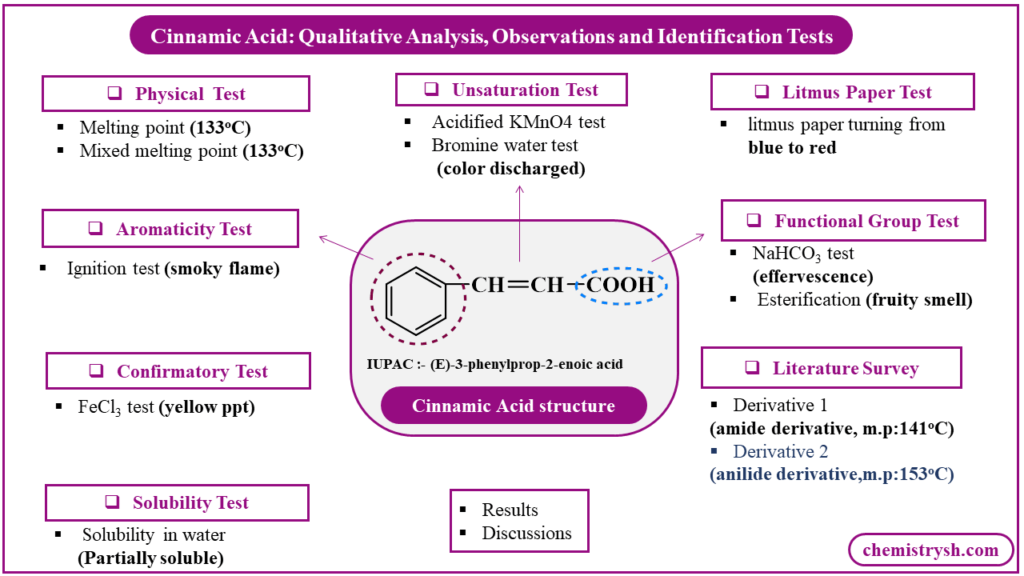
Qualitative Analysis of Cinnamic Acid — Procedure & Observations
The table below records the expected observation and chemical inference for each test. Full step-by-step bench procedures are given.
|
Test |
Procedure |
Observation |
Inference |
|
Physical Appearance |
Examine a small sample of cinnamic acid visually — note color, texture, and crystal form. |
White crystalline solid with a faint, characteristic odor. Colored compound absent. |
Absence of color rules out extended conjugation or transition-metal involvement; crystalline form suggests a pure organic solid, consistent with cinnamic acid. no extended conjugation reaching a chromophore, no d-d transitions from transition metals is concluded. |
|
Solubility |
Take a small amount of cinnamic acid in a test tube. Add distilled water and shake well. Note solubility at room temperature; then warm gently and re-check. |
Sparingly soluble in cold water; solubility increases on warming. |
Limited cold-water solubility is typical of carboxylic acids with a bulky aromatic/hydrophobic portion. |
|
Lassaigne’s Test (Sodium Fusion) |
Fuse a small amount of cinnamic acid with sodium metal in a fusion tube until red hot, then plunge into distilled water. Filter to obtain the sodium extract. Test separately for: N — add FeSO₄ and FeCl₃, boil, then acidify with dilute H₂SO₄ (not HCl, which can dissolve the Prussian blue precipitate). S — add sodium nitroprusside; separately add lead acetate solution.Halogens — boil with conc. HNO₃, then add AgNO₃ solution. |
N: No Prussian blue color formed. S: No violet/purple color with sodium nitroprusside; no black precipitate with lead acetate.Halogens: No white, pale yellow, or yellow precipitate with AgNO₃. |
Nitrogen absent — no nitrile, nitro, amino, or amide group present (Prussian blue, Fe₄[Fe(CN)₆]₃, would form if N were present). Sulfur absent — no thiol, sulfide, or sulfonic acid group (black PbS ppt or violet color would indicate S). Nitrogen absent — no nitrile, nitro, amino, or amide group present (Prussian blue, Fe₄[Fe(CN)₆]₃, would form if N were present). Sulfur absent — no thiol, sulfide, or sulfonic acid group (black PbS ppt or violet color would indicate S). Halogens absent — no C–X bond present (AgCl white, AgBr pale yellow, AgI yellow ppt would indicate Cl, Br, I respectively). Compound contains only C, H, and O — consistent with cinnamic acid (C₉H₈O₂). |
|
Ignition test |
Take a small quantity of cinnamic acid on a spatula/nichrome wire and introduce it into a non-luminous Bunsen flame. |
Burns with a yellow, sooty, smoky flame; leaves black carbon residue/soot |
Sooty flame indicates high C:H ratio — confirms presence of the benzene ring. |
|
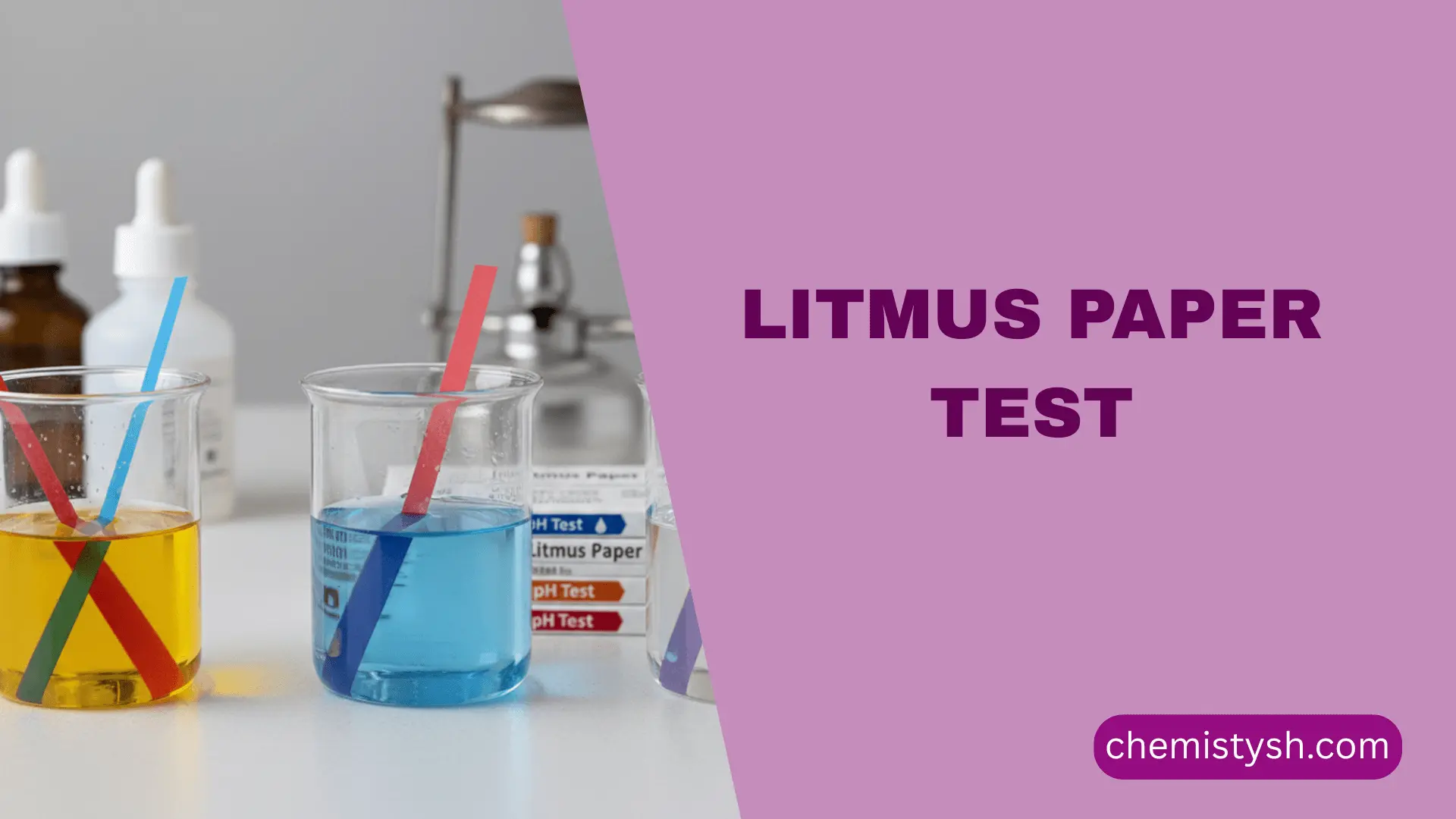
Litmus Test |
Dissolve a small amount of cinnamic acid in water. Dip blue and red litmus paper into the solution. |
Blue litmus turns red; red litmus shows no change. |
Indicates the compound is acidic in nature. However, this alone is not specific — sulfonic acids, amino acids, phenols, and certain carboxylic acid derivatives can also turn litmus red. Further tests are needed to confirm the acidic group is specifically a carboxylic acid. |
|
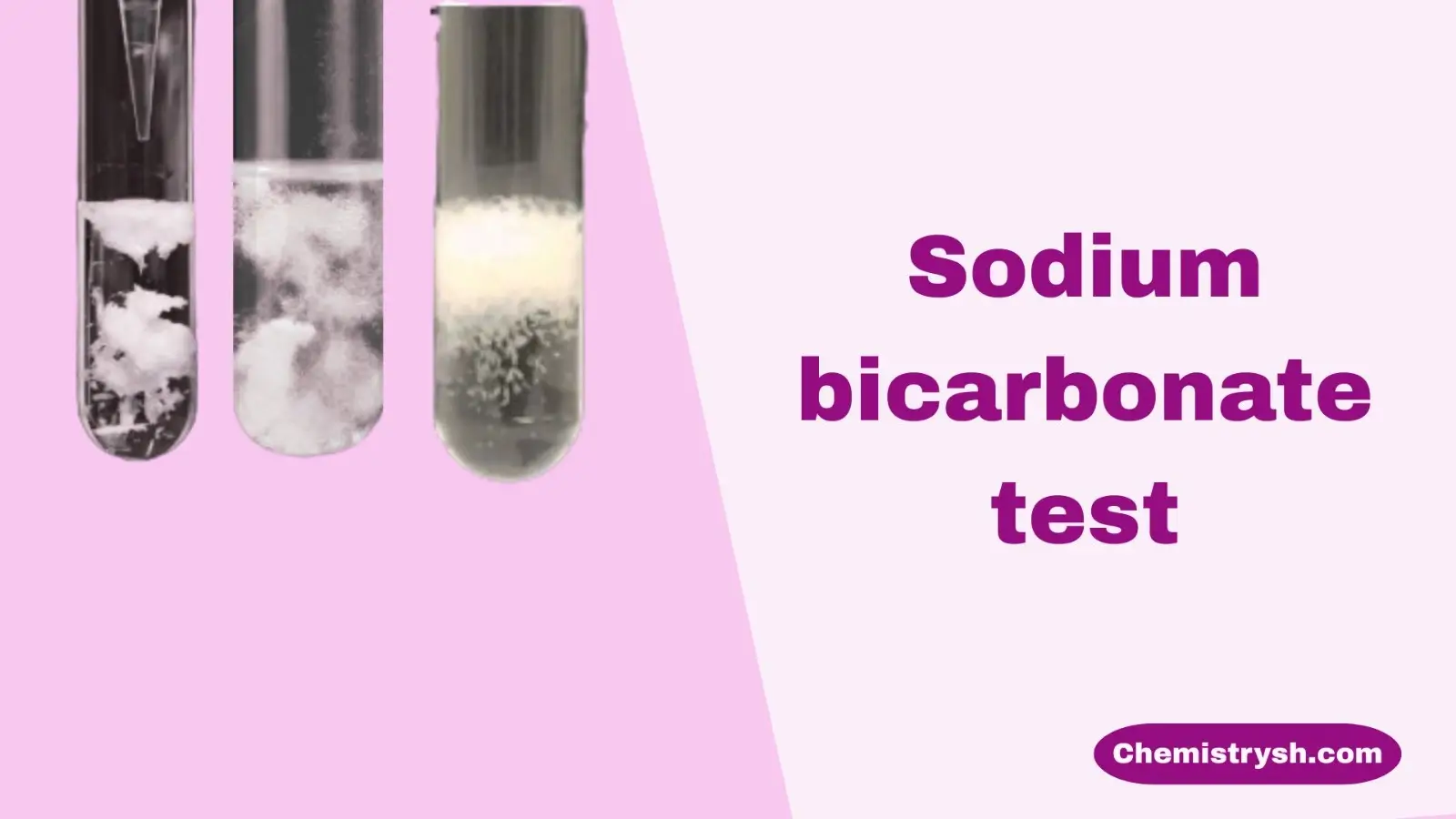
NaHCO₃ Test |
Add a pinch of cinnamic acid to NaHCO₃ solution. Pass evolved gas through freshly prepared lime water using a delivery tube. |
Brisk effervescence; gas evolved turns lime water milky. |
Gas confirmed as CO₂ (Ca(OH)₂ + CO₂ → CaCO₃↓ + H₂O). Specific to carboxylic acids (pKa ≈ 4–5), since phenols (pKa ≈ 10) are too weakly acidic to react with NaHCO₃. |
|
Ester Test |
Take cinnamic acid with ethanol and a few drops of conc. H₂SO₄; warm gently, then pour into cold water. |
A sweet, fruity smell is detected |
Confirms –COOH undergoes Fischer esterification with alcohol. Sulfonic acids do not esterify readily under these conditions, so this also rules out sulfonic acid — final confirmatory evidence for –COOH. |
|
Bromine Water Test |
Dissolve cinnamic acid in minimum water/dilute NaOH. Add bromine water dropwise and shake. |
Orange/reddish-brown color of bromine water decolorized — no white precipitate formed |
Decolorization (without precipitate) indicates Br₂ addition across the C=C bond, confirming unsaturation. Phenols instead give a white ppt (2,4,6-tribromophenol) via ring substitution — its absence rules out phenol and confirms C=C |
|
KMnO₄ Test |
Dissolve cinnamic acid in water; then add dilute KMnO₄ dropwise and shake. add dilute H₂SO₄, |
Purple/pink color of KMnO₄ decolorized; brown MnO₂ precipitate may form. On addition of sulphuric acid colourless solution |
Decolorization indicates oxidation of C=C by KMnO₄ (Baeyer’s test) — independent confirmation of unsaturation, reinforcing the bromine water result. |
|
Melting Point |
Pack a small amount of finely powdered, dry cinnamic acid into a capillary tube. Insert into the melting point apparatus and heat slowly and uniformly. |
Sharp melting point observed at 133°C. |
A sharp melting point indicates purity. The observed value closely matches the literature melting point of cinnamic acid (133°C), providing strong physical evidence supporting its identity |
|
Literature Survey |
|||
|
FeCl₃ Test |
Dissolve cinnamic acid in water/dilute ethanol. Add a few drops of neutral FeCl₃ solution. |
Light yellow precipitate observed — no deep violet/purple color typical of phenols. |
The light yellow precipitate is a characteristic feature of cinnamic acid’s reaction with FeCl₃, distinct from the phenol response. Confirms the absence of a phenolic –OH and supports identification as cinnamic acid. |
|
Control Test |
Repeat the FeCl₃ test using a known/authentic sample of cinnamic acid, under the same conditions as used for the unknown sample. Compare observations side-by-side. |
The authentic sample also gives a light yellow precipitate with FeCl₃, matching the unknown sample’s result. |
Since the FeCl₃ result for cinnamic acid isn’t as standard as the phenol reaction, comparison with an authentic sample confirms it’s a genuine, reproducible characteristic — not an artifact. Strengthens the reliability of the FeCl₃ test as confirmatory evidence. |
|
Amide Derivative |
Convert cinnamic acid to cinnamoyl chloride (using SOCl₂ or PCl₅), then treat with concentrated aqueous/alcoholic ammonia. Filter, wash, recrystallize. |
White crystalline solid (cinnamide) obtained; melting point 147°C. |
Formation of a solid amide via the acid chloride intermediate confirms reactivity typical of a carboxylic acid. The melting point closely matches the literature value, providing additional independent physical confirmation. |
|
Anilide Derivative |
Treat cinnamoyl chloride with aniline in presence of a mild base (e.g., pyridine or aqueous NaOH) to neutralize the HCl formed. Filter, wash, recrystallize. |
White/pale crystalline solid (cinnanilide) obtained; melting point 153°C. |
Formation of a solid anilide via nucleophilic acyl substitution with aniline further confirms carboxylic acid reactivity. Melting point closely matches the literature value, serving as a second independent physical checkpoint. |
|
Mixed Melting Point |
Mix a small, equal quantity of the unknown sample with an authentic sample of cinnamic acid. Pack into a capillary tube and determine melting point as before. |
The mixture melts sharply at 133°C — no depression and no elevation compared to the individual samples. |
No depression or elevation in melting point confirms both samples are identical, conclusively establishing the compound as cinnamic acid — the definitive physical confirmatory test in this analysis. |
Laboratory Note: Use a freshly prepared, approximately neutral ferric chloride solution. Acidic reagent suppresses phenolate formation, whereas alkaline solutions may produce Fe(OH)₃ precipitates and reduce test sensitivity.
What does a literature survey means for an organic compound?
When you carried out the solubility test then litmus paper test, sodium bicarbonate test, stratification test, unsaturation test with the help of bromine water test and the KMmO4 test, then you find out the melting point.
You conclude the following points. but you could not give the name to the compound.
- Litmus Paper Test: The compound was found to be acidic.
- Sodium Bicarbonate Test & Estertification Test: Confirmed the presence of a carboxylic acid (–COOH group).
- Bromine Water Test & Baeyer’s Test (KMnO₄): Positive — decolorization indicated carbon-carbon double bond (C=C unsaturation).
- Ignition (Combustion) Test: Smoky flame observed — confirmed the presence of an aromatic ring.
- Melting Point: Measured and recorded.
At this stage, the compound is characterized as: an aromatic, unsaturated carboxylic acid with a known melting point. However, the specific name of the compound cannot yet be determined from tests alone.
Then we need the literature survey.
In this case, we will search a compound having a carboxyl group, carbon carbon double bonds, and an aromatic system with the melting point of MP 133°C, from scientific published literature. The literature will guide us the compound with these characteristics is Cinnamic acid, now we will perform the confirmatory tests ( ferric chloride test, control test, mixed M.P.), and prepare the derivatives to confirm the compound
- .Confirmatory Tests → Single compound confirmed (e.g., Cinnamic Acid, MP 133°C)
Standard Literature Sources
- Merck Index — melting points, functional groups, physical constants
- CRC Handbook of Chemistry and Physics — comprehensive physical data tables
- Heilbron’s Dictionary of Organic Compounds
- PubChem / SDBS — modern digital equivalents
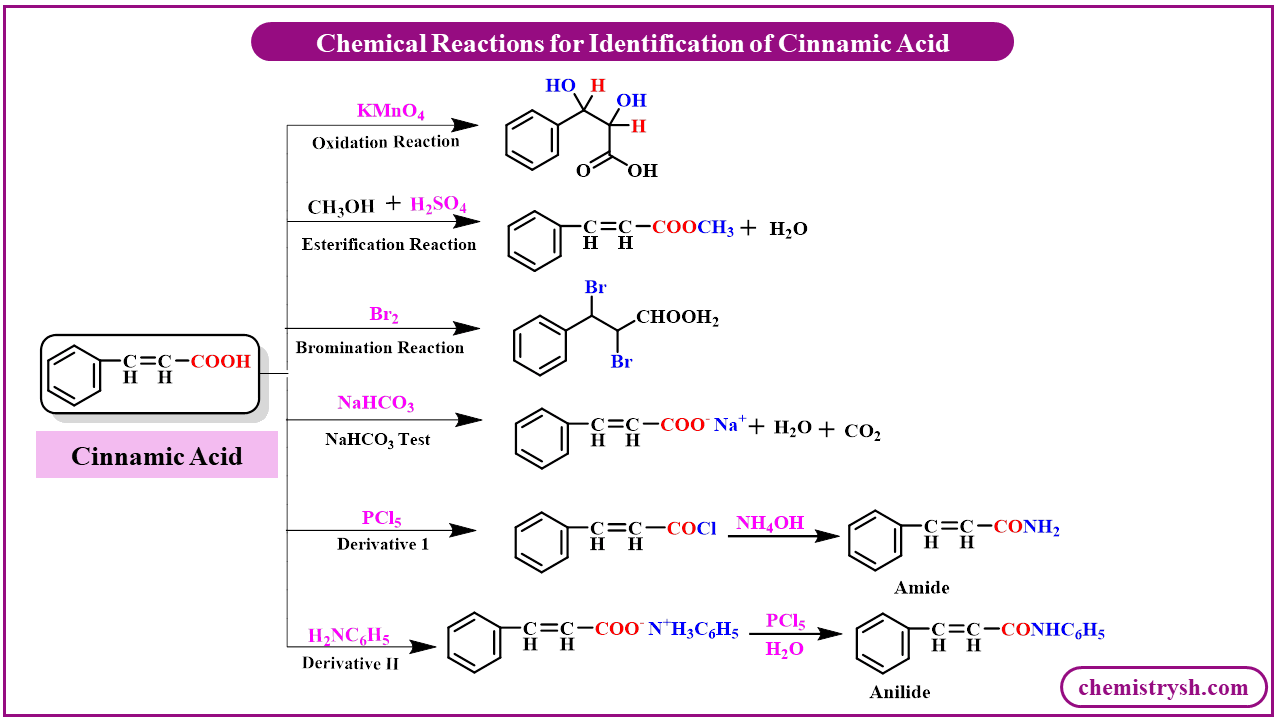
Reactions Involved
|
Reaction |
Equation and Mechanism Notes |
|
KMnO₄ — Baeyer’s Test |
3 C₆H₅–CH=CH–COOH + 2KMnO₄ + 4H₂O → 3 C₆H₅–CHOH–CHOH–COOH + 2MnO₂↓ + 2KOH (Syn dihydroxylation across C=C; purple KMnO₄ decolorises; brown MnO₂ precipitates) |
|
Bromine Water Test |
C₆H₅–CH=CH–COOH + Br₂ → C₆H₅–CHBr–CHBr–COOH (α,β-dibromocinnamic acid; electrophilic addition of Br₂ across C=C; orange bromine water decolorises; no precipitate) |
|
Sodium Bicarbonate Test |
C₆H₅–CH=CH–COOH + NaHCO₃ → C₆H₅–CH=CH–COONa + H₂O + CO₂↑ (Acid–base reaction; CO₂ confirmed by lime water: CO₂ + Ca(OH)₂ → CaCO₃↓ + H₂O) |
|
Esterification (Ester Test) |
C₆H₅–CH=CH–COOH + C₂H₅OH ⇌ (conc. H₂SO₄, Δ) C₆H₅–CH=CH–COOC₂H₅ + H₂O (Fischer esterification; ethyl cinnamate formed — sweet fruity odour; equilibrium driven by excess alcohol) |
|
Amide Derivative — Step 1 (Acid Chloride) |
C₆H₅–CH=CH–COOH + SOCl₂ → C₆H₅–CH=CH–COCl + SO₂↑ + HCl↑ (Nucleophilic acyl substitution: –OH replaced by –Cl using thionyl chloride) |
|
Amide Derivative — Step 2 (Cinnamide) |
C₆H₅–CH=CH–COCl + 2NH₃ → C₆H₅–CH=CH–CONH₂ + NH₄Cl (Nucleophilic acyl substitution with ammonia → cinnamide, m.p. 147°C) |
|
Anilide Derivative (Cinnanilide) |
C₆H₅–CH=CH–COCl + C₆H₅NH₂ → C₆H₅–CH=CH–CONHC₆H₅ + HCl (Nucleophilic acyl substitution with aniline; base neutralises HCl → cinnanilide, m.p. 153°C) |
Result Summary
All physical and chemical observations are consistent with the identity of the compound as cinnamic acid (C₆H₅–CH=CH–COOH).
All observations are consistent with the identity of the compound as cinnamic acid. The sample was a white crystalline solid (colored compounds absent), sparingly soluble in cold water. The flame test confirmed aromatic character (sooty flame), while the litmus, NaHCO₃, and ester tests together confirmed the presence of a carboxylic acid (–COOH) group. The bromine water and acidified KMnO₄ tests confirmed unsaturation (C=C double bond). The FeCl₃ test gave a light yellow precipitate, ruling out a phenolic component and matching the control sample’s behavior. The sharp melting point of 133°C, along with the amide (147°C) and anilide (153°C) derivatives, provided strong physical confirmation. Finally, the mixed melting point test showed no depression or elevation, conclusively confirming the identity of the compound.
Note on isomers: Cinnamic acid exists as cis (Z, m.p. ~68°C, oily solid) and trans (E, m.p. 133°C) isomers. The observed melting point of 133°C confirms that the trans isomer — the naturally occurring, thermodynamically stable form — is present.
Conclusion
Based on the combined physical and chemical evidence — aromatic character (sooty flame test), unsaturation (bromine water and KMnO₄ decolorisation), carboxylic acid functionality (NaHCO₃, litmus, and ester tests), characteristic FeCl₃ behaviour (light yellow precipitate, no phenol response, control test varified), matching literature melting point (133°C), confirmed derivative melting points (cinnamide 147°C; cinnanilide 153°C), and absence of mixed melting point depression — the given unknown compound is conclusively identified as:
Cinnamic Acid (C₆H₅–CH=CH–COOH)
IUPAC name: (E)-3-phenylprop-2-enoic acid | MW: 148.16 g/mol | m.p. 133°C (trans isomer)
Safety Precautions
General Laboratory Safety
- Wear a laboratory coat, safety goggles, and nitrile gloves throughout the entire experiment.
- Work in a well-ventilated laboratory. Use a fume cupboard for all steps involving bromine water, concentrated H₂SO₄, SOCl₂, and aniline.
- Never pipette by mouth. Use a pipette filler or dropper for all liquid reagents.
- Dispose of all chemical waste in the designated waste containers. Do not pour bromine water, KMnO₄, or heavy metal solutions down the sink.
- Know the location of the eyewash station, emergency shower, fire extinguisher, and first-aid kit before starting.
In case of skin or eye contact with any corrosive reagent, wash immediately with large volumes of water for at least 15 minutes and seek medical attention.
Per-Reagent Hazard and Precaution Table
|
Reagent |
Hazard Classification |
Specific Risk |
Precaution |
|
Cinnamic acid |
Low hazard (irritant) |
May cause mild skin, eye, and respiratory irritation on prolonged exposure. Not acutely toxic. |
Avoid inhaling dust. Wear gloves. Handle normally on open bench. |
|
Bromine water |
TOXIC • CORROSIVE • OXIDISING |
Bromine vapour is highly toxic by inhalation (TLV 0.1 ppm). Causes severe burns to skin and eyes. Bromine water is an oxidising agent. |
Use ONLY in a fume cupboard. Wear nitrile gloves and goggles. In case of skin contact, wash immediately with water then apply sodium thiosulfate solution. Never add water to bromine. |
|
Concentrated H₂SO₄ |
CORROSIVE • OXIDISING |
Causes severe, potentially permanent burns to skin, eyes, and mucous membranes. Reacts violently with water, releasing heat. |
Always add acid to the reaction mixture slowly and carefully — never the reverse. Use a fume cupboard. Wear acid-resistant gloves and goggles. In case of contact, flush with copious water immediately. |
|
NaHCO₃ solution |
Low hazard |
Mild irritant only. CO₂ evolved during the test is asphyxiant in enclosed spaces. |
Ensure adequate ventilation. Use a delivery tube to direct CO₂ into lime water safely. |
|
Neutral FeCl₃ solution |
IRRITANT |
Irritating to skin and eyes. Mildly corrosive. Iron(III) salts are harmful if swallowed. |
Wear gloves and goggles. Avoid contact with skin. Dispose of waste in heavy-metal waste container. |
|
Thionyl chloride (SOCl₂) |
HIGHLY CORROSIVE • TOXIC |
Reacts violently with water, releasing HCl and SO₂ gas — both are toxic and corrosive. Severe burns on skin and eye contact. Toxic by inhalation. |
Use ONLY in a dry fume cupboard. Ensure all glassware is completely dry. Wear acid-resistant gloves, goggles, and lab coat. Keep away from all water sources. Destroy excess with dry pyridine. |
|
Aniline |
TOXIC • HARMFUL |
Readily absorbed through the skin. Causes methaemoglobinaemia (reduces blood oxygen-carrying capacity) even from brief skin contact. Suspected carcinogen. |
Use in a fume cupboard at all times. Wear double gloves (nitrile over latex). If skin contact occurs, wash thoroughly with soap and water immediately and seek medical advice. Dispose of waste as toxic organic waste. |
|
Concentrated aqueous ammonia |
CORROSIVE • TOXIC (vapour) |
Pungent, irritating vapour causes respiratory tract and eye irritation. Corrosive at high concentration. |
Use in a fume cupboard. Keep the bottle closed when not in use. Wear goggles and gloves. |
|
Acidified KMnO₄ |
OXIDISING • IRRITANT |
Strong oxidising agent. Contact with combustible materials may cause fire. Manganese compounds are toxic by ingestion. |
Keep away from flammable solvents. Wear gloves. Dispose of waste in the heavy-metal waste container — do not pour down the drain. |
First Aid Summary
|
Exposure Route |
Immediate First Aid Action |
|
Eye contact with any chemical |
Immediately irrigate with large volumes of flowing water for at least 15 minutes, holding eyelids open. Seek medical attention. |
|
Skin contact — corrosive (H₂SO₄, SOCl₂, bromine) |
Remove contaminated clothing. Wash affected area with copious water for at least 15 minutes. For bromine: apply sodium thiosulfate solution after washing. Seek medical attention. |
|
Skin contact — aniline |
Remove contaminated clothing immediately. Wash with soap and water for at least 15 minutes. Seek medical attention — risk of systemic toxicity even after decontamination. |
|
Inhalation — bromine or SOCl₂ |
Move to fresh air immediately. If breathing is difficult, administer oxygen. Seek medical attention urgently. |
|
Ingestion |
Do NOT induce vomiting. Rinse mouth with water. Seek medical attention immediately and bring the chemical’s safety data sheet (SDS). |
Uses and Applications of Cinnamic Acid
|
Industry / Field |
Application |
Specific Role |
|
Fragrance & Perfumery |
Flavour and fragrance ingredient |
Imparts a warm, spicy, balsamic, cinnamon-like note. Used in soaps, cosmetics, perfumes, and scented candles. Esters of cinnamic acid (e.g. benzyl cinnamate, cinnamyl cinnamate) are major components of balsam of Peru. |
|
Food Industry |
Flavouring agent |
Approved food additive (E-number varies by region). Used to flavour confectionery, beverages, chewing gum, and baked goods. Imparts the characteristic cinnamon note. |
|
Pharmaceuticals |
Drug precursor and antimicrobial agent |
Starting material for the synthesis of chloroquine, an antimalarial drug. Cinnamic acid derivatives show antibacterial, antifungal, and anti-inflammatory activity in research settings. |
|
Sunscreen / Cosmetics |
UV-absorbing agent |
Cinnamate esters (e.g. octyl methoxycinnamate / octinoxate) are among the most widely used UV-B filters in commercial sunscreen formulations |
|
Agriculture |
Natural plant growth regulator |
Acts as an allelopathic compound — inhibits germination and growth of competing plants at certain concentrations. Studied as a biodegradable herbicide alternative. |
|
Polymer Chemistry |
Photocrosslinkable monomer |
The C=C bond in cinnamic acid undergoes [2+2] photocycloaddition under UV irradiation, forming cyclobutane dimers. Exploited in photoresist materials and UV-curable polymers. |
|
Organic Synthesis |
Versatile building block |
Precursor for cinnamaldehyde, cinnamyl alcohol, styrene, and various pharmaceutical scaffolds. The Perkin condensation, Knoevenagel condensation, and Reformatsky reactions all use cinnamic acid derivatives. |
FAQ’s
Multiple Choice Questions
MCQ 1
1. Cinnamic acid formula?
A. C₆H₅COOH
B. C₆H₅CH=CHCOOH
C. C₆H₅C≡CCOOH
D. C₆H₅CH₂COOH
MCQ 2
2. Cinnamic acid melting point?
A. 68°C
B. 133°C
C. 122°C
D. 147°C
MCQ 3
3. Cinnamic acid iupac name?
A. 3-phenylpropionic acid
B. (Z)-3-phenylprop-2-enoic acid
C. (E)-3-phenylprop-2-enoic acid
D. phenylacrylic acid
MCQ 4
4. Cinnamic acid saturated or unsaturated?
A. Litmus test
B. FeCl₃ test
C. Decolorisation of bromine water
D. Flame test
MCQ 5
5. Cinnamic acid with NaHCO₃ / pKa?
A. Cinnamic acid is a stronger base than phenol
B. Cinnamic acid (pKa ~4.44) is acidic enough to protonate HCO₃⁻; phenol (pKa ~10) is not
C. Phenol does not dissolve in NaHCO₃ solution
D. Phenol has a lower pKa than cinnamic acid
MCQ 6
6. Bromine water / cinnamic acid bromination?
A. Br₂ has added across the C=C double bond (electrophilic addition)
B. Br₂ has substituted onto the benzene ring
C. The –COOH group has reacted with Br₂
D. ) Oxidation of the benzene ring by Br₂
MCQ 7
7. Cinnamic acid reaction with KMnO₄?
A. The –COOH group reduces KMnO₄
B. CO₂ produced bleaches KMnO₄
C. KMnO₄ oxidises the C=C double bond
D. The benzene ring is oxidised
MCQ 8
8. Confirmatory test for cinnamic acid / FeCl₃?
A. Deep violet/purple coloration
B. Light yellow precipitate
C.Brick-red precipitate
D. No visible change
MCQ 9
9. Cinnamic acid functional group?
A. One (–COOH only)
B. Two (benzene ring and –COOH)
C. Three (benzene ring, C=C, and –COOH)
D. Four (benzene ring, C=C, –COOH, and –OH)
MCQ 10
10.Cinnamic acid flame test / aromatic or aliphatic?
A. It contains nitrogen
B. The benzene ring gives a high C:H ratio, causing incomplete combustion and soot formation
C. It is a purely aliphatic compound
D. It contains sulfur
MCQ 11
11. Cinnamic acid solubility in water?
A. It ionises completely in water
B. The nonpolar benzene ring dominates over the polar –COOH group, reducing overall water solubility
C. It has an extremely high molecular weight
D. It forms an insoluble precipitate with water
MCQ 12
12. Cinnamic acid degree of unsaturation?
A. 4
B. 5
C. 6 (4 from benzene ring + 1 from C=C + 1 from C=O)
D.7
MCQ 13
13. Cinnamic acid geometrical isomerism?
A. The cis isomer melts at 133°C and is the more stable form
B. The trans (E) isomer melts at 133°C and is the naturally occurring, thermodynamically stable form
C. Both isomers have the same melting point
D. Cinnamic acid does not show geometrical isomerism
MCQ 14
14. Cinnamic acid esterification / ethyl ester?
A. Ethyl cinnamate — sweet, fruity-smelling liquid
B. Cinnamoyl chloride — pungent lachrymatory liquid
C. Cinnamide — odourless white solid
D. Sodium cinnamate — water-soluble salt
MCQ 15
15. Cinnamic acid amide / derivatives?
A. 147°C
B. 133°C
C. 153°C
D. 163°C
MCQ 16
16. Mixed melting point?
A. Both samples are the same compound — identity is conclusively confirmed
B. Both samples are impure
C. The test has failed and must be repeated
D. The two compounds are different
MCQ 17
17. Safety / bromine water?
A. It reacts with the plastic fume cupboard lining and is neutralised
B. Bromine vapour is highly toxic by inhalation (TLV 0.1 ppm) and causes severe respiratory and eye damage
C. It evaporates too rapidly at room temperature
D. It is flammable and creates a fire hazard
MCQ 18
18. Cinnamic acid uses / applications?
A. As a nitrogen fertiliser in agriculture
B. As UV-B filters in sunscreen formulations (e.g. octyl methoxycinnamate)
C. As a reducing agent in metal plating
D. As a drying agent in organic solvents
MCQ 19
19. Cinnamic acid from benzaldehyde / Perkin reaction?
A. Oxidation of cinnamaldehyde with acidified KMnO₄
B. Hydrolysis of ethyl cinnamate with NaOH
C. Perkin condensation of benzaldehyde with acetic anhydride in the presence of sodium acetate
D. Reduction of cinnamic acid nitrile with H₂/Pd
MCQ 20
20. Cinnamic acid molecular weight?
A. 132.16 g/mol
B. 148.16 g/mol
C. 164.16 g/mol
D. 120.15 g/mol