

Phenol Identification: Key Facts at a Glance
- Phenol Molecular Formula (C₆H₅OH) · Molecular Mass (94.11 g/mol) · IUPAC Name (phenol) · Common Name (carbolic acid) · Appearance (colourless crystalline solid) · Melting Point (40–41 °C) · Boiling Point (181.7 °C) · Solubility (8.3 g/100 mL water at 20 °C) · Density (1.07 g/cm³) · pKa (9.95) · CAS Number (108-95-2) · Functional Group (phenolic –OH).
- Solubility test · Ignition (flame) test · Litmus test · Solubility in NaOH · NaHCO₃ test · Neutral FeCl₃ test (violet) · Bromine water test · Phthalein (dye) test · Liebermann’s test · Azo-dye test · Bromo derivative (m.p. ≈ 95 °C) · Phenyl urethane derivative (m.p. ≈ 126 °C) · Mixed melting point · Chemical structure · Resonance · Chemical reactions · Applications · Key terms · Results & Discussion · Conclusion · FAQs · MCQs · Practice table
What Is Phenol? (Compound vs. Class)
Hand a chemist an unlabeled white solid that smells faintly medicinal — how do they prove it’s phenol, and not something else entirely? Every test in this article exists to answer exactly that question
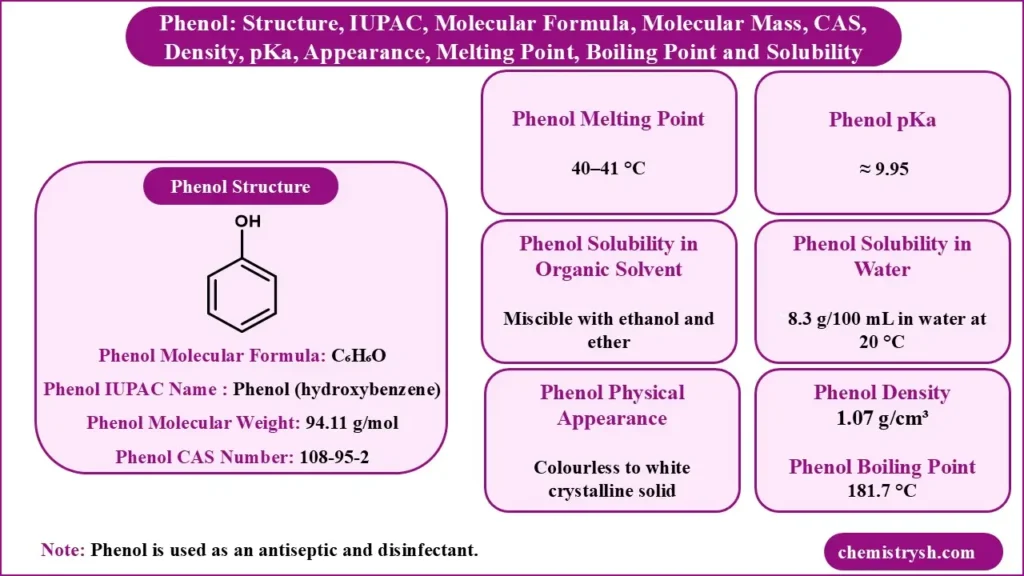
Phenol (also known as carbolic acid) is defined by a single structural feature — a hydroxyl (–OH) group bonded directly to an aromatic ring, giving the molecular formula C₆H₅OH. This phenolic functional group accounts for phenol’s unique properties, uses, and reactions, and distinguishes it from both alcohols (where –OH sits on a saturated carbon) and carboxylic acids. Its IUPAC name is simply “phenol” — one of the few organic compounds where the common name is also the retained IUPAC name. Understanding this structure is the starting point for every phenol identification.
Phenol vs. Phenyl
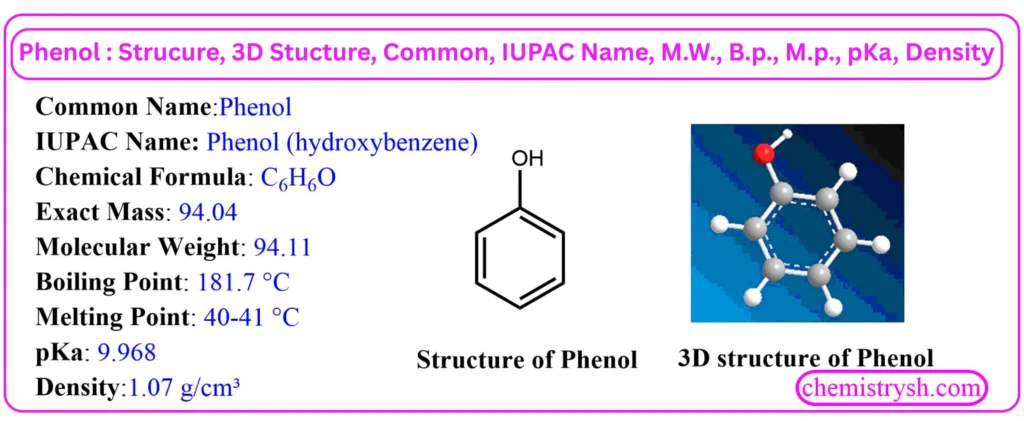
These two terms are often confused. The phenyl group (C₆H₅–) is the benzene ring alone, minus one hydrogen, used as a substituent name — it carries no oxygen. Phenol (C₆H₅OH) is the phenyl group with a hydroxyl (–OH) attached. In short, when comparing phenol vs phenyl: phenyl is a fragment name, phenol is a complete, independent compound.
More broadly, “phenol” is also used as a class name. Any compound with a hydroxyl group bonded directly to an aromatic ring — regardless of what else is substituted on the ring — is classified as a phenol.
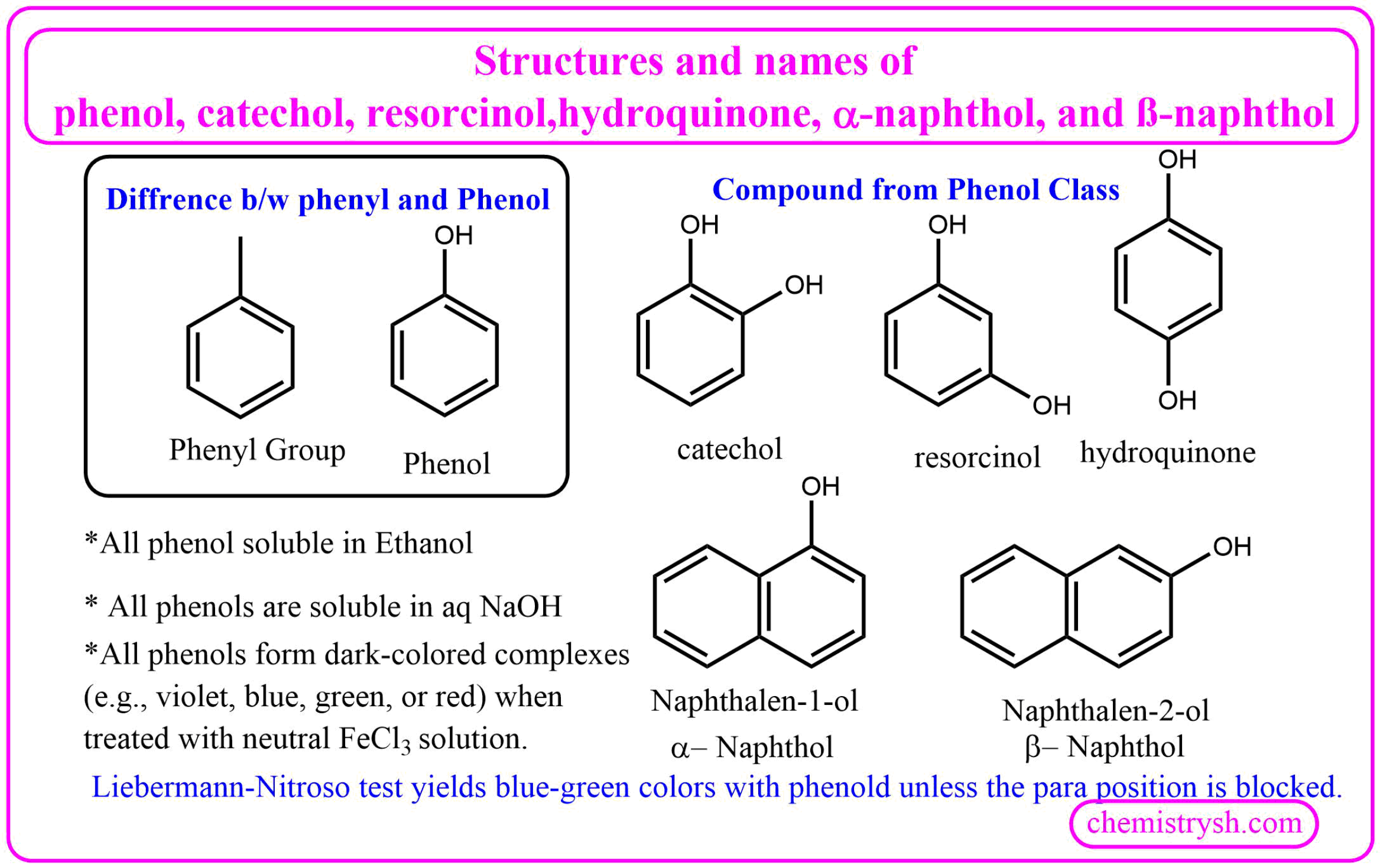
Common members of this class include catechol (ortho-dihydroxybenzene), resorcinol (meta-dihydroxybenzene), α-naphthol and β-naphthol (hydroxyl-substituted naphthalene), and substituted phenols such as m-nitrophenol and m-aminophenol. Each carries the same defining feature — an aromatic-ring–OH bond — regardless of what else is substituted on the ring.
This article covers the phenol qualitative test panel used to identify the parent compound, C₆H₅OH; the tests described below apply, with some variation in observed colour or precipitate, to substituted phenols as well.
Beyond the laboratory, phenol has significant industrial and historical importance. It was the first widely used surgical antiseptic, introduced by Joseph Lister in the 1860s, and remains a component in some disinfectants and antiseptic solutions today. Industrially, phenol is a key raw material for phenolic resins (Bakelite, used in electrical insulators and moulded plastics), and it serves as a starting material for compounds including bisphenol A, caprolactam (used in nylon production), and salicylic acid, the precursor to aspirin.
Physical Constants (Melting Point, Boiling Point, Density & pKa of Phenol)
Phenol (IUPAC name: phenol; also known as carbolic acid; CAS number 108-95-2) has the molecular formula C₆H₅OH with a molar mass (phenol molecular weight) of 94.11 g/mol. Its melting point is 40–41 °C and boiling point is 181.7 °C, with a density of 1.07 g/cm³ at room temperature. Phenol is moderately soluble in water (8.3 g/100 mL at 20 °C) and freely soluble in ethanol. Its pKa of approximately 9.95 reflects its weakly acidic character. All these physical constants of phenol are summarised in the table below.
|
Property |
Value |
|---|---|
|
IUPAC Name |
Phenol (hydroxybenzene) |
|
Molecular Formula |
C₆H₆O (C₆H₅OH) |
|
Molecular Mass |
94.11 g/mol |
|
Appearance |
Colourless to white crystalline solid; develops a pink tinge on prolonged exposure to light and air |
|
Melting Point |
40–41 °C |
|
Boiling Point |
181.7 °C |
|
Density |
1.07 g/cm³ |
|
Solubility |
~8.3 g/100 mL in water at 20 °C; miscible with ethanol and ether |
|
pKa |
≈ 9.95 |
|
CAS Number |
108-95-2 |
|
Functional Group |
Hydroxyl group (–OH) directly bonded to an aromatic ring (phenolic –OH) |
Planning the Identification: Decode the Structure First
Every competent phenol identification begins not at the bench, but on paper. Before a single reagent is added, the structural formula must be examined carefully. The formula C₆H₆O contains a single defining feature — but that one feature dictates almost the entire test panel.
Look at the structure of phenol in Figure 1. It has just two structural elements worth noting: the benzene ring and the phenolic –OH directly attached to it. Because the –OH is conjugated to the aromatic ring, it behaves as a weak acid — distinctly different from both an alcohol and a carboxylic acid, a distinction the solubility and NaHCO₃ tests confirm in Step 2. The question this article answers is:
Does this compound behave as a phenol specifically, and not as some other acidic or aromatic species?
Step 1: Identify the Functional Groups in Phenol
- Benzene ring — aromatic character; high C:H ratio.
- –OH group (phenolic) — weakly acidic; conjugated to the ring, giving it its characteristic reactivity.
Step 2: Identifying the Phenolic Functional Group — Which Test Confirms What
Each test in the phenol identification panel targets a specific feature of the phenolic functional group. The table below maps three structural clues to their corresponding confirmatory tests: the benzene ring (aromatic character — ignition test), the phenolic –OH indicating weak acidity (litmus test; solubility in NaOH; NaHCO₃ test), the activated aromatic system (bromine water test), and the phenolic –OH specifically (neutral ferric chloride test; phthalein dye test; Liebermann’s test; azo-dye test).
|
Structural Clue |
Tests to Confirm It |
|---|---|
|
Benzene ring (aromatic) |
Ignition (Flame) Test — smoky, sooty flame |
|
–OH (phenolic, weakly acidic) |
Solubility in water & ethanol • Litmus Test • Solubility in NaOH • NaHCO₃ Test (no effervescence — rules out –COOH) |
|
Phenolic –OH specifically |
Neutral FeCl₃ Test (violet) • Bromine Water Test (white ppt.) • Liebermann’s Test • Phthalein/Fluorescein Test • Azo-Dye Test |
Do you know?
The Azo-Dye Test only succeeds on an activated aromatic ring — one bearing an electron-donating group (such as –OH or –NH₂) capable of donating a lone pair into the ring. Phenol’s –OH activates the ring toward electrophilic attack by the diazonium salt, which is what allows the coupling reaction to proceed.
Step 3: Always Begin with Preliminary Observations
Two preliminary observations narrow the field before any chemical test is run: the physical appearance (colourless, deliquescent solid or liquid with a faint carbolic odour, developing a pink tinge on exposure to light and air) and the solubility behaviour (only sparingly soluble in water, freely soluble in ethanol, freely soluble in NaOH). A compound matching this profile already points toward a phenolic structure before a single colour test is performed.
Phenol Qualitative Tests: Complete Phenol Identification Sequence at a Glance
The table below summarises each identification step for phenol — what each test confirms, what it rules out, and the expected result.
Full procedural details for each individual test, including quantities, conditions, safety precautions, and interpretation of results, are covered on dedicated pages for each reagent test — including [Solubility Test], [Ignition Test], [Litmus Test], [Solubility in NaOH], [Sodium Bicarbonate Test], [Neutral Ferric Chloride Test], [Bromine Water Test], [Phthalein Dye Test], [Liebermann’s Test], [Azo-Dye Test], [Bromo Derivative], [Phenyl Urethane Derivative], and [Mixed Melting Point] — available on this website. Students are encouraged to visit the relevant test page before performing each procedure in the laboratory.
|
Test |
What It Establishes |
|
|---|---|---|
|
1 |
Physical Appearance |
Colourless, deliquescent solid; faint aromatic (carbolic) odour; pink tinge on prolonged exposure to light and air. |
|
2 |
Solubility Test (Water & Ethanol) |
Bulky phenyl ring limits water solubility; free solubility in ethanol confirms the polar –OH is still present. |
|
3 |
Ignition (Flame) Test |
Benzene ring present (sooty/smoky flame = high C:H ratio, aromatic character). |
|
4 |
Litmus Test |
Compound is acidic. |
|
5 |
Solubility Test (NaOH) |
Confirms acidic character (dissolves as sodium phenoxide) — does not yet distinguish phenol from a carboxylic acid. |
|
6 |
NaHCO₃ Test |
Carboxylic acid excluded (no effervescence); combined with NaOH solubility, confirms the acidic group is phenolic. |
|
7 |
Neutral FeCl₃ Test |
Phenolic –OH confirmed (violet colouration = phenolate complex; definitive fingerprint, though colour varies by phenol type). |
|
8 |
Bromine Water Test |
Phenolic –OH confirmed (white precipitate of 2,4,6-tribromophenol); alkenes excluded (decolourisation without precipitate). |
|
9 |
Phthalein (Dye) Test (Fluorescein Test) |
Confirms phenol capable of condensing with phthalic anhydride (pink/red phenolphthalein-type dye in alkaline medium). |
|
10 |
Liebermann’s (Nitroso) Test |
Phenolic –OH confirmed via nitrosophenol tautomer; requires a free para position. |
|
11 |
Azo-Dye (Coupling) Test |
Confirms phenol as coupling component; reaction occurs at the para position of the ring. |
|
12 |
Melting Point |
Purity check; identity against literature (40–41 °C). |
|
13 |
Control Test |
Validates FeCl₃ and bromine water responses against an authentic standard. |
|
14 |
Bromo Derivative (2,4,6-Tribromophenol) |
The white precipitate from the bromine water test is collected by filtration, washed, and dried; its m.p. ≈ 95 °C, confirmed against literature or an authentic sample, provides an independent physical checkpoint for phenol identity. |
|
15 |
Phenyl Urethane Derivative |
Second independent physical checkpoint (m.p. ≈ 126 °C). |
|
16 |
Mixed Melting Point |
Gold-standard definitive proof of identity. |
Solubility Test (Water & Ethanol)
Before the chemical tests, phenol’s solubility behaviour offers an early physical clue to its structure. Phenol solubility in water is limited — only moderately soluble at room temperature (approximately 8.3 g/100 mL at 20 °C), since the bulky hydrophobic ring outweighs the polar –OH group — and although phenol water solubility increases somewhat with temperature, ethanol remains by far the better solvent. The sample is tested separately in water and in ethanol.
|
Test |
Reagent |
Procedure |
Positive Observation |
Inference |
|---|---|---|---|---|
|
Solubility Test (Water & Ethanol) |
Water, ethanol |
Test the solubility of the sample separately in water and in ethanol |
Insoluble (or only sparingly soluble) in water; freely soluble in ethanol |
Free solubility in ethanol confirms that the poor water solubility is due to the bulky hydrophobic phenyl ring, not the absence of a polar functional group — ethanol can accommodate both the aromatic ring and the polar –OH, while water cannot |
Ignition (Flame) Test
Before the chemical tests, a simple preliminary check confirms phenol’s aromatic character. A small sample is placed on a clean spatula and ignited in a Bunsen flame.
|
Test |
Reagent |
Procedure |
Positive Observation |
Inference |
|---|---|---|---|---|
|
Ignition (Flame) Test |
None (Bunsen flame) |
Place a small amount of the sample on a clean spatula; ignite in a Bunsen flame |
Burns with a luminous, sooty/smoky flame |
Confirms aromatic character (benzene ring present); distinguishes phenol from non-aromatic (aliphatic) compounds, which burn with a clean blue flame |
Why Does Phenol React at Three Positions?
Why does bromine water substitute at three positions on the phenol ring at once — something benzene cannot do without a catalyst? The answer lies in phenol’s structure and how its electrons are arranged.
The Structure of Phenol
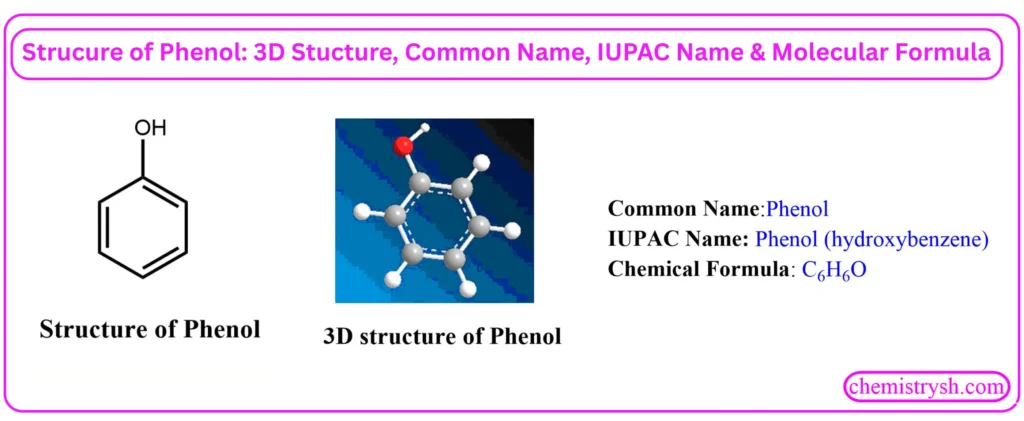
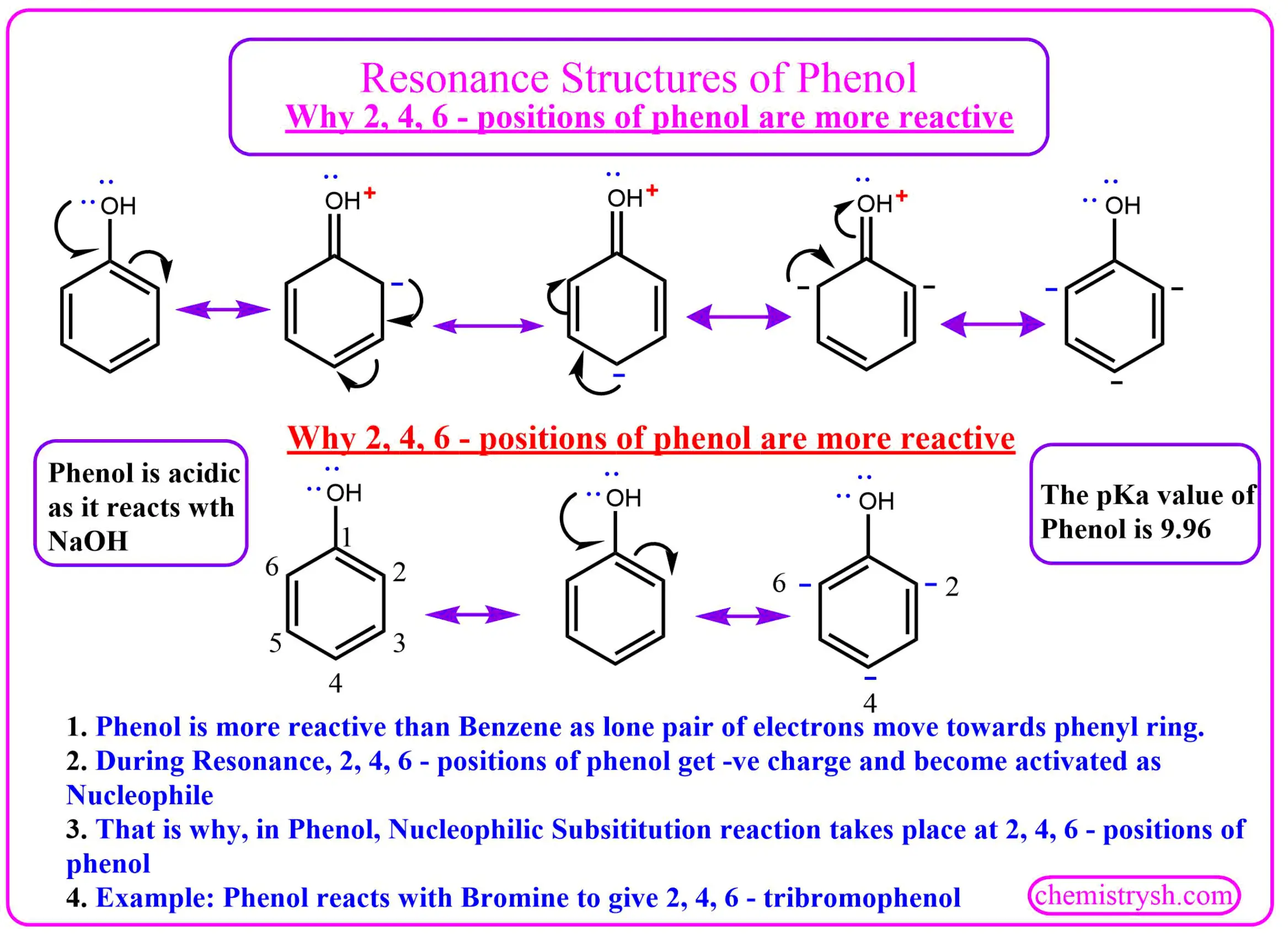
Phenol’s hydroxyl group is bonded directly to the benzene ring, forming the phenol functional group. This ring carries six carbon positions, numbered from the OH-bearing carbon, which determine exactly where the ring can react.
Resonance: Locating the Reactive Positions
The oxygen’s lone pair delocalises into the ring through resonance, concentrating electron density specifically at the ortho and para positions — carbons 2, 4, and 6. These become the ring’s most electron-rich, most reactive sites.
Setting Up the Confirmation (phenol react with bromine water)
- Resonance predicts that positions 2, 4, and 6 in phenol are more reactive.
- The Bromine Water Test confirms this prediction in the laboratory.
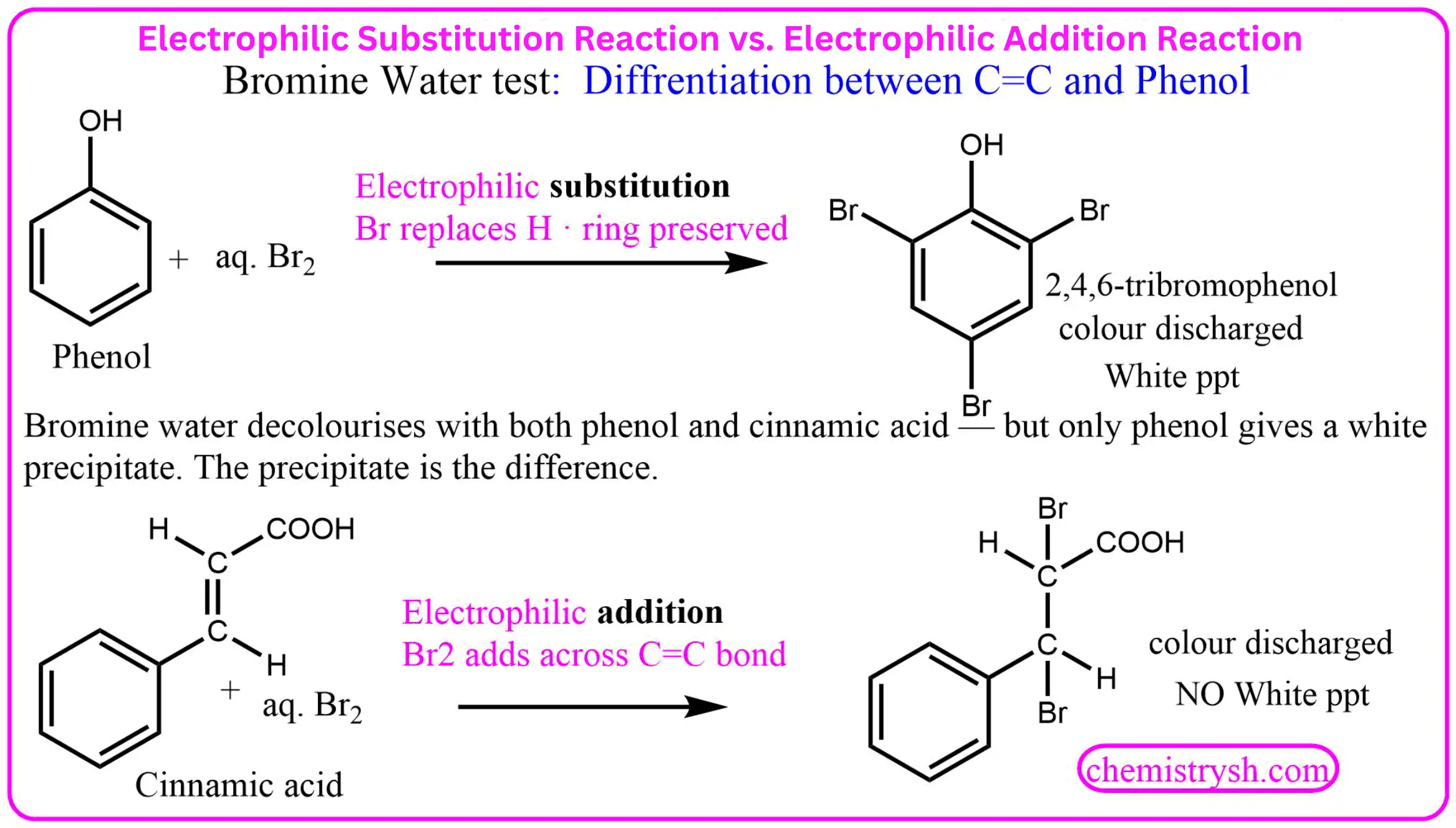
The full procedure — reagents, method, and observed result — is given in the Bromine Water Test section below.
Acidity of Phenol: Is Phenol Acidic or Basic? (Litmus, NaOH & NaHCO₃ Solubility Tests)
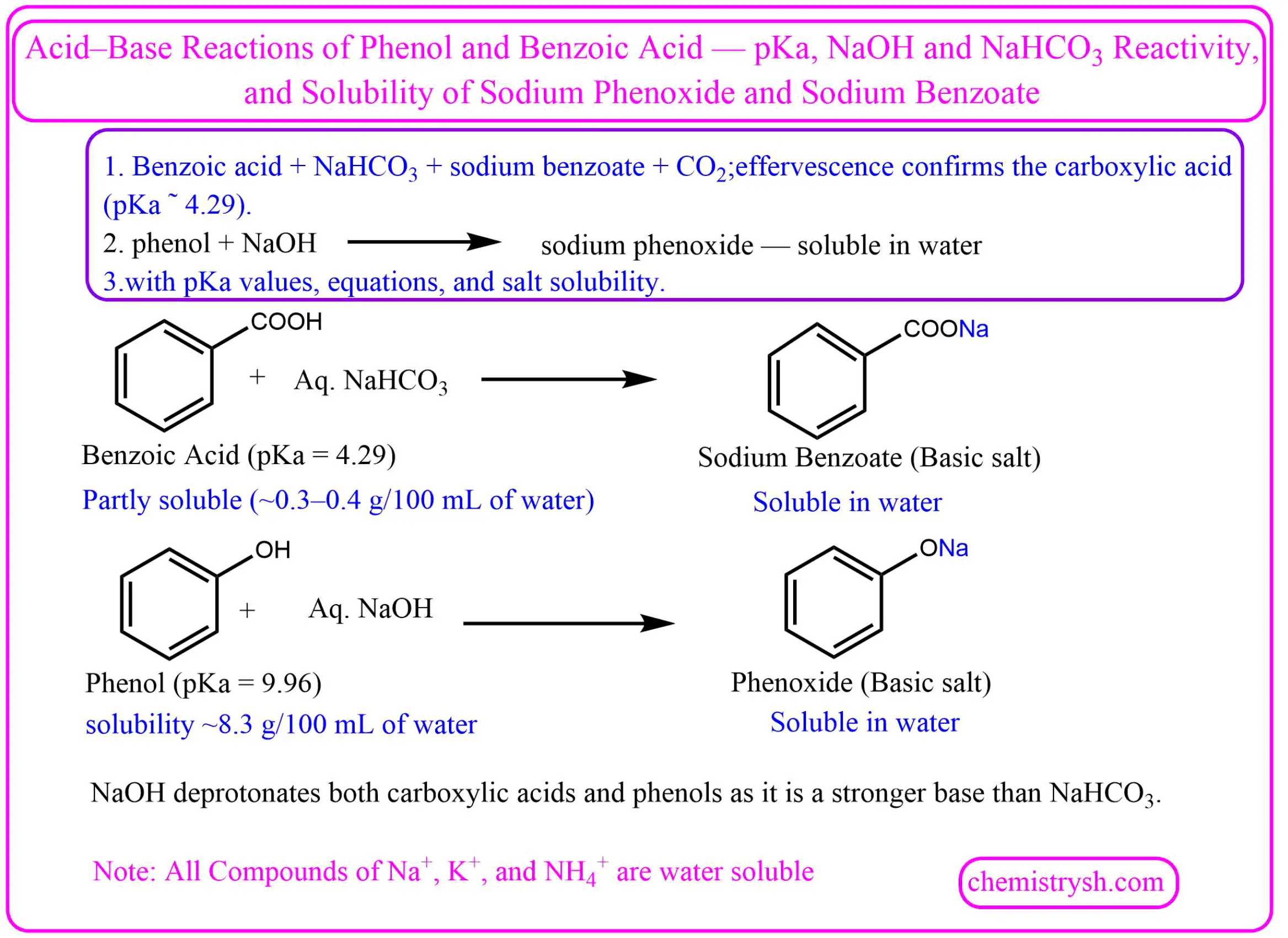
Phenol is weakly acidic — stronger than ordinary alcohols (pKa 15.5–16) but weaker than carboxylic acids (pKa ≈ 5). Its pKa (≈ 9.95) reflects resonance stabilisation of the phenoxide ion, where the negative charge delocalises into the ring; alkoxide ions from alcohols lack this stabilisation, which is why alcohols are far less acidic.
This acidity is strong enough for phenol to dissolve in NaOH, forming sodium phenoxide, but too weak to react with NaHCO₃ — the basis of the three tests below. This NaOH/NaHCO₃ pair is the standard way to distinguish phenol from carboxylic acids, which dissolve in both and only carboxylic acids release CO₂ gas with NaHCO₃, phenol does not react with sodium bicarbonate.
|
Test |
Reagent |
Procedure |
Positive Observation |
Inference |
|---|---|---|---|---|
|
Litmus Test |
Moist blue litmus paper |
Place a drop of the sample (or a small crystal) on the paper |
Blue litmus turns red |
Confirms weak acidity; carboxylic acids give the same result, so this test alone doesn’t distinguish the two |
|
Solubility in NaOH |
Aqueous NaOH |
Add the sample to aqueous NaOH solution |
Sample dissolves, forming sodium phenoxide |
Confirms phenol is acidic enough to react with a strong base. Combined with the negative NaHCO₃ result above, this is the standard pair used to distinguish phenols from carboxylic acids — carboxylic acids dissolve in BOTH NaOH and NaHCO₃, releasing CO₂ with the latter |
|
Sodium Bicarbonate (NaHCO₃) Test |
Aqueous NaHCO₃ |
Add the sample to aqueous NaHCO₃ solution |
No effervescence (no CO₂ gas) |
Negative result distinguishes phenol from carboxylic acids, which effervesce with NaHCO₃ |
Ferric Chloride Test (Phenol + FeCl₃)
Phenol with FeCl₃ (neutral aqueous ferric chloride) gives a violet colour — one of the most specific confirmatory tests for the phenolic group, since alcohols and carboxylic acids don’t produce this ferric phenolate complex.
|
Test |
Reagent |
Procedure |
Positive Observation |
Inference |
|---|---|---|---|---|
|
Neutral Ferric Chloride (FeCl₃) Test |
Neutral aqueous FeCl₃ (prepared by adding dilute NaOH to FeCl₃ dropwise until a faint permanent precipitate persists) |
Warm the sample with a few drops of neutral aqueous FeCl₃ |
Violet colouration |
Confirms phenolic –OH via ferric phenolate complex formation |
Bromine Water Test (Phenol Reacts with Bromine Water)
Phenol reacts with bromine water, discharging the Br₂ colour and forming a white 2,4,6-tribromophenol precipitate — no catalyst needed, unlike benzene. This bromine water reaction confirms all three ring positions activated in above discussion.
|
Test |
Reagent |
Procedure |
Positive Observation |
Inference |
|---|---|---|---|---|
|
Bromine Water Test |
Bromine water (Br₂/H₂O) |
Add bromine water dropwise to an aqueous solution of the sample |
Branch 1: Bromine colour discharged AND white precipitate forms — 2,4,6-tribromophenol (m.p. ≈ 95 °C). Branch 2: Bromine colour discharged but NO white precipitate forms. |
Branch 1 confirms phenol — ring activated toward electrophilic substitution by –OH. Branch 2 indicates a C=C double bond — this branch pair distinguishes phenols from alkenes. |
Phthalein (Dye) Test (Fluorescein Test)
The phenol H₂SO₄ condensation with phthalic anhydride — the Phthalein (Dye) Test, also known as the Fluorescein Test — forms phenolphthalein, the same dye used as a pH indicator. Excess NaOH added to the cooled product gives a pink/red colouration confirming phenol specifically; other phenols capable of this condensation, such as resorcinol, instead give a green fluorescence (fluorescein formation).
|
Test |
Reagent |
Procedure |
Positive Observation |
Inference |
|---|---|---|---|---|
|
Phthalein (Dye) Test (Fluorescein Test) |
Phthalic anhydride, concentrated H₂SO₄, excess NaOH (for confirmation step) |
Fuse 0.2 g compound with 0.2 g phthalic anhydride, moistened with 2 drops conc. H₂SO₄, for ~1 min. Cool, then add excess 10% NaOH. |
In the case of phenol, a pink/red colouration develops (phenolphthalein formation). Other phenols capable of this condensation (e.g., resorcinol) may instead give a green fluorescence (fluorescein formation). |
Confirms formation of phenolphthalein (the same dye used as a pH indicator), specific to phenols capable of condensing with phthalic anhydride; other phenols yield related dyes |
Liebermann’s Test & Azo-Dye Test
Two further confirmatory reactions round out the phenol test panel. Liebermann’s Test forms a nitrosophenol with sodium nitrite and concentrated H₂SO₄, giving an immediate blue colouration that turns red on dilution with water and green, blue, or violet on adding excess NaOH. The Azo-Dye Test couples phenol with a cold diazonium salt in dilute NaOH, producing an orange-red azo dye at the ring’s para position.
|
Test |
Reagent |
Procedure |
Positive Observation |
Inference |
|---|---|---|---|---|
|
Liebermann’s (Nitroso) Test |
Phthalic anhydride, Sodium nitrite (NaNO₂), concentrated H₂SO₄; water and NaOH for the follow-up stepH₂SO₄, excess NaOH (for confirmation step) |
Dissolve 0.2 g of the substance in 2 mL concentrated H₂SO₄ and add a few crystals of NaNO₂ |
A blue colouration develops immediately, which turns red on dilution with water. On adding NaOH in excess, the colour changes to green, blue, or violet |
Confirms phenolic –OH via nitrosophenol tautomer formation. Only phenols possessing a free para position respond to this test. Among dihydroxyphenols, only resorcinol gives a satisfactory positive test |
|
Azo-Dye (Coupling) Test |
A diazonium salt (e.g. benzenediazonium chloride), dilute NaOH |
Add the cold diazonium salt solution (prepared and kept at 0–5 °C) to the sample dissolved in cold dilute NaOH, with shaking |
Formation of an orange-to-red azo dye precipitate |
Confirms phenol as the coupling component in azo-dye formation; reaction occurs at the para position |
Derivative (Phenyl Urethane)
Phenol derivatives offer a final sharp check: reacting phenol with phenyl isocyanate forms phenyl urethane, a white solid melting at ≈126 °C, confirmed against literature or an authentic sample.
|
Test |
Reagent |
Procedure |
Positive Observation |
Inference |
|---|---|---|---|---|
|
Phenyl Urethane Derivative |
Phenyl isocyanate |
React the sample with phenyl isocyanate under standard derivative-preparation conditions |
White crystalline solid, m.p. ≈ 126 °C |
Sharp melting point used for final confirmatory identification and comparison against literature/authentic sample |
Bromo Derivative (2,4,6-Tribromophenol)
The white precipitate of 2,4,6-tribromophenol obtained from the bromine water test may be collected by filtration, washed, and dried. Its melting point (≈ 95 °C), confirmed against literature or an authentic sample, provides an independent physical checkpoint for phenol identity.
|
Test |
Reagent |
Procedure |
Positive Observation |
Inference |
|---|---|---|---|---|
|
Bromo Derivative (2,4,6-Tribromophenol) |
Bromine water (Br₂/H₂O) |
Collect the white precipitate from the bromine water test by filtration; wash and dry; determine the melting point |
White crystalline solid, m.p. ≈ 95 °C |
Independent physical checkpoint; m.p. confirmed against literature or authentic sample provides additional identity verification |
Results and Discussion: Qualitative Identification of Phenol
Acidic Character and Exclusion of Carboxylic Acid
The litmus paper turned red, indicating that the compound is acidic. Its acidic character was further confirmed by solubility in NaOH, where the compound dissolved readily forming a sodium salt. The sodium bicarbonate test (carboxylic acid excluded) produced no effervescence, ruling out a carboxylic acid and establishing that the acidic group is phenolic.
Confirmation of Phenolic Class
The ferric chloride test produced a violet colouration, confirming the presence of a phenolic –OH group through ferric phenolate complex formation. The bromine water test discharged the bromine colour and produced a white precipitate of 2,4,6-tribromophenol, confirming electrophilic substitution at the ortho and para positions — behaviour characteristic of the phenol class. The ignition test (aromatic character confirmed) showed a luminous sooty flame, consistent with the presence of a benzene ring.
Identification of the Specific Compound as Phenol
The phthalein test produced a pink colouration in alkaline medium, confirming formation of phenolphthalein and identifying the compound as phenol specifically within the phenol class. The melting point of the compound was recorded at 40–41 °C, consistent with the literature value for phenol. The phenyl urethane derivative melted sharply at ≈ 126 °C, and no depression was observed on mixed melting point with an authentic sample, providing definitive physical confirmation that the compound is phenol.
Conclusion
The compound is acidic (litmus paper; NaOH solubility) and not a carboxylic acid (sodium bicarbonate test — negative). It possesses an activated aromatic system, giving a white precipitate with bromine water (bromine water test — positive; 2,4,6-tribromophenol, m.p. ≈ 95 °C). A violet colouration with ferric chloride (FeCl₃ test — positive) confirms the phenolic –OH group. The melting point (40–41 °C) is consistent with literature, and the phenyl urethane derivative (m.p. ≈ 126 °C) showed no depression on mixed melting point with an authentic sample. The given compound is therefore identified as phenol.
Applications — One Test Panel, Every Phenol
You’ve just learned to identify phenol using eight tests. Here’s the useful part: the same panel works across the whole phenol class — catechol, resorcinol, α-naphthol, and β-naphthol all share phenol’s defining feature, an aromatic-ring–OH bond — so they respond to the same tests, though the exact colour or precipitate can shift from compound to compound.
A Real Lab Problem 1 : Can You Identify This Unknown Phenol from Its Chemical Test Results provided?
An unlabeled phenolic compound is tested and gives the following results:
A Real Lab Problem 2 : Can You Identify This Unknown Phenol from Its Chemical Test Results provided?
A second unknown phenolic compound gives the same first four results as above, but a different colour with ferric chloride:
A Catch Worth Knowing
Not every phenol pair separates this easily. Resorcinol actually gives the same violet/blue colour as phenol with FeCl₃ — so if two unknowns gave matching FeCl₃ results, you would need a different tiebreaker, such as the melting point of a solid derivative, to tell them apart. The FeCl₃ test is powerful, but it isn’t universal — real identification sometimes needs a second confirmatory test. Note also that β-naphthol is sparingly soluble in water and must be dissolved in ethanol before the FeCl₃ test is performed.
Key Terms and Definitions Used in the Qualitative Identification of Phenol
The glossary below defines ten essential chemistry terms behind the qualitative identification of phenol — covering activated aromatic systems, resonance stabilisation, electrophilic aromatic substitution, conjugation, delocalisation, ferric phenolate complex formation, nitrosophenol tautomerism, diazonium salt chemistry, pKa, and the mixed melting point test. Each term is explained with a concise definition and a real example drawn directly from phenol chemistry, giving students the precise vocabulary needed for viva examinations, practical assessments, and organic analysis.
Activated Aromatic System
An aromatic ring made significantly more reactive toward electrophilic attack by the presence of an electron-donating group directly attached to the ring. Example: In phenol, the –OH group donates electron density into the ring, activating the ortho and para positions — this is why bromine water substitutes at three positions simultaneously without a catalyst. In aniline, the –NH₂ group plays the same activating role.
Resonance Stabilisation
The reduction in energy of a molecule or ion due to delocalisation of electrons across multiple atoms through overlapping p-orbitals. Example: In the phenoxide ion, the negative charge does not remain on oxygen alone — it delocalises into the benzene ring at the ortho and para positions, making phenol a stronger acid than alcohols such as ethanol.
Electrophilic Aromatic Substitution
A reaction in which an electrophile replaces a hydrogen atom on an aromatic ring, while the ring retains its aromaticity. Example: In the bromine water test, Br₂ acts as the electrophile and substitutes at positions 2, 4, and 6 of the phenol ring simultaneously, giving 2,4,6-tribromophenol — no Lewis acid catalyst is needed because the ring is already activated by the –OH group.
Conjugation
The direct overlap of a lone pair or π-bond with the aromatic π-system, creating an extended electron network across multiple atoms. Example: In phenol, the oxygen lone pair of the –OH group is conjugated with the benzene ring — this is why the phenolic –OH is more acidic than an alcohol –OH, which sits on a non-conjugated sp³ carbon and has no such overlap.
Delocalisation
The spreading of electron density across more than two atoms, rather than being confined between just two atoms in a single bond. Example: In the phenoxide ion, the negative charge is delocalised across the oxygen and the ortho and para ring carbons — this delocalisation is what the resonance structures of phenol illustrate, and it is the reason phenol dissolves in NaOH.
Ferric Phenolate Complex
The coloured coordination complex formed when a phenolic compound reacts with neutral ferric chloride (FeCl₃), producing a characteristic colour used as a fingerprint for identification. Example: Phenol gives a violet ferric phenolate complex; catechol gives green; β-naphthol gives purple — each colour is a diagnostic fingerprint for that specific phenolic compound.
Nitrosophenol Tautomer
One of two interconverting structural forms of the product in Liebermann’s Test — the nitroso form and the oxime form existing in equilibrium, responsible for the characteristic colour changes observed. Example: In Liebermann’s Test on phenol, nitrosophenol forms first in concentrated H₂SO₄ giving a blue colour; on dilution with water it turns red; on adding excess NaOH the colour shifts to green, blue, or violet — each change reflects a shift in the tautomeric equilibrium with changing pH.
Diazonium Salt
A highly reactive organic compound containing the –N≡N⁺ group, prepared at 0–5 °C and used immediately because it decomposes rapidly at higher temperatures. Example: In the azo-dye test, benzenediazonium chloride is prepared at 0–5 °C and coupled with phenol dissolved in cold dilute NaOH to produce an orange-red azo dye precipitate — the reaction occurs at the para position of the phenol ring.
pKa
A numerical measure of acid strength — the negative logarithm of the acid dissociation constant. A lower pKa value indicates a stronger acid. Example: Acetic acid (pKa ≈ 4.76) is a stronger acid than phenol (pKa ≈ 9.95), which is in turn stronger than ethanol (pKa ≈ 15.9). This order directly explains why phenol dissolves in NaOH but does not react with NaHCO₃, while acetic acid dissolves in both and releases CO₂ with NaHCO₃.
Mixed Melting Point
A technique used to confirm the identity of an organic solid by mixing it with an authentic sample of the suspected compound and determining the melting point of the mixture. Method: Mix equal quantities of the unknown solid and the authentic reference compound; determine the melting point of the mixture. If both compounds are identical, the melting point remains unchanged — no depression is observed. If they are different compounds, the melting point of the mixture is depressed below that of either component alone — this depression is the diagnostic signal. Example: If the phenyl urethane derivative (m.p. ≈ 126 °C) shows no depression when mixed with authentic phenyl urethane, the identity of the compound as phenol is definitively confirmed.
FAQs
Multiple Choice Questions
MCQ 1
1. Given phenol’s aromatic ring–OH structure, its approximate molar mass is:
A. 78 g/mol
B. 94 g/mol
C. 108 g/mol
D. 122 g/mol
MCQ 2
2. Phenol’s molecular formula, C₆H₆O, corresponds to a density at room temperature closest to
A. 0.79 g/cm³
B. 1.90 g/cm³
C. 1.07 g/cm³
D. 1.49 g/cm³
MCQ 3
3. . Resonance stabilisation of the phenoxide ion explains why phenol is more acidic than:
A. Carboxylic acids
B. Cyclohexanol
C. Water
D. Hydrochloric acid
MCQ 4
4. Because its –OH group donates electron density into the ring by resonance, phenol is significantly more reactive toward electrophilic substitution than:
A. Cyclohexanol
B. Benzene
C. Water
D. Ethanol
MCQ 5
5. The –OH functional group in phenol sits on a ring carbon with hybridisation:
A. sp
B. sp²
C. sp³
D. sp³d
MCQ 6
6. Phenol’s resonance-driven bromination readily occurs without a catalyst, while its controlled oxidation instead yields:
A. A quinone-type product
B. Benzene
C. A carboxylic acid directly
D. No reaction
MCQ 7
7. A substance boiling at 181.7 °C with a sharp, medicinal odour is most likely:
A. Acetone
B. Benzoic acid
C. Phenol
D. Ethanol
MCQ 8
8. A colourless solid that turns violet with FeCl₃ and develops a pink tinge on exposure to light is:
A. Benzoic acid
B. Phenol
C. Cyclohexanol
D. Aniline
MCQ 9
9. Phenol’s weak acidity is consistent with its limited solubility in water, which is approximately:
A. Fully miscible
B. ~8.3 g per 100 mL
C. Insoluble
D. Soluble only in acid
MCQ 10
10. The phenyl urethane derivative (used to confirm phenol’s identity) contributes a molecular mass increment consistent with phenol’s own mass of approximately:
A. 78 g/mol
B. 122 g/mol
C. 94 g/mol
D. 108 g/mol
MCQ 11
11. The chemical formula that defines phenol is:
A. C₆H₅OH
B. C₆H₅CH₃
C. C₆H₅NH₂
D. C₆H₅Cl
MCQ 12
12. Beyond laboratory identification, phenol’s industrial uses (resins, disinfectants) trace back to which core property?
A. High volatility
B. Resonance-stabilised weak acidity
C. Basicity
D. Chemical inertness
MCQ 13
13. The structural formula of phenol, consistent with its general formula, is best written as:
A. C₆H₅–OH
B. C₆H₁₁–OH
C. CH₃–C₆H₄–OH
D. 1C₆H₅–O–CH₃
MCQ 14
14. The chemical formula that defines phenol is:
A. Strongly basic
B. Slightly acidic, consistent with its limited solubility in water
C. Neutral
D. Strongly acidic
MCQ 15
15. As a chemical, the phenol–water system at varying temperatures shows:
A. Complete immiscibility at all temperatures
B. Partial miscibility with a critical solution temperature
C. Complete miscibility at all temperatures
D. No interaction
MCQ 16
16. Exhaustive nitration converts phenol to picric acid, whose acidity is far greater than phenol’s; by comparison, is phenol a stronger or weaker acid than cresol?
A. Phenol is generally stronger
B. Cresol is generally stronger
C. They are equal
D. Not comparable
MCQ 17
17. Considering what phenol is mainly used for and what it is used for industrially, its largest-scale application is manufacture of:
A. Bakelite (phenol-formaldehyde resin) and disinfectants
B.Food preservatives only
C. Fuel additives only
D. Textile dyes only
MCQ 18
18. Phenol can be converted to aniline via a multi-step pathway; industrially, phenol itself is most commonly prepared from benzene via:
A. The cumene process
B. Direct chlorination
C. The Wacker process
D. The Haber process
MCQ 19
19. Considering phenol–benzene reactivity, treating phenol with concentrated HNO₃ (unlike dilute HNO₃) tends to cause:
A. Clean mono-nitration only
B. Oxidative decomposition/tarring alongside nitration
C. No reaction
D. Reduction to benzene
MCQ 20
20. Since phenol’s structure contributes only one acidic proton, its equivalent weight in acid-base titrations equals its full molecular weight of:
A. 94 g/mol
B.47 g/mol
C. 188 g/mol
D. 31 g/mol
Practice: Complete the Summary Tabe
Using the tests and observations described throughout this article, fill in the Positive Observation and Confirms columns for each test below.
|
Test |
Positive Observation |
Confirms |
|---|---|---|
|
Solubility Test (Water & Ethanol) |
||
|
Ignition Test |
||
|
Litmus Test |
||
|
Solubility in NaOH |
||
|
NaHCO₃ Test |
||
|
Ferric Chloride Test |
||
|
Bromine Water Test |
||
|
Phthalein (Dye) Test (Fluorescein Test) |
||
|
Liebermann’s Test |
||
|
Azo-Dye Test |
||
|
Derivative (Phenyl Urethane) |