
What is Soap?
Soap is a widely used cleansing agent in daily life. Chemically, it is the sodium or potassium salt of long-chain carboxylic acids, also known as fatty acids. Since sodium and potassium carboxylates are water-soluble, soaps dissolve easily in water and become effective for cleaning.
Key points about soap:
Solubility of Soap in Water
The solubility of soap is essential for its cleansing action. When soap is added to water, it dissociates into sodium or potassium ions and carboxylate ions (RCOO⁻). This ionic nature allows soap molecules to disperse uniformly and come into close contact with dirt particles.
Key points about soap:
Structure of Soap Molecule
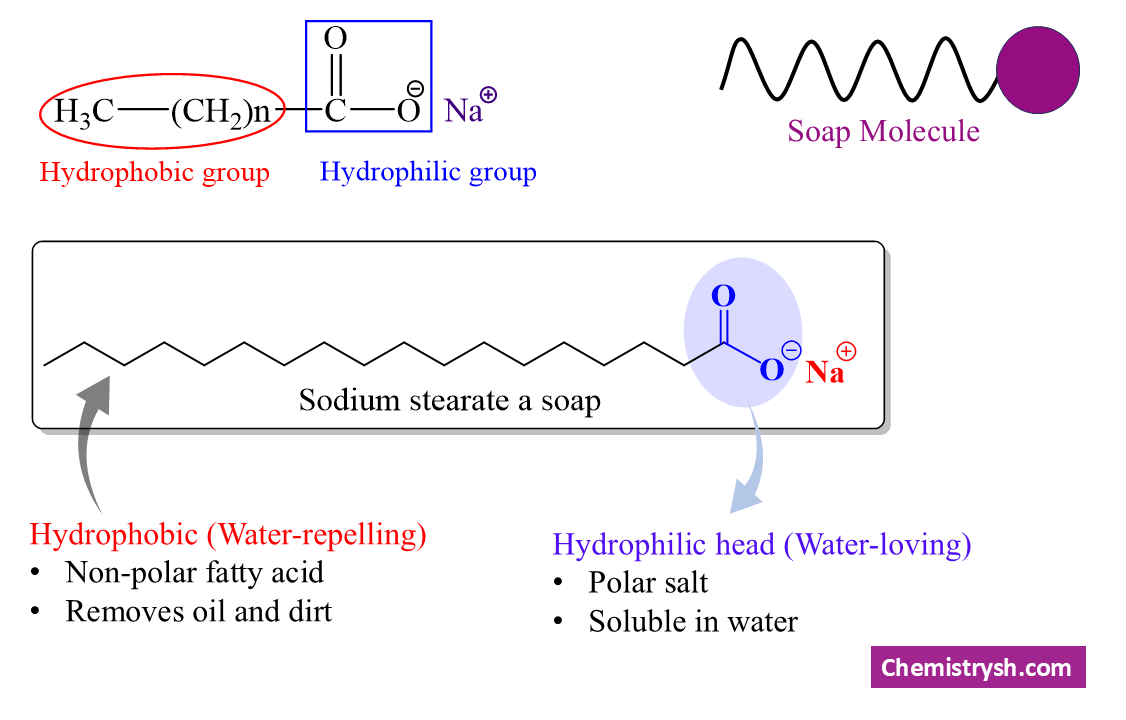
A soap molecule has an amphiphilic character, containing both hydrophilic and hydrophobic regions. This dual nature allows it to interact with water and oily substances, making it an effective cleansing agent.
A. Hydrophilic (water-loving) head:
The head contains the carboxylate group (–COO⁻), which is polar and soluble in water, allowing interaction with polar substances.
B. Hydrophobic (water-repelling) tail:
The tail is a long hydrocarbon chain that is non-polar and binds to oil, grease, and other non-polar impurities.
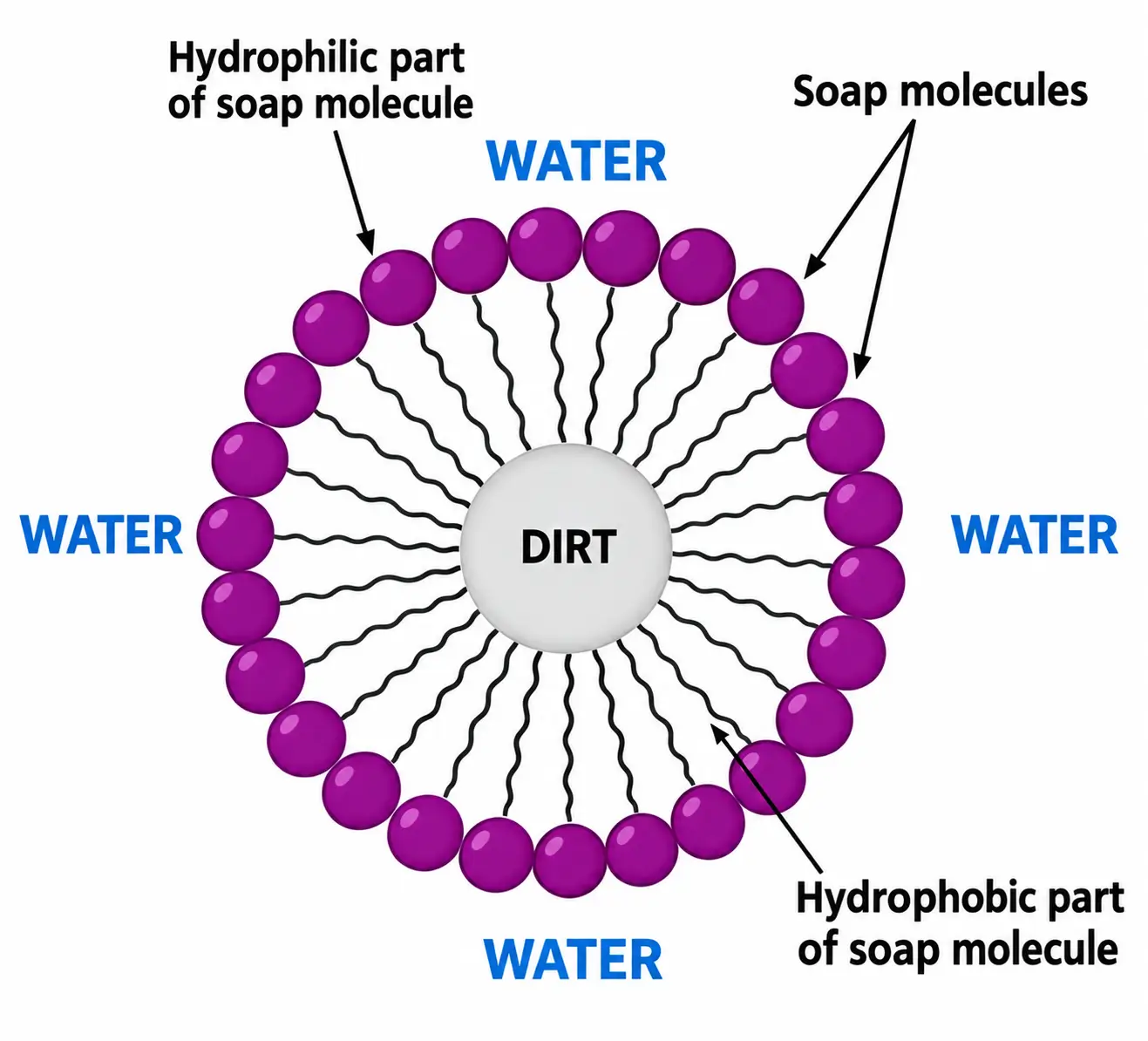
Together, the hydrophilic head and hydrophobic tail form micelles that trap dirt, enabling soap to remove both polar and non-polar impurities efficiently.
Cleansing Action of Soap
Most dirt is oily or greasy, which does not dissolve in water. Soap removes dirt by forming micelles, where the hydrophobic tails attach to grease and oil, and the hydrophilic heads interact with water.
The micelles trap the dirt, including polar impurities such as salts or dust particles, keeping them suspended in water. This allows both polar and non-polar impurities to be easily removed during rinsing, making soap an effective cleansing agent.
Effect of Hard Water on Soap Solubility
The efficiency of soap is affected by the type of water used. Hard water contains calcium (Ca²⁺) and magnesium (Mg²⁺) ions.
Effects in hard water:
- These salts are insoluble in water
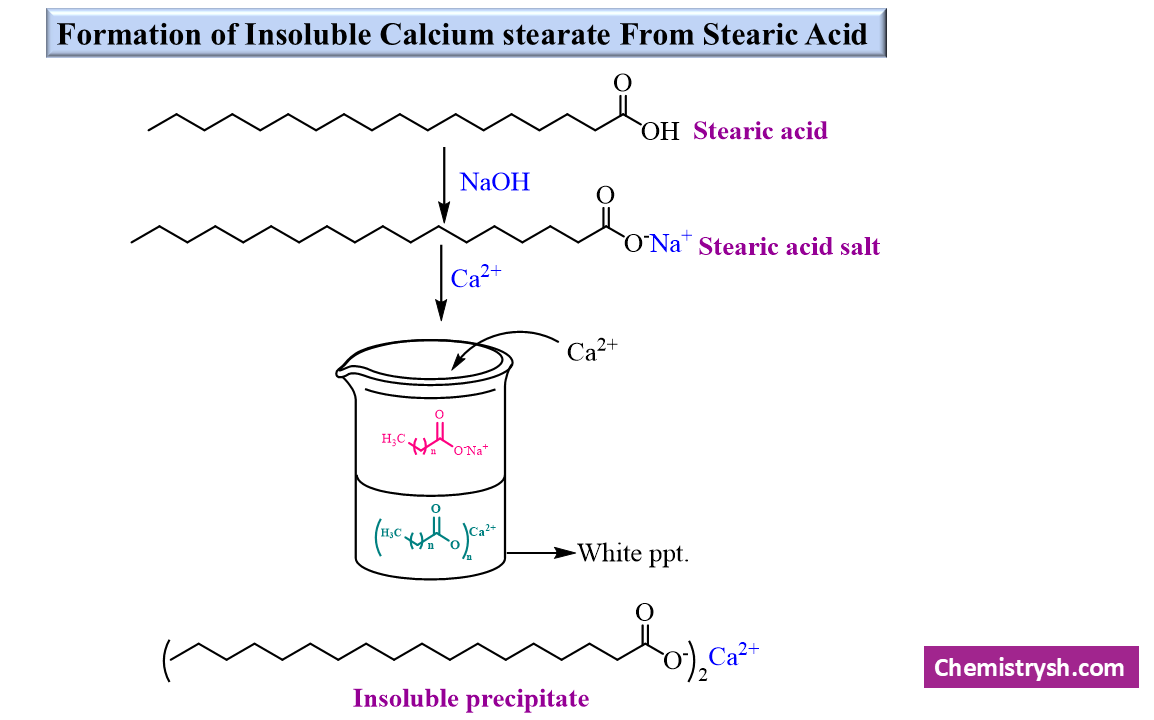
- Sodium and potassium carboxylates react with Ca²⁺ and Mg²⁺
- Form calcium and magnesium carboxylates
Ca2+ + 2C17H35COONa → (C17H35COO)2Ca + 2Na+
Mg2+ + 2C17H35COONa → (C17H35COO)2Mg + 2Na+
Formation of Scum or Curds
Calcium and magnesium carboxylates separate as curdy precipitates or scum, reducing the efficiency of soap.
Effects of scum formation:
- Deposits on fabrics, making them dull and rough
- Poor lather formation
- Reduced cleansing efficiency
Solubility Difference: Sodium vs Calcium Salts
Sodium and potassium carboxylates are highly soluble in water, which allows them to disperse evenly, interact with both polar and non-polar impurities, and form micelles that trap dirt effectively. This solubility makes soaps based on sodium or potassium salts very efficient in soft water, where there are few interfering ions, ensuring good lather formation and effective cleaning.
On the other hand, calcium and magnesium carboxylates are insoluble in water. In hard water, the sodium or potassium salts react with Ca²⁺ and Mg²⁺ ions to form insoluble precipitates known as soap scum, which reduces the number of active soap molecules and decreases cleansing efficiency. This explains why soap works poorly in hard water and why detergents, which do not form insoluble salts with calcium or magnesium, are preferred in such conditions.
Use of Soap and Carboxylate Salts for Identification of Carboxylic Acids
The behavior of soap in hard water can also be applied to identify aliphatic carboxylic acids in organic chemistry.
Key points:
- When aliphatic carboxylic acids are treated with calcium chloride, they form a white precipitate of calcium salts.
- Similarly, when soap is added to hard water, the sodium or potassium carboxylates react with Ca²⁺ or Mg²⁺ ions to produce white curdy precipitates.
- This demonstrates that the formation of insoluble calcium carboxylates can be used as a qualitative test to identify carboxylic acids.
Examples:
Differences in precipitation and solubility help in the identification and confirmation of carboxylic acids.
Oxalic acid, citric acid, and tartaric acid form calcium carboxylates in laboratory tests.
Summary:
- The white PPT formation observed with soap in hard water is analogous to the reaction of aliphatic carboxylic acids with calcium salts.
- Both reactions can be used for qualitative identification of carboxylic acids in organic chemistry.
Importance of Soap Solubility in Daily Life
Good soap solubility ensures effective cleaning, easy rinsing, and uniform distribution of the soap on surfaces or skin.
It also explains:
Why detergents are preferred in hard water
Answer: Hard water contains high amounts of calcium and magnesium ions, which react with soap to form insoluble scum. Detergents, however, are designed to remain soluble in hard water, making them more effective for cleaning.
Why soap works best in soft water
Answer: Soft water contains very few calcium and magnesium ions, so soap can dissolve easily, form lather, and clean effectively without forming scum.
Multiple Choice Questions
MCQ 1
1. Soap molecules are generally the sodium or potassium salts of:
A.Short‑chain carboxylic acids
B. Long‑chain carboxylic acids
C. Amino acids
D. Alcohols
MCQ 2
2. The main reason soap does not work efficiently in hard water is:
A. It forms more lather
B. It reacts to form an insoluble precipitate
C. It becomes acidic
D. It dissolves completely
MCQ 3
3. Which ions in hard water react with soap to form curdy precipitates?
A. Na⁺ and K⁺
B. Ca²⁺ and Mg²⁺
C. Cl⁻ and NO₃⁻
D. H⁺ and OH⁻
MCQ 4
4. When soap reacts with Ca²⁺ ions in hard water, the product formed is:
A. Calcium stearate precipitate
B. Potassium chloride
C. Sodium carbonate solution
D. Fatty acid solution
MCQ 5
5. Detergents are preferred over soaps in hard water because:
A. They produce scum
B. They form micelles slowly
C. They do not form insoluble precipitates with Ca²⁺ and Mg²⁺
D. They precipitate carboxylates
MCQ 6
6. The formation of a white precipitate on treating a sample with calcium chloride indicates the presence of:
A.Alkenes
B. Alkanols
C. Carboxylic acids
D. Aldehydes
FAQ’s
References
- Lucassen, J. (1966). Hydrolysis and precipitates in carboxylate soap solutions. Journal of Physical Chemistry Chemical Physics, 14(20), 7517–7527.
- Pereira, R. F. P., Valente, A. J. M., Fernandes, M., & Burrows, H. D. (2012). What drives the precipitation of long‑chain calcium carboxylates (soaps) in aqueous solution? Physical Chemistry Chemical Physics, 14(20), 7517–7527.
- Reusch, W. (n.d.). Application of solubility: Soaps. In MCC Organic Chemistry. SUNY–MCC Virtual Textbook.