
Solubility of Organic Compounds
Solubility is the ability of an organic compound to dissolve in a solvent. In qualitative organic analysis, a systematic series of reagents — water, NaOH, NaHCO₃, HCl, and concentrated H₂SO₄ — is applied in sequence to classify an unknown compound as polar or non-polar, and as acidic, basic, or neutral in nature. The complete scheme is described in the six tests below.
Classification of Organic Compounds as Acidic, Basic, or Neutral on the Basis of Solubility
Organic compounds can be systematically classified as acidic, basic, or neutral by observing their solubility behaviour in water and selected chemical reagents. The following scheme is applied:
Water Solubility Test
The water solubility test is the first and most fundamental step in the systematic identification of organic compounds. It determines the polar or non-polar nature of an unknown compound on the basis of its ability to dissolve in water.
Procedure
1. Take a small amount of the sample — approximately 0.1 g if solid or 2–3 drops if liquid — in a clean test tube.
2. Add 2–3 mL of distilled water as the solvent.
3. Shake the test tube vigorously for 1–2 minutes at room temperature.
4. Observe whether the compound dissolves completely, partially, or not at all.
Observation
1. If the compound dissolves completely and the solution appears clear and homogeneous → compound is completely soluble in water.
2. If the compound dissolves partially and the solution appears turbid or two separate layers are visible → compound is partially soluble in water.
3. If the compound does not dissolve at all and remains as a separate layer or solid at the bottom → compound is insoluble in water.
4. Note any additional changes such as heat evolution, colour change, or gas evolution on mixing.
Inference
1. Completely soluble in water → compound is polar in nature; a polar functional group such as –OH, –COOH, or –NH₂ is present (e.g. ethanol, acetic acid, methylamine, glucose).
2. Partially soluble in water → compound possesses both a polar and a non-polar part; the polar functional group is present but the non-polar part reduces water solubility (e.g. butanol, diethyl ether). In diethyl ether, the oxygen atom provides lone pairs that form weak hydrogen bonds with water, giving it partial solubility despite its predominantly non-polar ethyl groups.
3. Insoluble in water → compound is non-polar in nature; the polar functional group is absent (e.g. benzene, hexane, chloroform).
4. General rule: like dissolves like — polar compounds dissolve in polar solvents and non-polar compounds dissolve in non-polar solvents.
5. Even polar compounds become increasingly insoluble as the carbon chain length increases, because the non-polar part of the molecule dominates over the polar functional group.
Examples:
|
Compound |
Formula |
Solubility in Water |
Nature |
|
Ethanol |
C₂H₅OH |
Completely soluble |
Polar |
|
Acetic acid |
CH₃COOH |
Completely soluble |
Polar |
|
Methylamine |
CH₃NH₂ |
Completely soluble |
Polar |
|
Glucose |
C₆H₁₂O₆ |
Completely soluble |
Polar |
|
Acetone |
CH₃COCH₃ |
Completely soluble |
Polar |
|
Butanol |
CH₃COCH₃ |
Partially soluble |
Polar + non-polar |
|
Diethyl ether |
C₂H₅OC₂H₅ |
Partially soluble |
Polar + non-polar |
|
Benzene |
C₆H₆ |
Insoluble |
Non-polar |
|
Hexane |
C₆H₁₄ |
Insoluble |
Non-polar |
|
Chloroform |
CHCl₃ |
Insoluble* |
Polar (aprotic) |
* Chloroform (CHCl₃) is a polar molecule (dipole moment ≈ 1.15 D) but lacks an O–H or N–H group and therefore cannot act as a hydrogen-bond donor with water. Its low water solubility results from the absence of hydrogen-bond donation, not from non-polarity.
Litmus Paper Test for Water-Soluble Compounds
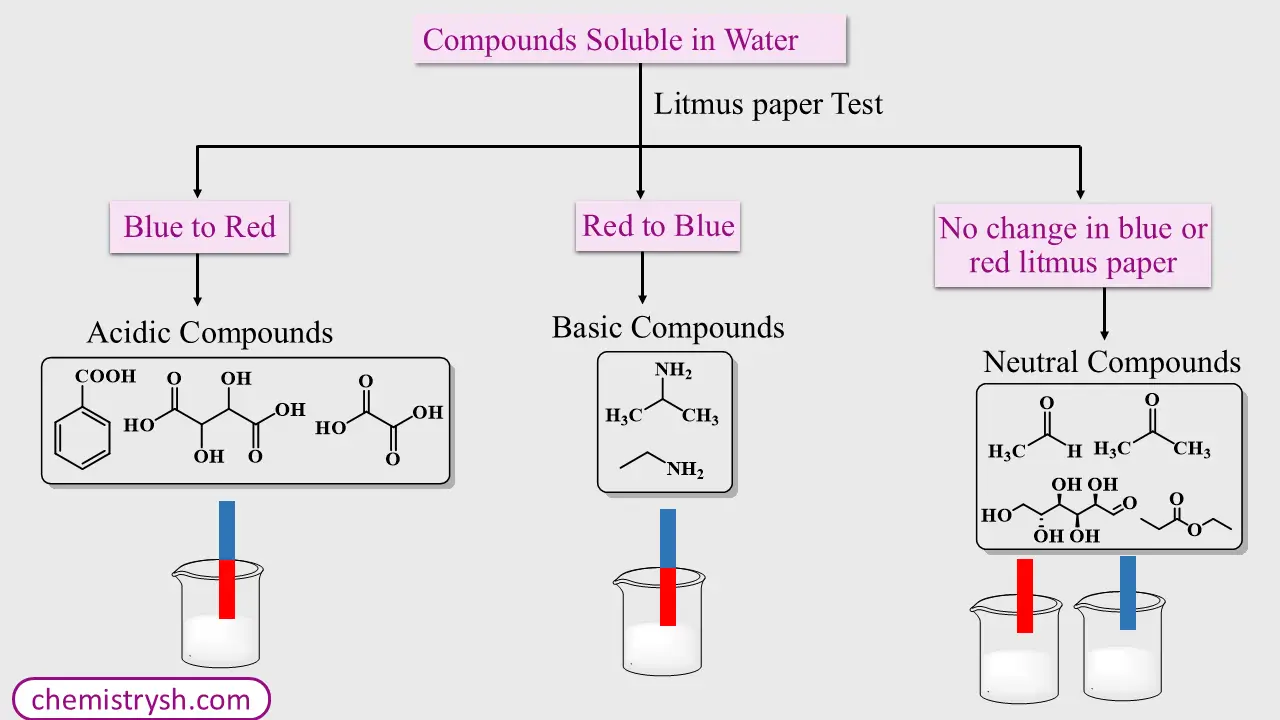
The litmus paper test is applied to compounds that are found to be soluble in water. It is a simple and rapid preliminary test used to classify an unknown organic compound as acidic, basic, or neutral in nature on the basis of its effect on litmus paper.
Procedure
1. Take the aqueous solution of the compound prepared in the water solubility test in a clean test tube.
2. Dip a strip of red litmus paper into the solution and observe any colour change.
3. Dip a strip of blue litmus paper into the solution and observe any colour change.
4. Record the observation and draw the inference accordingly.
Two Types of Litmus Paper and What Each Detects
1. Red litmus paper — detects basic compounds; turns blue in the presence of a basic compound.
2. Blue litmus paper — detects acidic compounds (Benzoic Acid, Acetylsalicylic Acid, Cinnamic Acid); turns red in the presence of an acidic compound.
3. No change in either — indicates the compound is neutral in nature.
A. Red Litmus Paper Changes to Blue
Observation: Red litmus paper changes to blue; blue litmus paper shows no change.
Inference: The compound is basic in nature.
Examples:
|
Compound |
Formula |
Class |
|
Methylamine |
CH₃NH₂ |
Aliphatic amine (1°) |
|
Ethylamine |
C₂H₅NH₂ |
Aliphatic amine (1°) |
|
Diethylamine |
(C₂H₅)₂NH |
Aliphatic amine (2°) |
|
Triethylamine |
(C₂H₅)₃N |
Aliphatic amine (3°) |
|
Butylamine |
C₄H₉NH₂ |
Aliphatic amine (1°) |
|
Aniline* |
C₆H₅NH₂ |
Aromatic amine (1°) |
|
p-Toluidine |
CH₃C₆H₄NH₂ |
Aromatic amine (1°) |
|
Pyridine |
C₅H₅N |
Heterocyclic amine |
* Aniline has limited water solubility (~3.6 g/100 mL at 20°C) and may form a separate oily layer in the water solubility test. In such cases, the litmus paper test may be inconclusive. The dilute HCl solubility test is the more reliable confirmation of its basic nature.
B. Blue Litmus Paper Changes to Red
Observation: Blue litmus paper changes to red; red litmus paper shows no change.
Inference: The compound is acidic in nature.
Examples:
|
Compound |
Formula |
Class |
|
Acetic acid |
CH₃COOH |
Carboxylic acid |
|
Formic acid |
HCOOH |
Carboxylic acid |
|
Oxalic acid |
(COOH)₂ |
Dicarboxylic acid |
|
Benzoic acid |
C₆H₅COOH |
Aromatic carboxylic acid |
|
Salicylic acid* |
C₇H₆O₃ |
Hydroxy acid |
|
Citric acid |
C₆H₈O₇ |
Tricarboxylic acid |
|
Tartaric acid |
C₄H₆O₆ |
Dihydroxy acid |
|
Lactic acid |
C₃H₆O₃ |
Hydroxy acid |
* Salicylic acid contains both –COOH and phenolic –OH functional groups. Its acidic litmus response is primarily due to the –COOH group.
C. No Change in Either Litmus Paper
Observation: No change in red litmus paper; no change in blue litmus paper.
Inference: The compound is neutral in nature.
Examples: Ethanol, glycerol, acetone, acetaldehyde, benzaldehyde, glucose, ethyl acetate and diethyl ether are neutral, as they do not change the colour of either red or blue litmus paper.
|
Compound |
Formula |
Class |
|
Ethanol |
C₂H₅OH |
Alcohol |
|
Glycerol |
C₃H₈O₃ |
Polyhydric alcohol |
|
Acetone |
CH₃COCH₃ |
Ketone |
|
Acetaldehyde |
CH₃CHO |
Aldehyde |
|
Benzaldehyde |
C₆H₅CHO |
Aromatic aldehyde |
|
Glucose |
C₆H₁₂O₆ |
Carbohydrate |
|
Ethyl acetate |
CH₃COOC₂H₅ |
Ester |
|
Diethyl ether |
C₂H₅OC₂H₅ |
Ether |
Special Notes
1. Weakly acidic compounds such as phenols may not give a clear colour change with litmus paper; the NaOH and NaHCO₃ solubility tests are more reliable for these compounds.
2. Aromatic amines such as aniline are very weak bases and have limited water solubility — aniline may appear as a separate oily layer rather than dissolving completely. The litmus paper result may therefore be inconclusive; the dilute HCl solubility test is the more reliable confirmation of basic nature.
3. Both red and blue litmus papers must be tested on every unknown compound — never rely on one litmus paper alone.
Solubility in Dilute NaOH
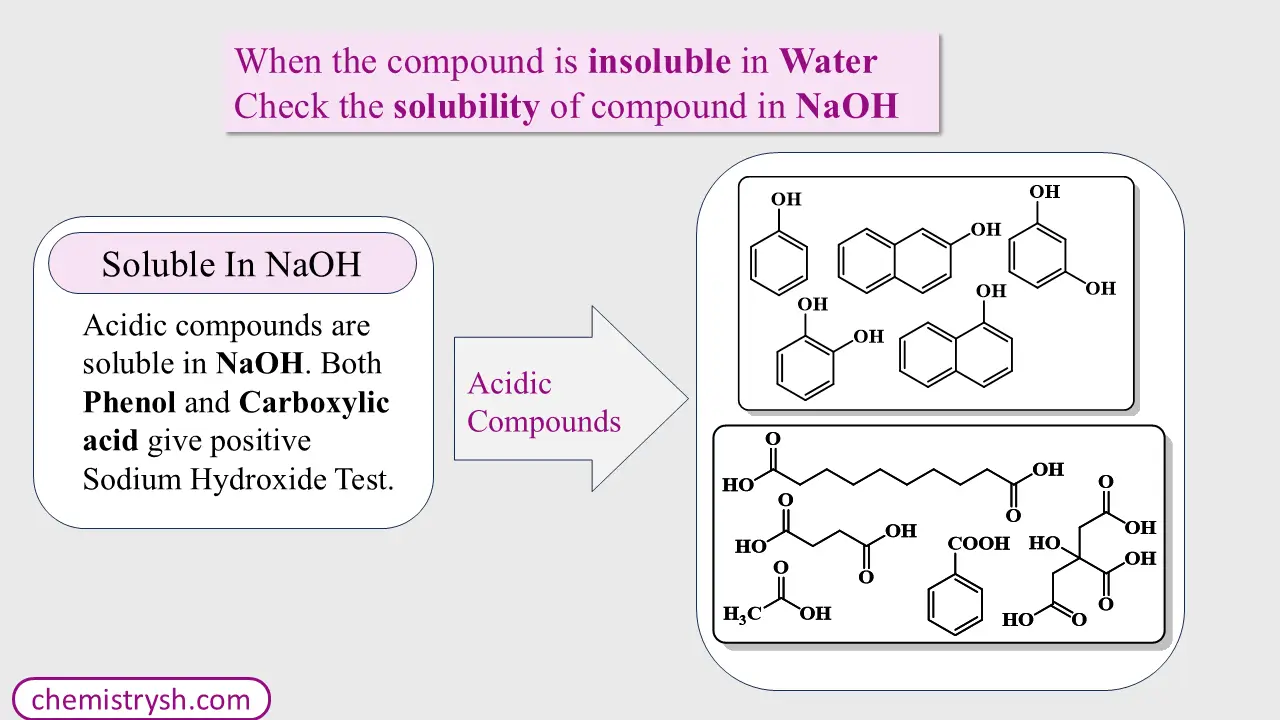
This test is applied to compounds that are insoluble in water. NaOH is a strong base that reacts with acidic compounds to form water-soluble sodium salts, causing them to dissolve. Both strongly acidic compounds (carboxylic acids) and weakly acidic compounds (phenols) dissolve in dilute NaOH.
Procedure
1. Take approximately 0.1 g if solid or 2–3 drops if liquid in a clean test tube.
2. Add 2–3 mL of dilute NaOH solution (5%) to the test tube.
3. Shake the test tube vigorously for 1–2 minutes at room temperature.
4. Observe whether the compound dissolves completely or not at all.
5. If the compound dissolves, it is confirmed as acidic in nature.
Why Acidic Compounds Dissolve in NaOH
1. NaOH is a strong base; it reacts with acidic compounds to form water-soluble sodium salts.
2. The reaction is an acid–base neutralisation — the acidic compound donates H⁺ to the OH⁻ of NaOH.
3. The sodium salt formed is ionic and dissolves readily in water.
4. Three classes dissolve in NaOH:
• Strongly acidic — carboxylic acids (pKa ≈ 4–5)
• Strongly acidic — sulphonic acids (pKa ≈ −1 to 2)
• Weakly acidic — phenols (pKa ≈ 9–10)
Chemical Equations
Carboxylic acids:
RCOOH + NaOH → RCOONa + H₂O
CH₃COOH + NaOH → CH₃COONa + H₂O (acetic acid → sodium acetate)
C₆H₅COOH + NaOH → C₆H₅COONa + H₂O (benzoic acid → sodium benzoate)
(COOH)₂ + 2NaOH → (COONa)₂ + 2H₂O (oxalic acid → sodium oxalate)
Phenols:
ArOH + NaOH → ArONa + H₂O
C₆H₅OH + NaOH → C₆H₅ONa + H₂O (phenol → sodium phenoxide)
C₁₀H₇OH + NaOH → C₁₀H₇ONa + H₂O (naphthol → sodium naphtholate)
C₆H₄(OH)₂ + 2NaOH → C₆H₄(ONa)₂ + 2H₂O (resorcinol → sodium resorcinolate)
pKa Values
pKa measures the acid strength — the lower the pKa, the stronger the acid. Carboxylic acids (pKa ≈ 4–5) are strongly acidic; their carboxylate anion (RCOO⁻) is stabilised by resonance over two oxygen atoms. Phenols such as α-naphthol, β-naphthol and resorcinol (pKa ≈ 9–10) are weakly acidic; the negative charge in the phenoxide anion is delocalised into the aromatic ring. Both dissolve in NaOH because NaOH (conjugate acid pKa ≈ 15.7) is strong enough to deprotonate both classes.
|
Class |
Example |
pKa |
Dissolves in NaOH |
Dissolves in NaHCO₃ |
|
Carboxylic acid |
Acetic acid |
4.75 |
Yes |
Yes |
|
Carboxylic acid |
Benzoic acid |
4.20 |
Yes |
Yes |
|
Phenol |
Phenol |
9.95 |
Yes |
No |
|
Phenol |
α-Naphthol |
9.34 |
Yes |
No |
|
Phenol |
β-Naphthol |
9.51 |
Yes |
No |
|
Phenol |
Resorcinol |
9.32 |
Yes |
No |
Solubility in Sodium Bicarbonate (NaHCO₃)
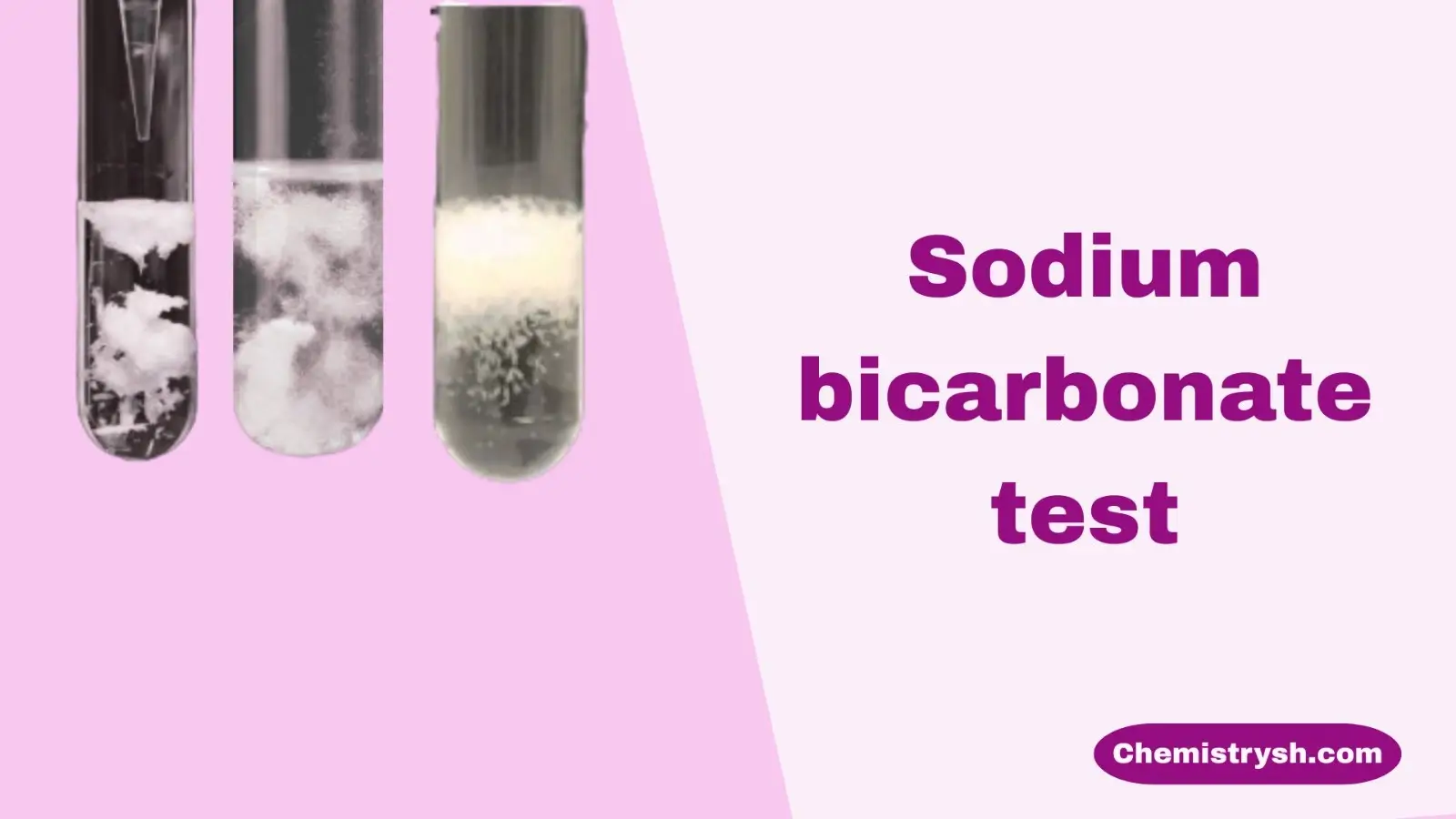
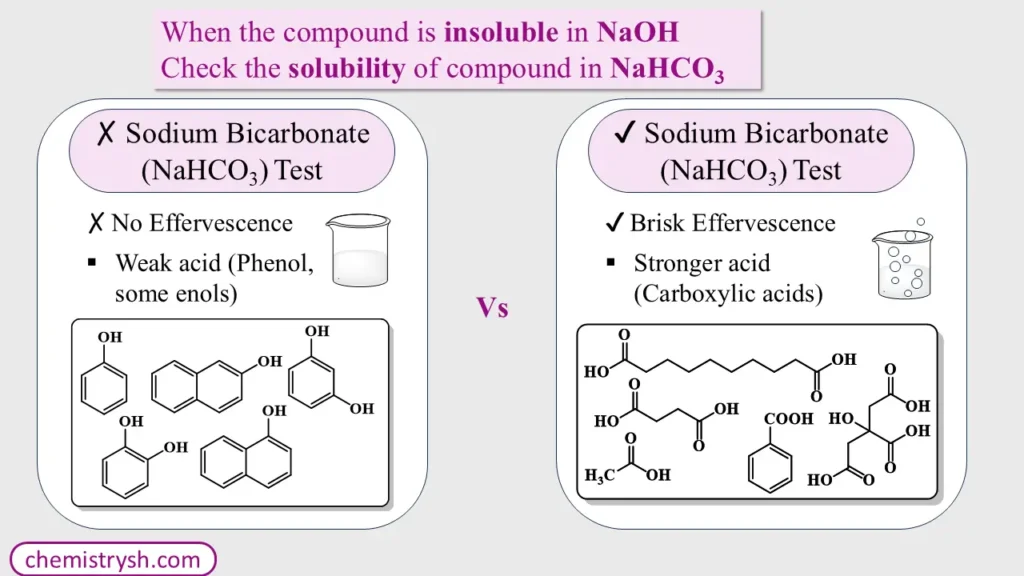
This test is applied after the NaOH test to distinguish between strongly acidic compounds (carboxylic acids like (Benzoic acid, Oxalic acid) and weakly acidic compounds (phenols). NaHCO₃ is a weak base and can only react with compounds whose pKa is less than 6.4 (the pKa of H₂CO₃). The key observation is effervescence (CO₂ gas evolution), which confirms a strongly acidic compound.
Procedure
1. Take approximately 0.1 g if solid or 2–3 drops if liquid in a clean test tube.
2. Add 2–3 mL of NaHCO₃ solution (5%) to the test tube.
3. Shake the test tube vigorously and observe.
4. Note whether the compound dissolves and whether CO₂ gas (effervescence) is evolved.
5. If the compound dissolves with effervescence, it is confirmed as strongly acidic.
6. If no dissolution occurs, the compound is weakly acidic (already confirmed by NaOH test).
Why NaHCO₃ Distinguishes Strongly from Weakly Acidic Compounds
1. NaHCO₃ is a weak base — it can only neutralise compounds with pKa < 6.4.
2. Carboxylic acids (pKa ≈ 4–5) react with NaHCO₃ → dissolve with CO₂ effervescence.
3. Sulphonic acids (pKa ≈ −1 to 2) also react with NaHCO₃ and dissolve with CO₂ effervescence. They are distinguished from carboxylic acids by the sodium fusion (Lassaigne) test — sulphur is detected as sodium sulphide (Na₂S), confirmed by the formation of a black precipitate with lead acetate solution, whereas carboxylic acids give no sulphur test..
4. Phenols (pKa ≈ 9–10) do not react with NaHCO₃ → do not dissolve.
5. This makes NaHCO₃ the definitive test to distinguish carboxylic acids from phenols.
pKa Cut-off Explanation (pKa < 6.4)
1. NaHCO₃ acts as a base only for compounds with pKa < 6.4.
2. Compound with pKa < 6.4 → reacts with NaHCO₃ → dissolves with CO₂↑.
3. Compound with pKa > 6.4 → does not react with NaHCO₃ → does not dissolve.
4. Carbonic acid (H₂CO₃) formed is unstable and immediately decomposes: H₂CO₃ → H₂O + CO₂↑ — this is the source of the effervescence observed.
Chemical Equations
Carboxylic acids (react — strongly acidic):
RCOOH + NaHCO₃ → RCOONa + H₂O + CO₂↑
CH₃COOH + NaHCO₃ → CH₃COONa + H₂O + CO₂↑
C₆H₅COOH + NaHCO₃ → C₆H₅COONa + H₂O + CO₂↑
(COOH)₂ + 2NaHCO₃ → (COONa)₂ + 2H₂O + 2CO₂↑
Phenols (do not react — weakly acidic):
C₆H₅OH + NaHCO₃ → No reaction
C₁₀H₇OH + NaHCO₃ → No reaction
Examples: Benzoic acid, oxalic acid, citric acid and salicylic acid are strongly acidic compounds, as they dissolve in NaHCO₃ solution with the evolution of CO₂ (effervescence). In contrast, phenol, α-naphthol, β-naphthol and resorcinol are weakly acidic and do not dissolve.
|
Compound |
Formula |
Result with NaHCO₃ |
Nature |
|
Acetic acid |
CH₃COOH |
Dissolves + CO₂↑ |
Strongly acidic |
|
Benzoic acid |
C₆H₅COOH |
Dissolves + CO₂↑ |
Strongly acidic |
|
Oxalic acid |
(COOH)₂ |
Dissolves + CO₂↑ |
Strongly acidic |
|
Formic acid |
HCOOH |
Dissolves + CO₂↑ |
Strongly acidic |
|
Citric acid |
C₆H₈O₇ |
Dissolves + CO₂↑ |
Strongly acidic |
|
Salicylic acid* |
C₇H₆O₃ |
Dissolves + CO₂↑ |
Strongly acidic |
|
Phenol |
C₆H₅OH |
Does not dissolve |
Weakly acidic |
|
α-Naphthol |
C₁₀H₇OH |
Does not dissolve |
Weakly acidic |
|
β-Naphthol |
C₁₀H₇OH |
Does not dissolve |
Weakly acidic |
|
Resorcinol |
C₆H₄(OH)₂ |
Does not dissolve |
Weakly acidic |
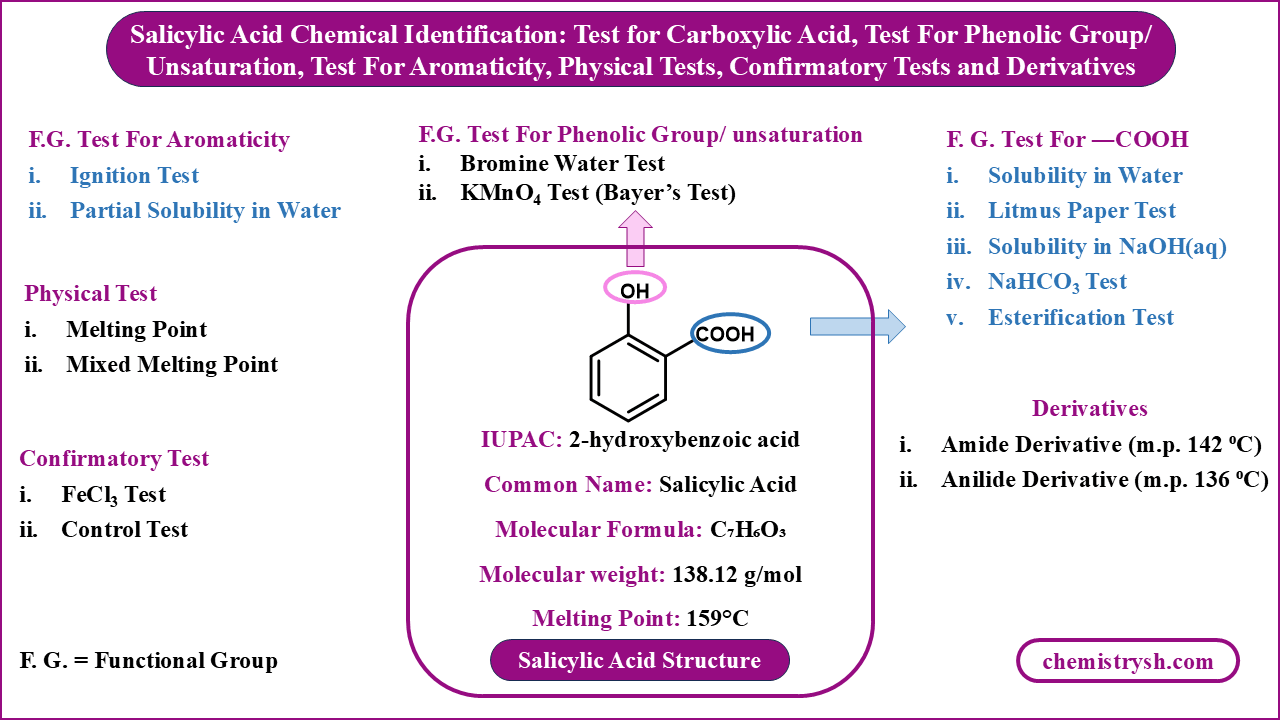
* Salicylic acid (2-hydroxybenzoic acid) contains both a carboxylic acid group (–COOH, pKa ≈ 2.97) and a phenolic hydroxyl group (–OH, pKa ≈ 13.4). It reacts with NaHCO₃ and dissolves with CO₂ effervescence exclusively through its –COOH group. The phenolic –OH group does not react with NaHCO₃. Salicylic acid will therefore also dissolve in dilute NaOH through both groups — this dual behaviour distinguishes it from simple phenols or simple carboxylic acids.
Solubility in Dilute HCl
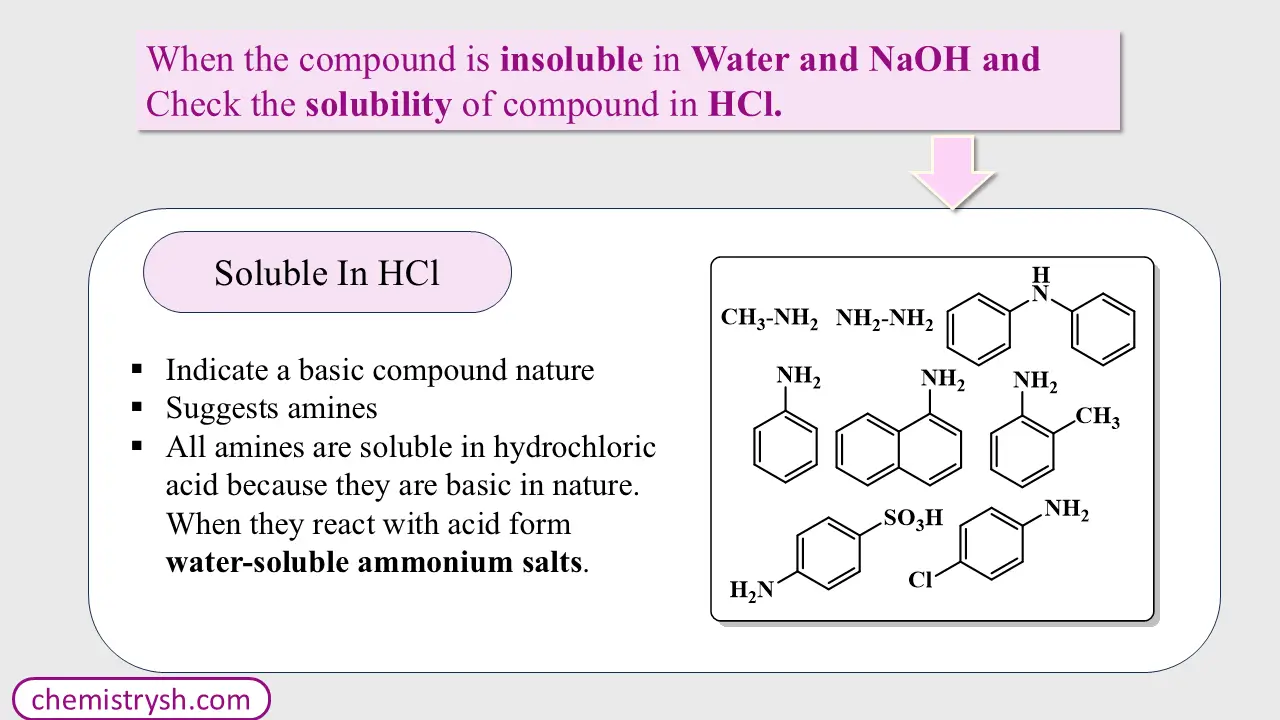
This test is applied to compounds that are insoluble in water and NaOH. HCl is a strong acid that reacts with basic compounds to form water-soluble hydrochloride salts. Both strongly basic compounds (aliphatic amines) and weakly basic compounds (aromatic amines) dissolve in dilute HCl.
Procedure
1. Take approximately 0.1 g if solid or 2–3 drops if liquid in a clean test tube.
2. Add 2–3 mL of dilute HCl solution (5%) to the test tube.
3. Shake the test tube vigorously for 1–2 minutes at room temperature.
4. Observe whether the compound dissolves completely or not at all.
5. If the compound dissolves, it is confirmed as basic in nature.
Why Basic Compounds Dissolve in HCl:
1. HCl is a strong acid; it reacts with basic compounds to form water-soluble hydrochloride salts.
2. The reaction is an acid–base neutralisation — HCl donates H⁺ to the lone pair of nitrogen in the amine.
3. The hydrochloride salt formed is ionic and dissolves readily in water.
4. Two classes dissolve in HCl:
• Strongly basic — aliphatic amines (conjugate acid pKa ≈ 9–11)
• Weakly basic — aromatic amines (conjugate acid pKa ≈ 0.8–5.2)
Chemical Equations
Aliphatic amines:
RNH₂ + HCl → RNH₃⁺Cl⁻
CH₃NH₂ + HCl → CH₃NH₃⁺Cl⁻ (methylamine → methylammonium chloride)
C₂H₅NH₂ + HCl → C₂H₅NH₃⁺Cl⁻ (ethylamine → ethylammonium chloride)
(C₂H₅)₂NH + HCl → (C₂H₅)₂NH₂⁺Cl⁻ (diethylamine → diethylammonium chloride)
Aromatic amines:
ArNH₂ + HCl → ArNH₃⁺Cl⁻
C₆H₅NH₂ + HCl → C₆H₅NH₃⁺Cl⁻ (aniline → anilinium chloride)
CH₃C₆H₄NH₂ + HCl → CH₃C₆H₄NH₃⁺Cl⁻ (p-toluidine → p-toluidinium chloride)
pKa Values of Conjugate Acids:
When an amine reacts with HCl it accepts H⁺ and forms a positively charged conjugate acid. The pKa of this conjugate acid measures how strongly the amine holds the proton — the higher the pKa, the more strongly basic the amine.
|
Compound |
Formula |
Conjugate Acid |
Conjugate Acid Formula |
pKa |
Nature |
|
Methylamine |
C₂H₅NH₂ |
Methylammonium ion |
CH₃NH₃⁺ |
10.6 |
Strongly basic |
|
Ethylamine |
C₂H₅NH₂ |
Ethylammonium ion |
C₂H₅NH₃⁺ |
10.6 |
Strongly basic |
|
Diethylamine |
(C₂H₅)₃N |
Diethylammonium ion |
(C₂H₅)₂NH₂⁺ |
10.9 |
Strongly basic |
|
Triethylamine |
(C₂H₅)₃N |
Triethylammonium ion |
(C₂H₅)₃NH⁺ |
10.7 |
Strongly basic |
|
Butylamine |
C₄H₉NH₂ |
Butylammonium ion |
C₄H₉NH₃⁺ |
10.6 |
Strongly basic |
|
Aniline |
C₆H₅NH₂ |
Anilinium ion |
C₆H₅NH₃⁺ |
10.9 |
Weakly basic |
|
Diphenylamine |
(C₆H₅)₂NH |
Diphenylammonium ion |
(C₆H₅)₂NH₂⁺ |
0.8 |
Weakly basic |
|
p-Toluidine |
CH₃C₆H₄NH₂ |
p-Toluidinium ion |
CH₃C₆H₄NH₃⁺ |
5.1 |
Weakly basic |
|
o-Nitroaniline |
O₂NC₆H₄NH₂ |
o-Nitroanilinium ion |
O₂NC₆H₄NH₃⁺ |
0.3 |
Weakly basic |
|
Pyridine |
C₅H₅N |
Pyridinium ion |
C₅H₅NH⁺ |
5.2 |
Weakly basic |
Treatment with Concentrated Sulfuric Acid (H₂SO₄)
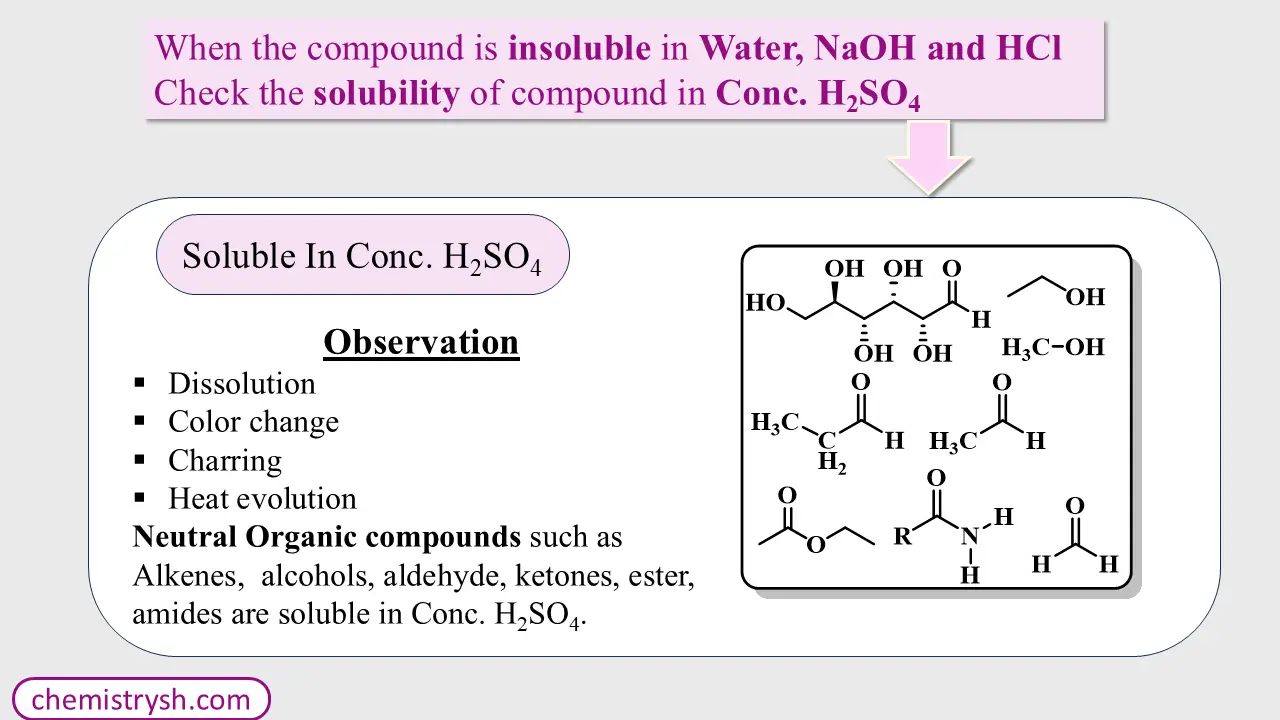
This test is applied to compounds that are insoluble in water, NaOH, and dilute HCl. These are neutral compounds. Concentrated H₂SO₄ protonates virtually all compounds containing oxygen or nitrogen functional groups. Any observable change — colour change, charring, gas evolution, or heat — indicates a reactive neutral compound. Compounds that show no reaction are classified as inert neutral compounds.
Procedure
1. Take approximately 0.1 g if solid or 2–3 drops if liquid in a clean test tube.
2. Carefully add 2–3 mL of concentrated H₂SO₄ — always add acid to sample, never sample to acid.
3. Shake gently and observe at room temperature.
4. Note any colour change, charring, gas evolution, heat evolution, or dissolution.
5. Carry out this test in a fume cupboard — concentrated H₂SO₄ is highly corrosive.
Three Types of Observations and What Each Indicates
1. Solubility with colour change or heat → reactive neutral compound (alkenes, alcohols, aldehydes, ketones, esters, ethers, amides, nitro compounds).
2. Charring with gas evolution (CO₂↑ and CO↑) → carbohydrate (glucose, sucrose, starch) or polyhydroxy acid (tartaric acid, citric acid).
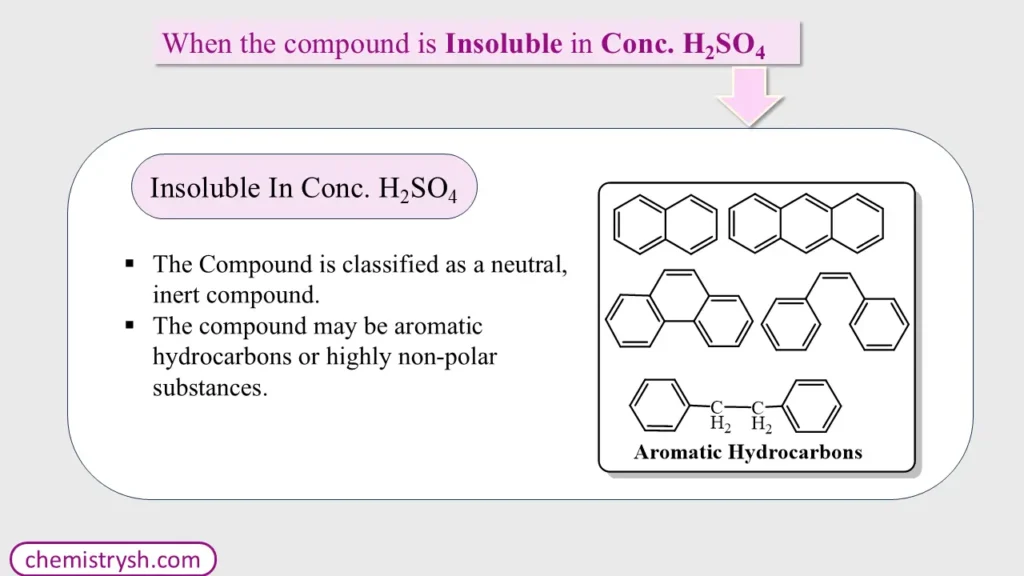
3. No reaction / insoluble → inert neutral compound (saturated hydrocarbons, haloalkanes, simple aromatic hydrocarbons).
General Protonation Reaction
R + H₂SO₄ → [R·H]⁺ + HSO₄⁻
Virtually all compounds containing oxygen or nitrogen are protonated by concentrated H₂SO₄ and become soluble in it.
Distinction Between Reactive and Inert Neutral Compounds
1. Reactive neutral — contains oxygen or nitrogen functional groups (–OH, C=O, –O–, –NH₂); dissolves in H₂SO₄ due to protonation.
2. Inert neutral — contains no reactive functional group (alkanes, haloalkanes, simple arenes); does not dissolve in H₂SO₄.
3. Toluene gives a slight colour change due to sulfonation of the aromatic ring — classified as inert/aromatic.
Reactive neutral — alcohol (protonation then dehydration):
C₂H₅OH + H₂SO₄ → C₂H₅OH₂⁺ + HSO₄⁻ (protonation — dissolves)
C₂H₅OH₂⁺ → C₂H₄ + H₃O⁺ (dehydration at higher temperature)
Reactive neutral — ether (protonation only):
C₂H₅OC₂H₅ + H₂SO₄ → (C₂H₅)₂OH⁺ + HSO₄⁻ (protonation — dissolves)
Reactive neutral — ketone (protonation of carbonyl):
CH₃COCH₃ + H₂SO₄ → CH₃C(OH⁺)CH₃ + HSO₄⁻ (protonation at oxygen — dissolves)
Carbohydrate — dehydration and charring:
C₆H₁₂O₆ →(H₂SO₄) 6C + 6H₂O (dehydration — black char)
C + 2H₂SO₄ → CO₂↑ + 2SO₂↑ + 2H₂O (oxidation of carbon — gas evolution)
Inert neutral — no reaction:
C₆H₁₄ + H₂SO₄ → No reaction (no functional group to protonate)
|
Compound |
Formula |
Result with H₂SO₄ |
Classification |
|
Ethanol |
C₂H₅OH |
Dissolves + colour change |
Reactive neutral |
|
Acetone |
CH₃COCH₃ |
Dissolves + colour change |
Reactive neutral |
|
Acetaldehyde |
CH₃CHO |
Dissolves + colour change |
Reactive neutral |
|
Diethyl ether |
C₂H₅OC₂H₅ |
Dissolves |
Reactive neutral |
|
Ethyl acetate |
CH₃COOC₂H₅ |
Dissolves |
Reactive neutral |
|
Cyclohexene |
C₆H₁₀ |
Dissolves + heat |
Reactive neutral |
|
Glucose |
C₆H₁₂O₆ |
Charring + CO₂↑+ CO↑ |
Carbohydrate |
|
Hexane |
C₆H₁₄ |
No reaction |
Inert neutral |
|
Chlorobenzene |
C₆H₅Cl |
No reaction |
Inert neutral |
|
Toluene |
C₆H₅CH₃ |
Slight colour change |
Inert/aromatic |
Summary of solubility and acidic, basic or neutral nature of compounds
The complete solubility scheme is applied in the following sequence:
(1) Water — determines polarity; soluble compounds are tested with litmus paper to classify as acidic (blue → red), basic (red → blue), or neutral (no change).
(2) Dilute NaOH (5%) — water-insoluble compounds that dissolve in NaOH are acidic (carboxylic acids pKa ≈ 4–5, or phenols pKa ≈ 9.95).
(3) NaHCO₃ (5%) — dissolution with CO₂ effervescence confirms strongly acidic compound (carboxylic acid, pKa < 6.35); no reaction confirms weakly acidic compound (phenol, pKa > 6.35).
(4) Dilute HCl (5%) — compounds insoluble in NaOH that dissolve in HCl are basic (aliphatic amines conjugate acid pKa ≈ 9–11; aromatic amines conjugate acid pKa ≈ 3–5).
(5) Concentrated H₂SO₄ — compounds insoluble in all the above: solubility with colour change or charring confirms reactive neutral (alcohols, aldehydes, ketones, esters, carbohydrates); no reaction confirms inert neutral (alkanes, haloalkanes, simple arenes). This sequential scheme systematically narrows down the class of an unknown compound and guides the selection of specific chemical tests for final identification.
Go to 2nd Part
Questions to Enhance the Understanding of the Students
The following questions are designed to enhance the conceptual understanding of solubility-based classification of organic compounds, including the identification of acidic, basic, neutral, polar, non-polar, phenol, carboxylic acid, carbohydrate, and aromatic hydrocarbon classes.
Multiple Choice Questions
The following questions are based on the concepts of polarity, solubility in water, solubility in NaOH, solubility in NaHCO₃, solubility in HCl, and treatment with concentrated H₂SO₄. Each question tests the classification of organic compounds as acidic, basic, neutral, polar, or non-polar.
MCQ 1
Q1. A compound dissolves completely in water and produces a clear homogeneous solution. What does this indicate about the nature of the compound?
A) The compound is non-polar
B) The compound is polar
C) The compound has both polar and non-polar parts
D) The compound is neutral
MCQ 2
Q2. Benzene (non-polar) is insoluble in water but dissolves readily in hexane (non-polar). This observation is best explained by:
A) Benzene is acidic and reacts with hexane
B) Benzene is polar and hexane is non-polar
C) Benzene is non-polar and follows the like dissolves like rule
D) Benzene reacts with hexane to form a soluble product
MCQ 3
Q3. Butanol (C₄H₉OH) is partially soluble in water. What does this indicate?
A) Butanol is completely non-polar
B) Butanol is completely polar
C) Butanol possesses both a polar –OH group and a non-polar C₄ carbon chain
C) Butanol possesses both a polar –OH group and a non-polar C₄ carbon chain
MCQ 4
Q4. A water-soluble compound turns blue litmus paper red. The compound is most likely:
A) Ethanol
B) Acetone
C) Acetic acid (pKa = 4.75)
D) Methylamine
MCQ 5
Q5. A water-soluble compound shows no change in either red or blue litmus paper. The compound belongs to which class?
A) Carboxylic acids (pKa ≈ 4–5)
B) Amines (conjugate acid pKa ≈ 9–11)
C) Alcohols, aldehydes, or ketones
D) Phenols (pKa ≈ 9.99)
MCQ 6
Q6. An unknown compound dissolves in dilute NaOH but does NOT dissolve in NaHCO₃. Given that the pKa cut-off for NaHCO₃ is 6.35 (pKa of H₂CO₃), the compound is most likely:
A) Acetic acid (pKa = 4.75)
B) Benzoic acid (pKa = 4.20)
C) Phenol (pKa = 9.95)
D) Formic acid (pKa = 3.75)
MCQ 7
Q7. A compound dissolves in dilute NaOH with the formation of a water-soluble sodium salt. What is the nature of the compound?
A) Basic
B) Neutral
C) Non-polar
D) Acidic
MCQ 8
Q8. When acetic acid (CH₃COOH, pKa = 4.75) is treated with NaHCO₃ solution, brisk effervescence is observed. The gas evolved is:
A) SO₂
B) CO₂
C) NH₃
D) H₂
MCQ 9
Q9. The pKa of H₂CO₃ is 6.35 — this is the cut-off for NaHCO₃ as a base. Which of the following compounds will NOT react with NaHCO₃?
A) Acetic acid (pKa = 4.75)
B) Formic acid (pKa = 3.75)
C) Phenol (pKa = 9.95)
D) Benzoic acid (pKa = 4.20)
MCQ 10
Q10. Aniline (C₆H₅NH₂, conjugate acid pKa = 4.6) dissolves in dilute HCl. This is because:
A) Aniline is acidic and reacts with HCl to form a salt
B) Aniline is basic and reacts with HCl to form a water-soluble hydrochloride salt
C) Aniline is neutral and dissolves physically in HCl
D) Aniline is non-polar and HCl is a non-polar solvent
MCQ 11
Q11. Which of the following amines is most strongly basic, based on the pKa of its conjugate acid?
A) Aniline (conjugate acid pKa = 4.6)
B) Pyridine (conjugate acid pKa = 5.2)
C) Methylamine (conjugate acid pKa = 10.6)
D) Diphenylamine (conjugate acid pKa = 0.8)
MCQ 12
Q12. A compound is treated with concentrated H₂SO₄ and immediately undergoes charring with evolution of CO₂ gas. The compound is most likely:
A) Hexane
B) Glucose (C₆H₁₂O₆)
C) Aniline
D) Chlorobenzene
MCQ 13
Q13. A compound shows no reaction with water, dilute NaOH, dilute HCl, or concentrated H₂SO₄. The compound is classified as:
A) Strongly acidic
B) Strongly basic
C) Reactive neutral
D) Inert neutral
MCQ 14
Q14. An unknown compound X dissolves in water and turns red litmus blue. When treated with dilute HCl it forms a water-soluble crystalline salt. The compound X is most likely:
A) Acetic acid (pKa = 4.75)
B) Phenol (pKa = 9.95)
C) Methylamine (conjugate acid pKa = 10.6)
D) Glucose
MCQ 15
Q15. An unknown compound Y is insoluble in water. It dissolves in dilute NaOH (conjugate acid pKa = 15.7) but does not dissolve in NaHCO₃ (pKa of H₂CO₃ = 6.35). It does not dissolve in dilute HCl. The compound Y is most likely:
A) Benzoic acid (pKa = 4.20)
A) Benzoic acid (pKa = 4.20)
C) Phenol (pKa = 9.95)
D) Hexane
Answer Key
|
Question |
Answer |
Concept Tested |
pKa Used |
|
1 |
B |
Water solubility → polarity |
— |
|
2 |
C |
Like dissolves like |
— |
|
3 |
C |
Partial solubility — polar + non-polar |
— |
|
4 |
C |
Litmus → acidic compound |
4.75 |
|
5 |
C |
Litmus → neutral compound |
— |
|
6 |
C |
NaOH vs NaHCO₃ — phenol vs carboxylic acid |
6.35, 9.95 |
|
7 |
D |
NaOH solubility → acidic nature |
— |
|
8 |
B |
CO₂ effervescence with NaHCO₃ |
4.75 |
|
9 |
C |
pKa cut-off 6.35 |
6.35, 9.95 |
|
10 |
B |
HCl solubility → basic nature |
4.6 |
|
11 |
C |
pKa of conjugate acid → base strength |
10.6 |
|
12 |
B |
H₂SO₄ charring → carbohydrate |
— |
|
13 |
D |
No reaction → inert neutral |
— |
|
14 |
C |
Combined — basic + HCl salt formation |
10.6 |
|
15 |
C |
Combined flowchart — phenol identification |
6.35, 9.95, 15.7 |