
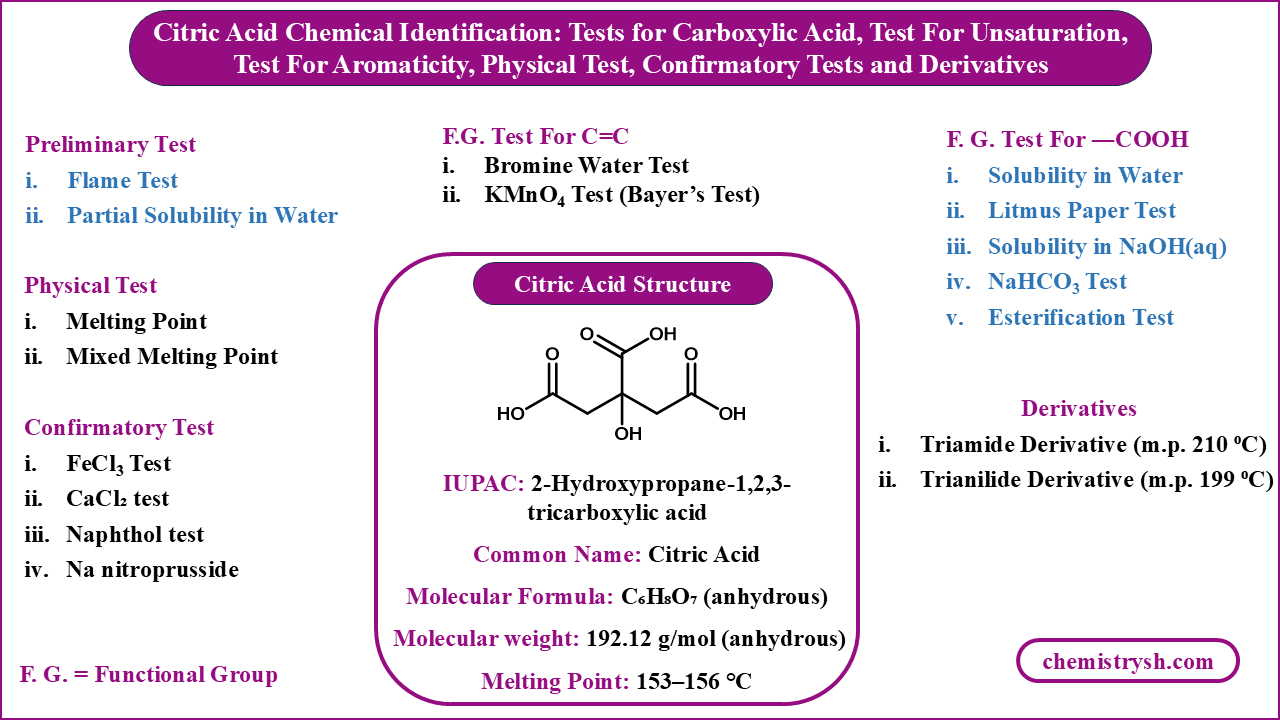
Citric Acid Identification: Key Facts at a Glance
- Physical Properties: Physical Appearance · Solubility · Flame Test · Melting Point (153–156 °C) · Citric Acid Triamide m.p. (210 °C) · Citric Acid Trianilide m.p. (199 °C) · Molecular Formula (C₆H₈O₇) · MW (192.12 g/mol) · pKa₁ (3.13) · pKa₂ (4.76) · pKa₃ (6.40) · CAS No. (77-92-9)
- Chemical Tests: Litmus · NaHCO₃ Test · Ester Test · FeCl₃ Test · Bromine Water · Acidified KMnO₄ · CaCl₂ Test (on heating) · Naphthol Test (green colour) · Sodium Nitroprusside Test (red → violet) · Control Test · Derivatives · Mixed Melting Point · Chemical Structure · Chemical Reactions · Applications · Safety · FAQs · MCQs · Viva Questions
What is Citric Acid? — Definition, Common Name & IUPAC Name and physical properties
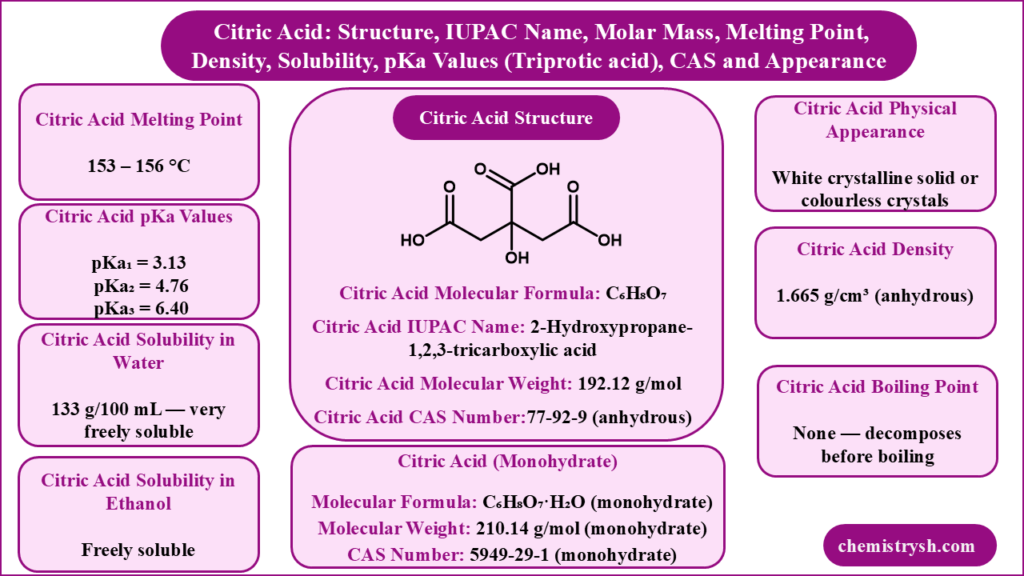
Citric acid is a white, odourless, crystalline solid with an intensely sour taste — the dominant acid in lemon and lime juice. It is a weak, triprotic, hydroxy tricarboxylic acid with molecular formula C₆H₈O₇, molar mass 192.12 g/mol, and three ionisable protons giving pKa1 = 3.13, pKa2 = 4.76, pKa3 = 6.40. A 1% aqueous solution has pH ≈ 2.2.
The citric acid IUPAC name is 2-hydroxypropane-1,2,3-tricarboxylic acid. Its common name, Citric acid, derives from the Latin citrus; in food regulation it is also known as E330. The chemical name used in pharmacopoeia monographs (BP, USP, EP) is identical to the IUPAC name. CAS: 77-92-9 (anhydrous), 5949-29-1 (monohydrate). The molecular weight is 192.12 g/mol (anhydrous) and 210.14 g/mol (monohydrate, C₆H₈O₇·H₂O).
Citric Acid — Chemical Formula, Structure and Properties
Citric acid has the molecular formula C₆H₈O₇ (anhydrous) with a molar mass of 192.12 g/mol. Its IUPAC name is 2-hydroxypropane-1,2,3-tricarboxylic acid, reflecting its three carboxyl (–COOH) groups and one hydroxyl (–OH) group on the central carbon. The condensed structural formula is HOOC–CH₂–C(OH)(COOH)–CH₂–COOH. Citric acid is a weak, triprotic acid with pKa values of 3.13, 4.76, and 6.40, and a melting point of 153–156 °C (anhydrous). The complete physical and chemical properties are summarised in the table below.
|
Property |
Value / Description |
|
1. CHEMICAL IDENTITY & NOMENCLATURE |
|
IUPAC name |
2-Hydroxypropane-1,2,3-tricarboxylic acid |
|
Common name |
Citric acid |
|
Also known as |
E330 (food additive) • 2-hydroxy-1,2,3-propanetricarboxylic acid |
|
CAS No. |
77-92-9 (anhydrous) • 5949-29-1 (monohydrate) |
|
PubChem CID |
311 |
|
Acid classification |
Weak, triprotic, hydroxy tricarboxylic acid |
|
2. MOLECULAR & STRUCTURAL DATA |
|
Molecular formula |
C₆H₈O₇ (anhydrous) • C₆H₈O₇·H₂O (monohydrate) |
|
Structural formula (condensed) |
HOOC–CH₂–C(OH)(COOH)–CH₂–COOH |
|
Elements / atom count |
Carbon, Hydrogen, Oxygen only (6 C + 8 H + 7 O per molecule) |
|
Functional groups |
3 × carboxyl (–COOH) + 1 × hydroxyl (–OH, tertiary) |
|
Molar mass |
192.12 g/mol (anhydrous) • 210.14 g/mol (monohydrate) |
|
Chirality |
Achiral — molecule possesses a plane of symmetry; C-2 bears two identical –CH₂COOH substituents and is therefore not a true stereocentre |
|
3. ACIDITY & STOICHIOMETRY |
|
Basicity / valency |
C₆H₈O₇ (anhydrous) • C₆H₈O₇·H₂O (monohydrate) |
|
pKa values |
HOOC–CH₂–C(OH)(COOH)–CH₂–COOH |
|
pH (1% aqueous solution) |
Carbon, Hydrogen, Oxygen only (6 C + 8 H + 7 O per molecule) |
|
Equivalent weight |
3 × carboxyl (–COOH) + 1 × hydroxyl (–OH, tertiary) |
|
4. APPEARANCE & SENSORY PROPERTIES |
|
Appearance |
White crystalline solid or colourless crystals; also available as powder |
|
Crystal System |
Orthorhombic (anhydrous) • Monoclinic (monohydrate) |
|
Odour |
Odourless — both solid and in solution (contrast: acetic acid is pungent) |
|
Taste |
Odourless — both solid and in solution (contrast: acetic acid is pungent) |
|
5. THERMAL BEHAVIOUR |
|
Melting point (anhydrous) |
153 – 156 °C (use this value for melting-point identification) |
|
Monohydrate on heating |
Effloresces (loses H₂O) at 70 – 75 °C → converts to anhydrous form → melts at 153 – 156 °C. No independent melting point. |
|
Thermal decomposition |
Above ≈ 175 °C: dehydration → cis-aconitic acid; further decomposition → itaconic acid + CO₂ |
|
Boiling point |
None — decomposes before boiling (no true boiling point) |
|
6. DENSITY & SOLUBILITY |
|
Density |
1.665 g/cm³ (anhydrous) • 1.542 g/cm³ (monohydrate) |
|
Solubility in water (20 °C) |
133 g/100 mL — very freely soluble |
|
Solubility in ethanol |
Freely soluble |
|
Solubility in diethyl ether |
Slightly soluble |
|
Solubility in chloroform |
Insoluble |
Natural Sources
Citric acid is found in highest concentrations in citrus fruits: lemon juice 5–8 g/100 mL, lime 5–6 g/100 mL, grapefruit ~2–3 g/100 mL. Secondary sources: strawberries (~0.6), pineapple (~0.5), tomatoes (~0.3 g/100 mL). Commercially, it is produced by fermentation of glucose or molasses using Aspergillus niger — not extracted from fruit.
Citric Acid Anhydrous vs Monohydrate — Key Differences
Citric acid exists in two forms: the anhydrous form (C₆H₈O₇, molar mass 192.12 g/mol) and the monohydrate form (C₆H₈O₇·H₂O, molar mass 210.14 g/mol). The anhydrous form melts cleanly at 153–156 °C and crystallises in the orthorhombic system, making it the preferred primary standard in alkalimetry. The monohydrate form, which crystallises in the monoclinic system, has no independent melting point — it effloresces at 70–75 °C, losing its water of crystallisation and converting to the anhydrous form before melting. Their equivalent weights differ accordingly: 64.04 g/eq (anhydrous) and 70.05 g/eq (monohydrate). Full comparison is in the table below.
|
Property |
Anhydrous |
Monohydrate |
|
Formula |
C₆H₈O₇ |
C₆H₈O₇·H₂O |
|
CAS number |
77-92-9 |
5949-29-1 |
|
Molar mass |
192.12 g/mol |
210.14 g/mol |
|
Melting point |
153–156 °C (clean melt) |
No clean MP — dehydrates at 70–75 °C first |
|
Density |
1.665 g/cm³ |
.542 g/cm³ |
|
Crystal System |
Orthorhombic |
Monoclinic |
|
Water content |
0% |
8.57% (1 mol H₂O / mol) |
|
Equivalent weight |
64.04 g/eq |
70.05 g/eq (210.14 ÷ 3) |
|
Lab use |
Primary standard, anhydrous reactions |
General reagent, food applications |
Planning the Identification of Citric acid: Think Like a Chemical Detective 🔍
Before picking up a single test tube, every good chemist asks one question: “What clues does this molecule already give me?”
Look closely at the structure of citric acid (HOOC–CH₂–C(OH)(COOH)–CH₂–COOH) — it is like a map with three highlighted zones, and each one tells us exactly which tests to run.
Step 1: Identify the Functional Groups in Citric Acid
- 🔵 Three –COOH groups → tricarboxylic acid (polyprotic)
- 🟡 One –OH group (tertiary) → alcohol / hydroxyl character
- ✅ Aliphatic (no benzene ring) → saturated carbon skeleton
Step 2: Citric Acid Qualitative Tests — Matching Structural Clues to Chemical Tests
|
Structural Clue |
Tests to Confirm It |
|
🔵 Three –COOH groups (tricarboxylic acid) |
Litmus Paper Test • NaHCO₃ Test (CO₂ evolution) • Ester Test |
|
🟡 –OH group (tertiary alcohol) |
FeCl₃ Test (positive) • Naphthol Test (green colour) • Sodium Nitroprusside Test (red → violet) |
|
🟢 Aliphatic / saturated skeleton |
Bromine Water Test — no decolourisation • No sooty flame • Freely soluble in water |
|
⚪ Whole compound (citric acid fingerprint) |
Calcium Chloride Test (white precipitate) • Melting Point (153 °C, anhydrous) • Mixed Melting Point |
Step 3: Begin with Preliminary Observations — Do Not Skip
Before any chemical test is run, three preliminary observations narrow down the compound class: physical appearance, solubility in water, and the flame test.
Citric Acid — Preliminary Observations (Physical & Solubility Properties)
|
Property |
Observation / Value |
|
Appearance |
White crystalline solid (monohydrate form common) |
|
Solubility |
Freely soluble in water; sparingly soluble in ethanol |
|
Dehydration behaviour |
Loses water of crystallisation at 130 °C to form the anhydrous acid |
|
Melting point (anhydrous) |
153 °C |
|
Flame test |
Clean blue flame; no soot (aliphatic compound, no benzene ring) |
A colourless crystalline solid that is freely soluble in cold water, dehydrates at 130 °C, and burns with a clean non-sooty flame is already pointing clearly toward an aliphatic hydroxy-tricarboxylic acid. The chemical tests then confirm what the physical observations already suggest.
How to Identify Citric Acid — Qualitative Analysis Step by Step
Identifying citric acid follows a systematic four-stage sequence. Preliminary observations (Stage 1) establish it as a white, aliphatic, acidic solid through appearance, solubility, and flame test. Functional group tests (Stage 2) — NaHCO₃, ester, bromine water, KMnO₄, and FeCl₃ — confirm carboxyl groups and saturated skeleton. The three citric acid-specific tests (Stage 3) — calcium chloride (white precipitate), naphthol (green colour), and sodium nitroprusside (red → violet) — provide the whole-compound fingerprint. Stage 4 confirms identity through melting point (153 °C), derivative melting points (amide 210 °C, anilide 199 °C), and mixed melting point. The complete sequence is in the table below.
Note: The table summarises only what each test establishes and why it matters for the identification of citric acid. Full procedural details — quantities, conditions, safety notes, and interpretation of borderline results — are provided on the page dedicated to each test. Readers are strongly encouraged to study the relevant page before attempting any procedure in the laboratory.
|
# |
Test |
What It Establishes |
|
STAGE 1 — Preliminary Tests |
|
1 |
Physical appearance |
White crystalline solid (monohydrate); confirms a pure organic acid |
|
2 |
Solubility |
Freely soluble in water; confirms –COOH ionisation; aliphatic profile |
|
3 |
Elemental Detection |
Clean blue non-sooty flame; confirms absence of benzene ring (no aromatic character) |
|
4 |
Elemental Detection |
To check the presence of N, S, Cl, Br, & I |
|
5 |
Litmus Test |
Compound is acidic; turns blue litmus red |
|
STAGE 2 — Functional Group Tests |
|
6 |
NaHCO₃ test |
Specifically a carboxylic acid; brisk CO₂ effervescence (gas turns lime water milky) |
|
7 |
Ester test |
Final –COOH confirmation; fruity ester odour formed with ethanol / conc. H₂SO₄ |
|
8 |
Bromine Water Test |
No decolourisation; confirms absence of C=C double bond (saturated aliphatic skeleton) |
|
9 |
Acidified KMnO₄ Test |
No decolourisation; confirms saturated aliphatic structure (Baeyer’s reagent stays purple) |
|
10 |
FeCl₃ Test |
Gives a positive result with FeCl₃ solution (characteristic colour change) |
|
STAGE 3 — Specific Tests for Citric Acid |
|
11 |
Calcium Chloride (CaCl₂) Test |
White precipitate of calcium citrate confirms citrate ion; whole-compound fingerprint Procedure: Neutralise a small quantity with NH₄OH, boil off excess NH₃, add CaCl₂ solution, and boil again → white precipitate forms. Adding a single drop of alkali facilitates precipitate formation. |
|
12 |
Naphthol Test |
Reacting with naphthol in conc. H₂SO₄ → green colour; colour persists on warming but becomes colourless on cooling; specific for citric acid |
|
13 |
Sodium Nitroprusside Test |
Add 2 drops of sodium nitroprusside solution to 1 mL neutral acid solution → red colour; addition of acetic acid changes colour to violet |
|
STAGE 4 — Confirmation |
|
14 |
Melting point |
Purity check; anhydrous acid melts at 153 °C (monohydrate loses H₂O at 130 °C first) |
|
15 |
Literature Survey |
Cross-check physical and chemical constants |
|
16 |
Control Test |
Validates CaCl₂ / Naphthol results against authentic citric acid standard |
|
17 |
Derivatives |
Amide derivative m.p. 210 °C • Anilide derivative m.p. 199 °C — independent physical checkpoints |
|
18 |
Mixed Melting Point |
Gold-standard definitive proof of identity — no depression with authentic sample |
This is the real skill of qualitative organic analysis: it is not about running every test in the textbook, but about reading the molecular structure and selecting tests that carry real diagnostic weight. The Naphthol and Sodium Nitroprusside tests are especially characteristic for citric acid and are rarely positive for other common aliphatic acids — making them powerful confirmation tools. Once that habit is established, identifying any unknown organic compound becomes a logical exercise rather than a guessing game.
Materials and Reagents Required for Citric Acid Identification Tests
- Citric acid sample (unknown)
- Distilled water
- Blue and red litmus paper
- NaHCO₃ solution (sodium bicarbonate, ~5% aqueous)
- Freshly prepared lime water (Ca(OH)₂ solution) — for CO₂ confirmation
- Absolute (anhydrous) ethanol — for ester test
- Concentrated H₂SO₄ — for ester test and Naphthol test
- Bromine water (dilute aqueous solution of Br₂)
- Acidified KMnO₄ solution (dilute) — Baeyer’s reagent
- Neutral FeCl₃ solution (~1% aqueous) — for FeCl₃ test
- Calcium chloride solution (CaCl₂, ~10% aqueous) — for calcium citrate precipitate test
- Ammonium hydroxide solution (NH₄OH) — for neutralisation in CaCl₂ test
- β-Naphthol (dissolved in conc. H₂SO₄) — for Naphthol test
- Sodium nitroprusside solution (Na₂[Fe(CN)₅NO], freshly prepared) — for Nitroprusside test
- Glacial acetic acid — for second step of Nitroprusside test (colour change to violet)
- Melting point apparatus with sealed capillary tubes
- Delivery tube assembly — for passing CO₂ into lime water
- Authentic (known) citric acid sample — for control test and mixed melting point
Result Summary — Citric Acid Identification
All physical and chemical observations are consistent with the identity of the compound as citric acid (C₆H₈O₇).
The sample was a white crystalline solid (monohydrate form), freely soluble in cold water, losing its water of crystallisation at 130 °C and melting sharply at 153 °C (anhydrous). The flame test confirmed an aliphatic structure (clean non-sooty blue flame), while the litmus, NaHCO₃, and ester tests together confirmed the presence of carboxylic acid (–COOH) groups. The bromine water and acidified KMnO₄ tests both gave negative results, confirming the absence of C=C unsaturation. The FeCl₃ test gave a positive result consistent with an α-hydroxy acid. The CaCl₂ test produced a white precipitate of calcium citrate under mildly alkaline conditions, providing a whole-compound fingerprint. The Naphthol test gave a characteristic green colour (reversible on cooling) and the Sodium Nitroprusside test gave a red colour changing to violet on addition of acetic acid — both highly specific for citric acid. The sharp melting point of 153 °C (anhydrous), together with the amide derivative (m.p. 210 °C) and anilide derivative (m.p. 199 °C), provided strong independent physical confirmation. Finally, the mixed melting point test showed no depression or elevation, conclusively confirming the identity of the compound.
Conclusion
Based on the combined physical and chemical evidence — aliphatic character (clean non-sooty flame), saturation (bromine water and KMnO₄ negative), polycarboxylic acid functionality (NaHCO₃, litmus, and ester tests), positive FeCl₃ behaviour (α-hydroxy acid), whole-compound fingerprints (CaCl₂ white precipitate; Naphthol green colour; Nitroprusside red-to-violet), matching literature melting point (153 °C anhydrous; 130 °C dehydration of monohydrate), confirmed derivative melting points (citric amide 210 °C; citranilide 199 °C), and absence of mixed melting point depression — the given unknown compound is conclusively identified as:
Citric Acid (C₆H₈O₇)
IUPAC name: (2R,3R)-2,3-dihydroxybutanedioic acid | MW: 150.09 g/mol | m.p. 170–172 °C (L-form) | dl-form m.p. 206 °C
Important note: Mixed melting point test — gold standard identity confirmation
The mixed melting point (or mixture melting point) test is the classical gold standard for confirming that an unknown compound is identical to a known authentic sample. It requires a separately sourced authentic sample of L-tartaric acid for comparison.
|
What is mixed |
Expected result if SAME compound |
Expected result if DIFFERENT compound |
|
Unknown alone |
MP = 170–172 °C |
MP = 170–172 °C |
|
Authentic L-tartaric acid alone |
MP = 170–172 °C |
MP = 170–172 °C |
|
1:1 mixture of unknown + authentic |
MP = 170–172 °C |
MP depressed 10-30 °C below both pure samples |
Theory: why depression occurs
When two different compounds are mixed, each acts as an impurity in the other, lowering both melting points (eutectic depression). The degree of depression is related to the mole fraction of impurity by the van’t Hoff equation. If no depression is observed, the two samples are the same compound — because neither acts as an impurity in the other’s lattice.
For tartaric acid specifically: mixing L-tartaric acid with meso-tartaric acid would show significant depression, confirming they are different compounds despite both giving zero optical rotation in the meso case. This is one practical example where the mixed MP test distinguishes isomers that a single-compound melting point cannot resolve.
Safety Precautions
General Laboratory Safety
- Wear a laboratory coat, safety goggles, and nitrile gloves throughout the entire experiment.
- Work in a well-ventilated laboratory. Use a fume cupboard for all steps involving concentrated H₂SO₄, SOCl₂, aniline, and β-naphthol.
- Never pipette by mouth. Use a pipette filler or dropper for all liquid reagents.
- Dispose of all chemical waste in the designated waste containers. Do not pour FeCl₃, KMnO₄, or heavy-metal solutions down the sink.
- Know the location of the eyewash station, emergency shower, fire extinguisher, and first-aid kit before starting.
- In case of skin or eye contact with any corrosive reagent, wash immediately with large volumes of water for at least 15 minutes and seek medical attention.
Per-Reagent Hazard and Precaution Table
|
Reagent |
Hazard Classification |
Specific Risk |
Precaution |
|
Citric acid |
Low hazard (irritant) |
May cause mild skin, eye, and respiratory irritation on prolonged exposure. Not acutely toxic. |
Avoid inhaling dust. Wear gloves. Handle normally on open bench. |
|
Concentrated H₂SO₄ |
CORROSIVE • OXIDISING |
Causes severe, potentially permanent burns to skin, eyes, and mucous membranes. Reacts violently with water, releasing heat. |
Always add acid slowly and carefully. Use a fume cupboard. Wear acid-resistant gloves and goggles. In case of contact, flush with copious water immediately. |
|
Acidified KMnO₄ |
OXIDISING • IRRITANT |
Strong oxidising agent. Contact with combustible materials may cause fire. Manganese compounds are toxic by ingestion. |
Keep away from flammable solvents. Wear gloves. Dispose of waste in the heavy-metal waste container. |
|
NaHCO₃ solution |
Low hazard |
Mild irritant only. CO₂ evolved during the test is asphyxiant in enclosed spaces. |
Ensure adequate ventilation. Use a delivery tube to direct CO₂ into lime water safely. |
|
FeCl₃ solution |
IRRITANT |
Irritating to skin and eyes. Mildly corrosive. Iron(III) salts harmful if swallowed. |
Wear gloves and goggles. Avoid contact with skin. Dispose of waste in heavy-metal waste container. |
|
CaCl₂ solution |
Low hazard (irritant) |
Mild irritant to skin and eyes. Hygroscopic — do not leave open. |
Wear gloves. Store sealed. |
|
NH₄OH solution |
CORROSIVE • TOXIC (vapour) |
Pungent, irritating vapour causes respiratory tract and eye irritation. Corrosive at high concentration. |
Use in a fume cupboard. Keep the bottle closed when not in use. Wear goggles and gloves. |
|
β-Naphthol / conc. H₂SO₄ |
CORROSIVE • IRRITANT |
Naphthol is a skin and eye irritant; conc. H₂SO₄ causes severe burns. Mixture is highly exothermic to prepare. |
Prepare in fume cupboard. Add naphthol to acid slowly. Wear acid-resistant gloves and goggles. |
|
Sodium nitroprusside |
TOXIC |
Toxic by ingestion and skin absorption. Releases cyanide under acidic conditions. |
Use in a fume cupboard. Wear gloves. Prepare fresh solution only. Dispose as toxic waste. |
|
Thionyl chloride (SOCl₂) |
HIGHLY CORROSIVE • TOXIC |
Reacts violently with water, releasing HCl and SO₂ — both toxic and corrosive. Severe burns. |
Use ONLY in a dry fume cupboard. Ensure all glassware is completely dry. Wear acid-resistant gloves and goggles. Keep away from all water sources. |
|
Aniline |
TOXIC • HARMFUL |
Readily absorbed through skin. Causes methaemoglobinaemia. Suspected carcinogen. |
Use in a fume cupboard at all times. Wear double gloves (nitrile over latex). Seek medical advice immediately if skin contact occurs. |
First Aid Summary
|
Exposure Route |
Immediate First Aid Action |
|
Eye contact with any chemical |
Immediately irrigate with large volumes of flowing water for at least 15 minutes, holding eyelids open. Seek medical attention. |
|
Skin contact — corrosive (H₂SO₄, SOCl₂) |
Remove contaminated clothing. Wash affected area with copious water for at least 15 minutes. Seek medical attention. |
|
Skin contact — aniline |
Remove contaminated clothing immediately. Wash with soap and water for at least 15 minutes. Seek medical attention — risk of systemic toxicity even after decontamination. |
|
Skin contact — sodium nitroprusside |
Wash thoroughly with soap and water. Seek medical attention. Alert physician to cyanide risk. |
|
Inhalation — SOCl₂ or NH₄OH vapour |
Move to fresh air immediately. If breathing is difficult, administer oxygen. Seek medical attention urgently. |
|
Ingestion |
Do NOT induce vomiting. Rinse mouth with water. Seek medical attention immediately and bring the chemical’s safety data sheet (SDS). |
Uses and Applications of Tartaric Acid
|
Industry / Field |
Application |
Specific Role |
|
Food & Beverage Industry |
Acidulant and flavour enhancer |
The most widely used food acidulant globally. Added to soft drinks, candies, jams, preserves, and processed foods to impart tartness and improve flavour balance. Assigned E330 status (EU food additive). |
|
Food Preservation |
Preservative / antioxidant synergist |
Chelates metal ions that catalyse oxidative rancidity, extending shelf life of oils and fats. Works synergistically with ascorbic acid and tocopherols. |
|
Pharmaceuticals |
Effervescent formulation base |
Essential component of effervescent tablets and granules (e.g. vitamin C tablets, antacid sachets). Reacts with NaHCO₃ to produce CO₂, aiding dissolution and palatability. |
|
Cosmetics & Personal Care |
pH adjuster and chelating agent |
Adjusts pH in skin creams, shampoos, and lotions. Chelates calcium and magnesium ions in hard water to improve lather and product stability. |
|
Cleaning Products |
Descaling and chelating agent |
Effective limescale remover in household and industrial descalers, dishwasher rinse aids, and bathroom cleaners. Chelates Ca²⁺ and Mg²⁺ from mineral deposits. |
|
Organic Synthesis |
Versatile building block |
Starting material for synthesis of aconitic acid, itaconic acid, and various citrate esters. Used as a ligand in coordination chemistry and as a green solvent additive. |
|
Biochemistry |
Krebs cycle intermediate |
Citric acid is the key metabolite that names the Krebs (citric acid) cycle — the central energy-producing pathway in aerobic organisms. Important biochemical significance beyond industrial use. |
|
Photography / Metal Treatment |
Complexing and buffering agent |
Used in photographic development solutions and as a mild metal etchant / depassivation agent for stainless steel and titanium. |
FAQ’s
Multiple Choice Questions
MCQ 1
1. The correct molecular formula of citric acid is:
A. C₆H₆O₆
B. C₆H₈O₇
C. C₆H₇O₇
D. C₄H₆O₅
MCQ 2
2. The melting point of anhydrous citric acid is:
A. 130 °C
B. 133 °C
C. 153 °C
D. 210 °C
MCQ 3
3. The IUPAC name of citric acid is:
A. 2-hydroxypropan-1,2-dicarboxylic acid
B. 2-hydroxypropane-1,2,3-tricarboxylic acid
C. 3-hydroxypentanedioic acid
D. propane-1,2,3-triol
MCQ 4
4. Which pair of tests BOTH confirm that citric acid is saturated (no C=C)?
A. Litmus test and FeCl₃ test
B. No decolourisation of bromine water AND no decolourisation of KMnO₄
C. Flame test and ester test
D. CaCl₂ test and Naphthol test
MCQ 5
5. Citric acid reacts vigorously with NaHCO₃ but phenol does not. The best explanation is:
A. Citric acid is a stronger base than phenol
B. Citric acid (pKa₁ 3.13) is acidic enough to protonate HCO₃⁻; phenol (pKa ~10) is not
C. Phenol does not dissolve in NaHCO₃ solution
D. Citric acid has a higher molecular weight than phenol
MCQ 6
6. When bromine water is added to citric acid, the result is:
A. Immediate decolourisation (Br₂ adds across C=C)
B. White precipitate forms (ring bromination)
C. Orange-brown colour is retained — no decolourisation
D. Purple colour develops
MCQ 7
7. Acidified KMnO₄ (Baeyer’s reagent) applied to citric acid gives:
A. Decolourisation and brown MnO₂ precipitate
B. Purple colour retained — no decolourisation
C. Green colour
D. Colourless precipitate
MCQ 8
8. The Naphthol test for citric acid gives:
A. Red colour changing to violet
B. White precipitate
C. Green colour that persists on warming but becomes colourless on cooling
D. No visible change
MCQ 9
9. The number of distinct functional group types in citric acid is:
A. One (–COOH only)
B. Two (–COOH and –OH)
C. Three (–COOH, –OH, and C=C)
D. Four (–COOH, –OH, C=C, and benzene ring)
MCQ 10
10. Citric acid burns with a clean blue non-sooty flame because:
A. It contains nitrogen
B. It has a high C:H ratio due to the benzene ring
C. It is a saturated aliphatic compound with no benzene ring, giving complete combustion
D. It contains sulfur
MCQ 11
11. Citric acid is freely soluble in cold water because:
A. It has a non-polar aliphatic chain that dissolves in water
B. Three –COOH groups and one –OH make the molecule highly polar and capable of extensive hydrogen bonding with water
C. It has an extremely low molecular weight
D. It ionises completely (strong acid) in water
MCQ 12
12. The degree of unsaturation (DoU) of citric acid (C₆H₈O₇) is:
A. 0
B. 3 (three C=O of –COOH groups only
C. 6 (as in cinnamic acid)
D. 5
MCQ 13
13. Which statement about citric acid and isomerism is CORRECT?
A. Citric acid shows geometrical isomerism due to its three –COOH groups
B. Citric acid shows no geometrical isomerism (no C=C bond); C-2 is a chiral centre so optical isomerism is possible
C. Citric acid shows both geometrical and optical isomerism
D. Citric acid has no stereocentres and no isomers
MCQ 14
14. The CaCl₂ test for citric acid requires prior neutralisation with NH₄OH because:
A. NH₄OH decomposes the citric acid
B. Calcium citrate precipitates selectively under near-neutral or mildly alkaline conditions, not in strongly acidic solution
C. NH₄OH acts as a catalyst for the reaction
D. CaCl₂ does not react with citric acid at all without NH₄OH
MCQ 15
15. The melting point of citric amide (amide derivative of citric acid) is:
A. 153 °C
B. 199 °C
C. 210 °C
D. 130 °C
MCQ 16
16. The unknown sample is mixed with authentic citric acid. The mixture melts sharply at 153 °C — no depression. This means:
A. Both samples are the same compound — identity is conclusively confirmed
B. Both samples are impure
C. The test has failed and must be repeated
D. The two compounds are different
MCQ 17
17. The Sodium Nitroprusside test for citric acid gives:
A. No colour change
B. Green colour that disappears on cooling
C. Red colour initially; changes to violet on addition of acetic acid
D. White precipitate
MCQ 18
18. Which of the following is the primary large-scale industrial application of citric acid?
A. As a UV-B filter in sunscreens
B. As a food acidulant and preservative (E330) in beverages, confectionery, and processed foods
C. As a starting material for chloroquine synthesis
D. As a photocrosslinkable monomer in polymer chemistry
MCQ 19
19. Citric acid is produced commercially by:
A. Oxidation of glucose with acidified KMnO₄
B. Perkin condensation of benzaldehyde
C. Fermentation of sucrose or glucose by Aspergillus niger under aerobic conditions
D. Hydrolysis of triethyl citrate with NaOH
MCQ 20
20. The molecular weight of citric acid (C₆H₈O₇) is:
A. 132.12 g/mol
B. 176.12 g/mol
C. 192.12 g/mol
D. 208.12 g/mol