
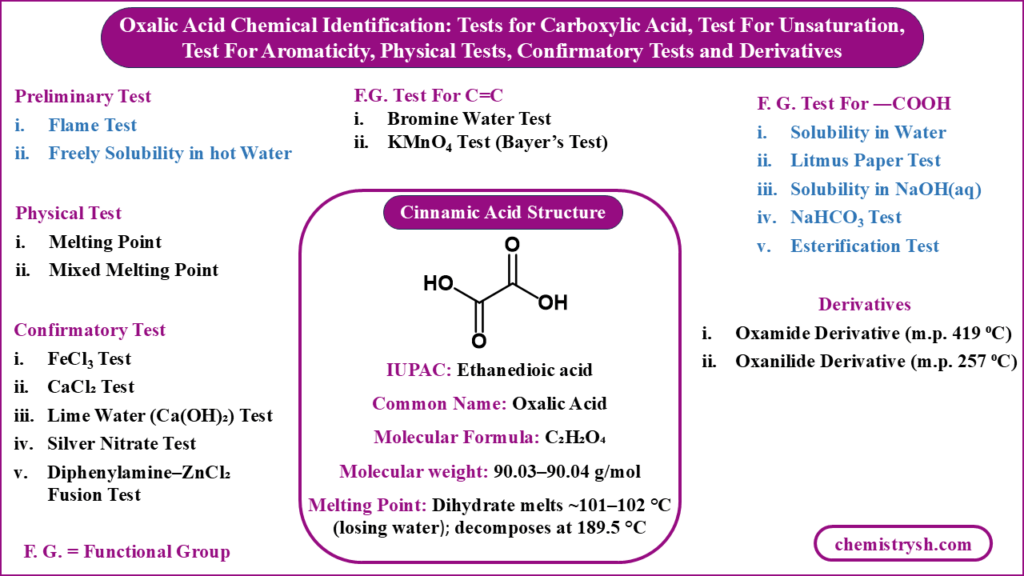
Identification Summary — Oxalic Acid
- Physical Properties: Physical Appearance · Solubility · Flame Test · Melting Point (dihydrate 101–102°C; anhydrous decomposes 189.5°C) · Molecular Formula (C₂H₂O₄) · MW (90.03 g/mol) · pKa₁ (1.25) · pKa₂ (3.81) · CAS No. (144-62-7) · IUPAC Name (Ethanedioic acid) · Common Name (Oxalic Acid)
- Chemical Tests: Litmus Test · NaHCO₃ Test · Esterification Test · Conc. H₂SO₄ Dehydration Test (CO + CO₂) · Acidified KMnO₄ Test · Bromine Water Test · CaCl₂ Test · Lime Water Test · Silver Nitrate Test · Diphenylamine–ZnCl₂ Fusion Test · Lassaigne’s Test · Iodine Test · Derivative Preparation (Oxamide m.p. 419°C) · Mixed Melting Point · Discussion · Conclusion · Observation and Inference Record · Applications · FAQs · MCQs
1. What Is Oxalic Acid? — Identity, Formula and Structure
1.a Identity and Formula
Oxalic acid is the simplest dicarboxylic acid found in nature. It occurs widely in plants — with the highest concentrations in rhubarb leaves, spinach, and wood sorrel (Oxalis) — from which it takes its name. First isolated and characterised by Carl Wilhelm Scheele in 1776, oxalic acid has since become a standard compound in undergraduate qualitative analysis practical examinations.
Its systematic IUPAC name is ethanedioic acid. The condensed structural formula HOOC–COOH reveals the defining feature: two carboxyl groups attached directly to each other with no intervening carbon chain, making it the simplest possible dicarboxylic acid.
Oxalic acid (HOOC–COOH) is the simplest case in the dicarboxylic acid series — and its structure is deceptively plain. There’s no chromophore, no ring, no double bond. That absence of clues is itself the first clue.
1.b Properties at a Glance
Oxalic acid (ethanedioic acid) has the molecular formula C₂H₂O₄ and a molecular weight of 90.03 g/mol. It appears as a white crystalline solid, odourless, with a melting point of 101–102°C for the dihydrate form and decomposition at 189.5°C for the anhydrous form. It is freely soluble in water (~90 g/L at 20°C) and carries two ionisable carboxyl groups with pKa₁ = 1.25 and pKa₂ = 3.81. Its CAS number is 144-62-7 (anhydrous).
|
# |
Property |
Value |
|
1 |
IUPAC name |
Ethanedioic acid |
|
2 |
Common names |
Oxalic acid; wood sorrel acid; dicarboxylic acid C2 |
|
3 |
Molecular formula |
C₂H₂O₄ (also written as HOOC–COOH) |
|
4 |
Molecular weight |
90.03–90.04 g/mol |
|
5 |
Functional groups |
2 × –COOH (carboxyl groups) |
|
6 |
Structural class |
Dicarboxylic acid (simplest member of the series) |
|
7 |
Degree of unsaturation |
2 (from two C=O groups, one per –COOH; no C=C, no rings) |
|
8 |
CAS number |
144-62-7 (anhydrous); 6153-56-6 (dihydrate) |
|
9 |
Acid character |
Diprotic — two ionisable –COOH groups; pKa₁ = 1.25–1.27, pKa₂ = 3.81 |
|
10 |
Appearance |
White crystalline solid; odourless |
|
11 |
Melting point |
Diprotic — two ionisable –COOH groups; pKa₁ = 1.25–1.27, pKa₂ = 3.81 |
|
12 |
Solubility in water |
~90 g/L at 20 °C (freely soluble); much lower in cold water |
|
13 |
Density |
1.90 g/cm³ (anhydrous) |
1.c Acid Strength — Is Oxalic Acid Strong or Weak?
Oxalic acid is classified as a weak dicarboxylic acid, though it is considerably stronger than most common organic acids. The first dissociation constant pKa₁ = 1.25 places it among the strongest of the weak acids — significantly stronger than acetic acid (pKa 4.76).
The high first acid dissociation constant arises from the inductive effect of the second carboxyl group, which withdraws electron density from the first –COOH via the short C–C bond, stabilising the conjugate base. The second dissociation (pKa₂ = 3.81) is weaker because the negative charge already present on the C₂O₄⁻ ion opposes removal of a second proton.
2. Where Is Oxalic Acid Found?
Oxalic acid is found in many plant species, where it occurs as the free acid and as calcium and potassium oxalate salts. The highest concentrations are found in:
Oxalic acid is found naturally in many plants and is also produced in the human body as a metabolic end product of ascorbic acid and glyoxylic acid metabolism.
- Rhubarb (Rheum rhabarbarum) leaves — up to 0.5 g/100 g fresh weight (leaves are toxic)
- Spinach (Spinacia oleracea) — 0.3–0.9 g/100 g fresh weight
- Wood sorrel (Oxalis) — source of the common name
- Beetroot, beet greens, Swiss chard, and kiwi fruit
In the human body, oxalic acid is produced endogenously as a metabolic end product of ascorbic acid (vitamin C) and glyoxylic acid metabolism. Elevated urinary oxalate leads to calcium oxalate kidney stones — the most common type of urinary calculus.
3. Planning the Identification of Oxalic Acid
3.a Identify the Functional Groups in Oxalic Acid
- No benzene ring → aliphatic, not aromatic
- No C=C double bond → fully saturated
- Two –COOH groups → dibasic carboxylic acid
- C–C bond flanked by two carbonyls → inherently oxidisable (reducing character)
That last point is the twist compared to cinnamic acid. In cinnamic acid, KMnO₄ was used to prove a double bond was there. In oxalic acid, there’s no double bond to find — instead, the molecule itself gets oxidised (to CO₂) by KMnO₄. The same reagent, doing a completely different diagnostic job.
3.b How to Identify Oxalic Acid — Structural Clues and Confirmatory Tests
Identifying oxalic acid in the laboratory depends on matching each structural feature of the molecule to a specific confirmatory test. The two carboxyl groups are confirmed by the NaHCO₃ and esterification tests; the reducing character of the C–C bond is confirmed by acidified KMnO₄ decolourisation; and the oxalate ion is specifically identified by calcium oxalate precipitation with lime water or CaCl₂.
|
Structural Clue |
Tests to Confirm It |
|
Absence of benzene ring |
Flame Test — burns without soot/smoke (low C:H ratio, non-aromatic) |
|
–COOH ×2 (dibasic acid) |
Litmus Test • NaHCO₃ Test (vigorous, rapid effervescence) • Ester Test |
|
Oxidisable C–C linkage |
Acidified KMnO₄ Test — decolourises on warming (hallmark test, not a C=C test here) |
|
Whole compound (oxalate ion) |
CaCl₂ Test / Lime Water Test — white precipitate of calcium oxalate, insoluble in acetic acid, soluble in dilute HCl |
3.b How to Identify Oxalic Acid — Structural Clues and Confirmatory Tests
A white/colourless crystalline solid, sparingly soluble in cold water but freely soluble in hot water and ethanol, that burns without a sooty flame is already pointing away from an aromatic acid and toward a simple aliphatic one. Strong, immediate litmus response and vigorous NaHCO₃ effervescence (stronger than a typical monocarboxylic acid) hint at the dibasic nature before a single confirmatory test is run.
4. Qualitative Tests for Oxalic Acid — Complete Step-by-Step Testing Sequence
The complete qualitative identification of oxalic acid follows a systematic testing sequence, beginning with physical appearance and solubility, progressing through functional group tests for the carboxyl group, and concluding with specific confirmatory tests for the oxalate ion — including acidified KMnO₄ decolourisation, calcium oxalate precipitation with lime water, silver nitrate test, and derivative preparation. The mixed melting point provides the final definitive confirmation of identity.
|
# |
Test |
What It Establishes |
|
1 |
Physical Appearance |
Colourless crystalline solid; no chromophore |
|
2 |
Solubility |
Sparingly soluble cold water, freely soluble hot water/ethanol; aliphatic acid profile |
|
3 |
Flame Test |
Absence of aromatic ring (clean, non-sooty flame) |
|
4 |
Elemental detection |
Confirms absence of N, S, Cl, Br, I |
|
5 |
Litmus Test |
Compound is acidic |
|
6 |
NaHCO₃ Test |
Carboxylic acid confirmed; vigorous effervescence consistent with a dibasic acid |
|
7 |
Ester Test |
–COOH confirmation; rules out sulfonic acid |
|
8 |
Acidified KMnO₄ Test |
Rapid decolourisation on warming = oxalate oxidised to CO₂ (reducing-agent signature — the key diagnostic test) |
|
9 |
CaCl₂ Test |
Fast screening confirmation of the oxalate ion (white precipitate on neutralisation + CaCl₂ addition) |
|
10 |
Melting Point / Decomposition |
Dihydrate melts ~101–102 °C (losing water); anhydrous acid decomposes at 189.5 °C without a sharp melt. Purity check against literature, not a single clean value |
|
11 |
Lime Water (Ca(OH)₂) Test |
Whole-compound fingerprint (white Ca-oxalate ppt, insoluble in AcOH, soluble in dil. HCl) |
|
12 |
Silver Nitrate Test |
Oxalate ion confirmation via photosensitive silver oxalate precipitate |
|
13 |
Diphenylamine–ZnCl₂ Fusion Test |
Blue colouration confirms oxalic acid via triphenylmethane-type dye formation |
|
14 |
Literature Survey |
Cross-check against standard references |
|
15 |
Control Test |
Validates precipitate results against authentic standard |
|
16 |
Diamide Derivative (Oxamide) |
m.p. 419 °C — verified value |
|
17 |
Dianilide Derivative (Oxanilide) |
m.p. 257 °C — verified value; second independent checkpoint |
|
18 |
Mixed Melting Point |
Gold-standard definitive proof of identity |
Note:
- This molecule does not contain the double bond, but the KMnO₄ colour is being discharged here. This indicates that the compound has reducing properties, and hence the KMnO₄ colour is discharged.
- With the benzene ring and double bond absent, the diagnostic weight shifts to the KMnO₄ test and the oxalate precipitation tests — not the flame test or bromine water used for cinnamic acid.
5. Materials and Reagents Required for Qualitative Identification of Oxalic Acid
The following materials and reagents are required to perform the complete qualitative identification of oxalic acid in an undergraduate laboratory.
- Oxalic acid sample (unknown), plus an authentic oxalic acid standard — for Mixed Melting Point
- Distilled water
- Metal spatula and Bunsen burner — for Dry Heating Test and Flame Test
- Nichrome wire loop — for Flame Test
- Blue litmus paper and universal pH paper — for Litmus/pH Test
- Sodium bicarbonate solution (5%) — for NaHCO₃ Test
- Ethanol and concentrated H₂SO₄ — for Esterification Test and Conc. H₂SO₄ Dehydration Test
- Sodium metal and an ignition tube — for Lassaigne’s Test
- Sodium nitroprusside solution and silver nitrate solution (elemental detection) — for Lassaigne’s Test
- Bromine water (Br₂/water) — for Bromine Water Test
- Acidified KMnO₄ solution (dilute H₂SO₄, 2% solution) — for Baeyer’s Test (hot/warm)
- Calcium chloride solution — for CaCl₂ Test
- Ammonium hydroxide (NH₄OH) solution — for neutralisation prior to CaCl₂ Test
- Lime water (Ca(OH)₂ solution) — for Lime Water Test
- Dilute acetic acid and dilute HCl — for confirming precipitate solubility in Lime Water Test
- Silver nitrate solution (AgNO₃) — for Silver Nitrate Test
- Capillary tubes, thermometer, liquid paraffin oil bath — for Melting Point Determination and Mixed Melting Point
- Lugol’s iodine solution (I₂ in KI) — for Iodine Test
- Diphenylamine and anhydrous zinc chloride (ZnCl₂) — for Diphenylamine–ZnCl₂ Fusion Test
- Ammonium oxalate or concentrated ammonia solution — for Oxamide Derivative Preparation
6. Systematic Qualitative Identification of Oxalic Acid — Step-by-Step Lab Procedure
The qualitative test for oxalic acid follows a fixed logical sequence: physical observations first, then functional group tests to narrow the compound class, then specific confirmatory tests for the oxalate ion, then derivative preparation and mixed melting point for definitive identity confirmation.
|
Step |
Test Name |
What It Detects / Rules Out |
Expected Result for Tartaric Acid |
Diagnostic Significance |
|
1 |
Physical Appearance |
Pure vs impure; organic vs inorganic; presence of colour |
White crystalline solid (anhydrous) or colourless monoclinic crystals (dihydrate); odourless |
Non-aromatic organic acid confirmed; no chromophore; no volatile acid vapour |
|
2 |
Solubility in water |
Polarity; hydrogen bonding capacity; distinguishes from benzoic acid (sparingly soluble) |
Freely soluble in water; clear colourless solution |
High polarity confirmed; two –COOH groups drive H-bonding |
|
3 |
Dry heating test |
Carboxylic acid character; hydroxy acid vs simple dicarboxylic acid |
Decomposes with evolution of colourless gas (CO + CO₂); no charring |
Dehydration/decomposition on heating — key diagnostic. Unlike tartaric acid (which chars), oxalic acid decomposes cleanly |
|
4 |
Flame test (ignition) |
Organic vs inorganic; aromatic vs aliphatic |
Burns with clean blue-yellow flame; no sooty smoke |
Aliphatic compound confirmed (no benzene ring); no soot distinguishes from aromatic acids |
|
5 |
Litmus / pH paper |
Acidic compound; strength of acid |
Blue litmus turns red; pH ≈ 1.4 (strongly acidic) |
Strongly acidic pH distinguishes oxalic acid from weaker carboxylic acids |
|
6 |
NaHCO₃ test |
–COOH group; diprotic character |
Brisk effervescence; 2 mol CO₂ per mol acid; gas turns lime water milky |
Confirms carboxylic acid; 2 mol CO₂ suggests diprotic acid |
|
7 |
Esterification test |
–COOH group confirmed; rules out sulfonic acid |
Fruity odour of diethyl oxalate on heating with ethanol and conc. H₂SO₄ |
Confirms esterifiable carboxyl group |
|
8 |
Conc. H₂SO₄ dehydration test |
Unique dehydration character of oxalic acid — distinguishes from other dicarboxylic acids |
Colourless gases (CO + CO₂) evolved immediately on addition of cold conc. H₂SO₄. No charring. |
CRITICAL DIAGNOSTIC: distinguishes oxalic acid from all other simple dicarboxylic acids |
|
9 |
Lassaigne’s test (elemental detection) |
Presence of N, S, Cl, Br, I |
Negative for all: compound contains C, H, and O only |
Rules out nitrogen-containing compounds, haloacids, and sulfonic acids |
|
10 |
Bromine water test |
C=C unsaturation; aromatic ring |
No decolourisation — NEGATIVE |
Confirms no C=C bonds, no aromatic ring; validates that Step 11’s KMnO₄ decolourisation is due to reducing character, not alkene oxidation |
|
11 |
Acidified KMnO₄ (Baeyer’s test) |
Reducing character; C=C double bond |
Rapid decolourisation of purple KMnO₄ on warming (hot solution) |
PRIMARY CONFIRMATORY TEST. POSITIVE and RAPID on warming — key contrast to tartaric acid, which decolourises far more slowly even under the same heated conditions. No other common solid carboxylic acid decolourises acidified KMnO₄ this way |
|
12 |
CaCl₂ test |
Oxalate ion — fast screening confirmation |
White precipitate forms immediately after neutralising with NH₄OH and adding CaCl₂ |
Fast preliminary confirmation of oxalate ion ahead of the more diagnostic Lime Water test |
|
13 |
Lime water test (Ca(OH)₂) |
Oxalate ion C₂O₄²⁻; specific to oxalic acid |
White precipitate of calcium oxalate (CaC₂O₄) forms immediately. Insoluble in dilute acetic acid; soluble in HCl. |
HIGHLY SPECIFIC. Insolubility in acetic acid distinguishes calcium oxalate from calcium tartrate |
|
14 |
Silver nitrate test (AgNO₃) |
Oxalate ion |
White precipitate of silver oxalate (Ag₂C₂O₄). Darkens on exposure to light (photosensitive). |
Photosensitivity of silver oxalate is a useful differentiating observation |
|
15 |
Diphenylamine–ZnCl₂ fusion test |
Oxalic acid confirmation via dye formation |
Mixture melts, then turns blue |
Confirms oxalic acid via formation of a triphenylmethane-type dye; ZnCl₂ acts as catalyst |
|
16 |
Melting point determination |
Purity; compound identity |
Dihydrate: melts ~101–102°C (loses water of crystallisation). Anhydrous: decomposes at 189.5°C without a sharp melt. |
The two forms give genuinely different results — not the same event at different rates. Compare: benzoic acid 122°C, citric acid 153°C, tartaric acid 171°C, salicylic acid 159°C |
|
17 |
Iodine test |
Polysaccharide / starch exclusion |
No colour change — NEGATIVE (remains yellow/brown) |
Negative result confirms glucose is NOT present and compound is not a polysaccharide |
|
18 |
Literature survey |
Identity cross-check against physical and chemical constants |
Literature match: aliphatic, saturated, diprotic acid, dihydrate m.p. 101–102°C / anhydrous decomposes 189.5°C, reducing character, oxalate precipitates with Ca²⁺ → ethanedioic acid (Sources: Merck Index, CRC Handbook, PubChem CID 971) |
Literature confirmation of m.p., solubility, pKa values, and reduction potential consistent with oxalic acid |
|
19 |
Derivative — Oxamide |
Literature comparison; independent of acid melting point ambiguity |
White crystalline solid; m.p. 419°C. Prepared by heating ammonium oxalate. |
High m.p. derivative provides unambiguous confirmation independent of the anhydrous/dihydrate ambiguity in the parent acid |
|
20 |
Mixed melting point |
Positive identity confirmation (gold standard) |
No depression when mixed 1:1 with authentic oxalic acid standard — conclusively confirms identity |
If mixed melting point is depressed, the unknown is NOT pure oxalic acid. A sharp, undepressed m.p. is the definitive confirmation |
7. Qualitative Test Procedures for Oxalic Acid — Observations and Equations
This section provides full procedural detail for each step in the identification sequence. Each test is presented as: Procedure → Observation → Inference → Chemical Equation (where applicable).
7.a Preliminary Tests
Step 1: Physical Appearance
Procedure: Examine the compound visually under good lighting. Waft cautiously with one hand — do not inhale directly.
Observation: White crystalline solid (anhydrous form) or colourless, monoclinic crystals (dihydrate form). Odourless. No colour.
Inference: Non-aromatic organic compound (no chromophore group). Absence of odour rules out volatile acids such as acetic acid and formic acid.
Step 2: Solubility in Water
Procedure: Add approximately 0.5 g of the compound to 5 mL distilled water. Shake to dissolve.
Observation: Freely soluble; gives a clear, colourless aqueous solution.
Inference: Polar compound with strong hydrogen-bonding capacity. Freely soluble in water distinguishes oxalic acid immediately from benzoic acid (sparingly soluble, 3 g/L) and phthalic acid.
Step 3: Dry Heating Test
Procedure: Place a small amount on a metal spatula. Heat gently over a Bunsen flame.
Observation: Compound decomposes; colourless gases are evolved (CO + CO₂). The compound does not char or melt cleanly — it sublimes partially and decomposes.
H₂C₂O₄ → CO↑ + CO₂↑ + H₂O (thermal decomposition above ~150°C)
1.b Properties at a Glance
Oxalic acid (ethanedioic acid) has the molecular formula C₂H₂O₄ and a molecular weight of 90.03 g/mol. It appears as a white crystalline solid, odourless, with a melting point of 101–102°C for the dihydrate form and decomposition at 189.5°C for the anhydrous form. It is freely soluble in water (~90 g/L at 20°C) and carries two ionisable carboxyl groups with pKa₁ = 1.25 and pKa₂ = 3.81. Its CAS number is 144-62-7 (anhydrous).
|
# |
Property |
Value |
|
1 |
IUPAC name |
Ethanedioic acid |
|
2 |
Common names |
Oxalic acid; wood sorrel acid; dicarboxylic acid C2 |
|
3 |
Molecular formula |
C₂H₂O₄ (also written as HOOC–COOH) |
|
4 |
Molecular weight |
90.03–90.04 g/mol |
|
5 |
Functional groups |
2 × –COOH (carboxyl groups) |
|
6 |
Structural class |
Dicarboxylic acid (simplest member of the series) |
|
7 |
Degree of unsaturation |
2 (from two C=O groups, one per –COOH; no C=C, no rings) |
|
8 |
CAS number |
144-62-7 (anhydrous); 6153-56-6 (dihydrate) |
|
9 |
Acid character |
Diprotic — two ionisable –COOH groups; pKa₁ = 1.25–1.27, pKa₂ = 3.81 |
|
10 |
Appearance |
White crystalline solid; odourless |
|
11 |
Melting point |
Diprotic — two ionisable –COOH groups; pKa₁ = 1.25–1.27, pKa₂ = 3.81 |
|
12 |
Solubility in water |
~90 g/L at 20 °C (freely soluble); much lower in cold water |
|
13 |
Density |
1.90 g/cm³ (anhydrous) |
1.c Acid Strength — Is Oxalic Acid Strong or Weak?
Oxalic acid is classified as a weak dicarboxylic acid, though it is considerably stronger than most common organic acids. The first dissociation constant pKa₁ = 1.25 places it among the strongest of the weak acids — significantly stronger than acetic acid (pKa 4.76).
The high first acid dissociation constant arises from the inductive effect of the second carboxyl group, which withdraws electron density from the first –COOH via the short C–C bond, stabilising the conjugate base. The second dissociation (pKa₂ = 3.81) is weaker because the negative charge already present on the C₂O₄⁻ ion opposes removal of a second proton.
10. Anhydrous vs. Dihydrate Forms
Same compound, two identities — the form you have changes everything about your melting point result.
• Anhydrous form — decomposes at 189.5°C, no sharp melt, density 1.90 g/cm³, white crystalline powder
• Dihydrate form (H₂C₂O₄·2H₂O) — melts at 101–102°C, loses water of crystallisation, density 1.653 g/cm³, colourless monoclinic crystals
Both forms dissolve to give the same aqueous solution with identical pH and chemical behaviour. Neither form shows optical rotation as oxalic acid contains no chiral centres. The dihydrate is the more commonly encountered laboratory form and is used as a primary standard for KMnO₄ standardisation and NaOH titrations. The anhydrous form is preferred where water-free conditions are required, such as in oxamide derivative preparation. The water of crystallisation in the dihydrate is released at 101–102°C — this is the event recorded during melting point determination, not thermal decomposition of the acid itself.
|
Property |
Anhydrous Form |
Dihydrate Form (H₂C₂O₄·2H₂O) |
|
Melting point |
Decomposes at 189.5 °C (no sharp melt) |
Loses water of crystallisation and melts ~101–102 °C |
|
Decomposition |
Decomposes above 150 °C to CO + CO₂ + H₂O, fully decomposed by 189.5 °C |
Loses water of crystallisation at ~101 °C, then behaves as anhydrous form |
|
Density |
1.90 g/cm³ |
1.653 g/cm³ |
|
Appearance |
White crystalline powder |
Colourless monoclinic crystals |
|
Optical rotation |
Not applicable (no chiral centres) |
Not applicable |
|
pH (0.1 M solution) |
Approximately 1.4 |
Same as anhydrous after dissolution |
11. Qualitative Identification of Oxalic Acid — Observation and Inference Record
The following results and discussion template is designed for practical examination reports on the qualitative identification of oxalic acid. Students should record observations for each chemical test — including solubility tests, precipitation tests, confirmatory tests, and functional group tests — in the observation column during the practical, and complete the inference column immediately after each test. Each observation and inference must be decided independently by the student. This practice develops the chemical observation and analytical reasoning skills that are essential for qualitative analysis — the ability to look at a result, understand what it confirms or rules out, and build a logical case for the identity of an unknown compound.
|
Step |
Test |
Reagent |
Observation (fill in) |
Inference (fill in) |
Confirms / Rules Out |
|
1 |
Physical appearance |
Visual |
|||
|
2 |
Solubility |
Distilled water |
Polarity, H-bonding |
||
|
3 |
Dry heating test |
Heat only |
Decarboxylation character |
||
|
4 |
Flame test |
Bunsen flame |
Aromatic vs aliphatic |
||
|
5 |
Litmus / pH paper |
PH paper |
Acid strength |
||
|
6 |
NaHCO₃ test |
NaHCO₃ solution |
–COOH group |
||
|
7 |
Esterification |
EtOH + conc. H₂SO₄ |
–COOH confirmed |
||
|
8 |
Conc. H₂SO₄ |
Cold Conc. H₂SO₄ |
Unique to oxalic acid |
||
|
9 |
Lassaigne’s |
Na fusion |
N, S, halogen absent |
||
|
10 |
Bromine water |
Br₂ / water |
C=C absent |
||
|
11 |
Acidified KMnO₄ |
KMnO₄/H₂SO₄, warm |
Primary confirmatory, reducing character |
||
|
12 |
CaCl₂ test |
NH₄OH then CaCl₂ |
Oxalate ion, fast screen |
||
|
13 |
Lime water |
Ca(OH)₂ |
Oxalate ion specific |
||
|
14 |
Silver nitrate |
AgNO₃ |
Oxalate ion |
||
|
15 |
Diphenylamine–ZnCl₂ |
Fusion |
Dye formation confirms identity |
||
|
16 |
Melting point |
Capillary/oil bath |
Physical identity |
||
|
17 |
Iodine test |
I₂/KI |
Polysaccharide absent |
||
|
18 |
Literature survey |
References |
Cross-check constants |
||
|
19 |
Derivative — oxamide |
NH₃ + heat |
Independent m.p. (419°C) |
||
|
20 |
Mixed melting point |
Authentic standard |
Gold standard confirm |
12. Applications of Oxalic Acid
Oxalic acid has significant applications in analytical chemistry, industry, and household cleaning. It is widely used as a primary standard for standardising KMnO₄ and NaOH solutions in volumetric titrations, owing to its high purity, stability, and well-defined stoichiometric reactions. As a bleaching agent, it is effective for rust removal, ink stain removal, and textile bleaching. Its ability to chelate iron oxides also makes it valuable as a metal cleaning agent and component of metal polishes.
|
Application |
Details |
|
Primary standard in analytical chemistry |
Used to standardise KMnO₄ and NaOH solutions in titrations, due to its high purity, stability, and well-defined stoichiometric reaction |
|
Bleaching agent |
Rust and ink stain removal, textile bleaching |
|
Metal cleaning / rust removal |
Chelates iron oxides, used in metal polishes |
13. Oxalic Acid Identification — Glossary of Key Terms
Chelation
The ability of a compound to form multiple bonds with a single metal ion, effectively trapping it. Oxalic acid chelates iron oxides, which is the basis of its use as a rust remover and metal cleaning agent.
Chiral Centre
A carbon atom bonded to four different groups, giving rise to non-superimposable mirror images called optical isomers. Oxalic acid has no chiral centres and therefore shows no optical rotation.
Chromophore
A structural feature of a molecule responsible for its colour by absorbing specific wavelengths of light. Oxalic acid has no chromophore, consistent with its appearance as a white, colourless solid.
Conjugate Base
The species formed when an acid donates a proton (H⁺) to a base. The conjugate base of oxalic acid after the first dissociation is the hydrogen oxalate ion (HC₂O₄⁻); after the second dissociation it is the oxalate ion (C₂O₄²⁻).
Degree of Unsaturation
A calculated value indicating the total number of double bonds and rings present in a molecule. Oxalic acid has a degree of unsaturation of 2, arising from the two C=O groups in its two carboxyl groups — with no C=C double bonds and no rings.
Diprotic Acid
An acid capable of donating two protons (H⁺) per molecule in successive dissociation steps. Oxalic acid is diprotic, with pKa₁ = 1.25 for the first dissociation and pKa₂ = 3.81 for the second.
Functional Group
A specific atom or group of atoms within a molecule responsible for its characteristic chemical reactions. The functional groups present in oxalic acid are two carboxyl groups (–COOH), which determine its acid character, reducing properties, and reactivity in all confirmatory tests.
Inductive Effect
The transmission of electron density through sigma (σ) bonds in a molecule. In oxalic acid, the second carboxyl group withdraws electron density from the first –COOH via the short C–C bond, stabilising the conjugate base and increasing acid strength.
Lewis Acid
A species that accepts an electron pair from a donor (Lewis base) to form a coordinate bond. In the diphenylamine–ZnCl₂ fusion test, zinc chloride (ZnCl₂) acts as a Lewis acid catalyst, enabling the condensation reaction that produces the characteristic blue colouration.
Optical Rotation
The rotation of plane-polarised light passing through a solution of a chiral compound. Oxalic acid shows no optical rotation as it contains no chiral centres — it is optically inactive.
Precipitation
The formation of an insoluble solid (precipitate) from solution when two reagents are combined. In oxalic acid identification, precipitation of calcium oxalate (CaC₂O₄) with lime water or CaCl₂ is a key confirmatory test for the oxalate ion.
Qualitative Analysis
The branch of analytical chemistry concerned with identifying which chemical substances are present in a sample, as opposed to quantitative analysis which measures how much of each is present. The systematic identification of oxalic acid through physical observations, functional group tests, and confirmatory tests is an example of qualitative analysis.
Reducing Agent
A substance that donates electrons to another substance, causing reduction while itself being oxidised. Oxalic acid is a strong reducing agent — it reduces Mn⁷⁺ in acidified KMnO₄ to Mn²⁺, causing rapid decolourisation on warming.
Triphenylmethane
A class of organic compound characterised by three phenyl groups attached to a central carbon. In the diphenylamine–ZnCl₂ fusion test, oxalic acid produces a blue-coloured triphenylmethane-type dye, confirming its identity.
FAQ’s
Multiple Choice Questions
MCQ 1
1. What is the IUPAC name of oxalic acid?
A. Propanedioic acid
B. Ethanedioic acid
C. Butanedioic acid
D. 2-hydroxypropanedioic acid
MCQ 2
2. Which of the following tests is MOST specific for the identification of oxalic acid among common carboxylic acids?
A. NaHCO₃ effervescence test
B. Diphenylamine–ZnCl₂ fusion colour test
C. Lime water (Ca(OH)₂) precipitate test
D. Litmus paper test
💡 Explanation: The Ca(OH)₂ test forms calcium oxalate — a white precipitate INSOLUBLE in acetic acid. This insolubility in acetic acid is unique to calcium oxalate and makes this test highly specific for the oxalate ion. NaHCO₃ and litmus tests confirm only carboxylic acid class.
MCQ 3
3. What gases are evolved when oxalic acid is heated with concentrated H₂SO₄?
A. CO₂ only
B. SO₂ and CO₂
C. CO and CO₂
D. CO and H₂O
Explanation: Concentrated H₂SO₄ dehydrates oxalic acid to give CO and CO₂ simultaneously. CO burns with a blue flame; CO₂ turns lime water milky. This simultaneous production of both gases is unique to oxalic acid among common dicarboxylic acids.
MCQ 4
4. In the reaction between oxalic acid and acidified KMnO₄, the reaction is initially slow but then accelerates. This behaviour is termed:
A. Exothermic catalysis
B. Autocatalysis
C. Chain reaction
D. Enzyme catalysis
Explanation: Autocatalysis occurs when a product of the reaction catalyses the reaction itself. As oxalic acid reduces KMnO₄, Mn²⁺ is produced, which acts as a catalyst for further oxidation of oxalic acid by KMnO₄, so the reaction accelerates as it proceeds.
MCQ 5
5. The mixed melting point of an unknown compound mixed 1:1 with authentic oxalic acid shows NO depression. This means:
A.The unknown has a higher melting point than oxalic acid
B. The unknown is a different compound
C. The unknown is oxalic acid
D. The unknown is contaminated with an impurity
Explanation: No melting point depression when two compounds are mixed means they are the same compound — no impurity effect occurs. A different compound would depress and broaden the melting range.
MCQ 6
6. When bromine water is added to tartaric acid, the result is:
A. Oxalic acid is not an acid
B. Oxalic acid cannot react with halogens
C. Oxalic acid cannot react with halogens
D. Oxalic acid is a primary standard
Explanation: A negative bromine water test confirms the absence of C=C double bonds and aromatic rings. This proves that the subsequent positive KMnO₄ decolourisation is due to the REDUCING CHARACTER of oxalic acid, not alkene oxidation.
MCQ 7
7. What is the melting point of anhydrous oxalic acid?
A. 101–102°C
B. 189.5°C (decomposes)
C. 122–123°C
D. 171–172°C
Explanation: Anhydrous oxalic acid decomposes at 189.5°C rather than melting cleanly. 101–102°C is the melting point of the dihydrate (H₂C₂O₄·2H₂O), which loses its water of crystallisation at that temperature — a common point of confusion since the dihydrate is the more frequently encountered laboratory form.
MCQ 8
8. Which property of calcium oxalate makes the lime water/CaCl₂ test specific for oxalic acid?
A. It is white in colour
B. It is insoluble in dilute acetic acid
C. It dissolves in dilute HCl
D. It forms immediately on mixing
Explanation: The critical property is insolubility in dilute acetic acid. Most other calcium salts of organic acids (calcium tartrate, calcium acetate) dissolve in dilute acetic acid. Calcium oxalate does not dissolve in acetic acid but does dissolve in HCl.
MCQ 9
9. What is the colour change observed when oxalic acid reduces acidified KMnO₄?
A. Colourless to pink
B. Purple/violet to colourless
C. Blue to green
D. Yellow to brown
Explanation: KMnO₄ is purple/violet in solution (Mn⁷⁺). When reduced by oxalic acid, Mn⁷⁺ is converted to Mn²⁺, which is nearly colourless in acidic solution. Therefore the purple colour disappears — decolourisation.
MCQ 10
10. Silver oxalate (Ag₂C₂O₄) is characterised by which distinctive property that helps identify it?
A. It is yellow in colour
B. It is soluble in water
C. It is photosensitive and darkens in light
D.It burns with a green flame
Explanation: Silver oxalate is white but darkens on exposure to light due to the photochemical reduction of Ag⁺ to Ag⁰ — the same principle as photographic film. The precipitate dissolves in dilute HNO₃.
MCQ 11
11. Why must the KMnO₄ solution be acidified with H₂SO₄ (not HCl or HNO₃) when testing oxalic acid?
A. HCl would reduce KMnO₄ independently, giving a false result
B. HNO₃ would oxidise oxalic acid before KMnO₄
C. Both A and B
D. H₂SO₄ is cheaper
Explanation: HCl would independently reduce permanganate, consuming KMnO₄ independently of the oxalic acid. HNO₃ is an oxidising acid that would oxidise oxalic acid itself before the test can proceed. H₂SO₄ is non-reducing and non-oxidising under these conditions.
MCQ 12
12.Which of the following is NOT a preliminary test for oxalic acid identification?
A. Physical appearance examination
B. Solubility in water
C. Diphenylamine–ZnCl₂ fusion test
D. Flame test
Explanation: The diphenylamine–ZnCl₂ fusion test is a CONFIRMATORY test, not a preliminary test. Preliminary tests cover physical observations: appearance, solubility, dry heating, and flame test. Confirmatory tests like this one come later and provide specific identity confirmation.
MCQ 13
13. Oxalic acid dihydrate is widely used as a primary standard for standardising titrations (e.g. KMnO₄ and NaOH solutions). Which property qualifies it for this role?
A. It is freely soluble in water
B. It is available in high purity, has a high equivalent weight, is stable, and does not absorb CO₂ or moisture readily
C. It is a strong acid
D. It reacts rapidly with KMnO₄
Explanation: A primary standard must be available in high purity, stable, have a reasonably high equivalent weight, and react completely and stoichiometrically with the titrant. Oxalic acid dihydrate (M = 126.07 g/mol; equivalent weight = 63.03 g/eq) meets all these criteria, which is why it is the standard choice for standardising titrations against KMnO₄ and NaOH
MCQ 14
14. What is the expected observation when oxalic acid solution is treated with AgNO₃ solution in sunlight compared to darkness?
A. No difference — silver oxalate is stable in both conditions
B. White precipitate in darkness; no precipitate in sunlight
C. White precipitate in both; precipitate darkens in sunlight
D. Yellow precipitate in sunlight; white in darkness
Explanation: Silver oxalate (Ag₂C₂O₄) precipitates as a white solid in both light and darkness. However, the precipitate darkens on exposure to sunlight due to the photochemical reduction of Ag⁺ → Ag⁰ (metallic silver) — the same principle underlying silver halide photographic film.