
Identification Summary — Glucose
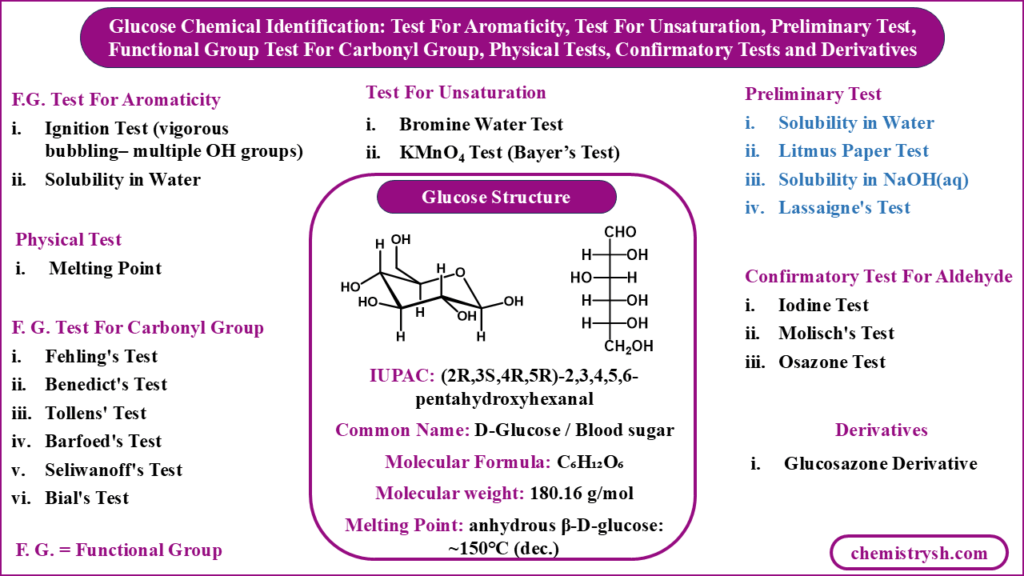
- Physical Properties: Physical Appearance · Solubility · Ignition Test · Litmus Test · Lassaigne’s Test · Melting Point (anhydrous α-D-glucose 146°C dec. · anhydrous β-D-glucose 150°C dec. · monohydrate 83°C) · Optical Rotation ([α]²⁰/D equilibrium +52.7° · α-D-glucose +112° · β-D-glucose +18.7°) · Molecular Formula (C₆H₁₂O₆) · MW (180.16 g/mol) · CAS No. (50-99-7) · IUPAC Name ((2R,3S,4R,5R)-2,3,4,5,6-pentahydroxyhexanal) · Common Names (D-Glucose · Dextrose · Grape Sugar · Blood Sugar)
- Chemical Tests: Brady’s Test (2,4-DNPH) · Molisch’s Test · Fehling’s Test · Benedict’s Test · Tollens’ Test · Barfoed’s Test · Seliwanoff’s Test · Iodine Test · Bial’s Test · Osazone Formation Test · Melting Point · Melting Point of Derivative (Glucosazone) · Discussion · Conclusion · Observation and Inference Record · Glossary · Uses and Applications · Safety Precautions · Glucose Identification Tests — Questions Designed to Increase Your Learning Capacity · MCQs
What Is Glucose? — Introduction and Background
Glucose is the most fundamental monosaccharide in biochemistry, with the molecular formula C₆H₁₂O₆ — an aldohexose, meaning it is a six-carbon sugar bearing an aldehyde group at C1. In its open-chain form, its full IUPAC name is (2R,3S,4R,5R)-2,3,4,5,6-pentahydroxyhexanal, more commonly written simply as D-glucose.
The common name derives from the Greek “glykys”, meaning sweet, and glucose is also widely known as dextrose, grape sugar, or blood sugar — the same compound measured in clinical blood glucose tests and monitored in diabetes management. This article presents a complete glucose qualitative analysis — the full step-by-step identification test sequence used in organic chemistry laboratories.
Glucose Molecular Formula, Structure and Physical Properties (Molecular Mass, Chemical Name and CAS Number)
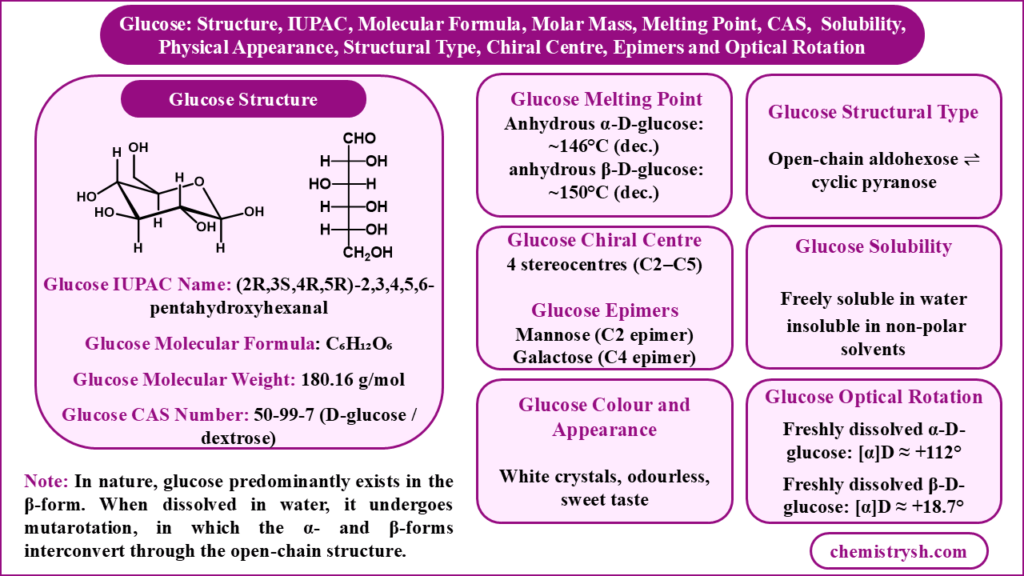
Glucose (molecular formula C₆H₁₂O₆; molar mass 180.16 g/mol; CAS 50-99-7) is the simplest aldohexose — its IUPAC name (2R,3S,4R,5R)-2,3,4,5,6-pentahydroxyhexanal encodes four stereocentres, a free aldehyde (–CHO), and five hydroxyl groups (–OH) that together explain every result in the identification panel below. In aqueous solution, glucose exists predominantly in the cyclic pyranose ring form (>99%), yet it is the open-chain aldehyde — accessible via mutarotation ([α]²⁰/D equilibrium +52.7°) — that makes it a reducing sugar and drives the positive Fehling’s, Benedict’s and Tollens’ tests. Melting point: 146°C (anhydrous α-D-glucose; CAS 492-62-6).
|
Property |
Value |
Significance for Identification |
|---|---|---|
|
IUPAC Name (Chemical Name) |
(2R,3S,4R,5R)-2,3,4,5,6-pentahydroxyhexanal |
Confirms the compound is an aldehyde (hexanal backbone) with four defined stereocentres — the full stereochemical identity of D-glucose |
|
Common Names / Other Names |
D-Glucose · Dextrose · Grape sugar · Blood sugar |
All four names refer to the same compound; “dextrose” is used in clinical/IV contexts; “blood sugar” in medical contexts |
|
Molecular Formula (Chemical Formula) |
C₆H₁₂O₆ |
Hexose; 1:2:1 C:H:O ratio typical of carbohydrates (hence the old term “hydrate of carbon”) |
|
Molar Mass (Molecular Mass / Molecular Weight) |
180.16 g/mol |
Used in mole calculations and in clinical/industrial dosing contexts (e.g. IV dextrose) |
|
CAS Number |
50-99-7 (D-glucose / dextrose); 492-62-6 (α-D-glucose anhydrous) |
50-99-7 (D-glucose / dextrose); 492-62-6 (α-D-glucose anhydrous) |
|
Functional Groups |
Aldehyde (–CHO, open-chain form) · Five hydroxyl groups (–OH) |
Aldehyde drives Fehling’s, Benedict’s, Tollens’; –OH groups drive Molisch’s and high water solubility |
|
Structural Type (Open-Chain and Cyclic Structure) |
Open-chain aldohexose ⇌ cyclic pyranose |
Cyclic form predominates in solution; governs which tests give clean results |
|
Chiral centres |
4 stereocentres (C2–C5) |
Cyclic form predominates in solution; governs which tests give clean results |
|
Epimers |
Mannose (C2 epimer), Galactose (C4 epimer) |
Distinguishes glucose from its closest structural relatives |
|
Colour & appearance |
White crystals, odourless, sweet taste |
No chromophore → rules out a conjugated/aromatic system |
|
Melting point |
Anhydrous α-D-glucose: ~146°C (dec.); anhydrous β-D-glucose: ~150°C (dec.); glucose monohydrate: ~83°C (loses water of crystallisation before the anhydrous form melts) |
Headline teaching value: 146°C (anhydrous α-form); β-D-glucose: 150°C; monohydrate: 83°C. Note: higher-purity preparations may read 150–152°C — the 146°C figure is the standard teaching value. |
|
Solubility |
Freely soluble in water; insoluble in non-polar solvents |
Explained by five –OH groups extensively hydrogen-bonding with water |
|
Optical Rotation (Mutarotation) |
Freshly dissolved α-D-glucose: [α]D ≈ +112°; freshly dissolved β-D-glucose: [α]D ≈ +18.7°; both mutarotate to equilibrium [α]D ≈ +52.7° (≈36% α : 64% β) |
This is an anomer difference (α vs β ring closure), not an anhydrous-vs-monohydrate difference. Equilibrium value [α]²⁰/D +52.7°, c = 10% (w/v) in water confirmed from Sigma-Aldrich G8270 (≥99.5% GC), verified August 2026. |
|
Reducing / Non-Reducing Sugar |
Reducing sugar (free/potential aldehyde) |
Governs the outcome of Fehling’s, Benedict’s, and Tollens’ tests later in the article |
Planning the Identification of Glucose — Decode the Structure First
Understanding how to identify glucose in the lab begins not at the bench but on paper — by reading the molecular structure before selecting any test. Every competent qualitative analysis begins the same way — not at the bench, but on paper. Before a single reagent is added, the structural formula of the compound must be examined carefully. The glucose structure is a direct instruction manual: it tells you exactly which tests to perform and, just as importantly, which tests would be irrelevant.
Study the glucose structure — both the open-chain Fischer projection and the cyclic Haworth/pyranose form. Three distinct structural features are immediately visible, and each one maps to a specific set of confirmatory tests.
Step 1 — Identify the Functional Groups in Glucose
- Aldehyde group (–CHO, open-chain form) → reducing character; drives Fehling’s, Benedict’s, and Tollens’ tests
- Five –OH groups (polyhydroxy) → high water solubility; drives Molisch’s test — the general carbohydrate test
- Cyclic hemiacetal (predominant form in solution, >99%) → explains mutarotation ([α]D ≈ +52.7°, ≈36% α : 64% β) and governs the specificity of the osazone reaction
Glucose carries no aromatic ring and no ionisable acidic group — instead, a cluster of hydroxyl groups alongside one reactive carbonyl. This is why its test battery relies on colour-change and precipitate reactions rather than acid–base chemistry.
Step 2 — Match Each Glucose Structural Feature to Its Confirmatory Identification Test
|
Structural Clue |
Structural Clue |
|
|---|---|---|
|
1 |
Polyhydroxy carbon skeleton (carbohydrate in general) |
Molisch’s Test |
|
2 |
Aliphatic (non-aromatic) skeleton + multiple –OH groups |
Ignition Test — clean non-sooty flame confirms aliphatic character; vigorous bubbling on burning confirms polyhydroxy character |
|
3 |
Aldehyde / potential aldehyde (reducing group) |
Fehling’s Test · Benedict’s Test · Tollens’ Test |
|
4 |
Monosaccharide vs. disaccharide |
Barfoed’s Test |
|
5 |
Aldose vs. ketose |
Seliwanoff’s Test |
|
6 |
Hexose vs. pentose; excludes polysaccharide |
Bial’s Test · Iodine Test |
|
7 |
Whole compound (glucose specifically) |
Whole compound (glucose specifically) |
Structure and Reactivity of Glucose
Before performing a single test, the structure of glucose already predicts every result in the identification panel. The key is to read both forms of glucose simultaneously — the open-chain Fischer projection and the cyclic Haworth/pyranose form — because each form explains a different part of the test behaviour.
I. The Open-Chain Form — Where the Reactivity Lives
In the open-chain (Fischer) form, C1 carries a free aldehyde group (–CHO). This aldehyde is the reactive centre that drives the three reducing-sugar tests: Fehling’s, Benedict’s, and Tollens’. It donates electrons to Cu²⁺ or Ag⁺, reducing them to Cu₂O and Ag respectively, while being oxidised itself to gluconate. No aldehyde — no silver mirror, no brick-red precipitate.
The five hydroxyl groups (–OH) on C2–C6 are equally important: they make glucose freely soluble in water via hydrogen bonding, and they are what Molisch’s reagent detects. Concentrated H₂SO₄ dehydrates these hydroxyls to a furfural-type intermediate that condenses with α-naphthol to produce the characteristic violet ring.
II. The Cyclic Form — Why Glucose is Still a Reducing Sugar in Solution
In aqueous solution, more than 99% of glucose exists in the cyclic pyranose form — a six-membered ring formed when the C1 aldehyde reacts with the C5 hydroxyl to create a hemiacetal. This raises an important question:
If the aldehyde is locked in the ring, why does glucose still give positive reducing-sugar tests?
The answer is mutarotation. The hemiacetal C1 bond (the anomeric position) is in dynamic equilibrium: the ring opens momentarily to regenerate the free aldehyde, which can then react with Fehling’s or Tollens’ reagent, before closing again as either the α- or β-anomer.
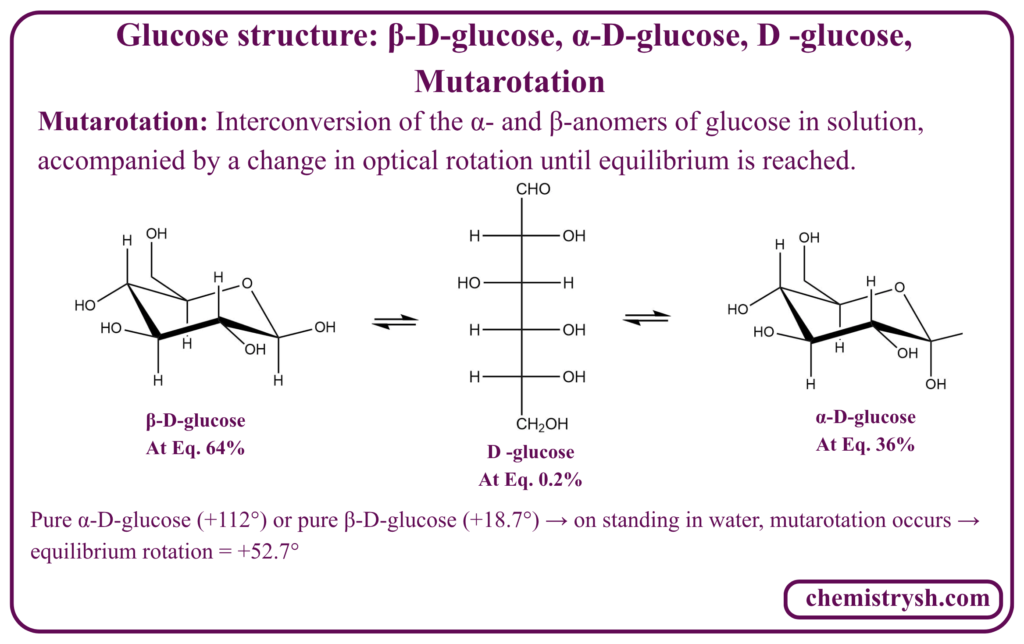
This equilibrium is the reason glucose shows mutarotation — freshly dissolved α-D-glucose ([α]D ≈ +112°) and β-D-glucose ([α]D ≈ +18.7°) both converge on the same equilibrium optical rotation ([α]D ≈ +52.7°, ≈36% α : 64% β) as the ring continuously opens and recycles. So the reducing tests work not because the aldehyde is permanently free, but because the ring equilibrium keeps supplying the open-chain form as it is consumed by the reagent.
Predicting Glucose Identification Test Results Directly from Molecular Structure
Seven structural features of glucose are directly testable in the laboratory. Each feature produces a specific observation that confirms one structural conclusion and excludes one alternative:
- No benzene ring (aliphatic skeleton) — clean non-sooty flame confirms aliphatic character; an aromatic compound would burn with a sooty luminous flame → Ignition Test
- Five –OH groups (polyhydroxy character) — freely soluble in water and vigorous frothing on burning indicate polyhydroxy character; finally confirmed by Molisch’s Test (violet ring) → Solubility Test · Ignition Test (indication) · Molisch’s Test (confirmation)
- Aldehyde / potential aldehyde (ring-opening equilibrium) — brick-red precipitate and silver mirror confirm reducing character; a non-reducing sugar such as sucrose gives neither → Fehling’s Test · Benedict’s Test · Tollens’ Test
- Monosaccharide (single sugar unit) — red precipitate within 2 minutes confirms monosaccharide; a disaccharide reacts too slowly to precipitate within this window → Barfoed’s Test
- Aldose (carbonyl at C1, not C2) — slow weak response confirms aldose (glucose); a ketose such as fructose gives rapid cherry-red within 1 minute → Seliwanoff’s Test
- Hexose; no helical polymer structure — Iodine Test: amylose gives blue-black, glycogen gives reddish-brown — polyiodide complex forms inside the helical structure; glucose gives no colour change — pale yellow-brown of reagent persists → polysaccharide excluded; free monosaccharide confirmed
- Hexose; not a pentose — Bial’s Test: pentoses dehydrate to furfural → condenses with orcinol → blue-green complex (positive); glucose dehydrates to hydroxymethylfurfural → condenses with orcinol → muddy-brown or yellow-gray (negative) → pentose excluded; hexose confirmed
- No nitrogen, sulfur, or halogens — no Prussian blue, no black precipitate, no AgCl confirms C, H, O only; amines, thio-compounds, and halogenated compounds each give a characteristic positive → Lassaigne’s Test
All structural features, their predicted observations, and their confirming tests are summarised in the table below.
|
Structural Feature |
Prediction Before Testing |
Significance for Identification |
|---|---|---|
|
No benzene ring (aliphatic skeleton) |
No sooty flame on ignition; burns clean |
Ignition Test (negative for sooty flame) |
|
Five –OH groups (polyhydroxy) |
Freely soluble in water; Molisch’s test will be positive; vigorous frothing on ignition (dehydration) |
Solubility Test; Molisch’s Test; Ignition Test (frothing) |
|
Aldehyde (–CHO) / potential aldehyde via ring-opening equilibrium |
Fehling’s, Benedict’s, and Tollens’ tests will all be POSITIVE (brick-red precipitate; silver mirror) |
Fehling’s Test; Benedict’s Test; Tollens’ Test |
|
Monosaccharide (single sugar unit) |
Barfoed’s test will be positive (fast reaction within 2 minutes, unlike disaccharides) |
Barfoed’s Test |
|
Aldose (carbonyl at C1, not a ketone at C2) |
Seliwanoff’s test will be NEGATIVE (slow/weak response — only ketoses react rapidly) |
Seliwanoff’s Test (negative confirms aldose) |
|
Hexose (6 carbons); no helical polymer structure |
Iodine test NEGATIVE (no blue-black); Bial’s test NEGATIVE (no blue-green — pentoses would give blue-green) |
Iodine Test (negative); Bial’s Test (negative) |
|
No nitrogen, sulfur, or halogens |
Lassaigne’s test will be NEGATIVE — compound contains only C, H, and O |
Lassaigne’s Test (negative) |
Having identified the structural features of glucose and their corresponding tests, the question is now one of sequence,
In what order should these tests be performed for maximum diagnostic efficiency?
The table below presents all identification tests in their recommended diagnostic order, from the cheapest and most informative preliminary observations through to the final confirmatory derivative.
Glucose Qualitative Analysis — Step-by-Step Identification Test Sequence
The following glucose qualitative analysis step by step sequence presents identification tests in diagnostic order. The glucose qualitative analysis sequence below presents fifteen identification tests in diagnostic order — from preliminary physical observations through to chemical confirmation and derivative preparation. Each test answers one specific structural question about the unknown compound:
- Is a carbohydrate present?
- Is it a reducing sugar?
- Is it a monosaccharide or disaccharide?
- Is it an aldose or ketose?
- Is it a hexose or pentose?
The sequence ends with glucosazone formation and a mixed melting point — the gold-standard confirmation of glucose identity.
|
Test |
What It Establishes |
|
|---|---|---|
|
1 |
Physical Appearance |
White crystalline solid, odourless; no chromophore — rules out a conjugated or aromatic structure |
|
2 |
Solubility |
Freely soluble in cold water (multiple –OH groups hydrogen-bond readily); insoluble in non-polar solvents |
|
3 |
Ignition (Flame) Test |
Absence of a sooty flame confirms an aliphatic (non-aromatic) structure; vigorous bubbling/frothing on burning is caused by dehydration of the multiple –OH groups, releasing water vapour — true of all carbohydrates, but NOT unique to them (e.g. tartaric acid shows the same dehydration bubbling), so it is read alongside Molisch’s test, not in place of it |
|
4 |
Lassaigne’s Test (Sodium Fusion Test) |
Detects the presence of heteroatoms — nitrogen, sulfur, and halogens — in the organic compound. A negative result confirms that the compound contains carbon, hydrogen, and oxygen only, with no nitrogen, sulfur, or halogen atoms present. Glucose gives a negative Lassaigne’s test — confirming it is a pure C, H, O compound with no heteroatoms. |
|
5 |
Molisch’s Test |
General test for ALL carbohydrates — confirms a carbohydrate is present but does not identify which one |
|
6 |
Fehling’s Test |
Reducing sugar confirmed — brick-red Cu₂O precipitate; free or potential aldehyde present |
|
7 |
Benedict’s Test |
Reducing sugar confirmed — a milder, more sensitive alternative to Fehling’s; brick-red precipitate |
|
8 |
Tollens’ Test |
Reducing sugar confirmed — silver mirror deposits on the inside of the test tube |
|
9 |
Barfoed’s Test |
Distinguishes monosaccharide from disaccharide — glucose gives a red Cu₂O precipitate within about 2 minutes under mild acidic conditions |
|
10 |
Seliwanoff’s Test |
Distinguishes aldose from ketose — glucose reacts slowly with little or no colour change, unlike fructose’s rapid cherry-red |
|
11 |
Iodine Test |
Negative result — excludes starch and glycogen (no blue-black colour), confirming glucose is a free monosaccharide, not a polysaccharide |
|
12 |
Bial’s Test |
Negative result — excludes pentose sugars, confirming glucose is a hexose |
|
13 |
Osazone Test |
Confirmatory derivative — glucosazone crystals form with a characteristic needle or “broomstick” shape and a sharp melting point |
|
14 |
Melting Point |
Purity check; identity confirmed against the literature value for the anhydrous α-form |
|
15 |
Melting Point of Derivative (Glucosazone) |
Melting Point of Derivative (Glucosazone) | Prepare glucosazone from the unknown sample; determine its melting point and compare against the literature value for glucosazone. Agreement confirms the identity of the unknown compound as glucose. |
Preliminary Test Results — Identifying the Compound Class of Glucose
For glucose, five preliminary tests are performed before any chemical reagent is applied:
The results of these five tests together narrow the compound class to aldehydes, ketones, and carbohydrates.
I. Physical Appearance
Observation: Examine the compound visually and by odour under safe laboratory conditions — white, odourless crystalline solid with a distinctly sweet taste (taste is a descriptive property only — never used as a laboratory identification step).
Conclusion:
- Coloured compounds, liquid compounds, and aromatic chromophore — all absent
- Polyhydroxy solid — indicated
II. Solubility Test
Reagents: Distilled water
Observation: Add a small quantity of glucose to 2 mL of cold distilled water and shake; warm gently and re-observe → freely soluble in cold water; solubility increases on warming.
Conclusion:
- Non-polar and aromatic compounds (aromatic compounds and phenols absent) — all absent
- Polar functional groups and multiple –OH groups hydrogen-bonding with water — Indicated
III. Ignition / Flame Test
Reagent: Bunsen burner
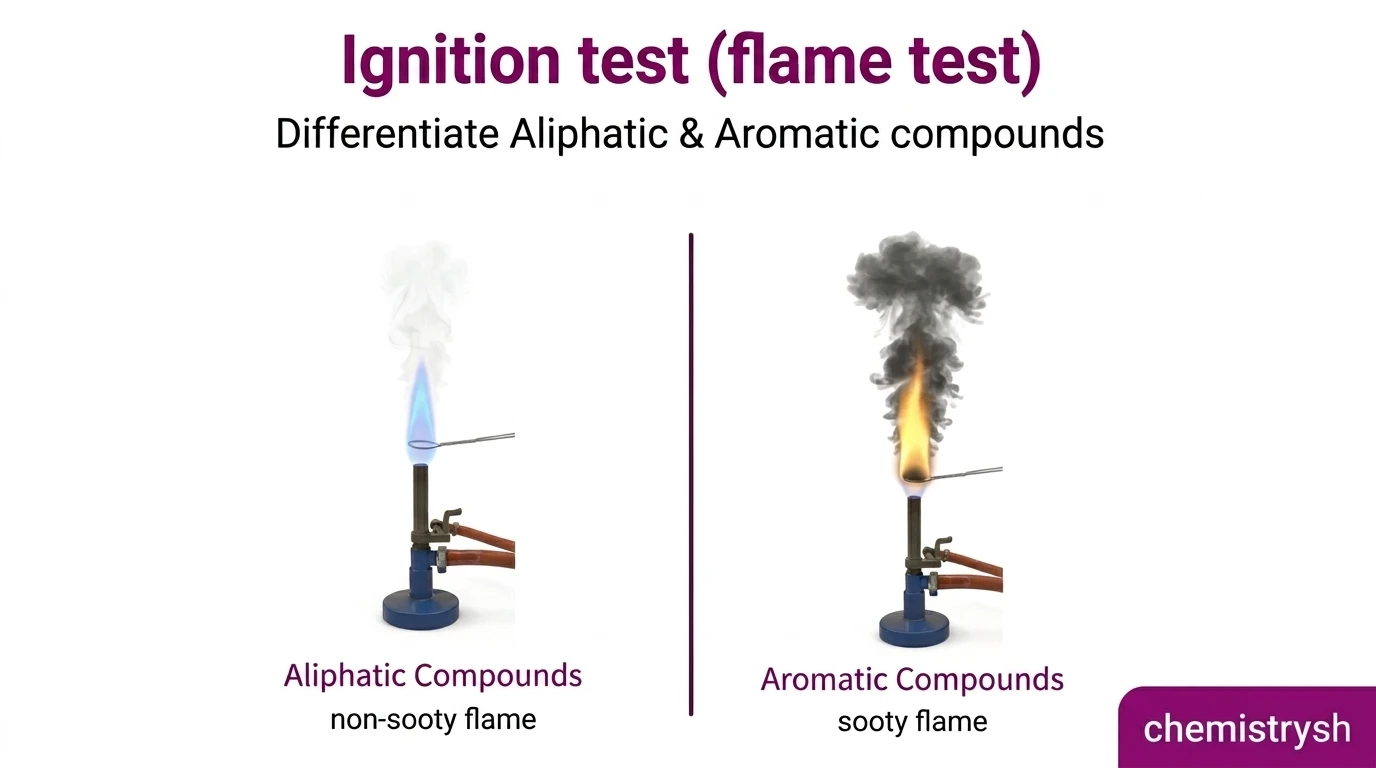
Observation: Heat a small quantity of glucose on a clean spatula at the edge of a Bunsen flame → burns without a sooty or luminous flame; the solid melts, chars, and bubbles/froths vigorously as it decomposes, producing a caramel-like odour, before charring to a black residue.
Conclusion:
- Aromatic compounds and conjugated structures — all absent
- Aliphatic character — confirmed
- Vigorous bubbling/frothing on burning caused by dehydration of multiple –OH groups releasing water vapour — polyhydroxy character indicated
- Note: this dehydration bubbling is characteristic of all carbohydrates but is NOT exclusive to them — other polyhydroxy compounds such as tartaric acid show the same behaviour
- This test must be read together with Molisch’s test, not in place of it
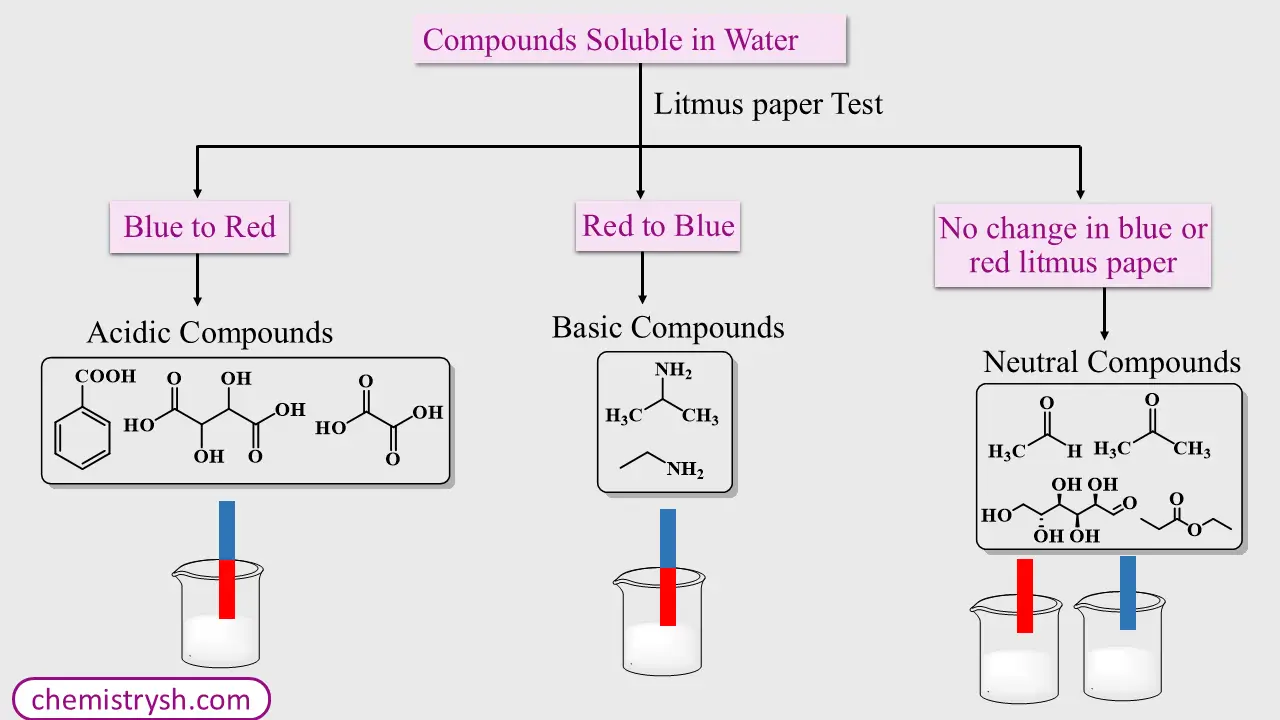
IV. Litmus Test
Reagents: Blue litmus paper · Red litmus paper
Observation: The solution of the given compound produces no colour change on either red or blue litmus paper → compound is neutral.
Conclusion:
- Carboxylic acids, phenols, sulfonic acids, amines, and anilines — all absent
- Compound is neutral → aldehydes, ketones, or carbohydrates — indicated
V. Lassaigne’s Test (Elemental Detection)
Reagents: Sodium metal · Distilled water · FeSO₄ solution · FeCl₃ solution · Sodium nitroprusside solution · AgNO₃ solution · Dilute HNO₃
Preparation of Lassaigne’s Extract: Place sodium metal in the ignition tube, add a small quantity of glucose carefully. Heat the ignition tube until red hot, cool cautiously, add distilled water carefully, boil, and filter to obtain the Lassaigne’s extract.
Detection of Nitrogen: Lassaigne’s extract + FeSO₄ → boil → cool → add FeCl₃ → acidify with dilute H₂SO₄ → no Prussian blue → nitrogen absent → amines and amides absent.
Detection of Sulfur: Alkaline Lassaigne’s extract + sodium nitroprusside solution → no violet/purple colour → sulfur absent → sulfonic acids and thio-compounds absent.
Detection of Halogens: Lassaigne’s extract + dilute HNO₃ + AgNO₃ solution → no precipitate → halogens absent → halogenated compounds absent.
Overall Conclusion:
- Nitrogen, sulfur, and halogens — all absent
- Amines, amides, sulfonic acids, and halogenated compounds — all absent
- Compound contains carbon, hydrogen, and oxygen only — confirmed
VI. Preliminary Test Results — Identifying the Compound Class of Glucose
aromatic or aliphatic nature is then decided by the ignition test. Solubility is next checked in water or any other suitable solvent, depending on the solubility behaviour of the compound. Finally, Lassaigne’s test is conducted to check the presence of heteroatoms — nitrogen, sulfur, and halogens. Based on these four preliminary observations, which single list below should be followed for the qualitative identification of glucose?
|
Group |
Compound Class |
Characteristic Tests |
Our Observation |
Verdict |
|---|---|---|---|---|
|
A |
Carboxylic Acids |
(i) Litmus test (ii) Sodium bicarbonate test (iii) Ferric chloride test (iv) Esterification test (v) Sodium hydroxide solubility test (vi) Flame test (vii) Sublimation test (viii) Melting point / mixed melting point (ix) Solid derivative — amide (x) Solid derivative — anilide |
Litmus neutral · No CO₂ with NaHCO₃ · Insoluble in NaOH |
Ruled out |
|
B |
Phenols |
(i) Litmus test (ii) Ferric chloride test (iii) Bromine water test (iv) Liebermann’s nitroso test (v) Phthalein dye test (vi) Azo dye test (vii) Millon’s test (viii) Sodium hydroxide solubility test (ix) Sodium bicarbonate test (negative) (x) Melting point / mixed melting point (xi) Solid derivative — tribromophenol |
Litmus neutral · Clean non-sooty flame · Insoluble in NaOH |
Ruled out |
|
C |
Amines |
(i) Litmus test (ii) Carbylamine test (iii) Nitrous acid test (iv) Hinsberg test (v) Azo dye test (vi) Acetylation test (vii) Benzoylation test (Schotten–Baumann) (viii) Lassaigne’s test (ix) Solid derivative — acetyl / benzoyl |
Litmus neutral · Nitrogen absent (Lassaigne’s) |
Ruled out |
|
D |
Aromatic Hydrocarbons |
(i) Baeyer’s test (negative) (ii) Bromine water test (substitution) (iii) Nitration test (iv) Sulfonation test (v) Friedel–Crafts test (vi) Combustion / flame test (sooty flame) (vii) Lassaigne’s test (viii) Melting point / mixed melting point (ix) Solid derivative — picrate (x) Solid derivative — charge transfer complex |
Clean non-sooty flame · No heteroatoms (Lassaigne’s) |
Ruled out |
|
E |
Aldehydes · Ketones · Carbohydrates |
(i) Brady’s test (ii) Tollens’ test (iii) Fehling’s test (iv) Benedict’s test (v) Molisch’s test (vi) Seliwanoff’s test (vii) Barfoed’s test (viii) Bial’s test (ix) Iodine test (x) Osazone formation test (xi) Optical rotation / mutarotation (xii) Melting point of osazone derivative |
Neutral · Polar · Aliphatic · No heteroatoms · Freely soluble in water |
Indicated ✅ |
- Carboxylic Acids — Ruled Out: Litmus neutral · no CO₂ effervescence with sodium bicarbonate · insoluble in NaOH — carboxylic acids, phenols, and sulfonic acids all absent
- Phenols — Ruled Out: Clean non-sooty flame · insoluble in NaOH · litmus neutral — phenols, aromatic acids, and conjugated structures all absent
- Amines — Ruled Out: Litmus neutral · nitrogen, sulfur, and halogens all absent in Lassaigne’s test — amines, amides, and halogenated compounds all absent
- Aromatic Hydrocarbons — Ruled Out: Clean non-sooty flame · no heteroatoms in Lassaigne’s test — aromatic hydrocarbons and heteroaromatic compounds all absent
- Aldehydes, Ketones, and Carbohydrates — Indicated ✅: Neutral litmus · freely soluble in water · clean non-sooty flame · nitrogen, sulfur, and halogens all absent — all preliminary observations consistent with aldehydes, ketones, and carbohydrates. Functional group tests of this class now apply
Chemical Reagents, Preparation and Uses in the Qualitative Identification of Glucose
The reagents covered include Molisch’s reagent, Fehling’s solution, Benedict’s reagent, Tollens’ reagent, Barfoed’s reagent, Seliwanoff’s reagent, Bial’s reagent, iodine solution, and phenylhydrazine — each serving a specific diagnostic purpose in the identification sequence.
Full details of each reagent, including preparation and safety notes, are available on the dedicated pages at chemistrysh.com — [Molisch’s Test], [Fehling’s Solution], [Benedict’s Reagent], [Tollens’ Reagent], [Barfoed’s Test], [Seliwanoff’s Test], [Bial’s Test], [Iodine Solution], and [Lassaigne’s Test].
|
Reagent |
Composition / Preparation |
Purpose in Identification |
|
|---|---|---|---|
|
1 |
Molisch’s Reagent |
α-Naphthol (5%) dissolved in ethanol; used with concentrated H₂SO₄ |
General test for ALL carbohydrates — Molisch’s Test |
|
2 |
Fehling’s Solution |
Fehling’s A: CuSO₄ in water. Fehling’s B: sodium potassium tartrate + NaOH in water. Mix equal volumes immediately before use. |
Confirms reducing sugar — brick-red Cu₂O precipitate positive for glucose |
|
3 |
Benedict’s Reagent |
CuSO₄ + sodium carbonate + sodium citrate dissolved in distilled water — stable single solution |
Confirms reducing sugar — more sensitive than Fehling’s; positive for glucose |
|
4 |
Tollens’ Reagent |
Step 1: Dissolve AgNO₃ in distilled water. Step 2: Add dilute NaOH — brown Ag₂O precipitate forms. Step 3: Add dilute NH₃ dropwise until precipitate dissolves — clear [Ag(NH₃)₂]OH solution obtained. Prepare freshly; never store. |
Confirms reducing sugar — silver mirror positive for glucose |
|
5 |
Barfoed’s Reagent |
Copper(II) acetate (0.33 M) dissolved in 1% acetic acid — prepare freshly before use |
Distinguishes monosaccharide from disaccharide — positive for glucose within 2 minutes |
|
6 |
Seliwanoff’s Reagent |
Resorcinol (0.05%) dissolved in concentrated HCl — prepare freshly before use |
Distinguishes aldose from ketose — slow/no colour change for glucose (aldose) |
|
7 |
Bial’s Reagent |
Orcinol (0.4 g) + concentrated HCl (200 mL) + ferric chloride solution (0.5 mL of 10%) — prepare freshly |
Distinguishes hexose from pentose — muddy-brown for glucose (hexose) |
|
8 |
Iodine Solution (Lugol’s Iodine) |
I₂ dissolved in aqueous KI solution |
Iodine Test — negative for glucose (no blue-black colour); positive for starch |
|
9 |
Phenylhydrazine Reagent |
Phenylhydrazine + glacial acetic acid + sodium acetate — use freshly prepared |
Osazone formation — glucosazone crystals confirm glucose |
|
10 |
Lassaigne’s Reagent |
Sodium metal + compound fused together — aqueous extract of fusion cake |
Detects nitrogen, sulfur, halogens — all absent in glucose |
|
11 |
Litmus Solution / Paper |
Aqueous litmus |
Determines acid/base character — neutral for glucose |
Glucose Qualitative Analysis: Identification Tests — Procedure, Observation and Inference
The table below presents the full qualitative identification procedure for glucose — each test with its complete procedure, observed result, and chemical inference. For deeper background on any individual test, detailed preparation notes and worked examples are available on the dedicated pages at chemistrysh.com: [Molisch’s Test], [Fehling’s Solution], [Benedict’s Reagent], [Tollens’ Reagent], [Barfoed’s Test], [Seliwanoff’s Test], [Iodine Test], [Bial’s Test], [Lassaigne’s Test], and [Osazone Formation Test].
|
Test |
Procedure |
Observation |
Inference |
|
|---|---|---|---|---|
|
1 |
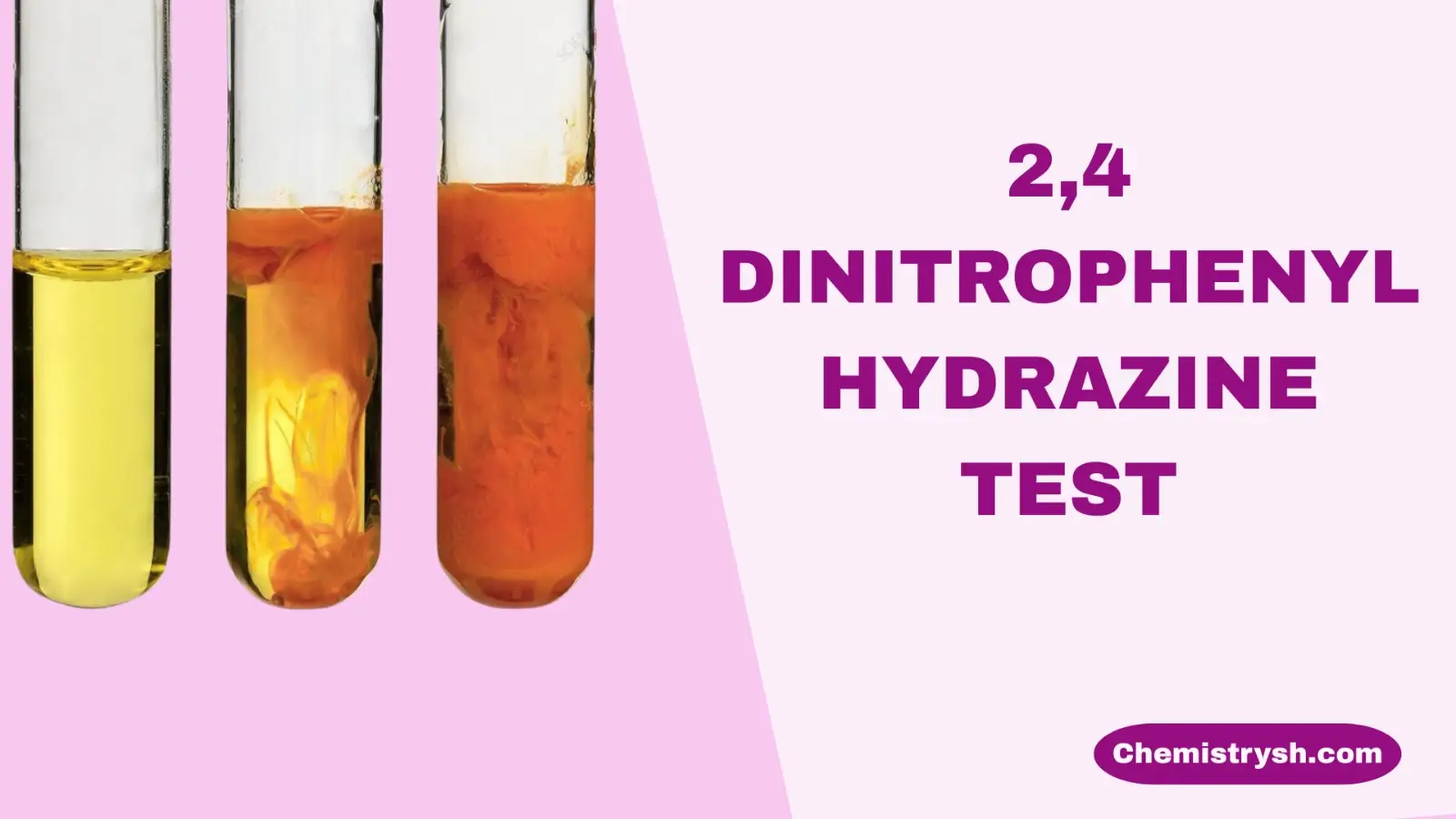
Brady’s Test (2,4-DNPH Test) |
Add a few drops of glucose solution to Brady’s reagent (2,4-dinitrophenylhydrazine in ethanol and dilute H₂SO₄); allow to stand at room temperature. |
No orange-yellow precipitate forms — negative result. |
Glucose exists as <0.02% open-chain aldehyde at equilibrium — the remainder is cyclic hemiacetal. Brady’s test fails because: (1) the aldehyde is present in only trace amounts; (2) the imine condensation is reversible — excess water shifts equilibrium back, preventing precipitate formation (Le Chatelier’s principle); (3) 2,4-DNPH is a weak nucleophile due to two electron-withdrawing nitro groups. Contrast with the osazone test — stronger nucleophile, boiling conditions, excess reagent — and with Fehling’s/Tollens’ — irreversible oxidations. Negative result is chemically expected and distinguishes glucose from simple aldehydes and ketones. |
|
2 |
Molisch’s Test |
Dissolve glucose in water; add 2–3 drops of Molisch’s reagent (α-naphthol in ethanol). Incline the tube and carefully add conc. H₂SO₄ down the side to form a lower layer. |
A violet/purple ring forms at the interface of the two liquid layers. |
Conc. H₂SO₄ dehydrates glucose to a hydroxymethylfurfural-type intermediate, which condenses with α-naphthol to give the violet complex. Confirms a carbohydrate is present — does not by itself identify which one. |
|
3 |
Fehling’s Test |
Mix equal volumes of Fehling’s A and B (deep blue solution). Add glucose solution and heat gently in a water bath. |
Blue colour fades; a brick-red precipitate forms. |
The aldehyde group reduces Cu²⁺ (as cupric tartrate) to Cu⁺, precipitating as Cu₂O, while glucose is oxidised to gluconate. Confirms a reducing sugar. |
|
4 |
Benedict’s Test |
Add glucose solution to Benedict’s reagent (single ready-mixed solution) and heat in a boiling water bath for 2–3 minutes. |
Blue colour passes through green/yellow to a brick-red precipitate. |
Same reducing-sugar chemistry as Fehling’s test, but with sodium citrate as the complexing agent; more sensitive and does not need fresh mixing. |
|
5 |
Tollens’ Test |
Prepare Tollens’ reagent fresh (add dilute NH₃ dropwise to AgNO₃ until the initial precipitate just redissolves). Add glucose solution; warm gently — do not boil. |
A bright silver mirror deposits on the clean inside surface of the test tube. |
The aldehyde group reduces the diammine–silver(I) complex [Ag(NH₃)₂]⁺ to metallic silver; glucose is oxidised to gluconate. Confirms the aldehyde-driven reducing character. |
|
6 |
Barfoed’s Test |
Add glucose solution to Barfoed’s reagent (cupric acetate in dilute acetic acid); heat in a boiling water bath for exactly 2–3 minutes. |
Distinguishes aldose from ketose — slow/no colour change for glucose (aldose) |
Barfoed’s reagent is only mildly acidic, so monosaccharides reduce it quickly while disaccharides react far more slowly. A prompt positive result confirms glucose is a monosaccharide. |
|
7 |
Seliwanoff’s Test |
Add glucose solution to Seliwanoff’s reagent (resorcinol in dilute HCl); heat in a boiling water bath. |
Little or no colour change, even after several minutes (contrast: fructose gives a rapid, intense cherry-red within ~1 minute). |
Ketoses dehydrate to furfural derivatives far faster than aldoses under these acidic conditions. Glucose’s slow, weak response confirms it is an aldose, not a ketose. |
|
8 |
Iodine Test |
Add 2–3 drops of dilute iodine solution to a glucose solution. |
No colour change; the pale yellow-brown colour of the reagent persists. No blue-black colour develops. |
Starch gives an intense blue-black colour and glycogen a red-brown colour with iodine, due to their helical polymer structure. Glucose, a free monosaccharide, gives neither — confirms it is not a polysaccharide. |
|
9 |
Bial’s Test |
Add glucose solution to Bial’s reagent (orcinol, conc. HCl, trace FeCl₃); heat gently. |
A muddy-brown colour develops; no blue-green colour (contrast: pentoses such as ribose give a distinct blue-green colour). |
Bial’s test depends on furfural formation, which pentoses give far more readily than hexoses. A negative result confirms glucose is a hexose, not a pentose. |
|
10 |
Osazone Test |
Warm glucose with excess phenylhydrazine hydrochloride and sodium acetate in dilute acetic acid for 30–45 minutes in a boiling water bath. Cool slowly. |
Yellow crystalline glucosazone precipitate; characteristic fine needle clusters often described as “broomstick” or “sunflower” shaped crystals. |
Yellow needle clusters (“broomstick” crystals) — glucosazone confirmed – Glucose, fructose, and mannose give osazones with identical melting points — distinguished by crystal habit: glucosazone (needles), fructosazone (needles, faster), mannosazone (rhombic plates) – Seliwanoff’s negative excludes fructose · Melting point of glucosazone derivative compared against literature value provides final confirmation of glucose identity |
|
11 |
Melting Point |
Pack dry powdered glucose in a sealed capillary tube. Heat at 1–2°C/min approaching the expected value. Record onset and completion. |
Melting/decomposition point at 146°C (anhydrous α-D-glucose) |
Decomposition at 146°C matching the literature value for anhydrous α-D-glucose confirms sample identity. Note: glucose does not melt cleanly — it decomposes at the melting point. A sharp, reproducible decomposition temperature confirms purity; a broad or depressed decomposition range indicates impurity or incorrect hydration state (monohydrate decomposes at 83°C, anhydrous β-form at 150°C). |
|
12 |
Melting Point of Derivative (Glucosazone) |
Prepare glucosazone from the unknown sample by warming with excess phenylhydrazine hydrochloride and sodium acetate in dilute acetic acid. Pack the dried crystals in a capillary tube and determine the melting point. |
Sharp melting point of glucosazone. |
Compare the observed melting point against the literature value for glucosazone. Agreement confirms the identity of the derivative and therefore the identity of the unknown compound as glucose. |
Preliminary Note — Carbonyl Group Confirmation from Combined Test Results
Glucose Chemical Reactions and Equations Involved in Identification Tests
1. Fehling’s Reaction
Type: Oxidation-reduction (redox) reaction
CH₂OH(CHOH)₄CHO + 2Cu²⁺ + 5OH⁻ → CH₂OH(CHOH)₄COO⁻ + Cu₂O↓ + 3H₂O
The aldehyde group of glucose is oxidised to gluconate; Cu²⁺, complexed by tartrate, is reduced to Cu₂O — the brick-red precipitate.
2. Benedict’s Reaction
Type: Oxidation-reduction (redox) reaction
CH₂OH(CHOH)₄CHO + 2Cu²⁺ + 5OH⁻ → CH₂OH(CHOH)₄COO⁻ + Cu₂O↓ + 3H₂O
Sodium citrate replaces tartrate as the Cu²⁺-complexing agent — this is why Benedict’s reagent is stable as a single pre-mixed solution, unlike Fehling’s which requires fresh mixing.
3. Tollens’ Reaction (Silver Mirror Test)
Type: Oxidation-reduction (redox) reaction
CH₂OH(CHOH)₄CHO + 2[Ag(NH₃)₂]⁺ + 3OH⁻ → CH₂OH(CHOH)₄COO⁻ + 2Ag↓ + 4NH₃ + 2H₂O
The aldehyde is oxidised to gluconate; the diammine–silver(I) complex is reduced to metallic silver, which deposits as the mirror on the inner wall of the test tube.
4. Barfoed’s Reaction
Type: Oxidation-reduction (redox) reaction — mild acidic conditions
CH₂OH(CHOH)₄CHO + 2Cu²⁺ + 2H₂O → CH₂OH(CHOH)₄COOH + Cu₂O↓ + 4H⁺
Mildly acidic medium allows monosaccharides to reduce Cu²⁺ rapidly; disaccharides react far more slowly under the same conditions — the timed 2-minute window is the diagnostic criterion.
5. Osazone Formation — Step 1 (Mono-phenylhydrazone)
Type: Condensation reaction — nucleophilic addition followed by elimination of water
CH₂OH(CHOH)₄CHO + C₆H₅NHNH₂ → CH₂OH(CHOH)₄CH=N–NHC₆H₅ + H₂O
The first equivalent of phenylhydrazine condenses with the aldehyde at C1 to give the mono-phenylhydrazone.
6. Osazone Formation — Step 2 (Overall equation)
Type: Oxidation followed by condensation
Glucose + 3C₆H₅NHNH₂ → Glucosazone + C₆H₅NH₂ + NH₃ + 2H₂O
A second equivalent of phenylhydrazine acts as the oxidising agent at C2 — converting the adjacent –OH to a carbonyl while itself being reduced to aniline and ammonia. A third equivalent then condenses with this new C2 carbonyl to complete the bis-phenylhydrazone (glucosazone).
7. Mutarotation Equilibrium
Type: Dynamic ring-opening equilibrium
α-D-glucose ⇌ open-chain aldehyde form ⇌ β-D-glucose
Ring-opening at the anomeric C1 hemiacetal allows interconversion between the two cyclic forms. Equilibrium favours the pyranose forms — approximately 36% α and 64% β in aqueous solution. The open-chain form is present in trace amounts but is the reactive species in Fehling’s, Benedict’s, and Tollens’ tests.
8. Glucose Combustion / Respiration
Type: Complete oxidation (combustion) / aerobic cellular respiration (biological)
C₆H₁₂O₆ + 6O₂ → 6CO₂ + 6H₂O ΔH° ≈ −2803 kJ/mol
The same net equation underlies both laboratory combustion and aerobic cellular respiration. In biology, the pathway proceeds via glycolysis, the citric acid cycle, and oxidative phosphorylation — not direct burning — but the overall reactants and products are identical.
Glucose Identification Tests — Quick-Reference Summary: Recorded Observations and Confirmations
Glucose identification tests are summarised below — a glucose test results table giving the recorded observation and inference for each test in the glucose qualitative analysis panel, from preliminary tests through reducing sugar tests to the glucosazone melting point that confirms identity.
|
Test |
Recorded Observation for (Glucose) |
What It Confirms |
|
|---|---|---|---|
|
1 |
Physical Appearance |
White crystals, odourless |
Purity; no chromophore rules out conjugation. |
|
2 |
Solubility |
Freely soluble in cold water; solubility increases on warming |
Polyhydroxy character; non-aromatic |
|
3 |
Ignition Test |
No sooty flame; vigorous bubbling/frothing on burning (dehydration — loss of water as vapour) |
Aliphatic structure + multiple –OH groups (all carbohydrates show this, but NOT unique to them) |
|
4 |
Litmus Test |
No change on red or blue litmus |
Compound is neutral — carboxylic acids, phenols, and amines absent |
|
5 |
Lassaigne’s Test |
No Prussian blue; no black precipitate; no AgCl precipitate |
Nitrogen, sulfur, and halogens — all absent |
|
6 |
Molisch’s Test |
Violet/purple ring at interface |
Carbohydrate present (general test) |
|
7 |
Fehling’s Test |
Brick-red Cu₂O precipitate |
Reducing sugar confirmed |
|
8 |
Benedict’s Test |
Brick-red precipitate |
Reducing sugar confirmed (more sensitive) |
|
9 |
Tollens’ Test |
Silver mirror |
Reducing sugar confirmed (aldehyde-specific) |
|
10 |
Barfoed’s Test |
Red Cu₂O precipitate forms within ~2 minutes in a boiling water bath |
Monosaccharide, not disaccharide |
|
11 |
Seliwanoff’s Test |
Very faint, slow colour response — no cherry-red |
Aldose, not ketose |
|
12 |
Iodine Test |
No blue-black colour |
Not a polysaccharide (starch/glycogen excluded) |
|
13 |
Bial’s Test |
No blue-green colour |
Hexose, not pentose |
|
14 |
Osazone Test |
Yellow “broomstick” crystals |
Confirmatory derivative; distinguishes from disaccharides |
|
15 |
Melting Point |
Sharp m.p. matching literature |
Purity and identity |
Results, Discussion and Conclusion: Qualitative Identification of Glucose
The preliminary tests established the compound class.
These five observations together eliminate carboxylic acids, phenols, amines, and aromatic hydrocarbons, leaving aldehydes, ketones, and carbohydrates as the only remaining compound class.
The chemical tests then confirmed the specific carbohydrate identity in three stages.
At this point glucose, galactose, and mannose remained as the only candidates.
The Osazone Test and the melting point of the glucosazone derivative resolved the final ambiguity. The characteristic yellow broomstick crystals of glucosazone and agreement of the derivative melting point with the literature value constitute the confirmation that the unknown compound is glucose specifically— not its epimers galactose or mannose, which yield osazones with different crystal habits and melting points.
Conclusion: Qualitative Identification of Glucose — Final Verdict
The qualitative analysis of glucose presented above establishes compound identity through the combined weight of physical and chemical evidence— aliphatic non-sooty ignition behaviour with characteristic frothing (polyhydroxy character), a positive Molisch’s test (carbohydrate confirmed), three convergent positive reducing-sugar tests (Fehling’s, Benedict’s, and Tollens’), a prompt positive Barfoed’s test (monosaccharide confirmed), a weak Seliwanoff’s response (aldose confirmed), negative iodine and Bial’s tests (hexose confirmed; polysaccharide and pentose excluded), characteristic glucosazone crystal formation, and agreement of the glucosazone melting point with the literature value — the given unknown compound is conclusively identified as:
Glucose (C₆H₁₂O₆)
Comparison of qualitative identification tests: aldehydes, ketones, and carbohydrates
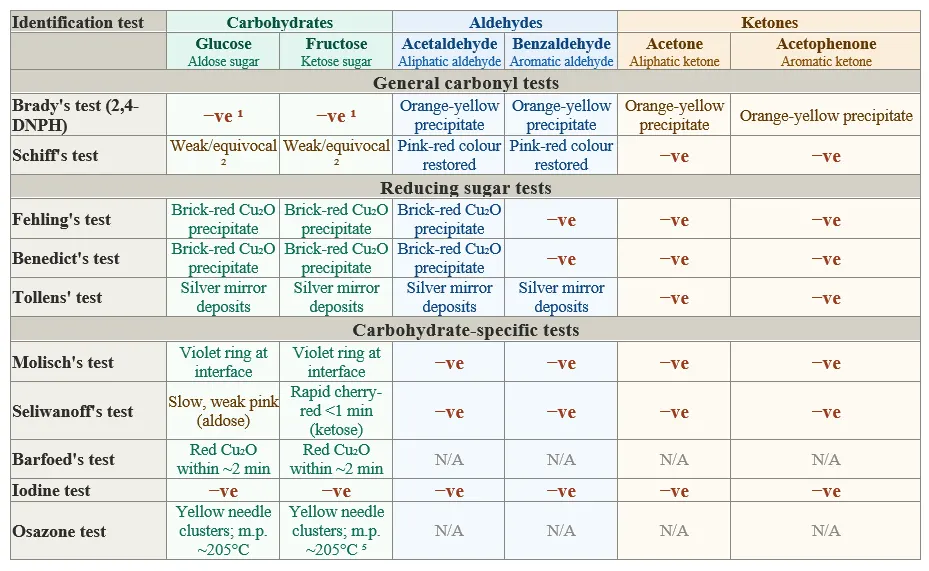
The table below compares the qualitative identification test results for three major classes of organic compounds — carbohydrates, aldehydes, and ketones — across six representative molecules: glucose, fructose, acetaldehyde, benzaldehyde, acetone, and acetophenone. Each compound responds differently to the same set of identification tests, and these differences form the diagnostic basis for distinguishing one compound class from another in qualitative organic analysis.
- Molisch’s test is the only test positive for carbohydrates (glucose and fructose) — all aldehydes and ketones give a negative result, making it the single most decisive class-separation test in this panel.
- Fehling’s and Benedict’s tests are positive for carbohydrates and aliphatic aldehydes (acetaldehyde) — but negative for aromatic aldehydes (benzaldehyde) and all ketones. Tollens’ test, however, is positive for all aldehydes including benzaldehyde, distinguishing it from Fehling’s and Benedict’s tests.”
- Brady’s test (2,4-DNPH) confirms carbonyl character in aldehydes and ketones but is negative for glucose and fructose — because both sugars exist predominantly as cyclic hemiacetals, not as free carbonyls, in solution.
- Seliwanoff’s test is the key intra-carbohydrate distinction — glucose (aldose) gives a slow, weak pink response while fructose (ketose) gives a rapid cherry-red colour within one minute.
- Iodoform test distinguishes methyl carbonyl compounds — positive for acetaldehyde, acetone, and acetophenone; negative for benzaldehyde and all carbohydrates.
- Barfoed’s and osazone tests apply exclusively to carbohydrates — they are not applicable to aldehydes or ketones and appear as N/A in the table.
Table 1. Comparison of qualitative identification tests for aldehydes, ketones, and carbohydrates: glucose, fructose, acetaldehyde, benzaldehyde, acetone, and acetophenone
Compounds grouped by category — carbohydrates · aldehydes · ketones — to show inter-category and intra-category differences.
¹ Glucose and fructose exist predominantly as cyclic hemiacetals; free carbonyl fraction (<0.02%) is insufficient to react with Brady’s reagent under standard conditions.
² Schiff’s test result for glucose and fructose is debated in the literature; hemiacetal suppresses free carbonyl character. Not recommended as a confirmatory test for sugars.
³ Benzaldehyde is an aromatic aldehyde — it gives a positive Tollens’ test (silver mirror) but does not reduce Fehling’s or Benedict’s solution. Aromatic aldehydes lack the reactivity required to reduce the Cu²⁺ complex under standard conditions.
4 Acetaldehyde (b.p. 20°C) is highly volatile and may evaporate before the reaction completes in a boiling water bath. Results should be obtained using a sealed or cooled vessel.
⁵ Glucosazone and fructosazone are identical — the osazone reaction destroys the C1 and C2 positions of both glucose and fructose, producing the same bis-phenylhydrazone product. The osazone test therefore does not distinguish glucose from fructose. Mannose also yields the same osazone.
Glossary — Key Terms in the Qualitative Identification of Glucose
The following glossary defines the specialist terms used throughout this qualitative analysis. Each entry includes a plain-language definition followed by a worked example drawn directly from the glucose identification tests covered in this article — so the terminology is always seen in context, not in isolation. Familiarity with these terms will strengthen both laboratory understanding and examination performance.
Mutarotation
The spontaneous change in optical rotation observed when either pure α-D-glucose or pure β-D-glucose is dissolved in water, caused by ring-opening at the anomeric C1 position and re-closure as either anomer until equilibrium is reached at [α]²⁰/D +52.7° (≈36% α : 64% β; <0.02% open-chain form).
Example: Freshly dissolved α-D-glucose shows [α]D +112°; this value changes gradually to +52.7° as the ring continuously opens and recycles between the two anomers — this process is mutarotation. It is also the reason glucose gives positive Fehling’s and Tollens’ tests despite existing predominantly in the cyclic form.
Anomer
One of two cyclic stereoisomers of a monosaccharide that differ only in the configuration at the anomeric carbon — the carbon that was the carbonyl carbon in the open-chain form. The α-anomer has the C1–OH in the axial position; the β-anomer has it in the equatorial position.
Example: α-D-glucopyranose ([α]D +112°) and β-D-glucopyranose ([α]D +18.7°) are the two anomers of glucose; they interconvert in aqueous solution via mutarotation, passing through the open-chain aldehyde form at each interconversion.
Anomeric Carbon
The carbon atom in a cyclic monosaccharide that was the carbonyl carbon in the open-chain form. It is the centre of the hemiacetal functional group and the only carbon that changes configuration during mutarotation. In aldoses, C1 is the anomeric carbon.
Example: In glucose, C1 is the anomeric carbon — it is the site of ring opening and closing during mutarotation, the site of glycosidic bond formation in disaccharides and polysaccharides, and the carbon whose configuration defines the α and β anomers. When the ring opens at C1, the free aldehyde is regenerated and becomes available to reduce Fehling’s and Tollens’ reagents.
Epimer
Two monosaccharides that have identical configurations at every stereocentre except one — other than the anomeric carbon. They are a specific subset of diastereomers distinguished by the position of the difference.
Example: Mannose is the C2 epimer of glucose — it differs from glucose only in the configuration at C2. Galactose is the C4 epimer of glucose. Both mannose and galactose yield glucosazone with the same melting point as glucose in the osazone test, because osazone formation destroys C1 and C2.
Reducing Sugar
A sugar that can donate electrons to an oxidising agent under the conditions of standard qualitative tests — specifically, one that contains a free or potential aldehyde group accessible through ring-opening equilibrium.
Example: Glucose is a reducing sugar — its cyclic hemiacetal is in equilibrium with the open-chain aldehyde, which reduces Cu²⁺ to Cu₂O in Fehling’s and Benedict’s tests and reduces [Ag(NH₃)₂]⁺ to metallic silver in Tollens’ test. Sucrose is a non-reducing sugar — its anomeric carbons are locked in a glycosidic bond and cannot open.
Hemiacetal
The functional group formed when an aldehyde reacts with one equivalent of an alcohol — giving a carbon bearing both an –OH and an –OR group. In monosaccharides, hemiacetal formation occurs intramolecularly to produce the cyclic ring structure.
Example: In glucose, the C1 aldehyde reacts with the C5 hydroxyl group to form a cyclic hemiacetal — a six-membered pyranose ring. The hemiacetal C1 bond is in dynamic equilibrium: it opens to regenerate the free aldehyde and closes as either the α or β anomer. This equilibrium is the chemical basis of mutarotation.
Aldohexose
A monosaccharide with six carbon atoms whose carbonyl group is an aldehyde at C1. The prefix “aldo” denotes the aldehyde; “hexose” denotes six carbons. Four stereocentres (C2–C5) give 2⁴ = 16 possible stereoisomers — 8 D-forms and 8 L-forms.
Example: Glucose is the most biologically significant D-aldohexose. Its closest aldohexose relatives are mannose (C2 epimer) and galactose (C4 epimer) — both distinguished from glucose by the osazone test crystal habit and by the mixed melting point.
Pyranose
The six-membered ring form of a monosaccharide, formed by intramolecular hemiacetal ring closure between C1 and C5. Named after pyran — the parent six-membered oxygen-containing heterocycle.
Example: In aqueous solution, glucose exists predominantly as α-D-glucopyranose (≈36%) and β-D-glucopyranose (≈64%), with less than 0.02% in the open-chain aldehyde form. The pyranose ring is the form present in starch, cellulose, and glycogen, where individual glucose units are linked by glycosidic bonds.
Glucosazone
The yellow crystalline bis-phenylhydrazone derivative formed when glucose reacts with excess phenylhydrazine under acidic conditions and heat. Formation involves three equivalents of phenylhydrazine — one condenses at C1, one oxidises C2, and one condenses at the new C2 carbonyl.
Example: Glucosazone forms characteristic fine needle clusters described as “broomstick” or “sunflower” shaped crystals. Glucose, fructose, and mannose all yield glucosazone with the same melting point — because osazone formation destroys C1 and C2, which are the only positions where these three sugars differ. Crystal habit and crystallisation time distinguish the three.
Hydroxymethylfurfural (HMF)
A furan-based aldehyde compound formed by acid-catalysed dehydration of hexose sugars under strongly acidic conditions. Pentoses yield furfural (the five-carbon equivalent); hexoses such as glucose yield hydroxymethylfurfural — the six-carbon equivalent. Both are reactive intermediates that condense with phenolic compounds to produce coloured products used in carbohydrate identification tests.
Example: In Molisch’s test, concentrated H₂SO₄ dehydrates glucose to a hydroxymethylfurfural-type intermediate, which condenses with α-naphthol to produce the characteristic violet ring at the acid–liquid interface. In Bial’s test, pentoses produce furfural that condenses with orcinol to give a blue-green colour — hexoses give only a muddy-brown, confirming glucose is a hexose, not a pentose.
Optical Rotation
The angle through which a chiral compound rotates the plane of plane-polarised light, measured in a polarimeter. A positive value indicates dextrorotation (rotation to the right); a negative value indicates laevorotation (rotation to the left). Optical rotation depends on the wavelength of light used, the temperature, the concentration of the solution, and the path length of the sample tube.
Example:When freshly dissolved α-D-glucose is placed in a polarimeter, its optical rotation reads approximately +112°. As mutarotation proceeds and the equilibrium mixture forms, the rotation decreases gradually to the equilibrium value of +52.7° — demonstrating that optical rotation is a dynamic property that changes as the anomer ratio changes.
Specific Rotation
A standardised measure of optical rotation that corrects for concentration and path length, expressed as [α]ᵀ_D where T is the temperature in °C and D refers to the sodium D-line (589 nm). It is calculated as: [α] = observed rotation ÷ (concentration in g/mL × path length in dm).
Example: For glucose: α-D-glucose [α]²⁰_D = +112°; β-D-glucose [α]²⁰_D = +18.7°; equilibrium mixture [α]²⁰_D = +52.7°, c = 10% (w/v) in water — confirmed from Sigma-Aldrich G8270, verified August 2026. Specific rotation is the standardised value that allows direct comparison between different laboratories and instruments.
Fehling’s Solution — Role of the Complexing Agent
In Fehling’s test, Cu²⁺ ions must be kept in alkaline solution without precipitating as Cu(OH)₂. Sodium potassium tartrate (Rochelle salt) achieves this by forming a coordination complex with Cu²⁺ — acting as the complexing agent. It holds Cu²⁺ in solution at the high pH needed for the test, controls its reactivity, and releases it slowly for reduction by the aldehyde. The complexing agent does not participate in the redox reaction itself.
Example: Fehling’s Solution A (CuSO₄) and Fehling’s Solution B (NaOH + Rochelle salt) must be mixed immediately before use — the tartrate complex is only stable for a limited time. In Benedict’s test, sodium citrate replaces tartrate as the complexing agent, which is why Benedict’s reagent is stable as a single pre-mixed solution that does not need fresh preparation.
Gluconate / Gluconic Acid
The oxidation product of glucose formed when the C1 aldehyde group is oxidised to a carboxylate group under mild alkaline conditions. Gluconate is the anionic form at alkaline pH; gluconic acid (CAS 526-95-4) is the protonated form at neutral or acidic pH.
Example:In Fehling’s, Benedict’s, and Tollens’ tests, glucose is oxidised to gluconate while the metal ion is simultaneously reduced — Cu²⁺ to Cu₂O (brick-red precipitate) or Ag⁺ to Ag (silver mirror). The balanced equation for Fehling’s test: CH₂OH(CHOH)₄CHO + 2Cu²⁺ + 5OH⁻ → CH₂OH(CHOH)₄COO⁻ + Cu₂O↓ + 3H₂O.
Condensation Reaction
A reaction in which two molecules combine to form a larger molecule with the simultaneous loss of a small molecule — most commonly water. In organic chemistry, condensation reactions between carbonyl compounds and hydrazine derivatives are used to prepare crystalline solid derivatives for identification purposes.
Example: In the osazone test, phenylhydrazine undergoes condensation with the C1 aldehyde of glucose — the hydrazine nitrogen attacks the carbonyl carbon, and water is eliminated to form a C=N bond. A second condensation occurs at C2 after oxidation, producing the bis-phenylhydrazone (glucosazone). In Molisch’s test, a condensation between the hydroxymethylfurfural intermediate and α-naphthol produces the violet ring.
Amylose and the Iodine Test
Amylose is the linear component of starch — a polymer of glucose units linked by α-1,4-glycosidic bonds. Its chain adopts a left-handed helical conformation with approximately 6 glucose units per turn, creating a hollow central channel of the right dimensions to trap iodine molecules (I₂) as a blue-black polyiodide complex.
Example: When iodine solution is added to starch, the I₂ molecules enter the amylose helix and form a charge-transfer complex — producing the intense blue-black colour that is the basis of the positive iodine test for starch. Glucose, as a free monosaccharide, has no helical structure and cannot trap iodine — giving a negative iodine test. Glycogen gives a red-brown colour because its shorter, more branched helical segments form a less stable complex.
Uses and Applications of Glucose
Glucose is one of the most versatile and widely used compounds in both biological systems and industrial chemistry. As the primary energy source for living cells, it underpins metabolism, clinical medicine, food production, and chemical synthesis. The table below summarises the principal applications of glucose across six domains — from its role as blood sugar in the human body to its use as a reference standard in analytical chemistry.
|
Industry / Field |
Application |
Specific Role |
|---|---|---|
|
Food & Nutrition |
Primary dietary energy source; sweetener |
Glucose is the body’s principal metabolic fuel, oxidised via glycolysis for ATP production. Industrially, glucose syrup (from starch hydrolysis) is a major sweetener and texturising agent in confectionery, baked goods, and soft drinks. |
|
Clinical Medicine |
Intravenous dextrose; oral rehydration |
Sterile dextrose (glucose) solutions are administered intravenously to restore blood sugar and provide rapid energy in clinical settings; glucose is also a key component of oral rehydration salts (ORS). |
|
Pharmaceuticals |
Excipient; diagnostic reagent |
Used as a tablet binder/filler and as a stabiliser in some formulations. Also the reagent basis of the oral glucose tolerance test (OGTT) used in diabetes screening. |
|
Biochemistry & Fermentation |
Fermentation substrate |
Glucose is fermented by yeast to ethanol and CO₂ (brewing, baking, biofuel production) and by various moulds/bacteria to citric acid, lactic acid, and other organic acids on an industrial scale. |
|
Industrial Chemistry |
Precursor for derivative synthesis |
Starting material for sorbitol (catalytic hydrogenation), gluconic acid (oxidation), and, via the Reichstein process, L-ascorbic acid (vitamin C). |
|
Analytical Chemistry |
Reference reducing-sugar standard |
Used to standardise Fehling’s and Benedict’s reagents, and as the calibration substrate for glucose oxidase–based biosensors (the same enzymatic principle used in blood glucose meters). |
Safety Precautions Before You Begin
Before any identification test is carried out, a careful review of the reagent hazards is essential. The chemicals used in glucose qualitative analysis range from corrosive concentrated acids to explosive residue-forming silver reagents — each requiring specific handling precautions. The guidance below covers the key hazards for every reagent in this test sequence, followed by a reagent-by-reagent hazard summary
Glucose hazards and general safety
Glucose itself is non-toxic and essentially non-hazardous — the risk in this experiment sequence comes almost entirely from the test reagents, not the sample. Wear a lab coat, chemical-splash goggles, and nitrile gloves throughout.
Glucose Identification Test Reagents: Hazard Summary
The table below provides a compound-by-compound hazard summary for every reagent used in the qualitative identification of glucose. Each entry lists the primary hazard classification and the single most important precaution for safe handling in the laboratory. This table should be read before beginning any test in the sequence — not after an incident has occurred.
|
Reagent |
Hazard |
Key Precaution |
|---|---|---|
|
Food & Glucose sample |
Essentially non-hazardous |
Normal bench handling; avoid inhalation of fine powder/dust |
|
Conc. H₂SO₄ (Molisch’s) |
CORROSIVE |
Add to mixture slowly, down the side of the tube. Goggles + acid-resistant gloves. Fume cupboard recommended. |
|
Tollens’ reagent (AgNO₃ + NH₃) |
IRRITANT • EXPLOSIVE RESIDUE RISK if stored |
Prepare fresh, use immediately, destroy leftovers with dilute HNO₃. Never store. |
|
Fehling’s / Benedict’s reagent |
IRRITANT (alkaline copper solution) |
Gloves and goggles; avoid skin/eye contact; heat-resistant gloves for the water bath step. |
|
Barfoed’s / Seliwanoff’s / Bial’s reagents |
IRRITANT (contain dilute/conc. acids) |
Goggles and gloves; use a test tube holder when heating. |
|
Phenylhydrazine hydrochloride |
TOXIC • Suspected carcinogen • skin absorption |
Fume cupboard. Double gloves. Wash skin contact immediately and seek medical advice. |
|
Bunsen burner / open flame (ignition test) |
FIRE RISK |
Tie back hair/clothing; keep ethanol and other flammables well clear of the flame. |
Glucose Identification Tests — Questions Designed to Increase Your Learning Capacity
Multiple Choice Questions (MCQs)
Molecular Formula
1. The correct molecular formula of glucose is:
A. C₆H₁₂O₅
B. C₆H₁₂O₆ ✓
C. C₅H₁₀O₅
D. C₆H₁₀O₆
Molar Mass
2. The molar mass of glucose (C₆H₁₂O₆) is:
A. 150.13 g/mol
B. 162.14 g/mol
C. 180.16 g/mol ✓
D. 198.17 g/mol
Chiral Carbons
3. How many chiral (stereogenic) carbons does glucose have in its open-chain form?
A. Two
B. Three
C. Four ✓
D. Five
Total Stereoisomers
4. Given four stereocentres, how many total stereoisomers are possible for an aldohexose skeleton?
A. 4
B. 8
C. 12
D. 16 ✓
Reducing Sugar Basis
5. Glucose behaves as a reducing sugar because of:
A. Its five hydroxyl groups
B. Its free/potential aldehyde group, which is oxidisable ✓
C. Its cyclic pyranose structure
D. Its optical activity
Fehling’s Test Result
6. A positive Fehling’s test with glucose produces:
A. A silver mirror
B. ) A brick-red Cu₂O precipitate ✓
C. A violet ring at the interface
D. A blue-black colour
Barfoed’s Test
7. Barfoed’s test distinguishes glucose from disaccharides because:
A. Glucose is coloured and disaccharides are not
B. The mildly acidic reagent is reduced quickly by monosaccharides but slowly by disaccharides ✓
C. Disaccharides do not dissolve in the reagent
D. Glucose does not react with Barfoed’s reagent at all
Seliwanoff’s Test
8. In Seliwanoff’s test, glucose (compared with fructose) shows::
A. A rapid, intense cherry-red colour
B. Little or no colour change, reacting slowly ✓
C. Immediate formation of a white precipitate
D. No reaction under any conditions
Iodine Test
9. Glucose gives a negative iodine test because:
A. It is coloured and masks the iodine colour
B. It lacks the helical amylose structure that traps iodine, unlike starch ✓
C. It reacts with iodine to form a colourless product
D. Iodine only reacts with proteins
Further Reading and Suggested Sources
- Furniss, B. S., Hannaford, A. J., Smith, P. W. G., & Tatchell, A. R. (1989). Vogel’s textbook of practical organic chemistry (5th ed.). Longman Scientific and Technical.
- Middleton, H. (1979). Systematic qualitative organic analysis (2nd ed.). Edward Arnold.
- Clayden, J., Greeves, N., & Warren, S. (2012). Organic chemistry (2nd ed.). Oxford University Press.
- National Center for Biotechnology Information. (2026). D-Glucose (CID 5793). PubChem. https://pubchem.ncbi.nlm.nih.gov/compound/5793