
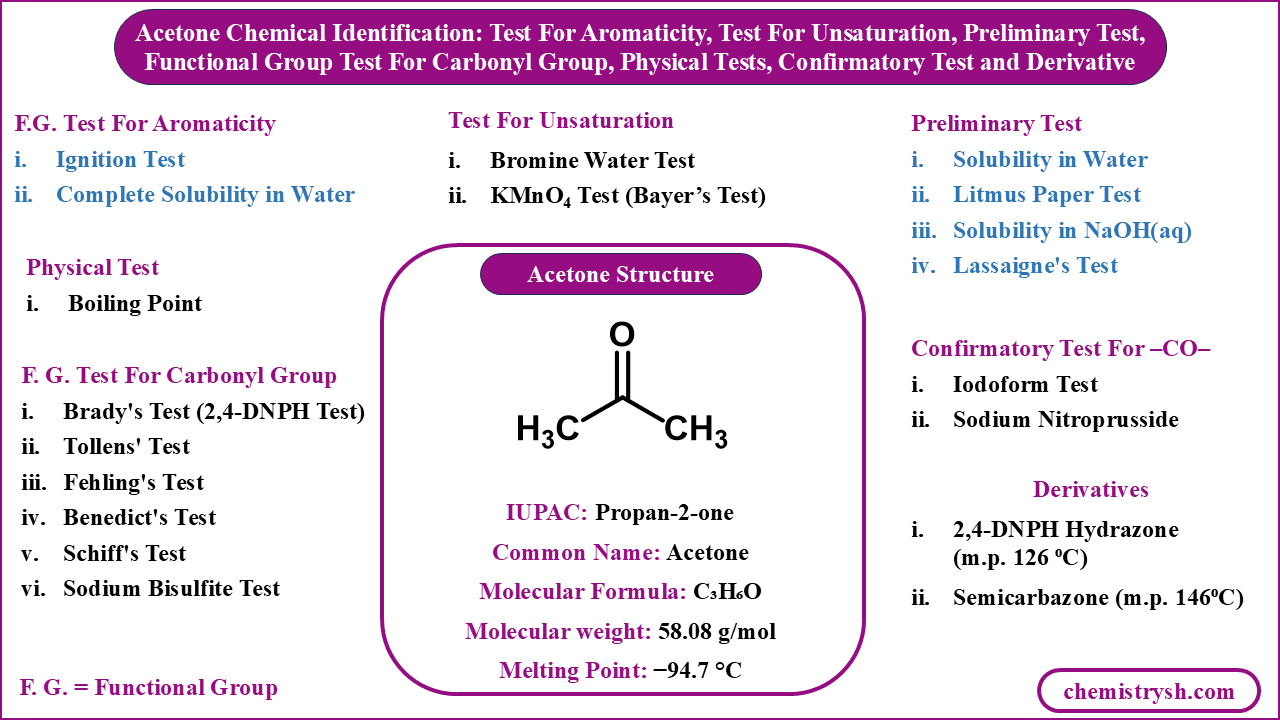
Acetone (Propan-2-one) Identification — Key Facts at a Glance
⦁ Molecular Formula (C₃H₆O) · Molecular Weight (58.08 g/mol) · IUPAC Name (Propan-2-one) · Common Name (Acetone) · Synonym (Dimethyl ketone) · Appearance (colourless, mobile liquid with sharp, characteristic sweet odour) · Boiling Point (56.05 °C) · Melting Point (−94.7 °C) · Density (0.791 g/mL at 25 °C) · Solubility (freely miscible with water, ethanol, and diethyl ether) · Flash Point (−20 °C) · CAS Number (67-64-1) · Functional Group (ketone — carbonyl group C=O flanked by two methyl groups) · Acid/Base Nature (neutral) · Polarity (polar; dipole moment 2.88 D)
⦁ Physical Appearance Test · Solubility Test · Ignition / Flame Test · Litmus Test · Lassaigne’s Test · Brady’s Test (2,4-DNPH — yellow precipitate) · Tollens’ Test (negative — no silver mirror) · Fehling’s and Benedict’s Test (negative) · Schiff’s Test (negative) · Sodium Bisulfite Test (positive — white precipitate) · Iodoform Test (positive — yellow precipitate CHI₃) · Legal’s Test (positive — red/wine-red colour) · 2,4-DNPH Hydrazone (m.p. 126–128 °C) · Semicarbazone (m.p. 189–190 °C) · Oxime (m.p. 60–63 °C)
§1 —What is Acetone? (Propan-2-one)
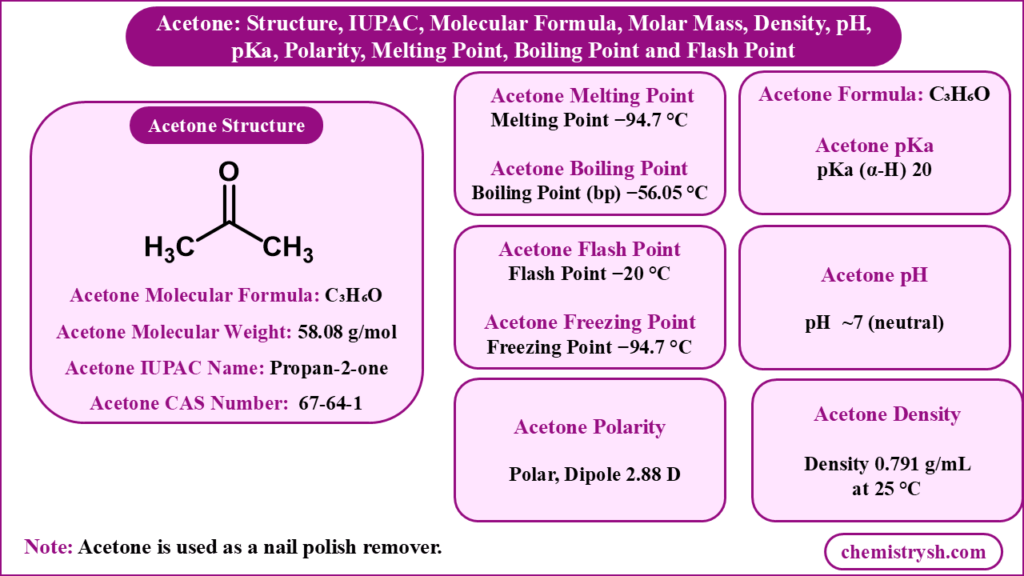
Acetone with molecular formula C₃H₆O is the simplest aliphatic ketone — the acetone IUPAC name is propan-2-one, reflecting the position of the carbonyl group on carbon 2 of a three-carbon chain. It is also known as dimethyl ketone (CAS 67-64-1).
Hand a chemist an unlabelled colourless liquid with a sharp, characteristic sweet odour — how do they prove it is acetone, and not something else entirely? Every test in this article exists to answer exactly that question.
§2 —Physical Constants of Acetone (Propan-2-one)
The acetone chemical formula is C₃H₆O — the acetone structural formula in condensed form is CH₃COCH₃, a structure consisting of a central carbonyl group (C=O) flanked by two methyl groups. The molecular formula of acetone confirms three carbons, six hydrogens, and one oxygen, with a molar mass of acetone of 58.08 g/mol. The acetone boiling point is 56.05 °C — notably low, reflecting high volatility — and the acetone density is 0.791 g/mL at 25 °C. The compound is polar (dipole moment 2.88 D), miscible with water in all proportions, and neutral — acetone pH is approximately 7 in aqueous solution. The acetone pKa of the α-hydrogen is 20, reflecting the weak acidity of the methyl group adjacent to the carbonyl.
A complete reference table of physical constants and other properties of acetone is given below.
|
IUPAC name |
2-Hydroxypropane-1,2,3-tricarboxylic acid |
|
IUPAC Name |
Propan-2-one |
|
Common Name |
Acetone; Dimethyl ketone |
|
Molecular Formula |
C₃H₆O |
|
Condensed Formula |
CH₃COCH₃ |
|
Molar Mass (Molecular Weight) |
58.08 g/mol |
|
CAS Number |
67-64-1 |
|
Appearance |
Colourless, mobile liquid |
|
Odour |
Sharp, characteristic sweet odour |
|
Boiling Point (bp) |
56.05 °C |
|
Melting Point |
−94.7 °C |
|
Density |
0.791 g/mL at 25 °C |
|
Solubility in Water |
Miscible in all proportions |
|
Miscibility |
Freely miscible with ethanol, diethyl ether, chloroform |
|
Refractive Index |
1.3588 at 20 °C |
|
Flash Point |
−20 °C (closed cup) |
|
Functional Group |
Ketone (C=O) — carbonyl group |
|
Polarity |
Polar (dipole moment 2.88 D) |
|
Acid/Base Nature |
Neutral |
|
pH |
~7 (neutral in aqueous solution) |
|
pKa (α-hydrogen) |
20 |
|
Degree of Unsaturation |
1 |
§3 —Planning the Identification: Decode the Structure First
Every competent qualitative analysis begins not at the bench, but on paper. Before a single reagent is added, the structure of acetone must be examined carefully — because the structure dictates the entire test panel.
Step 1 — Identify the Functional Groups in Acetone
Acetone has one defining structural feature:
🟠 Carbonyl group (C=O) — positioned between two methyl groups, with no hydrogen on the carbonyl carbon. This single feature classifies acetone as a ketone, not an aldehyde.
The acetone Lewis structure shows 24 valence electrons total — 12 from three carbon atoms, 6 from one oxygen atom, and 6 from six hydrogen atoms — with a C=O double bond and two lone pairs on the oxygen atom.
Step 2 — What Does the Structure Tell Us Before Any Test Is Run?
Acetone contains a carbonyl group (C=O) — the defining feature of all ketones and aldehydes. The presence of this carbonyl group can be confirmed by Brady’s Test (2,4-DNPH Test). Acetone is a ketone — confirmed by negative results in Tollens’ Test, Fehling’s Test, and Schiff’s Test. The CH₃–C=O arrangement identifies acetone specifically as a methyl ketone, confirmed by the Iodoform Test and Legal’s Test (Sodium Nitroprusside Test). The table below maps each of these structural clues to its predicted outcome.
|
Structural Clue |
What It Predicts |
|
C=O present |
Positive Brady’s test (2,4-DNPH) — carbonyl confirmed |
|
C=O between two carbons (ketone) |
Negative Tollens’, Fehling’s, Schiff’s — not an aldehyde |
|
CH₃–C=O (methyl ketone) |
Positive iodoform test — methyl ketone confirmed |
|
CH₃–C=O (methyl ketone) |
Positive Legal’s test (sodium nitroprusside) |
|
No aromatic ring |
Burns with clean, non-sooty flame |
|
Neutral compound |
No litmus change — no acidic or basic group |
|
No heteroatoms (N, S, halogens) |
Lassaigne’s test negative for all three |
§4 — Chemical Identification Tests: Which Group Applies?
When an unknown organic compound is presented in a qualitative organic chemistry practical or laboratory experiment, the identification process does not begin with chemical tests. It begins with a decision: which group of tests applies to this compound?
This decision is made by evaluating four criteria in order:
(i) Acid/Base Character
Test the compound with litmus paper.
(ii) Flame / Ignition Character
Ignite a small amount of the compound.
(iii) Elemental Composition
Test for the presence of nitrogen, sulfur, and halogens using Lassaigne’s test.
(iv) Solubility Behaviour
Test solubility in water and sodium hydroxide solution.
The four criteria above form the basis of organic qualitative analysis — the systematic process of organic compound identification through observation and chemical identification tests. In any qualitative analysis, only one group of tests is relevant for a given unknown compound — the rest are eliminated by the criteria above.
Based on the structure of acetone decoded in §3, and applying the four criteria — Litmus test, Ignition / Flame test, Lassaigne’s test, and Solubility in NaOH — which single list below should be followed for the qualitative identification of acetone?
(A)
(i) Litmus test (ii) Sodium bicarbonate test (iii) Ferric chloride test (iv) Esterification test (v) Sodium hydroxide solubility test (vi) Flame test (vii) Sublimation test (viii) Melting point / mixed melting point (ix) Solid derivative — amide (x) Solid derivative — anilide
(B)
(i) Litmus test (ii) Ferric chloride test (iii) Bromine water test (iv) Liebermann’s nitroso test (v) Phthalein dye test (vi) Azo dye test (vii) Millon’s test (viii) Sodium hydroxide solubility test (ix) Sodium bicarbonate test (negative) (x) Melting point / mixed melting point (xi) Solid derivative — tribromophenol
(C)
(i) Brady’s test (ii) Tollens’ test (iii) Fehling’s test (iv) Benedict’s test (v) Schiff’s test (vi) Sodium bisulfite addition test (vii) Iodoform test (viii) Molisch’s test (ix) Seliwanoff’s test (x) Barfoed’s test (xi) Osazone formation test (xii) 2,4-DNPH derivative melting point
(D)
(i) Litmus test (ii) Carbylamine test (iii) Nitrous acid test (iv) Hinsberg test (v) Azo dye test (vi) Acetylation test (vii) Benzoylation test (Schotten–Baumann) (viii) Lassaigne’s test (ix) Solid derivative — acetyl / benzoyl
(E)
(i) Baeyer’s test (negative) (ii) Bromine water test (substitution) (iii) Nitration test (iv) Sulfonation test (v) Friedel–Crafts test (vi) Combustion / flame test (sooty flame) (vii) Lassaigne’s test (viii) Melting point / mixed melting point (ix) Solid derivative — picrate (x) Solid derivative — charge transfer complex
§5 — Acetone Qualitative Tests: Complete Identification at a Glance
The table below summarises the complete qualitative test for acetone — each acetone test in sequence, what it confirms, what it rules out, and the expected result. The confirmatory test for acetone is the Iodoform Test and Legal’s Test — both presented in the final tier below. The colourless appearance of acetone immediately eliminates all coloured organic compounds from consideration — a point discussed in detail on the [Coloured Compounds] page.
Full procedural details for each individual test, including quantities, conditions, safety precautions, and interpretation of results, are covered on dedicated pages for each reagent test — including [Physical Appearance], [Solubility Test], [Ignition Test], [Litmus Test], [Lassaigne’s Test], [Brady’s Test], [Tollens’ Test], [Fehling’s Test], [Benedict’s Test], [Schiff’s Test], [Sodium Bisulfite Test], [Iodoform Test], [Legal’s Test], and [Derivative Preparation] — available on this website. Students are encouraged to visit the relevant test page before performing each procedure in the laboratory
|
# |
Test |
What It Establishes |
What It Rules Out |
|
Preliminary Tests |
|
1 |
Physical Appearance |
Colourless, mobile liquid; sharp sweet odour |
Coloured compounds — absent |
|
2 |
Solubility Test |
Polar compound; miscible with water |
Non-polar compounds — absent |
|
3 |
Ignition / Flame Test |
Clean, non-sooty flame — aliphatic character |
Aromatic compounds — absent |
|
4 |
Litmus Test |
Neutral compound |
Carboxylic acids — absent · Phenols — absent · Amines — absent |
|
5 |
Lassaigne’s Test |
No nitrogen, sulfur, or halogens present |
Amines — absent · Amides — absent · Halogenated compounds — absent |
|
Functional Group Tests |
|
6 |
Brady’s Test (2,4-DNPH Test) |
Carbonyl group (C=O) confirmed |
Non-carbonyl compounds — absent |
|
7 |
Tollens’ Test |
Negative — ketone, not an aldehyde |
Aldehydes — absent |
|
8 |
Fehling’s and Benedict’s Test |
Negative — not a reducing aldehyde |
Aliphatic aldehydes — absent · Reducing sugars — absent |
|
9 |
Schiff’s Test |
Negative — not an aldehyde |
Aldehydes — absent |
|
10 |
Sodium Bisulfite Test |
Positive — methyl ketone or aldehyde confirmed |
Non-reactive carbonyls — absent |
|
Confirmatory Tests |
|
11 |
Iodoform Test |
Yellow precipitate — methyl ketone confirmed |
Non-methyl ketones — absent |
|
12 |
Legal’s Test (Sodium Nitroprusside Test) |
Red/ruby colour — methyl ketone confirmed |
Non-methyl ketones — absent |
|
13 |
Derivative — 2,4-DNPH Hydrazone |
Melting point confirms acetone specifically |
Other methyl ketones — absent |
§6 — Chemical Reagents Used in the Qualitative Identification of Acetone
The reagents covered include Brady’s reagent, Tollens’ reagent, Fehling’s solution, iodine solution, and sodium nitroprusside solution — each serving a specific diagnostic purpose in the identification sequence.
Full details of each reagent, including preparation photographs and safety notes, are available on the dedicated pages at chemistrysh.com — [Tollens’ Reagent], [Fehling’s Solution], [Benedict’s Reagent], [Brady’s Reagent (2,4-DNPH)], [Iodine Solution], and [Litmus Test].
|
# |
Reagent |
Composition / Preparation |
Purpose in Identification |
|
1 |
Brady’s Reagent (2,4-DNPH Solution) |
2,4-Dinitrophenylhydrazine dissolved in methanol and dilute H₂SO₄ |
Detects carbonyl group (C=O) — Brady’s Test |
|
2 |
Tollens’ Reagent |
Step 1: Dissolve AgNO₃ in distilled water. Step 2: Add dilute NaOH — brown Ag₂O precipitate forms. Step 3: Add dilute NH₃ dropwise until precipitate dissolves — clear [Ag(NH₃)₂]OH solution obtained. Prepare freshly; never store. |
Distinguishes aldehyde from ketone — negative for acetone |
|
3 |
Fehling’s Solution |
Fehling’s A: CuSO₄ in water. Fehling’s B: sodium potassium tartrate + NaOH in water. Mix equal volumes immediately before use. |
Detects reducing aldehydes — negative for acetone |
|
4 |
Benedict’s Reagent |
CuSO₄ + sodium carbonate + sodium citrate dissolved in distilled water — stable single solution |
Detects reducing aldehydes and sugars — negative for acetone |
|
5 |
Schiff’s Reagent |
Basic fuchsin (1%) in water + sodium bisulfite (1%) + HCl (1%) — decolourised with activated charcoal, filtered to colourless solution. Prepare freshly; store in dark. |
Detects aldehydes — negative for acetone |
|
6 |
Saturated Sodium Bisulfite Solution |
Saturated aqueous NaHSO₃ in distilled water — prepare freshly before use |
Detects methyl ketones and aldehydes — positive for acetone |
|
7 |
Iodine Solution (Lugol’s Iodine) |
I₂ dissolved in aqueous KI solution |
Used with NaOH in Iodoform Test — positive for acetone |
|
8 |
Sodium Hydroxide Solution (10%) |
NaOH dissolved in distilled water — 10% w/v |
Used with iodine solution in Iodoform Test; also in Tollens’ preparation |
|
9 |
Sodium Nitroprusside Solution |
Na₂[Fe(CN)₅NO] dissolved in distilled water — prepare freshly before use |
Confirmatory — Legal’s Test (sodium nitroprusside test) — positive for acetone |
|
10 |
Lassaigne’s Reagent |
Sodium metal + compound fused together — aqueous extract of fusion cake |
Detects nitrogen, sulfur, halogens — all absent in acetone |
|
11 |
Litmus Solution / Paper |
Aqueous litmus |
Determines acid/base character — neutral for acetone |
Safety note: Tollens’ reagent and sodium nitroprusside solution must be freshly prepared immediately before use. Stored Tollens’ reagent can form explosive silver nitride — prepare only the quantity required and dispose of immediately after use.
§7 — Preliminary Tests
In qualitative analysis, a single preliminary observation can eliminate multiple compound classes at once. A neutral litmus result rules out all acidic and basic compounds together.
A clean, non-sooty flame rules out all aromatic compounds in one step. This is the power of preliminary testing — systematic elimination before a single chemical reagent is used.
7.i — Physical Appearance
Observation: Examine the compound visually and by odour under safe laboratory conditions — do not inhale directly — colourless, mobile liquid with a sharp, characteristic sweet odour — coloured compounds absent — liquid state consistent with low boiling point (56.05 °C).
7.ii — Solubility Test
Reagents: Distilled water; ethanol
Solubility: Add 2–3 drops of acetone to 2 mL of water and ethanol separately → freely miscible in both in all proportions → miscibility with water confirms polar functional group present → miscibility in all proportions confirms nonpolar part is small → aromatic hydrocarbons absent — aromatic hydrocarbons are insoluble in water.
7.iii — Ignition / Flame Test
Reagent: Bunsen burner (Caution: acetone is highly flammable — perform away from all other reagents)
Observation: Place a few drops of acetone on a clean evaporating dish, ignite carefully with a taper — burns readily with a clean, non-sooty blue flame — aromatic compounds absent (benzene, toluene) — phenols absent (phenol, cresol).
7.iv — Litmus Test
7.v — Lassaigne’s Test (Elemental Detection)
Reagents: Sodium metal; glucose; distilled water; FeSO₄ solution; FeCl₃ solution; sodium nitroprusside solution; AgNO₃ solution; dilute HNO₃
Preparation of Lassaigne’s Extract: Place sodium metal in the ignition tube, add a small quantity of acetone carefully, then fill the remaining space with glucose — glucose contains no nitrogen, sulfur, or halogens and does not interfere with any detection test; it reduces vapour escape and makes the fusion safer. Heat the ignition tube until red hot, cool cautiously, add distilled water carefully, boil, and filter to obtain the Lassaigne’s extract.
Preliminary Test Results: Identifying the Compound Class of Acetone
From the above observations, carboxylic acids, phenols, and sulfonic acids are absent (litmus paper test) — aromatic hydrocarbons and phenols are absent (ignition test: benzene, toluene, phenol, cresol) — amines, amides, and sulfonic acids are absent (Lassaigne’s test) — the compound may be an aldehyde, ketone, or carbohydrate.
§8 — Functional Group Tests: Carbonyl Detection
The preliminary tests confirmed the compound is neutral, aliphatic, and contains only carbon, hydrogen, and oxygen. A neutral, water-miscible carbonyl compound of this type belongs to one of three classes — aldehyde, ketone, or carbohydrate. The functional group tests in this section will determine which carbonyl compound class it belongs to.
Step 1 — Confirm carbonyl group:
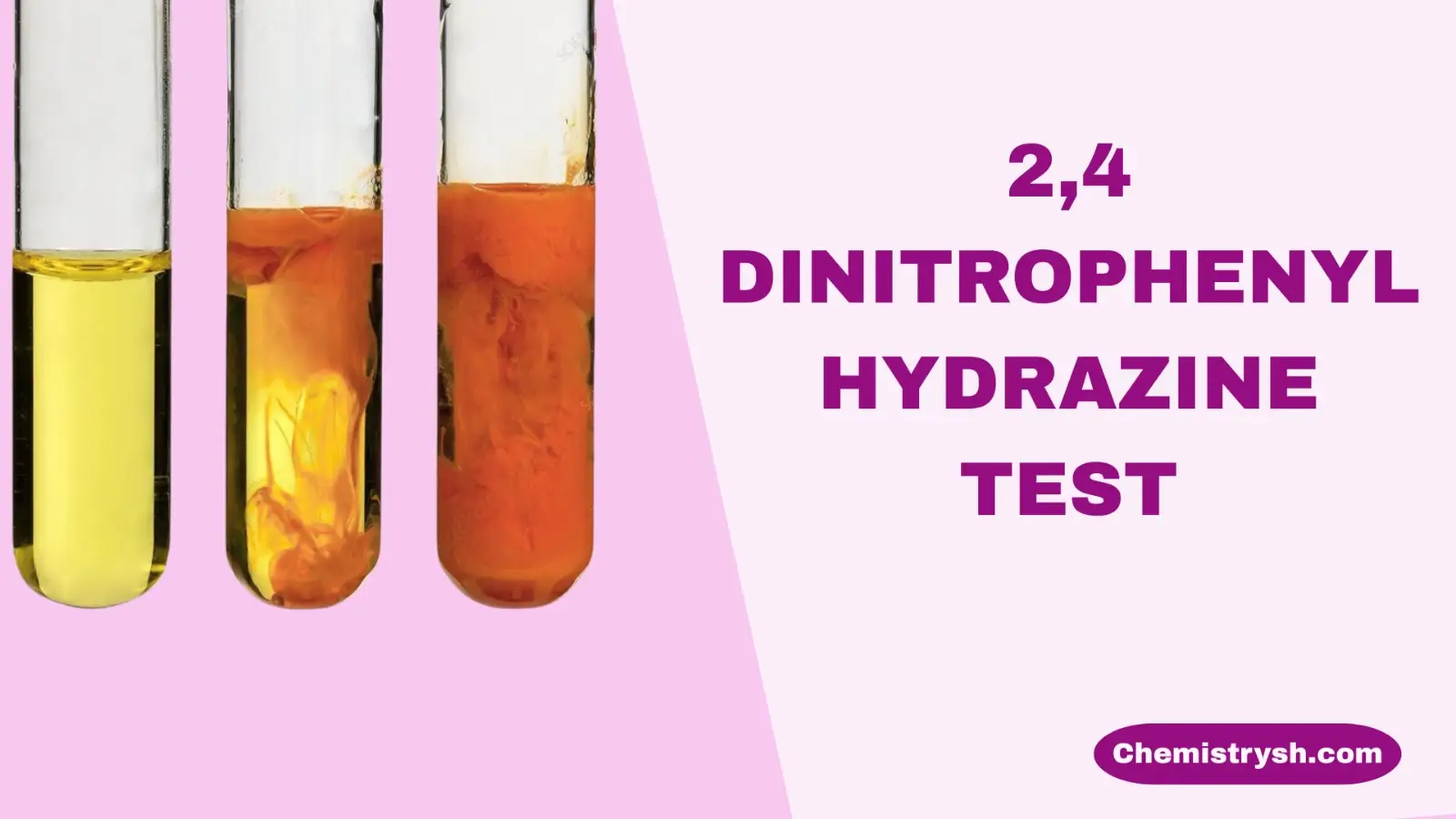
Brady’s Test (2,4-DNPH Test) → reacts with both aldehydes and ketones → positive result confirms carbonyl group (C=O) present.
Step 2 — Aldehyde or ketone?
Fehling’s Test, Benedict’s Test, and Schiff’s Test → all four selective for aldehydes → each giving a negative test result → compound is a ketone, not an aldehyde.
Step 3 — Which ketone?
Tollens’ Test, Sodium Bisulfite Test and Iodoform Test → confirm methyl ketone character → ketone functional group with CH₃–C=O arrangement → defining feature of acetone.
|
§ |
Test |
Result for Acetone |
|
§9 |
Brady’s Test (2,4-DNPH Test) |
Positive — carbonyl confirmed |
|
§10 |
Tollens’ Test |
Negative — not an aldehyde |
|
§11 |
Fehling’s and Benedict’s Test |
Negative — not a reducing aldehyde |
|
§12 |
Schiff’s Test |
Negative — not an aldehyde |
|
§13 |
Sodium Bisulfite Test |
Positive — methyl ketone confirmed |
|
§14 |
Iodoform Test |
Positive — methyl ketone confirmed |
|
§15 |
Legal’s Test (Sodium Nitroprusside Test) |
Positive — methyl ketone confirmed |
§10 — Test 2: Tollens’ Test (Silver Mirror Test)
Tollens’ Test (silver mirror test) uses [Ag(NH₃)₂]OH — the diamminesilver(I) complex — to distinguish aldehydes from ketones. Acetone gives a negative Tollens’ test — confirming a ketone, not an aldehyde.
Full details of Tollens’ Test are available at [Tollens’ Test — chemistrysh.com].
|
Test |
Reagent |
Procedure |
Positive Result |
Inference |
|
Tollens’ Test (Silver Mirror Test) |
Freshly prepared Tollens’ reagent — AgNO₃ + dilute NaOH → Ag₂O precipitate → add dilute NH₃ dropwise → clear [Ag(NH₃)₂]OH solution. Never store. |
Add 2–3 drops of acetone to 2 mL of Tollens’ reagent. Warm in water bath at 60°C for 5 minutes. Observe inner walls of test tube. |
No silver mirror formed — negative result for acetone. (Positive = bright silver mirror on inner walls — confirms aldehyde) |
Aldehyde absent — compound is a ketone. |
§11 — Test 3: Fehling’s Test and Benedict’s Test
Fehling’s Test and Benedict’s Test detect reducing aldehydes using Cu²⁺ ions — producing a brick-red precipitate of Cu₂O on positive result. Acetone gives a negative result in both — confirming a ketone, not a reducing aldehyde.
Full details are available at [Fehling’s Test — chemistrysh.com] and [Benedict’s Test — chemistrysh.com].
|
Test |
Reagent |
Procedure |
Positive Result |
Inference |
|
Fehling’s Test |
Fehling’s A (CuSO₄ solution) + Fehling’s B (sodium potassium tartrate + NaOH) — mix equal volumes immediately before use |
Add 1 mL of acetone to 2 mL of freshly mixed Fehling’s solution. Heat in boiling water bath for 5 minutes. Observe |
No brick-red precipitate — negative result for acetone. (Positive = brick-red Cu₂O precipitate — confirms reducing aldehyde) |
Reducing aldehyde absent — compound is a ketone. |
|
Benedict’s Test |
Benedict’s reagent — CuSO₄ + sodium carbonate + sodium citrate in water — stable single solution |
Add 1 mL of acetone to 2 mL of Benedict’s reagent. Heat in boiling water bath for 5 minutes. Observe. |
No colour change — blue solution remains — negative result for acetone. (Positive = brick-red precipitate — confirms reducing aldehyde) |
Reducing aldehyde absent — compound is a ketone. |
§12 — Test 4: Schiff’s Test
Schiff’s reagent — a decolourised solution of fuchsin dye — is restored to its pink/magenta colour by aldehydes. Ketones do not respond under normal conditions. Acetone gives a negative Schiff’s test — confirming a ketone, not an aldehyde.
Full details of Schiff’s Test are available at [Schiff’s Test — chemistrysh.com].
|
Test |
Reagent |
Procedure |
Positive Result |
Inference |
|
Schiff’s Test |
Schiff’s reagent — basic fuchsin (1%) decolourised with sodium bisulfite (1%) and HCl (1%). Prepare freshly; store in dark. |
Add 2–3 drops of acetone to 2 mL of Schiff’s reagent in a clean test tube. Allow to stand at room temperature for 5 minutes. Do not heat. Observe colour change. |
No pink or magenta colour — negative result for acetone. (Positive = immediate pink/magenta colour — confirms aldehyde) |
Aldehyde absent — compound is a ketone. |
§13 — Test 5: Sodium Bisulfite Test
The sodium bisulfite test detects aldehydes and methyl ketones by nucleophilic addition of HSO₃⁻ to the carbonyl carbon — forming a white crystalline bisulfite adduct. Acetone gives a positive result — confirming a methyl ketone or aldehyde is present.
|
Test |
Reagent |
Procedure |
Positive Result |
Inference |
|
Sodium Bisulfite Test |
aqueous NSaturated aHSO₃ solution — prepare freshly before use |
Add 1 mL of acetone to 2 mL of saturated sodium bisulfite solution in a clean test tube. Shake well and allow to stand for 15–20 minutes. Observe. |
White crystalline precipitate forms — positive result for acetone. (No precipitate = negative — sterically hindered ketone or non-reactive carbonyl) |
Methyl ketone or aldehyde confirmed. Sterically hindered ketones — absent. |
§14 — Test 6: Iodoform Test
The iodoform test is the key confirmatory test for methyl ketones. Acetone reacts with iodine (I₂) and sodium hydroxide (NaOH) to produce iodoform (CHI₃) — a yellow crystalline precipitate with a characteristic antiseptic odour. A positive iodoform test confirms the CH₃CO– group is present.
Full details of the Iodoform Test are available at [Iodoform Test — chemistrysh.com].
|
Test |
Reagent |
Procedure |
Positive Result |
Inference |
|
Iodoform Test |
Iodine solution (I₂ in aqueous KI) + sodium hydroxide solution (10% NaOH) |
Add 1 mL of acetone to 2 mL of NaOH solution in a clean test tube. Add iodine solution dropwise with shaking until a faint permanent yellow colour persists. Warm gently if no precipitate forms. Observe. |
Yellow crystalline precipitate of iodoform (CHI₃) with characteristic antiseptic odour — positive result for acetone |
Methyl ketone (CH₃CO–) confirmed. CH₃COCH₃ + 3I₂ + 4NaOH → CHI₃↓ + CH₃COONa + 3NaI + 3H₂O |
§15 — Test 7: Legal’s Test (Sodium Nitroprusside Test / Legal’s Test for Ketones)
Legal’s Test is the confirmatory test specific to methyl ketones. Acetone reacts with sodium nitroprusside [Na₂Fe(CN)₅NO] in alkaline medium to produce a red/wine-red colour — confirming the presence of the CH₃CO– group. Aldehydes do not respond to this test — making it ketone-specific.
|
Test |
Reagent |
Procedure |
Positive Result |
Inference |
|
Legal’s Test (Sodium Nitroprusside Test) |
Freshly prepared sodium nitroprusside solution — Na₂[Fe(CN)₅NO] dissolved in distilled water + sodium hydroxide solution (10% NaOH). Prepare freshly before use. |
|
Colour appears as red, wine-red, or violet — positive result for acetone. |
Methyl ketone (CH₃CO–) confirmed. Aldehydes — absent. Compound is a ketone. |
Clinical note: The same reaction is the basis of Rothera’s test — the clinical detection of ketone bodies (acetone and acetoacetic acid) in urine, used in the diagnosis and monitoring of diabetic ketoacidosis.
§16 — Solid Derivatives of Acetone and Their Melting Points
Solid derivatives provide the final confirmatory test for acetone through melting point determination. The melting point of acetone derivatives — particularly the 2,4-DNPH hydrazone (126–128 °C), semicarbazone (189–190 °C), and acetone oxime (60–63 °C) — acts as a fingerprint that distinguishes acetone from other methyl ketones sharing positive test results.
Three standard derivatives are prepared:
|
# |
Derivative |
Reagent |
Appearance |
Melting Point |
CAS |
|
1 |
2,4-Dinitrophenylhydrazone (2,4-DNPH hydrazone) |
Brady’s reagent — 2,4-DNPH in methanol/H₂SO₄ |
Yellow-orange crystalline solid |
126–128 °C |
1567-89-1 |
|
2 |
Semicarbazone |
Semicarbazide hydrochloride + sodium acetate in water |
White crystalline solid |
189–190 °C |
110-20-3 |
|
3 |
Oxime |
Hydroxylamine hydrochloride + sodium acetate in water |
White needle-like crystals |
60–63 °C |
127-06-0 |
How to Prepare Acetone Derivatives in the Laboratory
This procedure is a standard organic chemistry practical carried out in any laboratory experiment involving carbonyl compound identification.
- Dissolve acetone in the minimum volume of ethanol or water as appropriate.
- Add the reagent solution.
- Allow to stand or warm gently until crystallisation occurs.
- Filter and wash with cold solvent.
- Recrystallise to obtain a pure sample
- Determine the melting point of acetone derivative and compare with the tabulated values above.
Note: The 2,4-DNPH hydrazone melting point is sensitive to traces of acid in the crystals. Wash with dilute sodium bicarbonate solution before recrystallisation to obtain a sharp, reproducible value.
§17 — Chemical Reactions Involved in the Identification of Acetone
The seven identification tests performed on acetone involve distinct chemical reactions. For each test, the chemical reaction, type of reaction, and observation are given below.
17.i — Brady’s Test (2,4-DNPH Test)
Chemical Reaction:
CH₃COCH₃ + (O₂N)₂C₆H₃NHNH₂ → (O₂N)₂C₆H₃NH–N=C(CH₃)₂ + H₂O
Type of Reaction: Condensation reaction (nucleophilic addition-elimination) — the 2,4-DNPH adds across the C=O double bond, followed by elimination of water to form the hydrazone.
Observation: Yellow-orange crystalline precipitate — acetone 2,4-dinitrophenylhydrazone.
17.ii — Tollens’ Test
Chemical Reaction:
CH₃COCH₃ + 2[Ag(NH₃)₂]OH → No reaction
Type of Reaction: No reaction — acetone does not reduce Tollens’ reagent. Ketones lack the aldehydic hydrogen required for oxidation.
Observation: No silver mirror formed — negative result.
17.iii — Fehling’s Test and Benedict’s Test
Chemical Reaction:
CH₃COCH₃ + Cu²⁺ (Fehling’s/Benedict’s) → No reaction
Type of Reaction: No reaction — acetone is not a reducing agent under these conditions. Only aliphatic aldehydes reduce Cu²⁺ to Cu₂O.
Observation: No brick-red precipitate — blue solution remains — negative result.
17.iv — Schiff’s Test
Chemical Reaction:
CH₃COCH₃ + Schiff’s reagent → No reaction
Type of Reaction: No reaction — Schiff’s reagent is restored to its pink colour only by aldehydes. Ketones do not respond under normal conditions.
Observation: No pink or magenta colour — negative result.
17.v — Sodium Bisulfite Test
Chemical Reaction:
CH₃COCH₃ + NaHSO₃ → (CH₃)₂C(OH)SO₃Na
Type of Reaction: Nucleophilic addition — the bisulfite ion (HSO₃⁻) acts as a nucleophile and adds to the carbonyl carbon to form the bisulfite adduct.
Observation: White crystalline precipitate of sodium acetone bisulfite adduct — positive result.
17.vi — Iodoform Test
Chemical Reaction:
CH₃COCH₃ + 3I₂ + 4NaOH → CHI₃↓ + CH₃COONa + 3NaI + 3H₂O
Type of Reaction: Halogenation followed by nucleophilic cleavage — hydroxide ion acts first as a base (abstracting α-hydrogen) to allow successive iodination of the methyl group, then as a nucleophile to cleave the C–C bond, releasing iodoform (CHI₃).
The reaction mechanism proceeds in two stages: base-catalysed α-halogenation (three successive iodination steps) followed by nucleophilic acyl cleavage — making the iodoform test one of the most mechanistically informative reactions in qualitative organic analysis.
Observation: Yellow crystalline precipitate of iodoform (CHI₃) with characteristic antiseptic odour — positive result.
17.vii — Legal’s Test (Sodium Nitroprusside Test)
Chemical Reaction:
CH₃COCH₃ + Na₂[Fe(CN)₅NO] + NaOH → Red/wine-red coloured complex
Type of Reaction: Complex formation — under alkaline conditions, acetone forms an anion which reacts with the nitroprusside ion [Fe(CN)₅NO]²⁻ to form a coloured complex.
Observation: Red/wine-red colour — positive result. Colour may deepen to violet on standing depending on concentration and pH.
§18 — Acetone Test Results: Qualitative Identification of Acetone
The qualitative identification of acetone — the acetone test sequence — was carried out systematically through preliminary tests, functional group tests, and confirmatory tests following standard organic qualitative analysis protocol. The results of all tests are summarised in the table below.
|
# |
Test |
What It Establishes |
What It Rules Out |
|
Qualitative Test for Acetone — Summary of All Test Results |
|
# |
Test |
Observation |
Conclusion |
|
1 |
Physical Appearance |
Colourless, mobile liquid; sweet odour |
Coloured compounds — absent |
|
2 |
Solubility Test |
Freely miscible with water and ethanol |
Polar compound — aromatic hydrocarbons absent |
|
3 |
Ignition / Flame Test |
Clean, non-sooty blue flame |
Aromatic compounds and phenols — absent |
|
4 |
Litmus Test |
Neutral — no colour change |
Carboxylic acids, phenols, amines — absent |
|
5 |
Lassaigne’s Test |
N, S, halogens all absent |
Amines, amides, halogenated compounds — absent |
|
6 |
Brady’s Test (2,4-DNPH Test) |
Yellow-orange precipitate |
Carbonyl group (C=O) — confirmed |
|
7 |
Tollens’ Test |
No silver mirror — negative |
Aldehyde — absent; compound is a ketone |
|
8 |
Fehling’s and Benedict’s Test |
No brick-red precipitate — negative |
Reducing aldehyde — absent |
|
9 |
Schiff’s Test |
No pink colour — negative |
Aldehyde — absent |
|
10 |
Sodium Bisulfite Test |
White crystalline precipitate — positive |
Methyl ketone or aldehyde — confirmed |
|
11 |
Iodoform Test |
Yellow precipitate, antiseptic odour — positive |
Methyl ketone (CH₃CO–) — confirmed |
|
12 |
Legal’s Test (Sodium Nitroprusside) |
Red/wine-red colour — positive |
Methyl ketone — confirmed |
|
13 |
2,4-Dinitrophenylhydrazone (2,4-DNPH hydrazone) of Acetone |
m.p. 126–128 °C |
Consistent with acetone — confirmed |
Confirming Acetone as a Methyl Ketone — Test Result Interpretation
The preliminary tests established that the compound is a neutral, aliphatic, polar liquid containing only carbon, hydrogen, and oxygen — eliminating all acidic, basic, aromatic, and heteroatom-containing compound classes. Brady’s Test confirmed the presence of a carbonyl group. The sequential negative results in Tollens’, Fehling’s, Benedict’s, and Schiff’s tests eliminated all aldehyde possibilities and confirmed the compound as a ketone. The positive Sodium Bisulfite Test, positive Iodoform Test, and positive Legal’s Test together confirmed the compound as a methyl ketone. The melting point of the 2,4-DNPH hydrazone derivative (126–128 °C) is consistent with the literature value for acetone, providing the final identification. The compound is therefore identified as acetone (propan-2-one).
Identification Flowchart
The decision logic for the identification of acetone follows this sequence:
§19 — Conclusion
The carbonyl group (C=O) was confirmed (Brady’s Test — yellow-orange precipitate). The compound is not an aldehyde — established by negative results in (Tollens’ Test · Fehling’s Test · Benedict’s Test · Schiff’s Test). Methyl ketone character was confirmed (Sodium Bisulfite Test · Iodoform Test · Legal’s Test). The compound was identified as acetone (propan-2-one) from the melting point of its solid derivative (2,4-Dinitrophenylhydrazone — m.p. 126–128 °C).
The compound is confirmed as acetone — IUPAC name propan-2-one · molecular formula C₃H₆O · condensed formula CH₃COCH₃ · molecular weight 58.08 g/mol · density 0.791 g/mL · boiling point 56.05 °C · CAS 67-64-1.
§20 — Real-Case Problems: Distinguishing Acetone from Similar Compounds
The iodoform test, Tollens’ test, and Brady’s test are powerful tools — but several compounds share identical results in one or more of these tests. Correct identification of acetone requires knowing which single test resolves each ambiguity. Three real-case diagnostic problems are presented below:
Problem (a): Acetone vs Acetaldehyde
Acetone vs Acetaldehyde: Shared Positive Tests — Litmus, Brady’s, Iodoform, and Sodium Bisulfite
Although acetone and acetaldehyde respond identically to all four tests above, none of these tests can serve as the basis for differentiation.
Tollens’ Test resolves the ambiguity — acetaldehyde reduces Tollens’ reagent to give a silver mirror, while acetone gives no silver mirror. A silver mirror confirms acetaldehyde; no silver mirror confirms acetone.
|
Test |
Acetone |
Acetaldehyde |
Conclusion |
|
Tollens’ Test |
No silver mirror — negative |
Silver mirror formed — positive |
Acetaldehyde is an aldehyde — acetone is a ketone |
Problem (b): Acetone vs Acetophenone
Acetone and acetophenone share identical observations in the Brady’s Test, Iodoform Test, Legal’s Test, and Tollens’ Test. How can these two compounds be differentiated?
- Brady’s Test (2,4-DNPH) → positive for both
- Iodoform Test → positive for both
- Legal’s Test → positive for both
- Tollens’ Test → negative for both
Acetone vs Acetophenone: Shared Positive Tests — Brady’s, Iodoform, and Legal’s
Although acetone and acetophenone respond identically to all four tests above, none of these tests can serve as the basis for differentiation.
Three tests resolve the ambiguity — the Brady’s Test precipitate colour, the Ignition / Flame Test, and the derivative melting point together distinguish acetone from acetophenone. Any one is sufficient; all three together are conclusive.
|
Test |
Acetone |
Acetaldehyde |
Conclusion |
|
Brady’s Test — precipitate colour |
Yellow precipitate |
Orange/red precipitate |
Aliphatic vs aromatic ketone distinguished |
|
Ignition / Flame Test |
Clean, non-sooty flame |
Sooty, luminous flame |
Aromatic ring in acetophenone confirmed |
|
Derivative m.p. — 2,4-DNPH hydrazone |
126–128 °C |
250–252 °C |
Melting points clearly distinct |
Problem (c): Acetone vs Ethanol and Isopropanol
Acetone, ethanol, and isopropanol share identical observations in the Litmus Test, Solubility Test, and Iodoform Test. How can these three compounds be differentiated?
⦁ Litmus Test → neutral for all three
⦁ Solubility in water → miscible for all three
⦁ Iodoform Test → positive for all three — yellow CHI₃ precipitate
Acetone vs Ethanol and Isopropanol: Shared Positive Tests — Litmus, Solubility, and Iodoform
Although all three compounds respond identically to the tests above, none of these tests can serve as the basis for differentiation.
Brady’s Test resolves the ambiguity immediately — acetone contains a carbonyl group and gives a positive Brady’s Test, while ethanol and isopropanol are alcohols with no carbonyl group and give no precipitate. A positive iodoform test alone is never sufficient to identify acetone — Brady’s Test must always be performed to confirm the carbonyl group.
|
Test |
Acetone |
Acetaldehyde |
Isopropanol |
Conclusion |
|
Brady’s Test (2,4-DNPH) |
Positive — yellow precipitate |
Negative — no precipitate |
Negative — no precipitate |
Only acetone has a carbonyl group (C=O) |
§21 — Safety Note: Working with Acetone in the Laboratory
Acetone is highly volatile and flammable — boiling point 56.05 °C, flash point −20 °C, UN number UN1090. Understanding acetone hazards and acetone toxicity is essential before performing any identification test. It can ignite at room temperature. The following precautions apply to all tests in this article:
First aid: Skin — wash with soap and water. Eyes — irrigate for 15 minutes, seek medical attention. Inhalation — move to fresh air immediately.
§22 — What Are the Uses of Acetone? — Principal Applications
Note: This article focuses on the qualitative identification of acetone. The applications listed below are provided as supplementary information to give context to the compound being identified — not as the primary subject of this article.
Acetone (propan-2-one) is widely used as an acetone solvent in chemical manufacturing, as an acetone nail polish remover in consumer products, as an acetone paint remover for coatings and lacquers, as a laboratory reagent in qualitative analysis, and for clinical detection of acetone in urine in diabetic ketoacidosis.
§23 — Practice Exercise
Test your understanding of the qualitative identification of acetone with the two exercises below. Part A tests recall — Part B tests reasoning.
Part A — Complete the Summary Table
The table below is partially completed. Fill in the missing observations and conclusions based on what you have learned in this article.
|
# |
Test |
Observation |
Conclusion |
|
1 |
Physical Appearance |
|
Coloured compounds — absent |
|
2 |
Litmus Test |
Neutral — no colour change |
|
|
3 |
Brady’s Test (2,4-DNPH) |
|
Carbonyl group (C=O) — confirmed |
|
4 |
Tollens’ Test |
No silver mirror formed |
|
|
5 |
Fehling’s Test |
|
Reducing aldehyde — absent |
|
6 |
Schiff’s Test |
No pink or magenta colour |
|
|
7 |
Sodium Bisulfite Test |
|
Methyl ketone or aldehyde — confirmed |
|
8 |
Iodoform Test |
Yellow precipitate, antiseptic odour |
|
|
9 |
Legal’s Test |
|
Methyl ketone — confirmed |
|
10 |
2,4-DNPH Hydrazone derivative |
m.p. 126–128 °C |
|
Part B — Identify the Unknown
- Litmus Test → neutral
- Ignition Test → clean, non-sooty blue flame
- Lassaigne’s Test → nitrogen, sulfur, and halogens all absent
- Brady’s Test (2,4-DNPH) → yellow-orange precipitate
- Tollens’ Test → no silver mirror — negative
- Fehling’s Test → no brick-red precipitate — negative
- Schiff’s Test → no pink colour — negative
- Sodium Bisulfite Test → white crystalline precipitate — positive
- Iodoform Test → yellow precipitate with antiseptic odour — positive
- Legal’s Test → red/wine-red colour — positive
- 2,4-DNPH hydrazone derivative → m.p. 126–128 °C
Question 1: Which compound class does the unknown belong to? Justify your answer using the preliminary test results.
Question 2: Is the unknown an aldehyde or a ketone? Which tests confirm this?
Question 3: What specific type of ketone is indicated? Which two tests confirm this?
Question 4: Based on the derivative melting point of 126–128 °C, identify the unknown compound. State the IUPAC name.
§24 — Acetone Chemistry — Key Terms and Definitions for Qualitative Identification
Carbonyl Group
A carbonyl group (C=O) is a carbon atom double-bonded to an oxygen atom. It is the defining functional group of aldehydes, ketones, carboxylic acids, esters, and amides — and it makes these compounds reactive toward nucleophiles.
When Brady’s reagent (2,4-DNPH) is added to propanone, an orange-yellow precipitate forms — confirming the presence of a carbonyl group. The same test gives a positive result with benzaldehyde, confirming that Brady’s test detects the carbonyl group in both aldehydes and ketones.
Methyl Ketone
A methyl ketone (CH₃–C=O) is a ketone in which the carbonyl group is bonded directly to a methyl group. Methyl ketones are identified by two specific tests — the iodoform test and Legal’s test — which do not respond to ketones lacking this arrangement.
Propanone (CH₃COCH₃) and butanone (CH₃COC₂H₅) are both methyl ketones — both give a yellow iodoform precipitate and a red colour in Legal’s test. Diethyl ketone (C₂H₅COC₂H₅) has no methyl group attached to the carbonyl and gives negative results in both tests.
Nucleophilic Addition
Nucleophilic addition is a reaction in which a nucleophile — an electron-rich species carrying a lone pair or negative charge — attacks the electrophilic carbonyl carbon and adds across the C=O double bond, converting it from sp² to sp³ hybridisation.
When sodium bisulfite (NaHSO₃) is shaken with propanone, the bisulfite ion (HSO₃⁻) attacks the carbonyl carbon to form a white crystalline adduct. No atoms are lost — the product contains both the original carbon skeleton and the bisulfite group.
Bisulfite Adduct
A bisulfite adduct is a white crystalline addition product formed when sodium bisulfite (NaHSO₃) reacts with an aldehyde or methyl ketone by nucleophilic addition to the carbonyl carbon. The reaction is reversible — the adduct dissolves when treated with dilute acid or dilute alkali.
Shaking propanone with saturated sodium bisulfite solution gives a white crystalline precipitate — the bisulfite adduct (CH₃)₂C(OH)SO₃Na. Adding dilute hydrochloric acid to this precipitate dissolves it and regenerates propanone, confirming the reversible nature of the reaction.
Condensation Reaction
A condensation reaction is a reaction in which two molecules combine to form a larger product, with simultaneous elimination of a small molecule — most commonly water. In organic chemistry, condensation reactions are used to prepare solid crystalline derivatives of carbonyl compounds for identification purposes.
When propanone reacts with 2,4-dinitrophenylhydrazine (2,4-DNPH), water is eliminated and a yellow crystalline 2,4-dinitrophenylhydrazone derivative forms — melting point 126–128 °C. This sharp melting point distinguishes propanone from other carbonyl compounds.
Semicarbazone
A semicarbazone is a solid crystalline derivative formed by the condensation of an aldehyde or ketone with semicarbazide (H₂N–NH–CO–NH₂), with elimination of water. Semicarbazones are used in qualitative analysis to identify carbonyl compounds through characteristic melting points.
Propanone reacts with semicarbazide hydrochloride and sodium acetate to give acetone semicarbazone — a white crystalline solid melting at 189–190 °C. Butanone gives a semicarbazone melting at 136 °C — the different melting points distinguish the two ketones even though both give positive iodoform tests.
Oxime
An oxime is a solid crystalline derivative formed by the condensation of an aldehyde or ketone with hydroxylamine (NH₂OH), with elimination of water, giving a compound containing the C=N–OH group. Oximes are used as solid derivatives for identification of carbonyl compounds by melting point.
Propanone reacts with hydroxylamine hydrochloride and sodium acetate to give acetone oxime (propan-2-one oxime) — a white crystalline solid melting at 60–63 °C. The low melting point of acetone oxime distinguishes it from the oximes of other ketones such as cyclohexanone (m.p. 90 °C).
Rothera’s Test
Rothera’s test is a clinical qualitative test used to detect ketone bodies — acetone and acetoacetic acid — in urine, based on the reaction of the nitroprusside ion [Fe(CN)₅NO]²⁻ with methyl ketones in alkaline medium to produce a red or violet colour.
A urine sample from a patient with uncontrolled diabetes is treated with sodium nitroprusside solution and ammonia. A deep red or violet colour develops — indicating the presence of acetone or acetoacetate in the urine and suggesting diabetic ketoacidosis. A healthy individual’s urine gives no colour change.
Qualitative Analysis
Qualitative analysis is the branch of analytical chemistry concerned with identifying the substances present in a sample using systematic chemical tests — as opposed to quantitative analysis, which determines how much of each substance is present.
A student given an unlabelled colourless liquid performs a litmus test (neutral), a Brady’s test (positive — yellow precipitate), a Tollens’ test (negative), and an iodoform test (positive — yellow precipitate). From these results alone, the compound is identified as a methyl ketone — without knowing its name before the tests began.
Multiple C§26 — Multiple Choice Questions on the Qualitative Identification of Acetonehoice Questions
Test your understanding of the key concepts, tests, and reasoning covered in this article. Each question has one correct answer.
MCQ 1
1. The acetone formula is C₃H₆O and its acetone structure contains which functional group as the defining feature?
A. Hydroxyl group (–OH)
B. Carbonyl group (C=O)
C. Carboxyl group (–COOH)
D. Amino group (–NH₂)
The carbonyl group (C=O) flanked by two methyl groups is the defining feature of acetone’s structure — classifying it as a ketone.
MCQ 2
2. The iodoform test gives a positive result with acetone because acetone contains:
A. An aldehyde group (–CHO)
B. A hydroxyl group (–OH)
C. A methyl ketone group (CH₃–CO–)
D. A carboxylic acid group (–COOH)
Only compounds containing the CH₃–CO– structural unit — methyl ketones and certain alcohols — give a yellow precipitate of iodoform (CHI₃) in this test.
MCQ 3
3. Acetone gives a negative Tollens’ test. Which statement correctly explains this result?
A. Acetone does not contain a carbonyl group
B. Acetone is not soluble in water
C.Acetone is a ketone and cannot reduce [Ag(NH₃)₂]OH
D. Acetone reacts too slowly with Tollens’ reagent
The ketone functional group in acetone has no aldehydic hydrogen — it cannot donate electrons to reduce silver ions to metallic silver under normal conditions.
MCQ 4
4. Which reagent is used in the 2,4-DNPH test to detect the carbonyl group in acetone?
A. Sodium hydroxide and iodine
B. 2,4-Dinitrophenylhydrazine in acidic methanol
C. Sodium nitroprusside and NaOH
D. Fehling’s A and Fehling’s B
Brady’s reagent — 2,4-dinitrophenylhydrazine (2,4-DNPH) in methanol and dilute H₂SO₄ — reacts with the carbonyl compound to give a yellow-orange crystalline precipitate.
MCQ 5
5. The acetone boiling point is 56.05 °C. What does this low value indicate about acetone’s physical properties?
A. Acetone forms strong intermolecular hydrogen bonds
B. Acetone has a high acetone molecular weight
C. Acetone is highly volatile and cannot form hydrogen bonds between its own molecules
D. Acetone is ionic in nature
The low acetone boiling point reflects high volatility — acetone molecules accept but do not donate hydrogen bonds, giving weaker intermolecular forces than alcohols of similar molecular weight.
MCQ 6
6. The molar mass of acetone is 58.08 g/mol. In the iodoform reaction, one mole of acetone produces one mole of iodoform. What is the molecular formula of iodoform?
A. CI₃H
B. CHI₃
C. CH₂I₂
D. C₂HI₃
The iodoform test produces CHI₃ — triiodomethane — a yellow crystalline solid with antiseptic odour. The balanced equation: CH₃COCH₃ + 3I₂ + 4NaOH → CHI₃↓ + CH₃COONa + 3NaI + 3H₂O.
MCQ 7
7. Acetone and acetaldehyde both give positive results in the iodoform test and Brady’s test. Which single test distinguishes between them?
A. Litmus test
B. Sodium bisulfite test
C. Tollens’ test
D. Schiff’s test
Only aldehydes reduce Tollens’ reagent — acetaldehyde gives a silver mirror (positive), while acetone gives no silver mirror (negative). The ketone functional group in acetone lacks the aldehydic hydrogen required for this reduction.
MCQ 8
8. The sodium nitroprusside test (Legal’s test) gives a red/wine-red colour with acetone. This test is specific for:
A. Aldehydes
B. Carboxylic acids
C. Methyl ketones
D. Aromatic compounds
The sodium nitroprusside test detects the CH₃CO– structural unit — methyl ketones give a characteristic red, wine-red, or violet colour in alkaline medium. Aldehydes give no colour in this test.
MCQ 9
9. Which of the following best describes whether acetone is polar or nonpolar?
A. Nonpolar — the two methyl groups cancel the dipole
B. Polar — due to the electronegative carbonyl group (C=O) creating a permanent dipole
C. Ionic — acetone dissociates in water
D. Nonpolar — acetone does not dissolve in water
Acetone has a dipole moment of 2.88 D — the carbonyl compound C=O bond creates an unsymmetrical electron distribution. This polarity makes acetone fully miscible with water despite its two nonpolar methyl groups.
MCQ 10
10. The IUPAC name of acetone is propan-2-one. What does the locant “2” indicate?
A. Acetone has two carbon atoms
B. The carbonyl group is at carbon 2 of the three-carbon chain
C. Acetone has two functional groups
D. The acetone molecular weight is 2 g/mol
In IUPAC nomenclature, propan-2-one describes: propane (three-carbon chain) + -2- (carbonyl at C2) + -one (ketone). The acetone formula C₃H₆O is consistent with this structure.
MCQ 11
11. Which colour precipitate does acetone give in the iodoform test, and what is the name of this precipitate?
A. White — sodium acetate
B. Red — copper(I) oxide
C. Yellow — iodoform (CHI₃)
D. Blue — copper(II) hydroxide
The yellow precipitate of iodoform (CHI₃) with its characteristic antiseptic odour is the diagnostic observation of the iodoform test for acetone — both the colour and the odour confirm the positive result.
MCQ 12
12. Acetone, ethanol, and isopropanol all give a positive iodoform test. Which test immediately distinguishes acetone from the two alcohols?
A. Litmus test
B. 2,4-DNPH test (Brady’s Test)
C. Tollens’ test
D. Fehling’s test
The 2,4-DNPH test detects the carbonyl group (C=O) — only acetone gives a yellow precipitate with 2,4-DNPH. Ethanol and isopropanol are alcohols with no carbonyl group and give no precipitate.
MCQ 13
13. The acetone flash point is −20 °C and the acetone boiling point is 56.05 °C. What is the correct safety precaution for all heated tests involving acetone?
A. Heat acetone directly over a Bunsen burner
B. Use a water bath and keep away from all open flames
C. Store acetone in an open container near a heat source
D. No special precautions are needed below 56 °C
The acetone flash point of −20 °C means acetone vapour can ignite well below room temperature — a water bath must always be used for heated tests, and open flames must be eliminated from the working area.
MCQ 14
14. Which of the following compounds does NOT give a positive iodoform test?
A. Acetone (propan-2-one)
B. Ethanol
C. Isopropanol
D. Diethyl ketone (pentan-3-one)
Diethyl ketone (C₂H₅COC₂H₅) has no methyl group attached to the carbonyl group — it cannot undergo the successive iodination step required for the iodoform test. The other three compounds all contain or generate the CH₃CO– unit.
MCQ 15
15. The melting point of the acetone 2,4-DNPH hydrazone derivative is 126–128 °C. What is the purpose of preparing this solid derivative in the confirmatory test for acetone?
A. To confirm the presence of a hydroxyl group
B. To distinguish acetone from other methyl ketones by melting point
C. To detect nitrogen in the compound
D. To test for the presence of sulfur
The confirmatory test using the 2,4-DNPH test product (2,4-DNPH hydrazone, m.p. 126–128 °C) distinguishes acetone from other methyl ketones — butanone gives a hydrazone melting at 117 °C, a clearly different value.
§27 — References
- Sigma-Aldrich. Acetone (CAS 67-64-1, ACS reagent ≥99.5%). Product specification sheet. Merck KGaA, Darmstadt, Germany. Accessed August 2026. https://www.sigmaaldrich.com
- Vogel, A.I.; Tatchell, A.R.; Furnis, B.S.; Hannaford, A.J.; Smith, P.W.G. Vogel’s Textbook of Practical Organic Chemistry, 5th ed. Longman Scientific & Technical, Harlow, UK, 1989.
- Royal Society of Chemistry (RSC). Classic Chemistry Experiments: Brady’s Test for Carbonyl Compounds. RSC Education, London. Accessed August 2026. https://www.rsc.org
- chemistrysh.com. 2,4-Dinitrophenyl Hydrazine Test (Brady’s Reagent). Accessed August 2026. https://chemistrysh.com/24-dinitrophenyl-hydrazine/
- chemistrysh.com. Tollens’ Test (Silver Mirror Test). Accessed August 2026. https://chemistrysh.com/tollens-test/
- chemistrysh.com. Fehling’s Test: Reaction, Reagents, Procedure and Applications. Accessed August 2026. https://chemistrysh.com/fehlings-test/
- chemistrysh.com. Benedict Test for Reducing Sugars. Accessed August 2026. https://chemistrysh.com/benedict-test/
- chemistrysh.com. Iodoform Test: Principle, Reaction, Mechanism and Applications. Accessed August 2026. https://chemistrysh.com/iodoform-test/
- Rothera, A.C.H. Note on the sodium nitroprusside reaction for acetone. Journal of Physiology, 1908, 37(5), 491–494.