
Which chemical reaction is qualified for laboratory test?
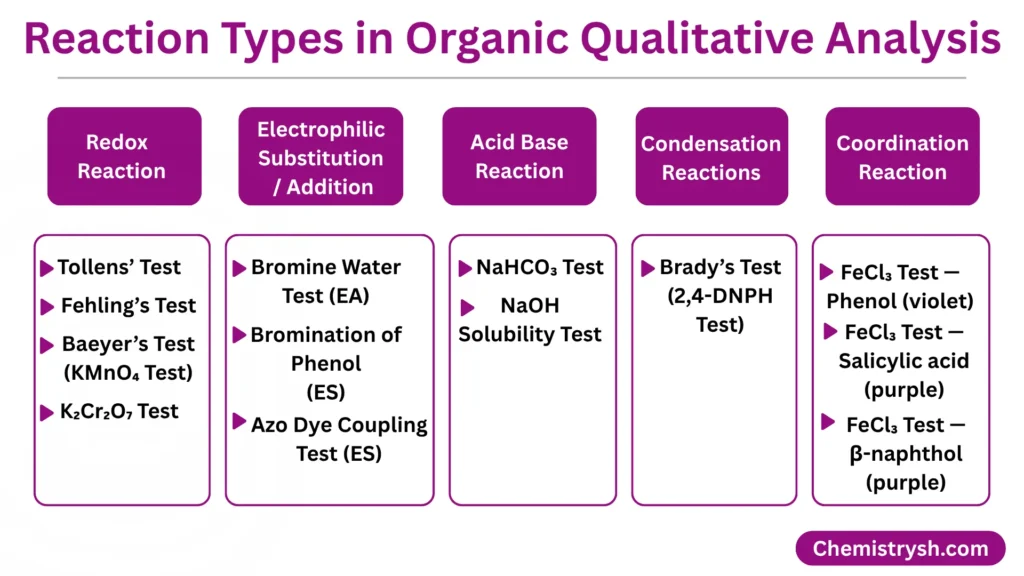
Chemistry is full of chemical reactions — but not every chemical reaction can be used as a laboratory identification test for organic compounds. What makes a chemical reaction suitable to be used as a laboratory identification test in the first place? The answer is simple: a visible change must occur. A chemical reaction in which a colour disappears, a colour is produced, a gas is evolved, a precipitate forms, or effervescence is observed that reaction qualifies as a laboratory identification test, a qualitative test, and a laboratory test for organic compounds. A reaction in which nothing visible happens cannot serve as an identification test at the bench. This is the principle that selects which reactions earn a place in qualitative analysis and which do not., seeing is believing.
The reactions that qualify all share one thing: they produce a visible, unmistakable change. Here are three examples that show exactly what that means:
Different observations — Different identifications — Different chemistry behind each test
Table 1: Visible Changes in Organic Qualitative Analysis Observation, Reaction Type and Compound Identified
The five observations described above represent the five most common types of visible change used in organic qualitative analysis. The table below summarises each observation alongside the reagent that produces it, the reaction type responsible, and the organic compound or functional group it identifies.
|
Observation |
Reagent Used |
Reaction Type |
Compound Identified |
|
Colour disappears |
Bromine water |
Electrophilic addition |
Alkene or alkyne |
|
Bubbles form (Effervescence) |
NaHCO₃ solution |
Acid-base reaction |
Carboxylic acid |
|
Colour appears |
FeCl₃ solution |
Coordination reaction |
Phenol, enol |
|
Precipitate forms |
AgNO₃ solution |
Precipitation reaction |
Halide compound |
|
Silver mirror forms |
Tollens’ reagent |
Redox reaction |
Aldehyde |
Real Case Study- Bromine Water Test – The same reagent – two completely different reactions
Every laboratory test has two sides: what you see and what is happening. Most textbooks focus on what you see. This article focuses on what is happening — the type of chemical reaction behind the observation.
Take bromine water as the perfect example:
Add bromine water to a compound with a double bond (alkene)
The reddish-brown colour disappears. No precipitate forms.
What is happening: Bromine adds across the C=C double bond. This is an electrophilic addition reaction. The bromine molecule is consumed entirely — that is why the colour disappears.
R–CH=CH–R’ + Br₂ → R–CHBr–CHBr–R’
Add bromine water to phenol
The reddish-brown colour disappears AND a white precipitate forms simultaneously.
What is happening: Bromine replaces three hydrogen atoms on the benzene ring. This is an electrophilic substitution reaction. The ring is preserved, tribromophenol precipitates, and HBr is released.
Same reagent. Same colour discharge. Two completely different reactions underneath.
Real Target of This Article — Real Chemistry Behind Each Chemistry Laboratory Test
The bromine water test makes the point perfectly. One reagent, one colour discharge, two completely different reactions — electrophilic addition with an alkene, electrophilic substitution with phenol. The observation alone does not tell the full story. This article tells complete story behind the chemistry laboratory test.
Every chemistry laboratory test covered in this article is explained not by its procedure or its observation, but by the real chemistry — the reaction type — happening underneath. The reaction types covered in this article are:
Acid-Base Reactions · Oxidation-Reduction (Redox) Reactions · Electrophilic Addition Reactions · Electrophilic Substitution Reactions · Nucleophilic Addition Reactions · Condensation Reactions · Coordination Reactions · Precipitation Reactions · Hydrolysis Reactions · Dehydration Reactions · Combustion Reactions
Each has its own section, its own logic, and its own explanation. By the end, a student will not just recognise a chemistry laboratory test or a qualitative identification test — they will understand the reaction type responsible, the functional group being identified, and the real chemistry behind every qualitative analysis of organic compounds.
Which Reaction Types and Laboratory Tests in Organic Qualitative Analysis Are Covered in This Article?
- Acid-Base Reactions — NaHCO₃ test, NaOH solubility test
- Oxidation-Reduction (Redox) Reactions — Tollens’ test, Fehling’s test, Baeyer’s test, K₂Cr₂O₇ test
- Electrophilic Addition and Substitution Reactions — Bromine water test, Bromination of phenol
- Electrophilic Substitution Reactions — Azo dye coupling
- Nucleophilic Addition Reactions — Bisulfite addition test, Schiff’s reagent test
- Condensation Reactions — Brady’s test
- Coordination / Complex Formation Reactions — FeCl₃ test (four variants)
- Precipitation Reactions — AgNO₃ test, Lassaigne’s test, CaCl₂/BaCl₂ test
- Hydrolysis Reactions — Ester hydrolysis, Aspirin hydrolysis, Amide hydrolysis
- Dehydration Reactions — Molisch’s test
- Combustion and Ignition Tests — Ignition test
- Substitution and Oxidation Reaction- Iodoform reaction, Haloform Reaction
Every section answers the same question: what type of reaction is happening here in organic qualitative analysis, and why does it produce what you see? Every chemistry laboratory test, every reaction type, one clear answer for the identification of organic compounds.
Acid-Base Reactions: NaHCO₃ and NaOH Tests Explained
In an acid-base reaction, a proton (H⁺) is transferred from one molecule to another — and in the laboratory, that transfer produces something you can see.
Tests covered in this section:
NaHCO₃ Test (Sodium Bicarbonate Test)
NaOH Solubility Test (Sodium Hydroxide Test)
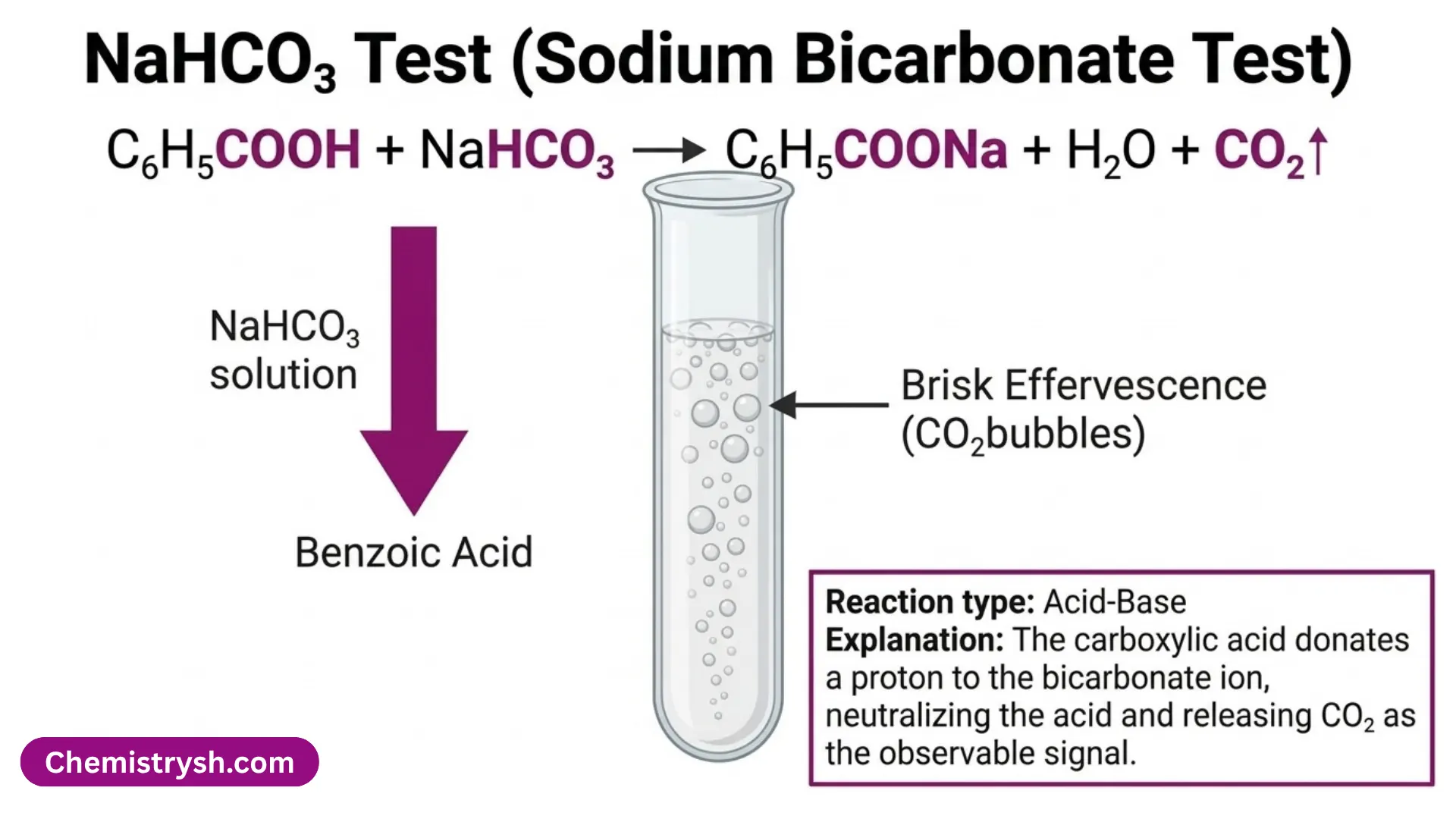
Sodium Bicarbonate Test — Acid-Base Reaction
When benzoic acid is treated with sodium bicarbonate solution, carbon dioxide gas is evolved as brisk effervescence. This is an acid-base reaction — the carboxylic acid donates a proton to the bicarbonate ion, neutralising the acid and releasing CO₂ as the observable signal.
C₆H₅COOH + NaHCO₃ → C₆H₅COONa + H₂O + CO₂↑
Observation: Brisk effervescence (CO₂ bubbles)
Reaction type: Acid-base
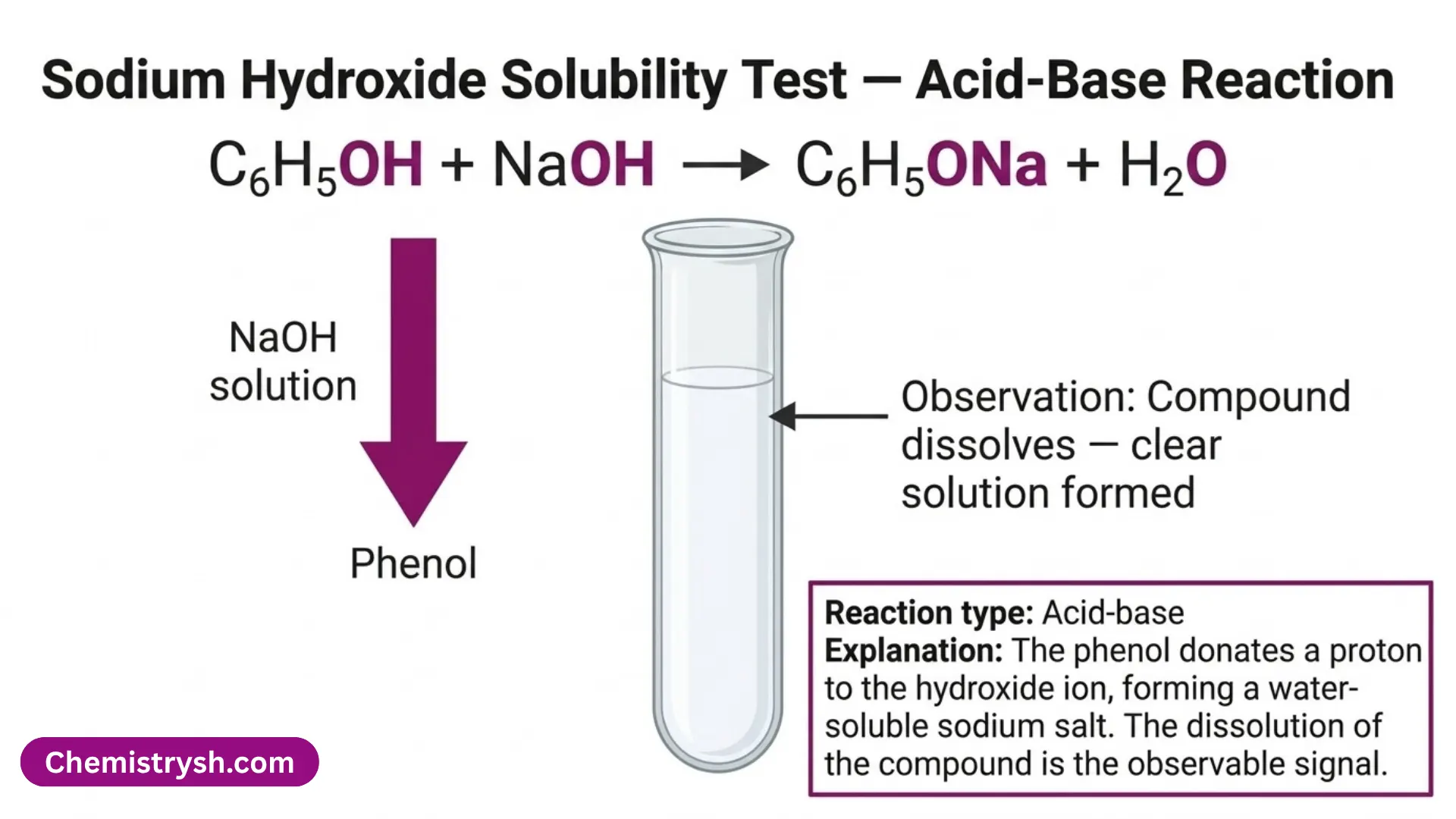
Sodium Hydroxide Solubility Test — Acid-Base Reaction
When phenol is treated with sodium hydroxide solution, it dissolves completely, forming sodium phenoxide. This is an acid-base reaction — the phenol donates a proton to the hydroxide ion, forming a water-soluble sodium salt. The dissolution of the compound is the observable signal.
C₆H₅OH + NaOH → C₆H₅ONa + H₂O
Observation: Compound dissolves — clear solution formed
Reaction type: Acid-base
Remember: Both phenols and carboxylic acids dissolve in NaOH — but only carboxylic acids produce bubbles with NaHCO₃. Effervescence is the deciding observation.
Remember
NaOH is a stronger base than NaHCO₃. It deprotonates both carboxylic acids and phenols. NaHCO₃ is weaker and deprotonates only acids strong enough to displace carbonic acid — in practice, pKa below about 6. Ordinary phenols (pKa ≈ 10) fall well outside that range, which is why they give no effervescence. The threshold is acid strength, not the name of the functional group: strongly acidic phenols such as picric acid do effervesce with bicarbonate.
Note: Na⁺, K⁺, NH₄⁺ — salts of these ions are always soluble in water. This is why both tests produce a visible result — the salt formed is soluble, so the compound disappears into solution rather than remaining as a solid.
One test separates carboxylic acids from everything else. The other separates phenols from neutral compounds. Together, they cover the two most common acidic functional groups in organic analysis.
Redox Reactions: Tollens’, Fehling’s, Baeyer’s and Dichromate Tests
In a redox reaction, electrons are transferred from one molecule to another — one species loses electrons (oxidation) and the other gains them (reduction). In the laboratory, that electron transfer produces a colour change, a precipitate, or a dramatic visual transformation that is impossible to miss.
- Tests covered in this section:
- Tollens’ Test (Silver Mirror Test)
- Fehling’s Test
- Baeyer’s Test (KMnO₄ Test)
- K₂Cr₂O₇ Test (Acidified Potassium Dichromate Test)
Tollens’ Test — Redox Reaction
When an aldehyde is added to Tollens’ reagent (ammoniacal silver nitrate), a bright silver mirror forms on the inner wall of the test tube. The aldehyde is oxidised to a carboxylate ion, while silver ions are reduced to metallic silver, which deposits as the mirror.
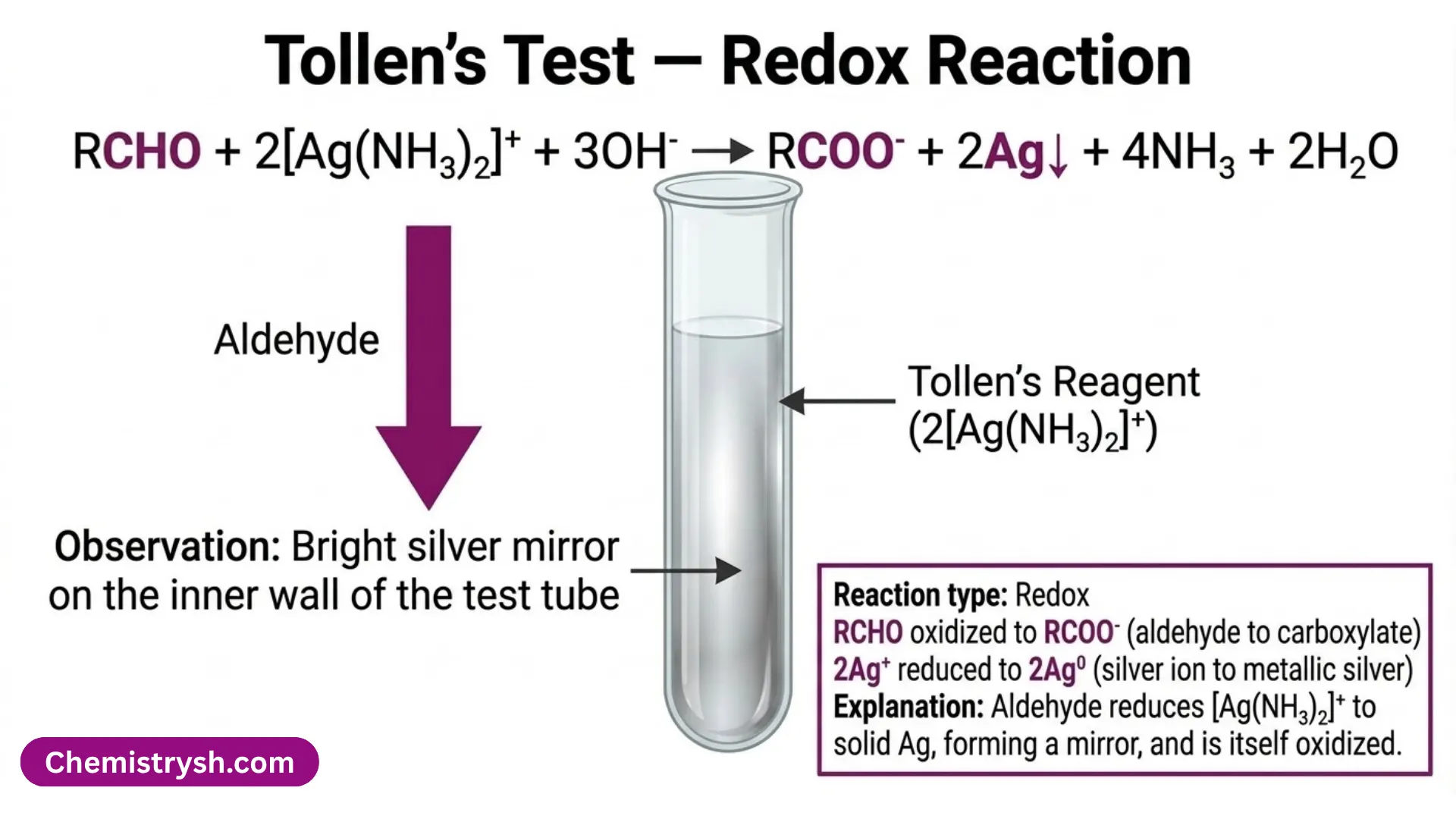
RCHO + 2[Ag(NH₃)₂]⁺ + 3OH⁻ → RCOO⁻ + 2Ag↓ + 4NH₃ + 2H₂O
Observation: Bright silver mirror on the inner wall of the test tube
Reaction type: Redox — aldehyde oxidised / Ag⁺ reduced to Ag⁰
Fehling’s Test — Redox Reaction
When an aliphatic aldehyde is treated with Fehling’s solution, a brick-red precipitate forms as the blue copper(II) solution is consumed. The aldehyde is oxidised, while cupric ions are reduced to cuprous oxide.
RCHO + 2Cu²⁺ + 5OH⁻ → RCOO⁻ + Cu₂O↓ + 3H₂O
Observation: Blue solution → brick-red precipitate of Cu₂O
Reaction type: Redox — aldehyde oxidised / Cu²⁺ reduced to Cu⁺
Remember: Aromatic aldehydes (e.g. benzaldehyde) do NOT give a positive Fehling’s test — but they DO give a positive Tollens’ test. This difference separates aliphatic from aromatic aldehydes.
Baeyer’s Test — Redox Reaction
When cold, dilute, neutral KMnO₄ is added to a compound containing a C=C or C≡C bond, the purple colour disappears. The unsaturated compound is oxidised, while permanganate is reduced to manganese dioxide.
3R–CH=CH–R’ + 2KMnO₄ + 4H₂O → 3R–CH(OH)–CH(OH)–R’ + 2MnO₂↓ + 2KOH
Observation: Purple colour discharged; brown MnO₂ precipitate
Reaction type: Redox — alkene oxidised / MnO₄⁻ reduced to MnO₂
Remember: Cold, dilute, neutral KMnO₄ only. Hot or acidic KMnO₄ oxidises further and cleaves C–C bonds. But note that the cold condition controls how far the oxidation goes — it does not make the test specific. Aldehydes, phenols and easily oxidised alcohols also discharge the purple colour, so Baeyer’s result must always be read alongside the bromine water result.
K₂Cr₂O₇ Test — Redox Reaction
When acidified potassium dichromate is added to a primary or secondary alcohol and warmed, the orange colour changes to green. A primary alcohol is oxidised through the aldehyde to a carboxylic acid; a secondary alcohol is oxidised to a ketone. In both cases chromium in the +6 oxidation state is reduced to chromium(III), which is green.
Primary alcohol:
3R–CH₂OH + 2Cr₂O₇²⁻ + 16H⁺ → 3R–COOH + 4Cr³⁺ + 11H₂O
Secondary alcohol:
3R₂CHOH + Cr₂O₇²⁻ + 8H⁺ → 3R₂C=O + 2Cr³⁺ + 7H₂O
Observation: Orange solution turns green
Reaction type: Redox — alcohol oxidised / Cr⁶⁺ reduced to Cr³⁺
Remember: Tertiary alcohols do not react — no colour change. This single observation separates primary and secondary alcohols from tertiary alcohols. Note also that a green colour confirms oxidation has occurred, not specifically that an alcohol was present — aldehydes also reduce dichromate to Cr³⁺. Read this test alongside Tollens’ or Brady’s before concluding.
Note
In every redox identification test, it is the reagent that visibly changes — not the compound being tested. Ag⁺ becomes a silver mirror. Cu²⁺ becomes a brick-red precipitate. MnO₄⁻ loses its purple colour. Cr⁶⁺ turns green. The reagent is reduced and the organic compound is oxidised.
.
Electrophilic Addition vs Substitution: What Bromine Water Actually Tells You
In an electrophilic addition reaction, an electrophile adds across a carbon-carbon double or triple bond. The π electrons of the unsaturated bond attack the electrophile, the π bond breaks, and two new σ bonds form. Nothing is lost — both the electrophile and the unsaturated compound become part of the product.
In an electrophilic substitution reaction, the electrophile replaces a hydrogen atom on an aromatic ring. The ring is preserved — nothing is added across a bond, and nothing is lost from the ring except one hydrogen atom.
Tests covered in this section:
Bromine Water Test
Bromination of Phenol
Bromine Water Test — Electrophilic Addition
When bromine water is added to a compound containing a C=C or C≡C bond, the reddish-brown colour disappears immediately. No precipitate forms. The bromine molecule adds directly across the double or triple bond — this is an electrophilic addition reaction. The bromine is consumed entirely, which is why the colour disappears.
R–CH=CH–R’ + Br₂ → R–CHBr–CHBr–R’
Observation: Reddish-brown colour discharged — colourless solution, no precipitate
Reaction type: Electrophilic addition — Br₂ adds across C=C
Remember: Benzene and other aromatic rings do NOT decolorise bromine water under ordinary laboratory conditions. Aromatic rings undergo electrophilic substitution — not addition — and that requires a Lewis acid catalyst (e.g. FeBr₃) not present in bromine water.
Bromination of Phenol — Electrophilic Substitution
When phenol is treated with bromine water, the hydroxyl group (-OH) activates the benzene ring strongly toward electrophilic substitution. Bromine replaces hydrogen atoms at the 2, 4, and 6 positions simultaneously, producing 2,4,6-tribromophenol as a white precipitate. This reaction occurs instantly at room temperature without any catalyst.
Remember: The -OH group is a powerful ring activator. It donates electron density into the ring, making positions 2, 4, and 6 highly reactive toward electrophiles — which is why all three positions substitute at once, without needing a catalyst.
Remember: Phenol DOES decolorise bromine water — but also produces a white precipitate of 2,4,6-tribromophenol simultaneously. Decolorisation alone = alkene. Decolorisation + white precipitate = phenol. The precipitate is the difference.
C₆H₅OH + 3Br₂ → C₆H₂Br₃OH↓ + 3HBr
Reaction type: Electrophilic substitution — Br replaces H at three ring positions
Observation: Reddish-brown colour discharged AND white precipitate forms simultaneously
Note
Electrophilic addition and electrophilic substitution both involve an electrophile attacking a carbon system — but the outcomes are opposite. In addition, the π bond breaks and the chain gains atoms. In substitution, the ring is preserved and a hydrogen atom is replaced. Bromine water tells you which one happened: no precipitate means addition, white precipitate means substitution.
Electrophilic Substitution: Azo Dye Coupling and Diazonium Salt Chemistry
In electrophilic substitution, an electrophile replaces a hydrogen atom on an aromatic ring — and the aromatic ring is preserved throughout.
What makes this possible is the electron-rich nature of the aromatic π system. The reaction is always initiated from the ring side, not the electrophile side:
The π electrons of the aromatic ring donate to the electrophile — the ring attacks first
The electrophile accepts those electrons — and in doing so, replaces a hydrogen atom on the ring
The aromatic system is maintained rather than destroyed — and that stability is exactly what drives the reaction to completion.
Tests covered in this section:
Bromination of Phenol
Azo Dye Coupling Test
Azo Dye Coupling Test — Electrophilic Substitution
When a primary aromatic amine (e.g. aniline) is treated with NaNO₂/HCl at 0–5°C, a diazonium salt is formed. This diazonium salt then couples with an activated aromatic compound, forming a brightly coloured azo dye. Coupling occurs at the position most activated by the electron-donating group — para in phenol and aniline, where that position is free. With β-naphthol the coupling occurs at C-1, the position adjacent to the –OH, giving 1-(phenylazo)-2-naphthol. This coupling step is an electrophilic substitution reaction — the diazonium ion acts as the electrophile and replaces a hydrogen on the activated ring.
ArNH₂ + NaNO₂/HCl (0–5°C) → ArN₂⁺Cl⁻ (diazonium salt)
ArN₂⁺Cl⁻ + β-naphthol/NaOH → Ar–N=N–C₁₀H₆–OH (1-(aryl-azo)-2-naphthol) ↓ orange-red
Observation: Bright orange or red azo dye formed
Reaction type: Electrophilic substitution — diazonium ion replaces H on activated aromatic ring
Remember: The coupling step only works with activated aromatic rings — those bearing electron-donating groups such as -OH or -NH₂. An unactivated ring will not couple with the diazonium salt.
Note: Both tests in this section involve an electrophile attacking an aromatic ring — but the electrophile is different in each case. In bromination, the electrophile is Br⁺ (or the Br₂ molecule polarised by the ring). In azo coupling, the electrophile is the diazonium ion ArN₂⁺. In both cases, the aromatic ring is preserved and a hydrogen atom is replaced — that is the defining feature of electrophilic substitution.
Nucleophilic Addition: Bisulfite and Schiff’s Reagent Tests
In a nucleophilic addition reaction, a nucleophile — an electron-rich species — donates its electrons to an electron-deficient carbon atom. In organic qualitative analysis, the target is always the carbonyl group (C=O), where the carbon carries a partial positive charge and is therefore vulnerable to nucleophilic attack.
What makes this reaction type visible in the laboratory:
The nucleophile attacks the carbonyl carbon — the C=O π bond breaks
Both atoms of the original C=O bond gain new partners — no atom is lost, nothing is eliminated
This is what separates nucleophilic addition from condensation — in addition, the product retains every atom of both reactants. Nothing is lost.
Tests covered in this section:
Bisulfite Addition Test
Schiff’s Reagent Test
Bisulfite Addition Test — Nucleophilic Addition
When a saturated solution of sodium bisulfite (NaHSO₃) is added to an aldehyde or a methyl ketone, a white crystalline precipitate forms. The bisulfite ion acts as the nucleophile, attacking the carbonyl carbon directly. This is a nucleophilic addition reaction — the C=O bond breaks, both the bisulfite and the carbonyl compound are incorporated into the product, and nothing is lost.
RCHO + NaHSO₃ → RCH(OH)SO₃Na↓ (white crystalline precipitate)
Observation: White crystalline precipitate
Reaction type: Nucleophilic addition — bisulfite ion attacks C=O
Remember: This test is positive for aldehydes and methyl ketones only. Dialkyl ketones (e.g. diethyl ketone) do not react — the bulky groups around the carbonyl carbon block the nucleophile from approaching.
Schiff’s Reagent Test — Nucleophilic Addition
Schiff’s Reagent Test — When Schiff’s reagent (decolorised fuchsin solution) is added to an aldehyde, the magenta colour is restored. The aldehyde reacts with the fuchsin molecule through nucleophilic addition at the carbonyl carbon, regenerating the coloured form of the dye.
RCHO + Schiff’s reagent → magenta-coloured complex
Observation: Colourless Schiff’s reagent → magenta/pink colour restored
Reaction type: Nucleophilic addition — aldehyde carbonyl attacked by the fuchsin nucleophile
Remember: Ketones do not restore the magenta colour with Schiff’s reagent. This makes Schiff’s test a useful complement to bisulfite — bisulfite catches both aldehydes and methyl ketones, Schiff’s catches aldehydes only.
Note
In nucleophilic addition, the nucleophile is always the attacking species and the carbonyl carbon is always the target. The C=O bond does not disappear — it becomes a C–O single bond as the nucleophile bonds to carbon. This is why nothing is lost and nothing is eliminated — the product contains every atom of both reactants.
Condensation Reactions: Brady’s Test and the 2,4-DNPH Precipitate
In a condensation reaction, two molecules combine and a small molecule — usually water — is eliminated in the process. In organic qualitative analysis, condensation reactions target the carbonyl group (C=O), and the eliminating molecule is what drives the formation of a new double bond (C=N) in the product.
What distinguishes condensation from nucleophilic addition:
In nucleophilic addition — the nucleophile adds to C=O, nothing is lost, the product has no new double bond
In condensation — the nucleophile adds to C=O first, then a small molecule is eliminated, and a new C=N double bond forms in its place
The observable result — a coloured crystalline precipitate — is produced by that new C=N bond, not by the addition step alone.
Tests covered in this section:
Brady’s Test (2,4-DNPH Test)
Brady’s Test — Condensation Reaction
When a solution of 2,4-dinitrophenylhydrazine (2,4-DNPH) is added to an aldehyde or ketone, an orange or yellow crystalline precipitate forms immediately. The 2,4-DNPH reagent first adds across the C=O bond, then water is eliminated, forming a hydrazone with a C=N linkage. This is a condensation reaction — addition followed by elimination of water.
RCHO + 2,4-DNPH → R–CH=N–NH–C₆H₃(NO₂)₂↓ + H₂O
Observation: Orange or yellow crystalline precipitate
Reaction type: Condensation — C=O reacts with 2,4-DNPH, H₂O eliminated, C=N formed
Remember: Brady’s test is positive for both aldehydes AND ketones. To distinguish between the two, follow up with Tollens’ or Fehling’s test — Brady’s test alone cannot tell them apart.
Note: In a condensation reaction, the observable product is never formed by the addition step alone. It is the elimination step — the loss of water — that creates the new C=N bond, called a hydrazone linkage, and produces the precipitate you see. Addition without elimination gives an invisible intermediate. The visible change belongs entirely to the elimination step.
Coordination Reactions: The FeCl₃ Test for Phenols and Enols
In a coordination reaction, a ligand donates a lone pair of electrons to a metal ion, forming a coordinate bond. The metal ion does not gain or lose electrons — it simply accepts the lone pair. The result is a coordination complex, and the colour of that complex is the observable signal in the laboratory.
What makes coordination reactions different from redox reactions:
In redox — electrons are fully transferred, the metal ion changes its oxidation state, and colour changes because the ion itself changes
In coordination — electrons are shared, not transferred, the metal ion keeps its oxidation state, and colour arises from the geometry and ligand field of the complex
The iron in the FeCl₃ test remains Fe³⁺ throughout — it is not reduced. The colour you see is produced by the complex, not by a change in oxidation state.
Tests covered in this section:
FeCl₃ Test — Phenol (violet)
FeCl₃ Test — Salicylic acid (purple)
FeCl₃ Test — β-naphthol (purple)
FeCl₃ Test (Phenol) — Coordination Reaction
Phenol — When a drop of dilute ferric chloride solution is added to phenol, a violet colour develops instantly. The phenoxide ion donates lone pairs from its oxygen to Fe³⁺, forming a violet coordination complex. This is a coordination reaction — Fe³⁺ is the metal ion, the phenoxide ion is the ligand.
Observation: Violet colour
Reaction type: Coordination — phenoxide oxygen donates lone pair to Fe³⁺
FeCl₃ Test (Salicylic Acid) — Coordination Reaction
Salicylic Acid — Salicylic acid gives a purple colour with FeCl₃. Both the phenolic -OH and the carboxylate group coordinate to Fe³⁺, forming a stable chelate complex.
Observation: Purple colour
Reaction type: Coordination — chelate complex formed via phenolic -OH and carboxylate groups
FeCl₃ Test (β-Naphthol) — Coordination Reaction
β-naphthol — β-naphthol gives a purple colour with FeCl₃. The extended aromatic system of the naphthol ring changes the ligand field compared to simple phenol, shifting the colour of the complex.
Observation: Purple colour
Reaction type: Coordination — naphthoxide oxygen donates lone pair to Fe³⁺
FeCl₃ Test (Enols) — Coordination Reaction
Enols and β-diketones (e.g. acetylacetone) give red, blue, or green colours with FeCl₃, depending on the specific compound. The enol oxygen coordinates to Fe³⁺ through its lone pair.
Observation: Red, blue, or green colour (compound-specific)
Reaction type: Coordination — enol oxygen donates lone pair to Fe³⁺
Remember: The FeCl₃ test is not a redox test. Fe³⁺ is not reduced to Fe²⁺. The colour comes from the coordination complex formed — ligand-to-metal charge transfer (LMCT) is responsible for the intense colours observed.
Note
A coordination bond is formed when one atom donates both electrons to another — unlike a covalent bond where each atom contributes one electron. In the FeCl₃ test, the oxygen atom of the phenol, enol, or carboxylate group is always the donor, and Fe³⁺ is always the acceptor. The specific colour produced depends on which ligand is coordinating and how strongly it interacts with the metal ion’s d-orbitals.
Control Test: The colours reported for the FeCl₃ test are reference colours only — do not rely on them as absolute indicators. The actual colour observed in the laboratory depends on several factors: the concentration of the compound, the concentration of the FeCl₃ reagent, the pH of the solution, whether conditions are acidic or basic, and the time elapsed after mixing. Always run a control test with a known compound alongside the unknown to confirm the colour by direct comparison — not by memory or reference alone.
Precipitation Reactions: AgNO₃, Lassaigne’s and CaCl₂ Tests
In a precipitation reaction, two soluble ions in solution combine to form an insoluble solid — the precipitate — which separates out of solution. The precipitate is the observable signal. Its colour, solubility in different reagents, and the conditions under which it forms are all diagnostic.
What makes precipitation reactions reliable for identification:
The insoluble product forms immediately — no heating or waiting required in most cases
The colour and solubility of the precipitate are specific to the ion or functional group being detected
Solubility tests on the precipitate (e.g. dissolves in NH₃ or not) add a second layer of confirmation
Tests covered in this section:
Remember: The precipitates can be further confirmed by their solubility in ammonia solution — AgCl dissolves in dilute NH₃, AgBr dissolves only in concentrated NH₃, and AgI does not dissolve in NH₃ at all. This solubility difference is a second-level confirmation.
Remember
This test detects halide ions, not halogen atoms. In an organic compound the halogen is covalently bonded, so adding AgNO₃ directly to a compound such as chlorobenzene gives no precipitate — the chlorine is present but not ionic. The halogen must first be converted to ionic form by sodium fusion (Lassaigne’s test, below). Reactive alkyl halides give a precipitate with alcoholic AgNO₃ on warming, but aryl and vinyl halides give none even then.
Reaction type: Precipitation — Ag⁺ combines with halide ion to form insoluble AgX
Observation: White, pale yellow, or yellow precipitate depending on halide present
Ag⁺ + I⁻ → AgI↓ (yellow precipitate)
Ag⁺ + Br⁻ → AgBr↓ (pale yellow precipitate)
Ag⁺ + Cl⁻ → AgCl↓ (white precipitate)
When silver nitrate solution is added to a solution containing halide ions, an insoluble silver halide precipitate forms immediately. The colour of the precipitate identifies the halide present.
AgNO₃ Test — Precipitation Reaction
Lassaigne’s Test — Precipitation Reaction
Lassaigne’s Test (Sodium Fusion Test)
CaCl₂ / BaCl₂ Test
Lassaigne’s Test (Sodium Fusion Test)— When an organic compound is fused with sodium metal, any nitrogen, sulfur, or halogen present is converted to ionic form (NaCN, Na₂S, NaX). These ions are then detected by precipitation reactions with specific reagents.
Detection of nitrogen:
NaCN + FeSO₄ → Na₄[Fe(CN)₆] (boil the alkaline extract)
3Na₄[Fe(CN)₆] + 4Fe³⁺ → Fe₄[Fe(CN)₆]₃↓ (acidify with dilute H₂SO₄ — Prussian blue appears)
The blue colour only develops after acidification. Before that step the mixture is a dirty green-brown suspension of iron hydroxides, which students often mistake for a negative result.
Detection of sulfur → Na₂S + Pb(CH₃COO)₂ → PbS↓ (black precipitate)
Detection of halogen → boil extract with dilute HNO₃ to expel CN⁻ and S²⁻, then add AgNO₃ → AgX↓ (white/pale yellow/yellow precipitate)
Without this step, AgCN (white) or Ag₂S (black) will form and be misread as a halide precipitate.
Observation: Prussian blue (N), black precipitate (S), or AgX precipitate (halogen)
Reaction type: Precipitation — ionic products of sodium fusion detected by precipitate formation
Remember: Lassaigne’s test converts organic heteroatoms into inorganic ionic form first — only then can precipitation reactions detect them. The sodium fusion step is essential; without it, nitrogen, sulfur, and halogens remain covalently bonded and cannot be detected by simple ionic precipitation.
Remember
If the compound contains both nitrogen and sulfur, sodium fusion gives NaSCN rather than NaCN, and the test produces a blood-red colour with Fe³⁺ instead of Prussian blue. A red result therefore confirms that both elements are present — it is not a failed nitrogen test. Using excess sodium during fusion decomposes NaSCN to NaCN and Na₂S, restoring the separate blue and black results.
CaCl₂ / BaCl₂ Test — Precipitation Reactio
When calcium chloride or barium chloride solution is added to a compound containing oxalate ions, a white precipitate forms. This test specifically detects oxalic acid and its salts.
Ca²⁺ + C₂O₄²⁻ → CaC₂O₄↓ (white precipitate)
Observation: White precipitate
Reaction type: Precipitation — Ca²⁺ or Ba²⁺ combines with oxalate ion to form insoluble salt
Remember: A white precipitate alone does not confirm oxalate — tartaric and citric acids also precipitate with Ca²⁺. The identification comes from the second step: calcium oxalate is insoluble in acetic acid but dissolves in dilute mineral acid, whereas calcium tartrate and calcium citrate both dissolve in acetic acid. The solubility behaviour of the precipitate, not the precipitate itself, is the diagnostic.
Note: In every precipitation reaction, the driving force is the formation of an insoluble product — a compound whose solubility product (Ksp) is exceeded under the reaction conditions. The precipitate forms because the ions cannot remain dissolved together. Colour, crystal form, and solubility in secondary reagents (acids, bases, ammonia) are all used to confirm which precipitate has formed.
Hydrolysis Reactions: Ester, Aspirin and Amide Identification
In a hydrolysis reaction, water cleaves a chemical bond — breaking a molecule into two parts, with the H and OH of water adding across the broken bond. In organic qualitative analysis, hydrolysis is used to break down esters, amides, and acetyl groups, releasing products that can then be identified by other tests. Hydrolysis is rarely the observable event itself — it is the step that makes the final identification possible.
What hydrolysis does in the laboratory:
It breaks a bond — ester (C–O), amide (C–N), or acetyl linkage — using water, with acid or base to drive it. Acid acts as a true catalyst and the reaction is reversible. Base is consumed as a reagent, not recovered, and the reaction goes to completion
It releases a product — an acid, an alcohol, an amine, or ammonia — that is detectable by a subsequent test
The observable change belongs to the product, not to the hydrolysis step itself
Tests covered in this section:
- Ester Hydrolysis
- Aspirin Hydrolysis
- Amide Hydrolysis
Ester Hydrolysis — Hydrolysis Reaction
When an ester is heated with NaOH solution (saponification), the ester bond is cleaved. The fruity smell of the ester disappears as it is converted to a carboxylate salt and an alcohol. The disappearance of the smell is the observable signal.
RCOOR’ + NaOH → RCOONa + R’OH
Observation: Fruity smell disappears on heating with NaOH
Reaction type: Hydrolysis — ester bond cleaved by water/base, carboxylate salt and alcohol released
Remember: The fruity smell disappearing is a negative observation — it confirms that the ester is no longer present. The product (RCOONa) is a sodium salt: odourless and water-soluble. And because NaOH is consumed rather than acting as a catalyst, the reaction is irreversible — the smell does not come back.
Aspirin Hydrolysis — Hydrolysis Reaction
When aspirin (acetylsalicylic acid) is hydrolysed by NaOH and the product is then treated with FeCl₃, an intense violet colour develops. The hydrolysis releases salicylic acid, which then forms the violet coordination complex with Fe³⁺. Without the hydrolysis step, aspirin itself gives no violet colour with FeCl₃.
CH₃COOC₆H₄COOH + NaOH → C₆H₄(OH)COONa + CH₃COONa (salicylate released)
C₆H₄(OH)COONa + FeCl₃ → intense violet colour
Observation: No colour with FeCl₃ before hydrolysis → intense violet colour after hydrolysis
Reaction type: Hydrolysis — acetyl group cleaved, salicylic acid released, then detected by FeCl₃ coordination test
Remember: This is a two-step identification — hydrolysis first, then FeCl₃ colour test. The hydrolysis is not directly visible. The violet colour in the second step is the actual observable signal that confirms aspirin was present.
Amide Hydrolysis — Hydrolysis Reaction
When an amide is heated with NaOH solution, the C–N bond is cleaved. Ammonia gas is released, which can be detected by its pungent smell or by turning moist red litmus paper blue.
RCONH₂ + NaOH → RCOONa + NH₃↑
Observation: Ammonia gas evolved — pungent smell, moist red litmus turns blue
Reaction type: Hydrolysis — amide bond cleaved by base, ammonia released
Remember: The ammonia evolved in amide hydrolysis is the same signal used to distinguish amides from amines in preliminary tests. An amine does not release ammonia on heating with NaOH — only an amide does.
Note
Hydrolysis is always a bond-breaking reaction driven by water. The bond broken — ester, amide, or acetyl — determines what product is released. That product is then detected by a separate test. In qualitative analysis, hydrolysis is therefore always a preparatory step — it unmasks a functional group that was previously hidden inside a larger molecule.
.
Dehydration Reactions: Furfural Formation and Molisch’s Test for Carbohydrates
In a dehydration reaction, water is removed from a molecule. The removal of water is not simply a loss — it triggers the formation of a new, more reactive compound that produces the observable change in the laboratory.
In organic qualitative analysis, dehydration is the primary event in only one test — Molisch’s test — but it is a critical one: without dehydration, the test produces no colour at all. The dehydration step converts carbohydrates into reactive furan derivatives, which then condense with the reagent to produce the observable purple ring.
What dehydration does in Molisch’s test:
Concentrated H₂SO₄ removes water from the carbohydrate — this is the dehydration step
A furan derivative forms — furfural from pentoses, hydroxymethylfurfural (HMF) from hexoses
The furan derivative condenses with α-naphthol at the interface of the two layers — producing the purple ring you see
The purple ring is not produced by the carbohydrate directly. It is produced by the furan derivative — and the furan derivative only exists because of the dehydration step.
Tests covered in this section:
Molisch’s Test
Molisch’s Test — Dehydration Reaction
When a carbohydrate solution is treated with α-naphthol and concentrated H₂SO₄ is carefully poured down the side of the test tube, a purple or violet ring forms at the interface of the two liquid layers. Concentrated H₂SO₄ dehydrates the carbohydrate to furfural (from pentoses) or hydroxymethylfurfural (from hexoses), which then condenses with α-naphthol at the interface to produce the coloured ring. This is a dehydration reaction followed by a condensation — the dehydration step is what makes the colour possible.
Pentose → (conc. H₂SO₄) → furfural → (α-naphthol) → purple ring
Hexose → (conc. H₂SO₄) → hydroxymethylfurfural (HMF) → (α-naphthol) → purple ring
Observation: Purple or violet ring at the interface of the two liquid layers
Reaction type: Dehydration (primary) followed by condensation — carbohydrate dehydrated to furan derivative, which condenses with α-naphthol
Remember: The purple ring forms specifically at the interface — not throughout the solution — because that is where concentrated H₂SO₄ and the aqueous carbohydrate solution meet. Dehydration occurs only where the acid contacts the carbohydrate, and the condensation with α-naphthol happens immediately at the same point.
Note: Molisch’s test is a general test for all carbohydrates — monosaccharides, disaccharides, and polysaccharides all give a positive result, because all carbohydrates can be dehydrated by concentrated H₂SO₄. A positive Molisch’s test confirms the presence of a carbohydrate but does not identify which one. Further tests are needed for that.
Combustion and Ignition: The Ignition Test for Aromatic vs Aliphatic
In a combustion reaction, an organic compound reacts with oxygen to produce carbon dioxide, water, and energy. In the laboratory, combustion and ignition tests are the simplest of all identification tests — they require no reagents, no preparation, and no equipment other than a flame. What you observe — the character of the flame and the nature of any residue — tells you something immediate and useful about the compound’s structure.
Combustion is not a precise test. It does not identify a specific compound. But it narrows the field quickly:
The flame character reveals the carbon-to-hydrogen ratio — and therefore whether the compound is aliphatic or aromatic
The residue indicates whether metals or inorganic components are present
Tests covered in this section:
Ignition Test
Ignition Test — Combustion Reaction
When a small sample of an organic compound is ignited, the character of the flame reveals structural information about the compound.
|
Flame Character |
Interpretation |
|
Clean blue flame, no soot |
Aliphatic compound with low C:H ratio (e.g. methane, ethanol) |
|
Luminous yellow flame with soot |
Aromatic compound or high C:H ratio (e.g. benzene, naphthalene) |
CH₄ + 2O₂ → CO₂ + 2H₂O (clean blue flame — aliphatic, low C:H ratio)
2C₆H₆ + 15O₂ → 12CO₂ + 6H₂O (sooty luminous flame — aromatic, high C:H ratio)
Observation: Clean blue flame = aliphatic; sooty luminous yellow flame = aromatic
Reaction type: Combustion — organic compound oxidised by O₂, CO₂ and H₂O produced
Remember: The sootiness of the flame is caused by incomplete combustion. Aromatic compounds have a high carbon-to-hydrogen ratio — there is more carbon than can be fully oxidised to CO₂, so some carbon escapes as black soot particles. An aliphatic compound with a lower C:H ratio burns more completely, giving a clean flame.
Note: The ignition test is always performed first in organic qualitative analysis — before any reagent is added to the sample. It is rapid, requires no preparation, and immediately narrows the compound class. A sooty flame rules in aromatic character, and this single observation alone can significantly guide the direction of all subsequent tests.
Organic Qualitative Tests by Reaction Type: Redox, Addition, Substitution, Coordination and Hydrolysis
This section brings together all twenty-four laboratory tests covered in this article in a single reference table. Each test is listed with its reaction type, reagent, observable result, and the compound or functional group it identifies. Whether you are preparing for a practical examination, checking a test result at the bench, or revising organic qualitative analysis, this table gives you the complete picture in one place.
|
Test |
Reaction Type |
Reagent |
Observation |
Compound/Group Identified |
|
NaHCO₃ Test |
Acid-Base |
NaHCO₃ solution |
Brisk effervescence (CO₂) |
Carboxylic acid |
|
NaOH Solubility Test |
Acid-Base |
NaOH solution |
Compound dissolves |
Carboxylic acid or phenol |
|
Tollens’ Test |
Redox |
Ammoniacal AgNO₃ |
Compound dissolves |
Aldehyde |
|
Fehling’s Test |
Redox |
Fehling’s solution |
Brick-red precipitate (Cu₂O) |
Aliphatic aldehyde |
|
Baeyer’s Test |
Redox |
Cold KMnO₄ (neutral) |
Purple colour discharged |
C=C or C≡C (unsaturation) |
|
K₂Cr₂O₇ Test |
Redox |
Acidified K₂Cr₂O₇ |
Orange → green |
Primary or secondary alcohol |
|
Bromine Water Test |
Electrophilic Addition |
Bromine water |
Colour discharged, no precipitate |
C=C or C≡C bond |
|
Bromination of Phenol |
Electrophilic Substitution |
Bromine water |
Colour discharged + white precipitate |
Phenol |
|
Azo Dye Coupling Test |
Electrophilic Substitution |
NaNO₂/HCl + β-naphthol/NaOH |
Orange/red azo dye |
Primary aromatic amine |
|
Bisulfite Addition Test |
Nucleophilic Addition |
NaHSO₃ (saturated) |
White crystalline precipitate |
Aldehyde or methyl ketone |
|
Schiff’s Reagent Test |
Nucleophilic Addition |
Schiff’s reagent |
Magenta colour restored |
Aldehyde |
|
Brady’s Test |
Condensation |
2,4-DNPH solution |
Orange/yellow crystalline precipitate |
Aldehyde or ketone |
|
FeCl₃ Test — Phenol |
Coordination |
FeCl₃ solution |
Violet colour |
Phenol |
|
FeCl₃ Test — Salicylic acid |
Coordination |
FeCl₃ solution |
Purple colour |
Salicylic acid |
|
FeCl₃ Test — β-naphthol |
Coordination |
FeCl₃ solution |
Purple colour |
β-naphthol |
|
FeCl₃ Test — Enols/β-diketones |
Coordination |
FeCl₃ solution |
Red/blue/green colour |
Enol or β-diketone |
|
AgNO₃ Test |
Precipitation |
AgNO₃ solution |
White/pale yellow/yellow precipitate |
Halide (Cl⁻/Br⁻/I⁻) |
|
Lassaigne’s Test |
Precipitation |
Na fusion + reagents |
Prussian blue/black/AgX |
N, S, or halogen |
|
CaCl₂/BaCl₂ Test |
Precipitation |
CaCl₂ or BaCl₂ solution |
White precipitate |
Oxalate group |
|
Ester Hydrolysis |
Hydrolysis |
NaOH, heat |
Fruity smell disappears |
Ester |
|
Aspirin Hydrolysis |
Hydrolysis |
NaOH, then FeCl₃ |
Violet colour after hydrolysis |
Aspirin (acetylsalicylic acid) |
|
Amide Hydrolysis |
Hydrolysis |
NaOH, heat |
NH₃ evolved (litmus turns blue) |
Amide |
|
Molisch’s Test |
Dehydration + Condensation |
α-naphthol + conc. H₂SO |
Purple ring at interface |
Carbohydrate |
|
Ignition Test |
Combustion |
Flame only |
Clean blue / sooty yellow flame |
Clean blue / sooty yellow flame |
Every observation in this table has a reaction type behind it. That reaction type is the chemistry — and understanding it is what separates memorising a test from truly knowing it.
What Are the Reaction Types in Organic Qualitative Analysis? Frequently Asked Questions
Practice MCQs: Reaction Types in Organic Qualitative Analysis
MCQ 1
1. A compound decolorises bromine water but produces no precipitate. Which reaction type is responsible?
A. Electrophilic substitution
B. Electrophilic addition
C. Nucleophilic addition
D. Coordination
MCQ 2
2. Which of the following correctly explains why Tollens’ test gives a positive result with benzaldehyde but Fehling’s test does not?
A. Benzaldehyde is not an aldehyde
B. The silver ion is a stronger oxidising agent than Cu²⁺
C. The silver ion is a stronger oxidising agent than Cu²⁺
D. Fehling’s solution contains no oxidising agent
MCQ 3
3. In Brady’s test, what chemical bond is formed in the precipitate that gives it its characteristic colour?
A.C–O bond
B. C=N bond (hydrazone linkage)
C. C–N single bond
D. N=N azo bond
MCQ 4
4. Why does the bisulfite addition test fail with diethyl ketone (pentan-3-one) but succeed with acetone (propan-2-one)?
A. Diethyl ketone is not a ketone
B. Steric hindrance from two ethyl groups blocks nucleophilic attack
C. The bisulfite ion cannot dissolve diethyl ketone
D. Diethyl ketone has no carbonyl group
MCQ 5
5. In the FeCl₃ test, what type of bond forms between the phenoxide oxygen and Fe³⁺?
A. Ionic bond
B. Covalent bond (shared electrons)
C. Coordinate (dative) bond
D. Hydrogen bond
MCQ 6
6. A student performs Lassaigne’s test and obtains a Prussian blue precipitate. What does this confirm?
A. Sulfur is present
B. A halogen is present
C. Nitrogen is present as CN⁻
D. The compound is aromatic
MCQ 7
7. Which condition is most critical in Baeyer’s test to avoid a false positive result?
A. The KMnO₄ must be concentrated
B. The solution must be heated
C. The KMnO₄ must be cold, dilute, and neutral
D. The sample must be dissolved in ethanol
MCQ 8
8. A compound gives a positive Brady’s test but a negative Tollens’ test. What is the most likely functional group present?
A. Aldehyde
B. Carboxylic acid
C. Ketone
D. Alcohol
MCQ 9
9.In aspirin hydrolysis identification, what is the role of NaOH?
A.NaOH removes impurities
B. NaOH cleaves the ester bond, freeing the phenolic -OH that then coordinates to Fe³⁺
C. NaOH activates FeCl₃
D. NaOH dissolves aspirin faster
MCQ 10
10. What would happen in Molisch’s test if dilute H₂SO₄ were used instead of concentrated H₂SO₄?
A. A deeper purple ring would form
B.The ring would form throughout the solution
C. No purple ring would form
D. The test would be faster
MCQ 11
11. A compound gives a sooty luminous yellow flame on ignition. Which structural feature does this most likely indicate?
A. Nitrogen is present
B. The compound is aliphatic
C. The compound has a high C:H ratio consistent with an aromatic ring
D.A halogen is present
MCQ 12
12. In the NaHCO₃ test, why is CO₂ gas the observable signal?
A. CO₂ is always produced with NaHCO₃
B. The carboxylate salt dissolves silently — only CO₂ provides a visible signal
C. CO₂ turns the solution red
D. NaHCO₃ decomposes spontaneously
MCQ 13
13. Why does tertiary alcohol show no colour change with acidified K₂Cr₂O₇?
A. Tertiary alcohols are not acidic
B. The chromate ion cannot dissolve them
C. Oxidation requires a hydrogen atom on the carbon bearing -OH, which tertiary alcohols lack
D. They form a colourless product
MCQ 14
14. In the azo dye coupling test, what is the role of NaOH in the coupling step?
A.NaOH dissolves β-naphthol
B. NaOH converts β-naphthol to the more reactive naphthoxide ion, activating the ring for electrophilic attack
C. NaOH stabilises the diazonium salt
D. NaOH provides hydroxide for the azo bond
Organic Qualitative Analysis — Key Terms and Definitions: Reaction Types, Tests, Functional Groups and Reagents
- Acid-Base Reaction — A reaction in which a proton (H⁺) is transferred from one molecule to another. Benzoic acid donates a proton to sodium bicarbonate, producing carbon dioxide gas and sodium benzoate.
- Activated Aromatic Compound — A benzene ring bearing a strong electron-donating group, such as -OH, that makes it reactive toward electrophilic attack. Phenol and β-naphthol are activated aromatic compounds that couple readily with diazonium salts.
- Aldehyde — An organic compound containing a carbonyl group (C=O) at the end of a carbon chain, with a hydrogen attached to the carbonyl carbon. Benzaldehyde and acetaldehyde are common examples.
- Amide — An organic compound containing a carbonyl group bonded directly to a nitrogen atom (-CONH₂). When heated with NaOH, an amide releases ammonia gas, which turns moist red litmus paper blue.
- Azo Dye — A coloured organic compound containing the -N=N- linkage, formed by coupling a diazonium salt with an activated aromatic ring. The reaction of benzenediazonium chloride with β-naphthol produces an orange-red azo dye.
- Baeyer’s Test — A qualitative test for unsaturation using cold, dilute, neutral potassium permanganate (KMnO₄). A positive result is the discharge of the purple colour, indicating the presence of a C=C or C≡C bond.
- Brady’s Test — A qualitative test for aldehydes and ketones using 2,4-dinitrophenylhydrazine (2,4-DNPH). An orange or yellow crystalline precipitate confirms the presence of a carbonyl group.
- Carbonyl Group — The functional group consisting of a carbon atom double-bonded to oxygen (C=O). It is the reactive site in aldehydes, ketones, esters, and amides toward nucleophilic addition and condensation reactions.
- Chelate Complex — A coordination complex in which a single ligand bonds to a metal ion at more than one point simultaneously. Salicylic acid forms a chelate complex with Fe³⁺ through both its phenolic -OH and its carboxylate group, producing a purple colour.
- Combustion — The reaction of an organic compound with oxygen to produce carbon dioxide, water, and energy. Aromatic compounds burn with a sooty luminous flame due to their high carbon-to-hydrogen ratio.
- Condensation Reaction — A reaction in which two molecules combine and a small molecule — usually water or ammonia — is eliminated. The reaction of an aldehyde with 2,4-DNPH produces a hydrazone precipitate with elimination of water.
- Coordinate Bond (Dative Bond) — A bond formed when one atom donates both electrons of a lone pair to another. In the FeCl₃ test, the oxygen of a phenol donates its lone pair to Fe³⁺.
- Coordination Complex — A compound formed when one or more ligands donate lone pairs to a central metal ion through coordinate bonds. The reaction of phenol with FeCl₃ produces a violet coordination complex.
- Dehydration — A reaction in which water is removed from a molecule, typically producing a more reactive intermediate. Concentrated H₂SO₄ dehydrates glucose to hydroxymethylfurfural (HMF), which then condenses with α-naphthol to give a purple ring.
- Diazonium Salt — A compound containing the -N₂⁺ group, formed when a primary aromatic amine reacts with nitrous acid at 0–5°C. Aniline reacts with NaNO₂/HCl at 0–5°C to form benzenediazonium chloride, which is stable at that temperature.
- Electrophile — An electron-deficient species that accepts electrons from a nucleophile or π system. Bromine (Br₂) acts as an electrophile when it reacts with alkenes or aromatic rings.
- Electrophilic Addition — A reaction in which an electrophile adds across a carbon–carbon double or triple bond, breaking the π bond. Bromine adds across the C=C bond of an alkene, forming a dibromoalkane and discharging the reddish-brown colour.
- Electrophilic Substitution — A reaction in which an electrophile replaces a hydrogen atom on an aromatic ring, preserving the ring. Bromine substitutes three hydrogen atoms on the phenol ring to give 2,4,6-tribromophenol and HBr.
- Ester — An organic compound formed by reaction of a carboxylic acid with an alcohol, containing the -COO- linkage. Esters have a characteristic fruity smell, which disappears when the ester is hydrolysed by NaOH.
- Fehling’s Test — A qualitative test for aliphatic aldehydes using alkaline copper(II) solution. A brick-red precipitate of copper(I) oxide (Cu₂O) confirms a positive result; aromatic aldehydes do not give this test.
- FeCl₃ Test — A qualitative test for phenols and enols using dilute ferric chloride solution. Phenol gives a violet colour, salicylic acid gives purple, and β-naphthol gives purple — each colour arising from a specific coordination complex.
- Functional Group — An atom or group of atoms in an organic molecule responsible for its characteristic chemical reactions. The carbonyl group (C=O) is the functional group responsible for the reactions of aldehydes and ketones.
- Halide — An ion or compound derived from a halogen (fluorine, chlorine, bromine, or iodine). Silver nitrate solution produces a white precipitate with chloride ions, a pale yellow precipitate with bromide ions, and a yellow precipitate with iodide ions.
- Hydrazone Linkage — The C=N bond formed in the product of a condensation reaction between a carbonyl compound and a hydrazine derivative. The orange precipitate formed in Brady’s test contains a hydrazone linkage between the carbonyl carbon and the 2,4-DNPH nitrogen.
- Hydrolysis — A reaction in which water cleaves a chemical bond, breaking the molecule into two parts. Heating aspirin with NaOH hydrolyses the ester bond, releasing salicylic acid, which is then detected by the FeCl₃ test.
- Ignition Test — A preliminary identification test in which a small sample of an organic compound is burned in a flame. A clean blue flame indicates an aliphatic compound; a sooty luminous yellow flame indicates an aromatic compound with a high carbon-to-hydrogen ratio.
- Ketone — An organic compound containing a carbonyl group (C=O) bonded to two carbon groups. Acetone (propan-2-one) gives a positive Brady’s test but a negative Tollens’ test, confirming it is a ketone and not an aldehyde.
- Lassaigne’s Test — A qualitative test that detects nitrogen, sulfur, and halogens in organic compounds by first converting them to ionic form through fusion with sodium metal. The resulting sodium cyanide, sodium sulfide, or sodium halide is then detected by standard precipitation reactions.
- Ligand — An atom, ion, or molecule that donates a lone pair of electrons to a metal ion to form a coordinate bond. The phenoxide ion acts as a ligand when it donates its oxygen lone pair to Fe³⁺ in the FeCl₃ test.
- Molisch’s Test — A general qualitative test for all carbohydrates using α-naphthol and concentrated H₂SO₄. A purple or violet ring at the interface of the two liquid layers confirms the presence of a carbohydrate.
- Nucleophile — An electron-rich species that donates electrons to an electron-deficient atom. The bisulfite ion (HSO₃⁻) acts as a nucleophile when it attacks the carbonyl carbon of an aldehyde or methyl ketone.
- Nucleophilic Addition — A reaction in which a nucleophile adds to a carbonyl group (C=O), breaking the π bond, with nothing eliminated. The bisulfite ion adds to the carbonyl carbon of acetaldehyde to form a white crystalline addition product.
- Oxidation — The loss of electrons, or the addition of oxygen, or the removal of hydrogen from a molecule. In Tollens’ test, the aldehyde is oxidised to a carboxylate ion while silver ions are reduced to metallic silver.
- π Bond (Pi Bond) — A bond formed by sideways overlap of p orbitals, found in double and triple bonds. In electrophilic addition, the π bond of an alkene is broken when bromine adds across the C=C bond.
- Precipitation Reaction — A reaction in which two soluble ions combine in solution to form an insoluble solid that separates out. Silver nitrate solution reacts with chloride ions to form white silver chloride precipitate (AgCl), which is insoluble in water.
- Qualitative Analysis — The branch of chemistry concerned with identifying what substances are present in a sample, using observable chemical reactions rather than quantitative measurement. A colour change, precipitate, or gas evolution in a test tube is the typical observable result.
- Reduction — The gain of electrons by a species during a chemical reaction. In Fehling’s test, Cu²⁺ is reduced to Cu⁺ (as Cu₂O) when it oxidises an aliphatic aldehyde.
- Schiff’s Reagent — A decolorised fuchsin solution used to detect aldehydes. When an aldehyde reacts with Schiff’s reagent, the magenta colour of fuchsin is restored.
- Sodium Fusion (Lassaigne’s Test) — The conversion of covalently bonded heteroatoms (N, S, X) in an organic compound to ionic form by fusing the compound with sodium metal at high temperature. Without this step, nitrogen and halogens cannot be detected by simple ionic precipitation tests.
- Solubility Product (Ksp) — The equilibrium constant for the dissolution of a sparingly soluble ionic compound. A precipitate forms when the product of ion concentrations in solution exceeds the Ksp of that compound.
- Tollens’ Test — A qualitative test for aldehydes using ammoniacal silver nitrate solution. A positive result is the formation of a bright silver mirror on the inner wall of the test tube.