
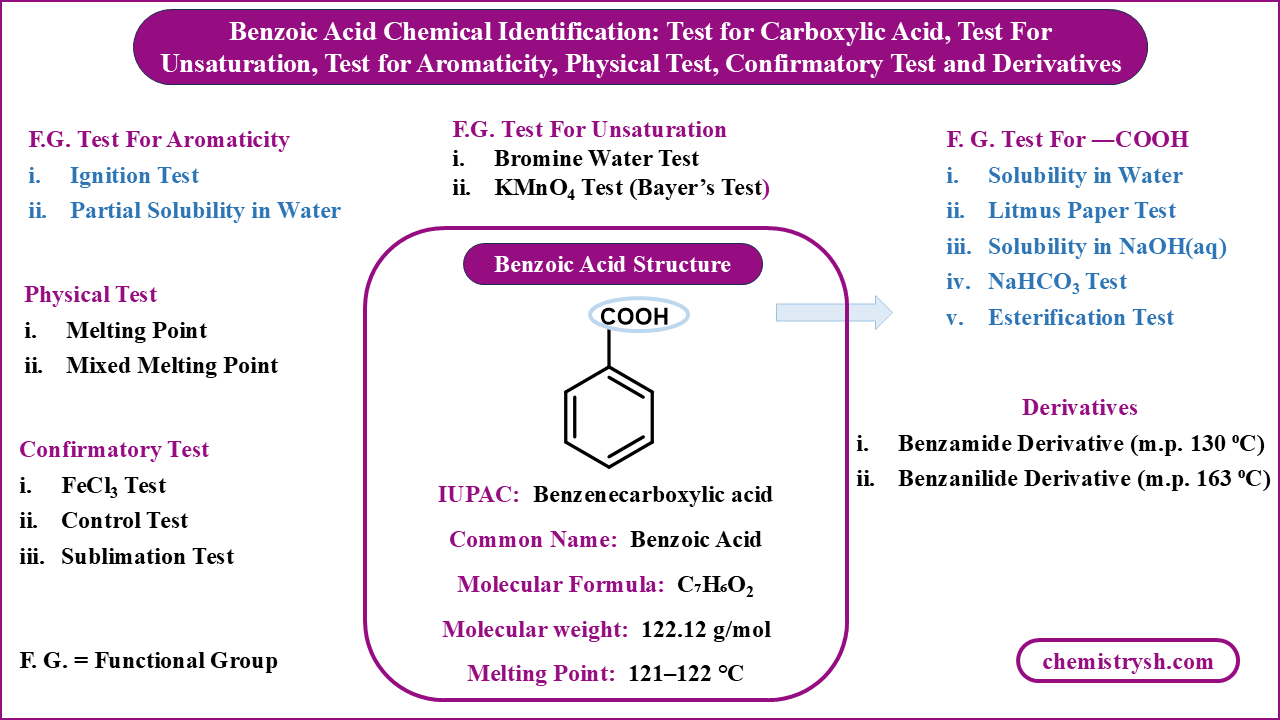
- Benzoic Acid Identification: Key Facts at a Glance
- Physical Properties: Physical Appearance · Solubility · Sublimation · Flame Test · Melting Point (121–122 °C) · Benzamide m.p. (130 °C) · Benzanilide m.p. (163 °C) · Molecular Formula (C₇H₆O₂) · MW (122.12 g/mol) · pKa (4.20)
- Chemical Tests & Coverage: Litmus · NaHCO₃ Test · Ester Test · FeCl₃ Test (buff/salmon precipitate) · Bromine Water · Sublimation Test · Control Test · Benzamide · Benzanilide · Mixed Melting Point · Chemical Structure · Chemical Reactions · Applications · Safety · FAQs · MCQs · Viva Questions
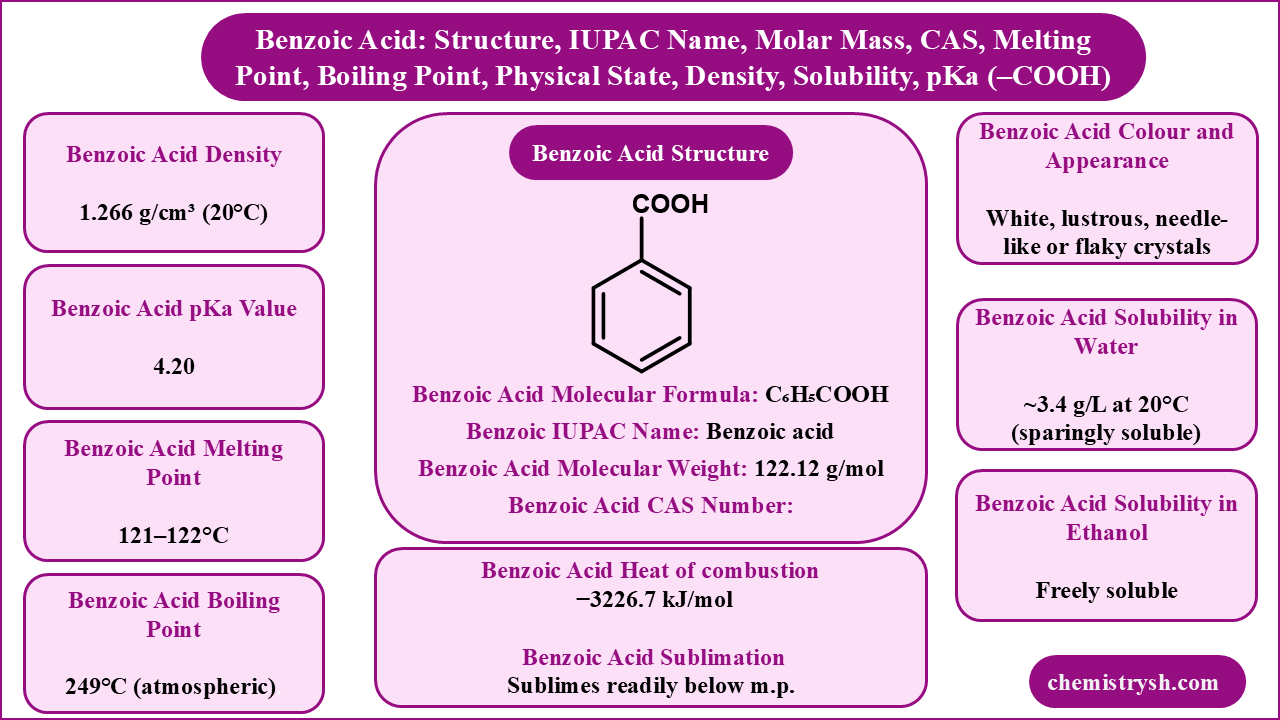
What Is Benzoic Acid? — Introduction and Background
Benzoic acid is the simplest aromatic carboxylic acid, with the molecular formula C₆H₅COOH (also written C₇H₆O₂). Its IUPAC name is benzoic acid — one of the rare cases where the common name and IUPAC name are identical. The common name derives from gum benzoin, the resin from which it was first isolated in the sixteenth century. Its molar mass is 122.12 g/mol, and it presents as white needle-like or flaky crystals with a faint, pleasant aromatic odour.
|
Property |
Value |
Significance for Identification or Context |
|
Molecular formula |
C₆H₅COOH (C₇H₆O₂) |
Two functional regions: benzene ring and –COOH only. No C=C, no phenolic –OH, no ester. |
|
Molar mass |
122.12 g/mol |
Used in mole calculations, neutralisation equivalent determination, and calorimetric standard calibration. |
|
IUPAC name |
Benzoic acid |
Preferred IUPAC name: benzoic acid (retained by IUPAC 2013 recommendations). Alternative systematic name: benzenecarboxylic acid (also accepted). Phenylmethanoic acid is a third systematic alternative. |
|
Common name |
Benzoic acid; also: benzenecarboxylic acid, |
Derived from gum benzoin. Sodium salt = sodium benzoate (food preservative E211). |
|
Colour & appearance |
White, lustrous, needle-like or flaky crystals; faint pleasant aromatic odour |
Colourless solid → no chromophore; aromatic odour consistent with benzene ring. |
|
Melting point |
121–122°C |
Sharp m.p. = purity indicator. Used as primary standard in calorimetry. |
|
Boiling point |
249°C (atmospheric) |
High b.p. due to strong –COOH H-bonding. Benzoic acid forms hydrogen-bonded dimers in the vapour phase. |
|
Density |
1.266 g/cm³ (20°C) |
Denser than water; sinks when solid is placed in water. |
|
~3.4 g/L at 20°C (sparingly soluble) |
Increases significantly on warming (29 g/L at 75°C). Freely soluble in NaOH (forms sodium benzoate). |
|
|
Solubility in ethanol |
Freely soluble |
Used in FeCl₃ test and ester preparation. |
|
pKa |
4.20 |
Stronger acid than acetic acid (pKa 4.76). Resonance stabilisation of the carboxylate anion (C₆H₅COO⁻) through delocalization of negative charge. Reacts with NaHCO₃. |
|
Benzoic acid vs acetic acid |
Benzoic acid (pKa 4.20) is MORE acidic than acetic acid (pKa 4.76) |
The electron-withdrawing benzene ring delocalises the carboxylate anion charge more effectively than the methyl group of acetic acid, stabilising the conjugate base. |
|
Conjugate base |
Benzoate anion (C₆H₅COO⁻) |
Benzoate is the conjugate base of benzoic acid. Resonance stabilisation of the carboxylate anion (C₆H₅COO⁻) through delocalization of negative charge |
|
Saturated or unsaturated |
Aromatic (not simply saturated or unsaturated) |
Benzoic acid’s benzene ring is aromatic. It does NOT undergo addition reactions like an alkene. It will not decolorise Bromine water. |
|
Heat of combustion |
−3226.7 kJ/mol |
Used as the international calorimetric standard for bomb calorimetry. |
|
Dimer formation |
Forms H-bonded dimers in vapour and non-polar solvents |
Explains anomalously high m.p. and low vapour pressure relative to its MW. |
|
Sublimation |
Sublimes readily below m.p. |
Distinctive among common organic acids. White needles form on any cooler surface. Used as a qualitative test. |
Planning the Identification: Decode the Structure First 🔍
Every competent qualitative analysis begins the same way — not at the bench, but on paper. Before a single reagent is added, the structural formula of the compound must be examined carefully. The benzoic acid structure (C₆H₅COOH) is a direct instruction manual: it tells you exactly which tests to perform and, just as importantly, which tests would be irrelevant.
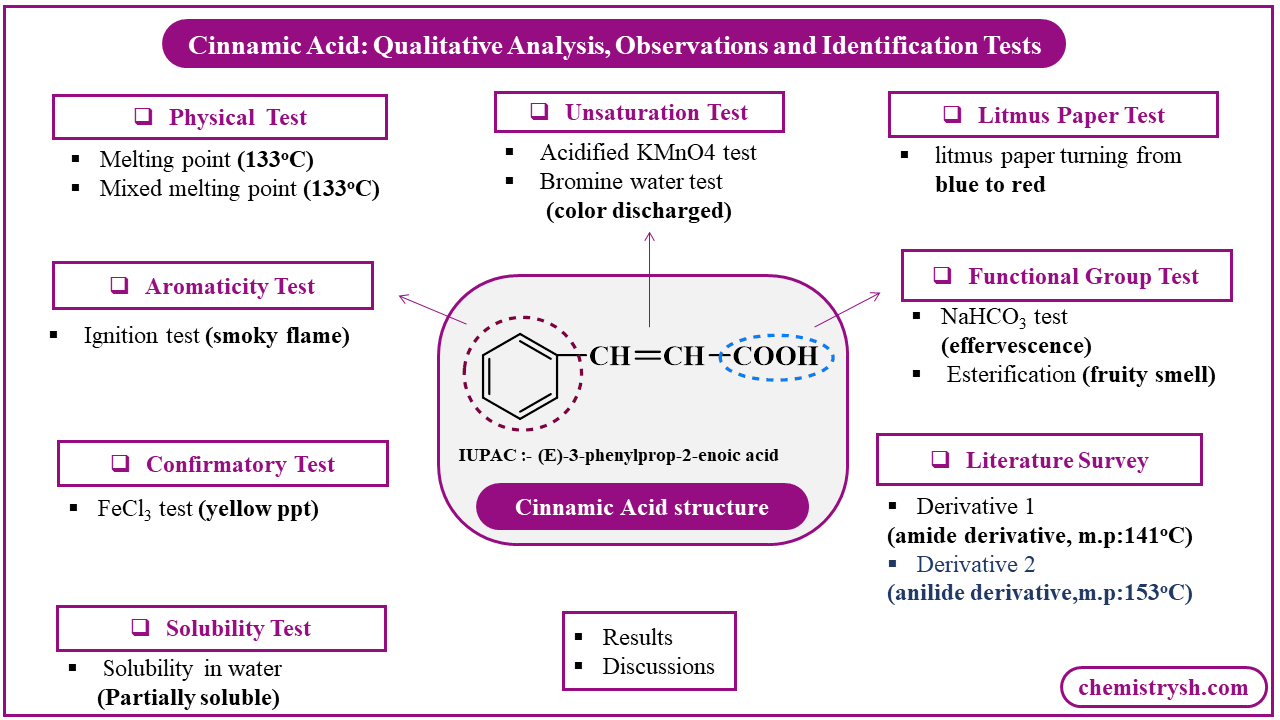
Study the benzoic acid formula and structure shown in Figure 1. Two distinct regions are immediately visible, and each one maps to a specific set of confirmatory tests.
Step 1: Identify the Functional Groups in Benzoic Acid
- 🔵 Benzene ring → aromatic character; high carbon-to-hydrogen ratio
- 🟣 –COOH group → carboxylic acid; the sole acidic centre in the molecule
Notably absent from benzoic acid: there is no C=C alkene bond (unlike cinnamic acid), no phenolic –OH (unlike salicylic acid), and no ester linkage (unlike aspirin). This absence of extra functional groups simplifies test selection — fewer reactions to run, but each must be interpreted with precision.
Step 2: Match Each Structural Clue to Its Confirmatory Test
|
Structural Clue |
Tests to Confirm It |
|
🔵 Benzene ring (aromatic system) |
Flame Test — sooty, smoky luminous yellow flame |
|
🟣 –COOH (carboxylic acid group) |
Litmus Paper Test • NaHCO₃ Test • Ester Test (Fischer esterification to ethyl benzoate) |
|
⚪ Whole compound (benzoic acid) |
FeCl₃ Test (buff/salmon precipitate) • Sublimation Test • Melting point 122°C |
Step 3: Always Begin with Preliminary Observations
Before any chemical test is attempted, three preliminary observations narrow the field of possibilities: the physical appearance of the solid (white benzoic acid crystals with faint aromatic odour), its solubility behaviour in water (sparingly soluble in cold water, freely soluble in NaOH), and its melting point (122°C). A compound matching all three is already pointing strongly toward benzoic acid. The chemical tests then confirm what the physical data suggests.
The Testing Sequence at a Glance
|
# |
Test |
What It Establishes |
|
1 |
Physical Appearance |
White benzoic acid crystals; aromatic odour; no chromophore |
|
2 |
Solubility |
Hydrophobic ring + acidic –COOH ionises in NaOH → sodium benzoate |
|
3 |
Flame Test |
Benzene ring present (sooty flame = high C:H ratio) |
|
4 |
Litmus Test |
Compound is acidic |
|
5 |
NaHCO₃ Test |
Carboxylic acid confirmed; phenols excluded by pKa argument |
|
6 |
Ester Test |
Fischer esterification → ethyl benzoate (floral odour); –COOH confirmed |
|
7 |
FeCl₃ Test |
Buff/salmon ferric benzoate precipitate; no phenolic –OH |
|
8 |
Sublimation Test |
Distinctive physical property unique to benzoic acid |
|
9 |
Melting Point |
Purity check; identity against literature (121–122°C) |
|
10 |
Control Test |
Validates FeCl₃ buff result against authentic standard |
|
11 |
Benzamide Derivative |
Independent physical checkpoint (m.p. 130°C) |
|
12 |
Benzanilide Derivative |
Second independent physical checkpoint (m.p. 163°C) |
|
13 |
Mixed Melting Point |
Gold-standard definitive proof of identity |
The skill of qualitative organic analysis lies not in running every test in the book, but in reading the molecular structure and selecting tests that carry real diagnostic weight. Benzoic acid is a beautifully simple molecule for practising this discipline: two functional regions, a clean set of tests, and a highly distinctive sublimation behaviour that sets it apart from almost every other common organic acid.
Materials & Reagents to Test the Benzoic acid
- Benzoic acid sample (unknown)
- Distilled water
- NaHCO₃ solution (aqueous, ~5%) — for sodium bicarbonate and benzoic acid reaction
- Freshly prepared lime water (Ca(OH)₂) — for CO₂ confirmation
- Blue and red litmus paper
- Absolute ethanol — for ester test (benzoic acid esterification to ethyl benzoate / ethyl ester)
- Concentrated H₂SO₄ — for ester test
- Neutral FeCl₃ solution (~1% aqueous)
- Thionyl chloride (SOCl₂) or PCl₅ — for benzoic acid derivatives preparation (fume cupboard only)
- Concentrated aqueous ammonia — for benzamide
- Aniline + pyridine or dilute NaOH — for benzanilide
- Melting point apparatus with sealed capillary tubes
- Watch glass and cold water — for sublimation test
- Authentic (known) benzoic acid sample — for control test and mixed melting point
Qualitative Analysis of Benzoic Acid — Procedure & Observations
|
Test |
Procedure |
Observations |
Inference |
|
Physical Appearance |
Examine a small sample on a white tile. Observe colour, crystal form (benzoic acid crystals), and odour. |
White, lustrous, needle-like or flaky crystalline solid. Faint pleasant aromatic odour. No colour detected. |
The colourless benzoic acid appearance rules out any chromophore-bearing structure and transition-metal involvement. The white benzoic acid crystals and aromatic odour are consistent with a pure aromatic organic acid. |
|
Solubility |
Add a small quantity to cold distilled water and shake. Warm gently and re-observe. Add NaOH solution to a fresh portion. |
Sparingly soluble in cold water (benzoic acid solubility in water ~3.4 g/L at 20°C). Solubility increases on warming. Dissolves readily in NaOH. |
Limited water solubility reflects the hydrophobic benzene ring dominating over the polar –COOH group. Ready dissolution in NaOH confirms the acidic –COOH group, which ionises to form water-soluble sodium benzoate (C₆H₅COONa). Benzoic acid is freely soluble in ethanol (benzoic acid solubility in ethanol). |
|
Flame Test |
Introduce a small quantity into the outer edge of a Bunsen flame on a spatula. Observe the flame character. |
Burns with a bright, sooty yellow flame. Black carbonaceous soot visible. No clean blue flame. |
A sooty, smoky flame is characteristic of a high C:H ratio — the fingerprint of an aromatic compound. The benzene ring’s incomplete combustion produces soot that glows yellow. Confirms the benzene ring is present in benzoic acid. |
|
Litmus Test |
Dissolve a small quantity in warm water. Dip blue and red litmus strips into the solution. |
Blue litmus turns red. Red litmus unchanged. |
Confirms the compound is acidic. Litmus alone is preliminary — does not distinguish –COOH from phenols or sulfonic acids. Proceed to NaHCO₃ and ester tests for specificity. |
|
NaHCO₃ Test |
Add compound to NaHCO₃ solution. Pass evolved gas through freshly prepared lime water via a delivery tube. |
Brisk effervescence. Evolved gas turns lime water milky/white. |
CO₂ evolution confirmed by lime water: CO₂ + Ca(OH)₂ → CaCO₃↓ + H₂O. Sodium bicarbonate and benzoic acid reaction: C₆H₅COOH + NaHCO₃ → C₆H₅COONa + H₂O + CO₂↑. Only –COOH groups (pKa ≈4–5) are strong enough to liberate CO₂ from bicarbonate. Phenols (pKa ≈10) cannot. |
|
Ester Test |
Mix compound with absolute ethanol and a few drops of conc. H₂SO₄. Warm gently at 60–70°C for 3–4 min. Pour into cold water. Waft vapour |
Sweet, pleasant floral odour of ethyl benzoate (ethyl ester of benzoic acid) detected. |
Benzoic acid esterification with ethanol (Fischer esterification) produces ethyl benzoate (C₆H₅COOC₂H₅). |
|
FeCl₃ Test |
Dissolve in water or dilute ethanol. Add 3–4 drops of neutral FeCl₃ solution. Run against authentic control simultaneously. |
Buff/salmon-coloured precipitate forms in both tubes. No violet or purple coloration observed. |
The buff precipitate is the ferric benzoate complex: 3 C₆H₅COOH + FeCl₃ → Fe(C₆H₅COO)₃↓ + 3 HCl. |
|
Sublimation Test |
Heat a small quantity gently under a cold watch glass (held 2–3 cm above). Observe underside of watch glass. |
White needle-like crystalline sublimate forms on the cold surface. No visible melting of bulk solid. |
This distinctive physical property is not shared by most common organic acids under gentle heating conditions (citric, tartaric, and salicylic acids do not sublime under these conditions). Note: oxalic acid also sublimes but decomposes at higher temperatures to CO₂ and CO, so the sublimate is not the same compound — benzoic acid sublimes cleanly without decomposition. Confirms the molecular nature of the solid and its relatively low lattice energy. |
|
Melting Point |
Pack dry powdered sample in a sealed capillary. Heat at 1–2°C/min from ~115°C. Record onset and completion. |
Sharp melting point at 121–122°C over a range of less than 1°C. |
Matches the literature melting point of benzoic acid (121–122°C). |
|
Control Test |
Repeat FeCl₃ test with certified authentic benzoic acid. Compare results side-by-side. |
Authentic sample gives same buff/salmon precipitate. Results visually identical. |
Confirms the FeCl₃ result is a genuine, reproducible characteristic of benzoic acid — not an artefact. |
|
Benzamide Derivative |
React with SOCl₂ → benzoyl chloride; treat with NH₃; filter, recrystallise. Determine m.p. |
White crystalline solid (benzamide) obtained. M.p. 130°C. |
Reaction: C₆H₅COCl + 2NH₃ → C₆H₅CONH₂ + NH₄Cl. |
|
Benzanilide Derivative |
Treat benzoyl chloride with aniline in presence of mild base. Filter, recrystallise. Determine m.p. |
White crystalline solid (benzanilide) obtained. M.p. 163°C. |
Reaction: C₆H₅COCl + C₆H₅NH₂ → C₆H₅CONHC₆H₅ + HCl. |
|
Mixed Melting Point |
Mix equal masses of unknown sample and authentic benzoic acid. Pack in fresh capillary. Determine m.p. |
Mixture melts sharply at 121–122°C. No depression or elevation observed. |
No melting point depression confirms both samples are the same compound. |
Quick Reference Summary — Chemical Tests for Tartaric Acid Identification
|
# |
Test |
Positive Result (Benzoic Acid) |
What it confirms |
|
1 |
Physical Appearance |
White benzoic acid crystals; aromatic odour; no colour |
Purity; absence of colour rules out chromophore |
|
2 |
Solubility |
Sparingly soluble cold H₂O; freely soluble in hot H₂O and NaOH |
Hydrophobic benzene ring + acidic –COOH group |
|
3 |
Flame Test |
Bright, luminous, sooty yellow flame with black smoke |
Aromatic compound (benzene ring present) |
|
4 |
Litmus Test |
Blue litmus → red; red litmus unchanged |
Acidic compound |
|
5 |
NaHCO₃ Test |
Brisk effervescence; lime water turns milky (CO₂ confirmed) |
Carboxylic acid; phenols excluded |
|
6 |
Ester Test |
Sweet, floral odour of ethyl benzoate on pouring into cold water |
Free –COOH confirmed; sulfonic acids excluded |
|
7 |
FeCl₃ Test |
Buff / pale salmon precipitate; NO violet colour |
Ferric benzoate complex; phenolic –OH absent |
|
8 |
Sublimation Test |
White needle-like sublimate on cold watch glass; no bulk melting |
Distinctive physical property of benzoic acid |
|
9 |
Melting Point |
Excess NH₃; evaporate; recrystallise |
White solid; m.p. 195 °C |
|
10 |
Benzamide Derivative |
Aniline at 120 °C; recrystallise EtOH |
White solid; m.p. 180 °C |
|
11 |
Mixed Melting Point |
Excess NH₃; evaporate; recrystallise |
White solid; m.p. 195 °C |
Quick Reference Summary — Chemical Tests for Tartaric Acid Identification
|
Reaction |
Equation and Mechanism Notes |
|
Sodium Bicarbonate and Benzoic Acid Reaction |
C₆H₅COOH + NaHCO₃ → C₆H₅COONa + H₂O + CO₂↑ (Acid–base reaction: CO₂ confirmed by lime water: CO₂ + Ca(OH)₂ → CaCO₃↓ + H₂O) |
|
Benzoic Acid and NaOH Reaction (Solubility) |
C₆H₅COOH + NaOH → C₆H₅COONa + H₂O (Salt formation: sodium benzoate is freely water-soluble, unlike benzoic acid itself) |
|
Esterification — Benzoic Acid Ethyl Ester (Ester Test) |
C₆H₅COOH + C₂H₅OH ⇌ (conc. H₂SO₄, Δ) C₆H₅COOC₂H₅ + H₂O (Fischer esterification; ethyl benzoate formed — sweet floral odour) |
|
FeCl₃ Test |
3 C₆H₅COOH + FeCl₃ → Fe(C₆H₅COO)₃↓ + 3 HCl (Coordination complex: ferric benzoate — buff/salmon precipitate) |
|
Benzamide Derivative — Step 1 |
C₆H₅COOH + SOCl₂ → C₆H₅COCl + SO₂↑ + HCl↑ (Nucleophilic acyl substitution: –OH replaced by –Cl to give benzoyl chloride) |
|
Benzamide Derivative — Step 2 |
C₆H₅COCl + 2NH₃ → C₆H₅CONH₂ + NH₄Cl (Nucleophilic acyl substitution with NH₃ → benzamide, m.p. 130°C) |
|
Benzanilide Derivative |
C₆H₅COCl + C₆H₅NH₂ → C₆H₅CONHC₆H₅ + HCl (Nucleophilic acyl substitution with aniline; base neutralises HCl → benzanilide, m.p. 163°C) |
|
Benzoic Acid Combustion Reaction |
|
Result Summary
All observations are consistent with the identity of the compound as benzoic acid (C₆H₅COOH).
The sample was a white, lustrous crystalline solid with a faint aromatic odour and no detectable colour, ruling out chromophore-bearing structures. The compound was sparingly soluble in cold water (benzoic acid solubility in water ~3.4 g/L at 20°C) but dissolved freely in aqueous NaOH, confirming the ionisable –COOH group and forming sodium benzoate.
The flame test produced a bright, sooty, smoky yellow flame, confirming aromatic (benzene ring) character. The litmus, NaHCO₃, and ester tests together confirmed the –COOH group: litmus confirmed acidity; the sodium bicarbonate and benzoic acid reaction produced CO₂ (lime water turned milky), excluding phenols; and Fischer esterification with ethanol produced ethyl benzoate (benzoic acid ethyl ester) identified by its characteristic floral scent, excluding sulfonic acids.
The FeCl₃ test gave a buff/salmon-coloured precipitate — ferric benzoate complex — with no trace of violet, ruling out any phenolic –OH. The sublimation test showed the compound converting directly from solid to white needle-like crystals on a cold surface — a distinctive physical property unique to benzoic acid among common organic acids. The melting point was sharp at 122°C, matching the literature value of 121–122°C. Benzamide (m.p. 130°C) and benzanilide (m.p. 163°C) provided two independent physical confirmations. The mixed melting point test showed no depression, conclusively confirming identity.
Conclusion
Based on the combined weight of physical and chemical evidence — aromatic character (sooty flame test), carboxylic acid functionality (NaHCO₃, litmus, and ester tests), buff ferric benzoate precipitate (FeCl₃ test, no phenolic response), distinctive sublimation behaviour, sharp melting point 122°C, matching derivative melting points (benzamide 130°C; benzanilide 163°C), and absence of mixed melting point depression — the given unknown compound is conclusively identified as:
Benzoic Acid (C₆H₅COOH)
IUPAC name: benzoic acid | Molar mass: 122.12 g/mol | M.p. 121–122°C | B.p. 249°C | Density: 1.266 g/cm³
Uses and Applications of Benzoic Acid
|
Industry / Field |
Application |
Specific Role |
|
Food Preservation |
Food additive (E210) — antimicrobial preservative |
Benzoic acid and its salt sodium benzoate (E211) inhibit the growth of moulds, yeasts, and certain bacteria in acidic foods. Used in soft drinks, fruit juices, pickles, and condiments. Sodium benzoate is the most commercially important derivative. |
|
Pharmaceuticals |
Active ingredient in antifungal preparations |
Benzoic acid acts as the antifungal component. |
|
Organic Synthesis |
Versatile chemical building block |
Starting material for benzamide, benzoyl chloride, methyl benzoate, and ethyl benzoate. Used in the synthesis of dyes, perfumes, and pharmaceuticals including ester-type local anaesthetics such as benzocaine, procaine, and tetracaine, which are para-aminobenzoic acid (PABA) or benzoate ester derivatives. Note: lidocaine is an amide-type anaesthetic derived from aniline, not from benzoic acid. |
|
Flavour & Fragrance |
Flavouring and fragrance ingredient |
Imparts a balsamic, slightly sweet note. Benzyl benzoate and methyl benzoate are used in perfumery and as flavouring agents. Benzoic acid itself provides a pleasant background note in some fragrances. |
|
Cosmetics |
Preservative and pH adjuster |
Used at low concentrations (≤0.5%) as a preservative in cosmetics and personal care products. Functions most effectively at acidic pH (below 4.5) where the undissociated acid predominates. |
|
Analytical Chemistry |
Primary standard for calorimetry and acid–base titrations |
Benzoic acid is the international primary standard for bomb calorimetry (heat of combustion = −3226.7 kJ/mol; heat capacity standard). Also used as a primary standard for standardising NaOH solutions in acidimetry. |
|
Industrial Chemistry |
Precursor to phenol and caprolactam |
Industrial route: oxidation of toluene → benzoic acid → phenol (by decarboxylation). Also a precursor in the synthesis of caprolactam, the monomer for Nylon-6. |
Safety Precautions
Benzoic acid hazards and general safety
- Wear a lab coat, chemical-splash goggles, and nitrile gloves throughout. Benzoic acid is a mild irritant (skin, eyes, respiratory tract).
- Work in a well-ventilated fume cupboard when handling conc. H₂SO₄, SOCl₂, aniline, and during sublimation and ester tests.
- Concentrated H₂SO₄ is highly corrosive: always add acid to mixture, never reverse. Flush skin/eye contact with copious water for 15 min.
- SOCl₂ and PCl₅ react violently with water — all glassware must be bone-dry. Use fume cupboard only.
- Aniline is toxic by skin absorption and is a suspected carcinogen. Wear double gloves; seek medical advice on any skin contact.
- Benzoic acid is flammable. Keep the flame test quantity minimal. Keep ethanol away from open flames. Dispose of all waste in designated containers. Do not pour FeCl₃, acid, or organic waste down the sink.
Reagent Hazard Summary
|
Reagent |
Hazard |
Key Precaution |
|
Benzoic acid |
Mild irritant |
Avoid inhalation of dust. Normal bench handling with gloves. |
|
Conc. H₂SO₄ |
CORROSIVE • OXIDISING |
Add to mixture slowly. Goggles + acid-resistant gloves. Fume cupboard. |
|
SOCl₂ / PCl₅ |
HIGHLY CORROSIVE • TOXIC |
Bone-dry glassware. Fume cupboard only. Destroy excess with dry pyridine. |
|
Aniline |
TOXIC • Suspected carcinogen |
Fume cupboard. Double gloves. Wash skin contact immediately. |
|
FeCl₃ solution |
IRRITANT |
Gloves and goggles. Dispose in heavy-metal waste container. |
|
Concentrated NH₃ |
CORROSIVE vapour |
Fume cupboard. Keep bottle sealed. Goggles + gloves. |
FAQ’s
Multiple Choice Questions
MCQ 1
1. The correct molecular formula of benzoic acid is:
A. C₆H₅OH
B. C₇H₆O₂ (C₆H₅COOH)
C. C₆H₅CH=CHCOOH
D. C₆H₄(OH)(COOH)
MCQ 2
2. The molar mass of benzoic acid (C₇H₆O₂) is:
A. 94.11 g/mol
B. 108.14 g/mol
C. 122.12 g/mol
D. 138.12 g/mol
MCQ 3
3. How many functional regions does benzoic acid have?
A. One (–COOH only)
B. Two (benzene ring and –COOH)
C. Three (benzene ring, C=C, and –COOH)
D. Three (benzene ring, phenolic –OH, and –COOH)
MCQ 4
4. Benzoic acid (pKa 4.20) is more acidic than acetic acid (pKa 4.76) because:
A. Benzoic acid has a higher molecular weight
B. The benzene ring stabilises the benzoate anion by resonance delocalisation of the negative charge, lowering pKa
C. Acetic acid has more hydrogen atoms in its molecule
D. Benzoic acid is more soluble in water
MCQ 5
5. Benzoic acid is sparingly soluble in cold water because:
A. The large hydrophobic benzene ring dominates over the polar –COOH group, limiting interaction with water molecules.
B. Benzoic acid is completely insoluble in all solvents
C. The –COOH group repels water molecules
D. Benzoic acid forms insoluble dimers in water
MCQ 6
6. When bromine water is added to tartaric acid, the result is:
A. Immediate decolourisation (C=C present)
B. White precipitate forms
C. Orange-brown colour retained — no decolourisation
D. Purple colour develops
MCQ 7
7. Tartaric acid decolourises acidified KMnO₄ slowly because:
A. It has a C=C double bond that is oxidised instantly
B. The secondary –OH groups are slowly oxidised; no C=C is present
C. The carboxyl groups reduce KMnO₄
D. KMnO₄ reacts with the tartrate ion to form a precipitate
MCQ 8
8. The cream of tartar test for tartaric acid involves:
A. Adding NaOH to form a white sodium tartrate precipitate
B. Adding CaCl₂ in cold; white precipitate forms
C. Concentrating the solution then adding saturated KCl; white KHC₄H₄O₆ precipitate forms
D. Adding H₂O₂ and excess NaOH to produce a blue colour
MCQ 9
9. The number of distinct functional group types in tartaric acid is:
A. One (–COOH only)
B. Two (–COOH and –OH)
C. Three (–COOH, –OH, and C=C)
D. Four (–COOH, –OH, C=C, and benzene ring)
MCQ 10
10. Tartaric acid burns with a clean non-sooty flame because:
A. It contains nitrogen
B. It has a high C:H ratio due to the benzene ring
C. It is a saturated aliphatic compound with no benzene ring; combustion is relatively complete
D. It contains sulfur
MCQ 11
11. The FeCl₃ test on tartaric acid gives:
A. Deep violet/purple coloration (phenol response)
B. Light yellow precipitate
C. Buff-yellow colouration; no deep violet
D. No visible change
MCQ 12
12. The degree of unsaturation (DoU) of tartaric acid (C₄H₆O₆) is:
A. 0
B. 2 (from two C=O groups in the two –COOH moieties)
C. 3
D. 6
MCQ 13
13. Which statement about stereoisomerism in tartaric acid is CORRECT?
A. Tartaric acid has no stereocentres
B. There are two stereoisomers: L and D forms only
C. There are three stereoisomers: L-(+), D-(–), and meso forms; the meso form is optically inactive
D. Tartaric acid shows geometrical isomerism due to C=C
MCQ 14
14. The key difference between the CaCl₂ test for tartaric acid and citric acid is:
A. Tartaric acid gives a blue precipitate; citric acid gives a white precipitate
B. Calcium tartrate precipitates in cold solution; calcium citrate only precipitates on heating
C. Both acids require heating to produce a precipitate
D. Only citric acid reacts with CaCl₂
MCQ 15
15. The melting point of tartramide (amide derivative of tartaric acid) is:
A. 170 °C
B. 180 °C
C. 195 °C
D. 210 °C
MCQ 16
16. The unknown sample is mixed with authentic L-tartaric acid. The mixture melts at 170–172 °C with no depression. This means:
A. The compound is meso-tartaric acid
B. The compound is dl-tartaric acid
C. Both samples are identical — the compound is conclusively identified as L-tartaric acid
D. The test has failed
MCQ 17
17. Fenton’s reagent test for tartaric acid involves:
A. Adding FeSO₄ + H₂O₂ and observing a red colour
B. Adding one drop of H₂O₂ then excess NaOH → intense blue colour
C. Adding KMnO₄ and H₂SO₄ and observing slow decolourisation
D. Adding AgNO₃ in ammonia and observing a silver mirror
MCQ 18
18. The cream of tartar used in baking is:
A. Calcium tartrate (CaC₄H₄O₆)
B. Potassium hydrogen tartrate (KHC₄H₄O₆)
C. Sodium potassium tartrate (Rochelle salt)
D. dl-Tartaric acid
MCQ 19
19. On heating in a dry test tube, tartaric acid gives:
A. Clean sublimation with no residue
B. Sweet fruity ester odour
C. Charring and odour of burnt sugar
D. White fumes of SO₂
MCQ 20
20. The molecular weight of tartaric acid (C₄H₆O₆) is:
A. 132.07 g/mol
B. 150.09 g/mol
C. 192.12 g/mol
D. 168.06 g/mol