
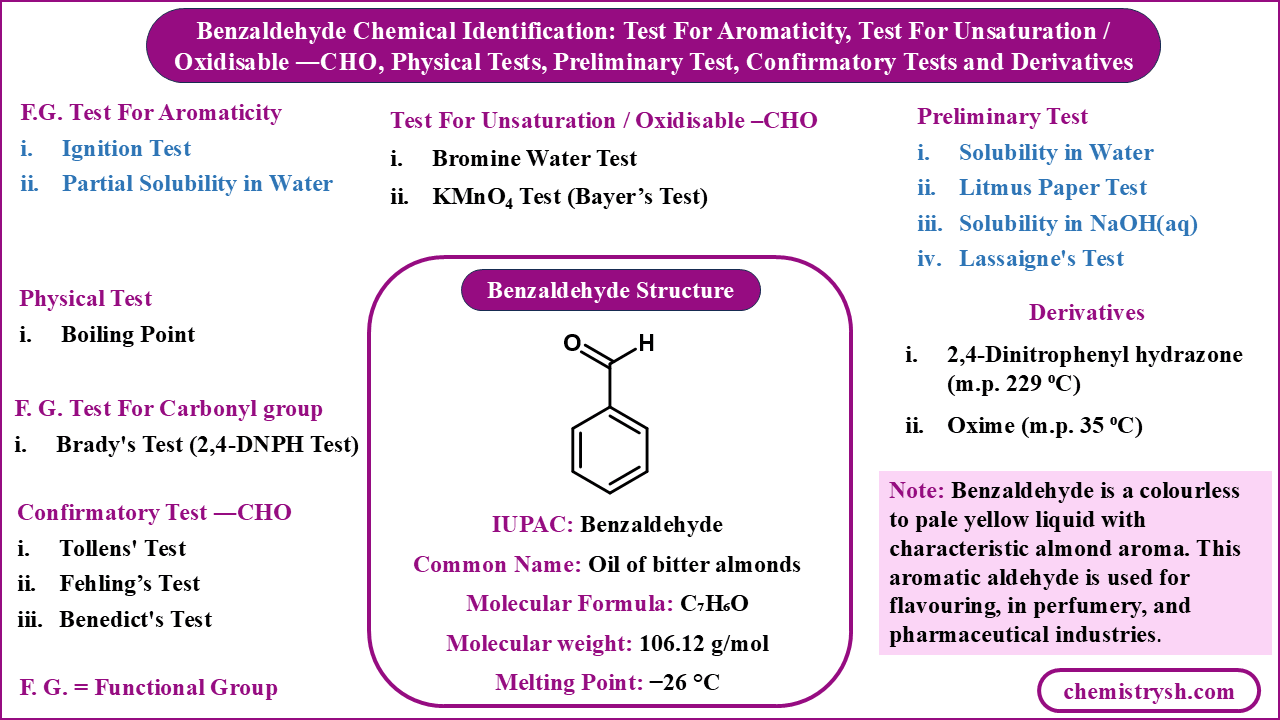
Benzaldehyde (Phenylmethanal) Identification — Key Facts at a Glance
● Molecular Formula (C₇H₆O) · Molecular Weight (106.12 g/mol) · IUPAC Name (Benzaldehyde) · Common Name (Oil of bitter almonds) · Synonym (Phenylmethanal) · Appearance (colourless to pale yellow, strongly refractive liquid with strong, characteristic almond aroma) · Boiling Point (178.1 °C) · Melting Point (−26 °C) · Density (1.044 g/mL at 25 °C) · Solubility (sparingly soluble in water; freely miscible with ethanol, diethyl ether, and chloroform) · Refractive Index (1.5456 at 20 °C) · Flash Point (64 °C) · CAS Number (100-52-7) · Functional Group (aldehyde — carbonyl group –CHO directly bonded to benzene ring) · Degree of Unsaturation (5) · Acid/Base Nature (neutral)
● Physical Appearance Test · Solubility Test · Ignition / Flame Test · Litmus Test · NaOH Test · Lassaigne’s Test · Brady’s Test (2,4-DNP — orange/yellow precipitate) · Tollens’ Test (positive — silver mirror, slow) · Fehling’s and Benedict’s Test (negative — aromatic aldehyde) · Acidified KMnO₄ Test (positive — purple decolourised) · Bromine Water Test (negative — colour persists) · FeCl₃ Test (negative — no phenol or enol) · Boiling Point (178–179 °C) · 2,4-DNP Derivative (m.p. 237 °C) · Oxime (m.p. 133 °C, E-isomer) · Semicarbazone (m.p. 213.5–217.5 °C)
What is Benzaldehyde?
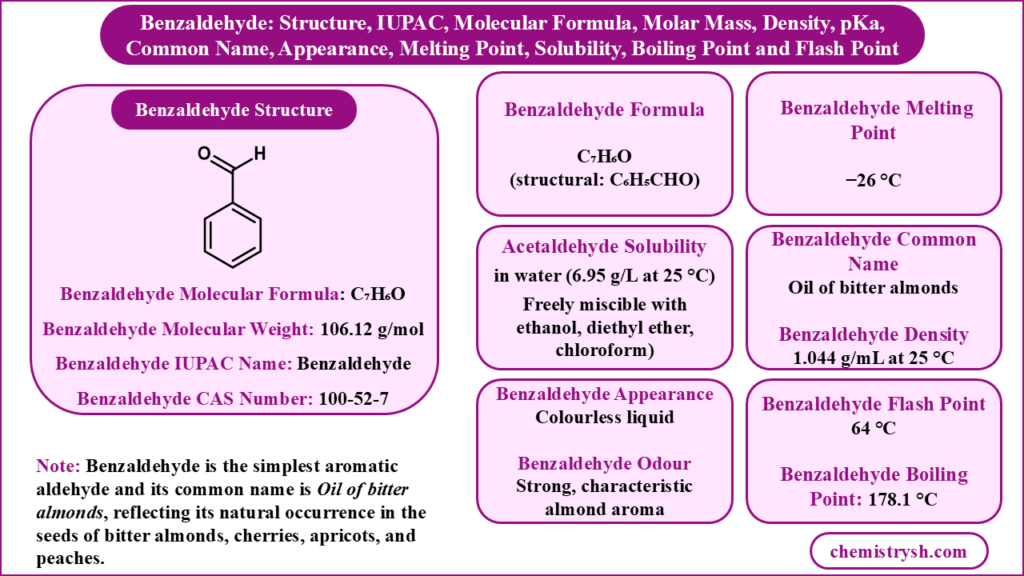
Benzaldehyde (C6H5CHO) is the simplest aromatic aldehyde — a benzene ring directly bonded to an aldehyde group (–CHO). Its IUPAC name is benzaldehyde and its common name is Oil of bitter almonds, reflecting its natural occurrence in the seeds of bitter almonds, cherries, apricots, and peaches, where it exists bound as the glycoside amygdalin.
Benzaldehyde is a colourless to pale yellow liquid with a strong, characteristic almond aroma. It is one of the most widely used aromatic aldehydes in the flavouring, perfumery, and pharmaceutical industries.
This article applies the systematic identification tests for benzaldehyde or Qualitative Test for Benzaldehyde, covering preliminary tests, functional group tests, confirmatory tests, derivative preparation, and spectroscopic identification.
Physical Constants of Benzaldehyde
The benzaldehyde IUPAC name is benzenecarbaldehyde; its benzaldehyde common name is Oil of bitter almonds (CAS 100-52-7). The benzaldehyde chemical formula and molecular formula are both expressed as C₇H₆O, and its benzaldehyde condensed structural formula is C₆H₅CHO — a benzene ring directly bonded to an aldehyde group. The benzaldehyde color (colour) is colourless to pale yellow; it is a strongly refractive liquid with a strong, characteristic almond aroma. The benzaldehyde molar mass (molecular weight) is 106.12 g/mol, and the benzaldehyde density is 1.044 g/mL at 25 °C. The benzaldehyde boiling point is 178.1 °C; it melts at −26 °C, making it a liquid at room temperature. It is sparingly soluble in water (6.95 g/L at 25 °C) but freely miscible with ethanol, diethyl ether, and chloroform. Its degree of unsaturation is 5, accounting for the benzene ring (DoU = 4) and the carbonyl group (DoU = 1). Benzaldehyde is neutral in acid–base character, carrying no ionisable proton.
|
Property |
Value |
|
IUPAC Name |
Benzaldehyde |
|
Common Name |
Oil of bitter almonds |
|
Synonym |
Phenylmethanal |
|
Molecular Formula |
C₇H₆O (structural: C₆H₅CHO) |
|
Molar Mass (Molecular Weight) |
106.12 g/mol |
|
CAS Number |
100-52-7 |
|
Appearance |
Colourless liquid, strongly refractive |
|
Odour |
Strong, characteristic almond aroma |
|
Boiling Point |
178.1 °C |
|
Melting Point |
−26 °C |
|
Density |
1.044 g/mL at 25 °C |
|
Solubility in Water |
6.95 g/L at 25 °C |
|
Miscibility |
Freely miscible with ethanol, diethyl ether, chloroform |
|
Refractive Index |
1.5456 at 20 °C |
|
Flash Point |
64 °C |
|
Functional Groups |
Aldehyde (–CHO) · Aromatic ring |
|
Degree of Unsaturation |
5 (benzene ring = 4, C=O = 1) |
|
Acid/Base Nature |
Neutral |
Planning the Identification: Reading Benzaldehyde’s Structure
The question this article answers is: “Does this compound behave as an aromatic aldehyde specifically, and not as some other neutral or carbonyl-containing species?”
Step 1: Identify the Functional Groups in Benzaldehyde
Benzene ring — aromatic character; high C:H ratio; sooty flame on ignition
Aldehyde group (–CHO) — neutral; carbonyl group; reducing agent; no α-hydrogen
Step 2: Identifying the Aldehyde Functional Group — Which Test Confirms What
Each test in the benzaldehyde qualitative analysis panel targets a specific structural feature. The table below maps each structural clue to its corresponding confirmatory tests.
|
Structural Clue |
Tests to Confirm It |
|
Benzene ring (aromatic) |
Ignition Test · Solubility pattern |
|
–CHO (carbonyl — aldehyde or ketone) |
Brady’s test (2,4-DNP) |
|
Neutral character |
Litmus test · NaOH test |
Qualitative Test for Benzaldehyde: Complete Identification Sequence at a Glance
The table below summarises each identification step for benzaldehyde — what each test confirms and what it rules out. Full procedural details for each test are covered in §4 of this article.
Group A — Preliminary Tests
|
Test |
What It Establishes |
|
Physical Appearance |
Colourless to pale yellow oily liquid; strong bitter almond odour; liquid at room temperature |
|
Solubility Test |
Large non-polar benzene ring limits water solubility; free miscibility with ethanol confirms polar –CHO group is present |
|
Ignition / Flame Test |
Benzene ring present — sooty, luminous flame confirms aromatic character |
|
Litmus Test |
Compound is neutral — carboxylic acids, phenols, and amines ruled out |
|
NaOH Test |
Resinous material produced — compound is not acidic; aldehyde group indicated |
|
Lassaigne’s Test |
No nitrogen, sulfur, or halogens — amines, amides, halogenated compounds ruled out |
Group B — Chemical Identification Tests – Qualitative Test for Benzaldehyde
|
Test |
What It Establishes |
|
Brady’s Test (2,4-DNP) |
Carbonyl group confirmed — orange/yellow precipitate |
|
Tollens’ Test |
Aldehyde confirmed — silver mirror |
|
Fehling’s / Benedict’s Test |
Negative — confirms aromatic aldehyde, not aliphatic |
|
Acidified KMnO₄ Test |
Oxidisable –CHO group — purple decolourised |
|
Bromine Water Test |
No phenol, no C=C double bond — bromine water colour persists |
|
FeCl₃ Test |
Negative — no phenol or enol; confirms simple aromatic aldehyde |
|
Melting Point / Boiling Point |
BP 178.1 °C — matches benzaldehyde literature value |
|
Derivative I — 2,4-DNP |
MP = 237 °C — independent physical confirmation |
|
Derivative II — Oxime / Semicarbazone |
MP matches literature — definitive proof of identity |
Preliminary Tests (Ignition Test, Solubility Test, Litmus Test, Lassaigne’s Test)
When an unknown organic compound is provided, preliminary tests are performed in the following order:
(1) Ignition Test — to determine aromatic or aliphatic character.
(2) Solubility Test (water, ethanol, hexane) — to determine polar or non-polar nature.
(3) Litmus Test — to determine acidic, basic, or neutral character.
(4) Lassaigne’s Test — to detect heteroatoms (nitrogen, sulfur, and halogens).
These four parameters together define the compound class before specific chemical tests are applied.
(i) Ignition / Flame Test
Procedure: Hold a small amount of the compound on a spatula and ignite it in a Bunsen flame.
Observation: Burns with a sooty, luminous flame.
Conclusion: Aromatic character indicated. The compound contains a benzene ring.
(ii) Solubility Test
Procedure: Add a few drops of the compound to water in a test tube and shake. Repeat with ethanol, diethyl ether, and chloroform.
Observation: Sparingly soluble in water — a turbid mixture is formed. Freely miscible with ethanol, diethyl ether, and chloroform. A distinctive bitter almond odour is noted.
Conclusion: Sparingly soluble in water indicates a polar group is present but the major part of the molecule is non-polar. Increased solubility in ethanol confirms the presence of a polar group alongside a large non-polar group. An aromatic system is indicated.
(iii) Litmus Test
Procedure: Place a drop of the compound on blue litmus paper and red litmus paper.
Observation: No change in either blue or red litmus paper.
Conclusion: The compound is neutral. Acidic compounds (carboxylic acids, phenols) and basic compounds (amines) are ruled out.
To confirm carboxylic acids and phenols are ruled out, apply the NaOH Test.
Observation: Does not dissolve in NaOH. Resinous material produced.
Conclusion: Compound is neutral — not acidic. Resinous material produced with NaOH indicates the compound may be an aldehyde.
(iv) Lassaigne’s Test (Elementary Detection)
Procedure: Fuse a small amount of the compound with sodium metal. Dissolve the fused mass in distilled water and filter. Test the filtrate for nitrogen, sulfur, and halogens.
Observation: No Prussian blue colour (nitrogen absent). No black precipitate (sulfur absent). No precipitate with silver nitrate (halogens absent).
Conclusion: No heteroatoms detected. Amines, amides, and halogenated compounds are ruled out.
|
Element |
Result for Benzaldehyde |
Conclusion |
|
Nitrogen |
Absent (no Prussian blue) |
Amines and amides ruled out |
|
Sulfur |
Absent (no black precipitate) |
Sulfur compounds ruled out |
|
Halogens |
Absent (no AgCl/AgBr precipitate |
Halogenated compounds ruled out |
Elimination and Conclusion on the Basis of preliminary tests:
Applying the results of the preliminary tests to the four class lists:
|
Class |
Eliminated? |
Reason |
|
(A) Carboxylic Acids |
Eliminated |
Litmus neutral; does not dissolve in NaOH |
|
(B) Phenols |
Eliminated |
Litmus neutral; resinous material in NaOH — not a phenol |
|
(C) Aldehydes, Ketones & Carbohydrates |
Proceed |
Only List C remains — Aldehydes, Ketones, and Carbohydrates |
|
(D) Amines |
Eliminated |
Litmus neutral; nitrogen absent in Lassaigne’s test |
Concluding Remarks regarding Preliminary Tests (Ignition Test, Solubility Test, Litmus Test, Lassaigne’s Test)
The preliminary tests establish the following:
• Aromatic (sooty flame; sparingly soluble in water, freely soluble in ethanol)
• Distinctive bitter almond odour noted — characteristic of benzaldehyde
• Neutral (no litmus change; carboxylic acids and phenols ruled out)
• No heteroatoms (nitrogen, sulfur, halogens absent; amines and amides ruled out)
• NaOH test: resinous material produced — aldehyde indicated
Conclusion: Carboxylic acids, phenols, amines, and amides are absent. Only aldehydes, ketones, and carbohydrates remain as the possible compound class. Chemical tests that confirm the presence of a carbonyl group will now be applied.
Benzaldehyde Qualitative Tests: Complete Identification Sequence
Stage 1 — Confirm the Carbonyl Group (Aldehyde or Ketone)
Test 1 — Brady’s Test (2,4-Dinitrophenylhydrazine Test)
Reagent: Brady’s reagent — 2,4-dinitrophenylhydrazine (2,4-DNPH) dissolved in ethanol and dilute hydrochloric acid.
Procedure: Add a few drops of the compound to Brady’s reagent in a test tube. Shake and allow to stand.
Observation: An orange to yellow crystalline precipitate is formed.
Result: Carbonyl group (C=O) confirmed. The compound is an aldehyde or a ketone.
Stage 2 — Confirm Aldehyde (Not Ketone)
Test 2 — Tollens’ Test (Silver Mirror Test)
Reagent: Tollens’ reagent — freshly prepared ammoniacal silver nitrate solution [Ag(NH₃)₂]⁺ OH⁻.
Procedure: Add freshly prepared Tollens’ reagent to the compound in a clean test tube. Warm in a water bath at 60–70 °C for 5 minutes.
Observation: A bright silver mirror deposits on the inner wall of the test tube.
Result: Aldehyde group confirmed. The benzaldehyde Tollens test gives a positive silver mirror — the reaction is slower than aliphatic aldehydes due to the electron-withdrawing effect of the benzene ring on the carbonyl group. The Tollens test for benzaldehyde is the key aldehyde-confirmatory step in this identification sequence.
Note: Use freshly prepared Tollens’ reagent only. Stored reagent may form explosive silver nitride.
Test 3 — Fehling’s Test / Benedict’s Test
Reagent: Fehling’s solution A + Fehling’s solution B (mixed in equal volumes); or Benedict’s solution.
Procedure: Add the compound to Fehling’s solution. Heat in a water bath for 5 minutes.
Observation: No brick-red precipitate. Solution remains blue.
Result: Negative result. The benzaldehyde Benedict’s test and Fehling’s test are both negative — benzaldehyde does not reduce cupric ions. This confirms benzaldehyde is an aromatic aldehyde, not an aliphatic aldehyde. Aliphatic aldehydes (acetaldehyde, formaldehyde) give a positive Fehling’s test.
Stage 3 — Confirm Aromatic Character and Rule Out Phenol
Test 4 — Acidified KMnO₄ Test
Reagent: Acidified potassium permanganate solution (KMnO₄ + dilute H₂SO₄).
Procedure: Add 2–3 drops of acidified KMnO₄ solution to the compound in a test tube.
Observation: The purple colour of KMnO₄ is decolourised.
Result: An oxidisable group is present. The aldehyde group (–CHO) is oxidised to benzoic acid (–COOH). Confirms the presence of a reducible functional group.
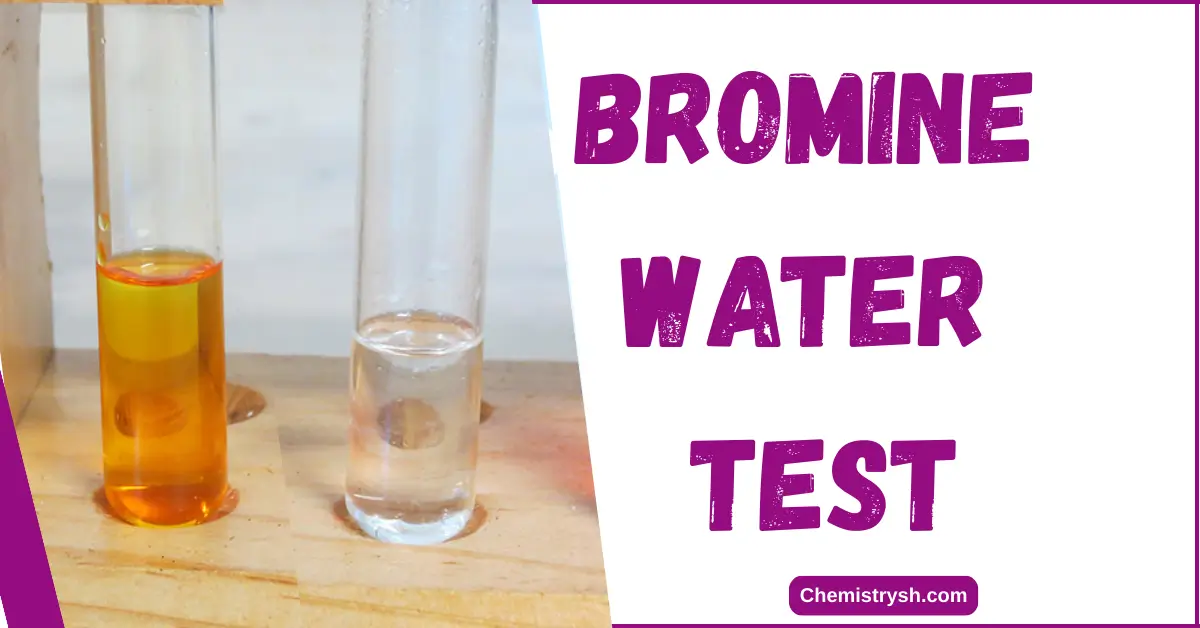
Test 5 — Bromine Water Test
Reagent: Bromine water (Br₂ dissolved in water).
Procedure: Add bromine water dropwise to the compound in a test tube.
Observation: Bromine water is not decolourised. The orange-brown colour persists.
Result: The colour of bromine water persists — no phenol group and no aliphatic C=C double bond are present. The aromatic ring does not react with bromine water under these conditions.
Test 6 — Ferric Chloride Test (FeCl₃ Test)
Reagent: Neutral ferric chloride solution (FeCl₃, aqueous).
Procedure: Add 2–3 drops of neutral FeCl₃ solution to the compound in a test tube.
Observation: No characteristic colour complex formed. Solution remains yellow-brown.
Result: Negative result. Confirms absence of a phenol or enol group. Benzaldehyde gives a negative FeCl₃ test, distinguishing it from phenolic aldehydes such as salicylaldehyde, which give a positive purple colour.
Stage 4 — Physical Confirmation
Test 7 — Boiling Point Determination
Procedure: Benzaldehyde is a liquid at room temperature (melting point −26 °C). Determine the boiling point using a distillation assembly or a micro boiling point apparatus.
Observation: Boiling point observed at 178–179 °C.
Result: Physical constant matches the literature value for benzaldehyde (BP 178.1 °C, Sigma-Aldrich). Independent physical confirmation of identity.
Derivatives of Benzaldehyde
Benzaldehyde is a liquid at room temperature. Since a melting point cannot be determined directly, a solid benzaldehyde derivative is prepared to provide an independent physical confirmation of identity. The melting point of the derivative is determined and compared with the value reported in the literature. Agreement with the literature melting point confirms the identity of the compound. Derivative preparation serves as the confirmatory test of benzaldehyde when the parent compound is a liquid and its melting point cannot be determined directly; the solid derivative provides the physical constant required for identification.
Derivative I — 2,4-Dinitrophenylhydrazone (2,4-DNPH Derivative)
Reagent: Brady’s reagent — 2,4-dinitrophenylhydrazine in ethanol and dilute hydrochloric acid.
Procedure: Add the compound to Brady’s reagent. Allow the orange/yellow precipitate to form. Filter, wash with cold ethanol, and dry.
Observation: Orange to yellow crystalline solid obtained.
Melting Point: 237 °C (Vogel’s Practical Organic Chemistry, lit.)
Significance: The isolated 2,4-DNP derivative provides a solid physical constant for comparison. The melting point of the derivative is compared with the value reported in the literature to confirm identity.
Derivative II — Oxime
Reagent: Hydroxylamine hydrochloride (NH₂OH·HCl) in the presence of sodium acetate.
Procedure: Dissolve hydroxylamine hydrochloride and sodium acetate in water. Add the compound and warm gently. Cool, filter, wash, and dry the solid product.
Observation: White to pale yellow crystalline solid obtained.
Melting Point: Z-isomer (anti): 33 °C · E-isomer (syn): 133 °C (Source: NIST WebBook, CAS 622-32-2 and 622-31-1)
Significance: The oxime derivative confirms the presence of a carbonyl group. The E-isomer (MP 133 °C) is more useful for identification due to its higher, more distinct melting point.
Derivative III — Semicarbazone
Reagent: Semicarbazide hydrochloride (H₂NNHCONH₂·HCl) in the presence of sodium acetate.
Procedure: Dissolve semicarbazide hydrochloride and sodium acetate in water. Add the compound, warm gently, cool, filter, and dry.
Observation: White crystalline solid obtained.
Melting Point: 213.5–217.5 °C (Sigma-Aldrich, CAS 1574-10-3, lit.)
Significance: The semicarbazone is the preferred alternative to the oxime — it gives a single, unambiguous melting point range, avoiding the complication of geometric isomerism.
Chemical Reactions of Benzaldehyde in the Qualitative Chemical Identification Tests
The following chemical equations correspond to the identification tests performed in §5 and the derivatives prepared in §6. All equations are to be verified by Dr. Shafqat before publication.
Reaction 1 — Brady’s Test (2,4-DNPH Formation)
Type of Reaction: Condensation reaction (nucleophilic addition–elimination)
C₆H₅CHO + C₆H₃(NO₂)₂NHNH₂ → C₆H₅CH=N–NH–C₆H₃(NO₂)₂ + H₂O
Benzaldehyde reacts with 2,4-dinitrophenylhydrazine to form benzaldehyde 2,4-dinitrophenylhydrazone (orange/yellow crystalline precipitate) and water.
Reaction 2 — Tollens’ Test (Silver Mirror)
Type of Reaction: Oxidation–reduction reaction (aldehyde oxidised to carboxylate; Ag⁺ reduced to Ag)
C₆H₅CHO + 2[Ag(NH₃)₂]⁺ + 2OH⁻ → C₆H₅COO⁻ + 2Ag↓ + 4NH₃ + H₂O
Benzaldehyde is oxidised to benzoate ion. Silver ions are reduced to metallic silver, depositing as a bright mirror on the inner wall of the test tube.
Reaction 3 — Acidified KMnO₄ Test (Oxidation to Benzoic Acid)
Type of Reaction: Oxidation–reduction reaction (aldehyde oxidised to carboxylic acid; MnO₄⁻ reduced)
5 C₆H₅CHO + 2 KMnO₄ + 3 H₂SO₄ → 5 C₆H₅COOH + 2 MnSO₄ + K₂SO₄ + 3 H₂O
Benzaldehyde oxidation converts the aldehyde group (–CHO) to a carboxylic acid (–COOH), yielding benzaldehyde benzoic acid as the product. Potassium permanganate is reduced — purple colour decolourised.
Reaction 4 — Derivative II: Oxime Formation
Type of Reaction: Condensation reaction (nucleophilic addition–elimination)
C₆H₅CHO + NH₂OH → C₆H₅CH=NOH + H₂O
Benzaldehyde reacts with hydroxylamine to form benzaldehyde oxime and water.
Reaction 5 — Derivative III: Semicarbazone Formation
Type of Reaction: Condensation reaction (nucleophilic addition–elimination)
C₆H₅CHO + H₂NNHCONH₂ → C₆H₅CH=N–NHCONH₂ + H₂O
Benzaldehyde reacts with semicarbazide to form benzaldehyde semicarbazone and water.
Results and Discussion: Qualitative Identification of Benzaldehyde
The systematic application of preliminary tests and chemical identification tests to the unknown compound yielded the following results:
Results Summary Table
|
Test |
Observation |
Conclusion |
|
Physical Appearance |
Colourless oily liquid; bitter almond odour |
Consistent with aromatic aldehyde |
|
Solubility Test |
Sparingly soluble in water; freely miscible with ethanol |
Large non-polar group present; polar –CHO indicated |
|
Ignition / Flame Test |
Sooty, luminous flame |
Aromatic character indicated |
|
Litmus Test |
No change in blue or red litmus |
Compound is neutral |
|
NaOH Test |
Does not dissolve; resinous material produced |
Not acidic; aldehyde group indicated |
|
Lassaigne’s Test |
No Prussian blue; no black ppt; no AgCl/AgBr |
No heteroatoms — N, S, halogens absent |
|
Brady’s Test (2,4-DNP) |
Orange/yellow crystalline precipitate ✓ |
Carbonyl group (C=O) confirmed |
|
Tollens’ Test |
Silver mirror on test tube wall ✓ |
Aldehyde group confirmed |
|
Fehling’s / Benedict’s Test |
No brick-red precipitate; solution remains blue ✗ |
Aromatic aldehyde confirmed — not aliphatic |
|
Acidified KMnO₄ Test |
Purple decolourised ✓ |
Oxidisable –CHO group present |
|
FeCl₃ Test |
No colour complex; remains yellow-brown ✗ |
No phenol or enol group |
|
Boiling Point |
178–179 °C |
Matches literature value for benzaldehyde |
|
Derivative I — 2,4-DNP |
MP = 237 °C |
Matches literature — identity confirmed |
|
Derivative II — Oxime |
MP = 133 °C (E-isomer) |
Matches literature — identity confirmed |
|
Derivative III — Semicarbazone |
MP = 213.5–217.5 °C |
Matches literature — identity confirmed |
Discussion
The compound is aromatic (ignition test — sooty flame; solubility test — sparingly soluble in water, freely miscible with ethanol) and neutral (litmus test — no change; NaOH test — resinous material, not acidic). No heteroatoms are present (Lassaigne’s test — nitrogen, sulfur, and halogens absent). These preliminary results eliminate carboxylic acids, phenols, and amines, leaving aldehydes, ketones, and carbohydrates as the only remaining compound class.
A carbonyl group is confirmed (Brady’s test — orange/yellow precipitate). The compound is an aldehyde, not a ketone (Tollens’ test — silver mirror). It is specifically an aromatic aldehyde, not an aliphatic one — the negative Fehling’s test is the key distinguishing result, confirming that the carbonyl group lacks the reducing power of aliphatic aldehydes. No phenol or enol group is present (FeCl₃ test — negative). The boiling point (178–179 °C) and all three derivative melting points (2,4-DNP — 237 °C; oxime E-isomer — 133 °C; semicarbazone — 213.5–217.5 °C) match literature values, providing definitive physical confirmation of identity.
From the above experimentation and systematic analysis, it is concluded that:
The given compound is Benzaldehyde (C₆H₅CHO) — an aromatic aldehyde characterised by: aromatic ring · aldehyde group (–CHO) · neutral nature · no α-hydrogen · no heteroatoms.
Conclusion: Identification of Benzaldehyde Confirmed
The systematic qualitative analysis of the unknown compound, using preliminary tests and a defined series of chemical identification tests, leads to the following confirmed conclusion:
The unknown compound is benzaldehyde (C₆H₅CHO; CAS 100-52-7) — the simplest aromatic aldehyde, with a boiling point of 178–179 °C and a molar mass of 106.12 g/mol.
The identification rests on three independent lines of evidence:
(1) Preliminary tests: The compound is aromatic, neutral, and free of heteroatoms. These results eliminated carboxylic acids, phenols, amines, amides, and halogenated compounds at the outset.
(2) Functional group tests: Brady’s test confirmed the carbonyl group. Tollens’ test confirmed the aldehyde. The negative Fehling’s test confirmed an aromatic aldehyde specifically — distinguishing benzaldehyde from aliphatic aldehydes.
(3) Physical constants: Boiling point 178–179 °C. Derivative melting points: 2,4-DNP derivative 237 °C; oxime E-isomer 133 °C; semicarbazone 213.5–217.5 °C. All match literature values.
Benzaldehyde Chemistry — Key Terms, Glossary and Definitions
α-hydrogen: A hydrogen atom bonded to the carbon atom directly adjacent to a carbonyl group (the α-carbon). Its presence or absence determines whether an aldehyde undergoes aldol condensation or the Cannizzaro reaction. Example: Benzaldehyde has no α-hydrogen — the carbonyl group is directly bonded to the benzene ring, leaving no α-carbon. This is why benzaldehyde undergoes the Cannizzaro reaction rather than aldol condensation.
Cannizzaro reaction: A disproportionation reaction in which an aldehyde without α-hydrogen atoms is simultaneously oxidised and reduced in concentrated alkali. Example: Benzaldehyde reacts with concentrated KOH to give potassium benzoate (C₆H₅COOK — oxidised product) and benzyl alcohol (C₆H₅CH₂OH — reduced product).
Degree of unsaturation (DoU): A numerical value indicating the total number of rings and multiple bonds in a molecule. Calculated as DoU = (2C + 2 + N − H − X) / 2. Example: Benzaldehyde (C₇H₆O) has a DoU of 5 — four from the benzene ring (3 double bonds + 1 ring) and one from the C=O group.
Derivative: A solid compound prepared from an unknown substance to provide a physical constant (melting point) for identification purposes. The melting point of the derivative is compared with the value reported in the literature to confirm identity. Example: The 2,4-DNP derivative of benzaldehyde has a melting point of 237 °C; the semicarbazone has a melting point of 213.5–217.5 °C.
Disproportionation: A reaction in which a single compound is simultaneously oxidised and reduced, producing two different products. Example: In the Cannizzaro reaction, one molecule of benzaldehyde is oxidised to potassium benzoate while another is reduced to benzyl alcohol.
Lassaigne’s test: A qualitative test for the detection of heteroatoms in organic compounds. The compound is fused with sodium metal, converting covalently bonded nitrogen, sulfur, and halogens into their corresponding ionic sodium salts — sodium cyanide (NaCN), sodium sulphide (Na₂S), and sodium halide (NaCl, NaBr, or NaI) respectively. The fused mass is dissolved in water and each element is detected by a specific confirmatory test. Example: Benzaldehyde gives a negative Lassaigne’s test — no nitrogen, sulfur, or halogens are present, ruling out amines, amides, and halogenated compounds.
Nucleophilic addition: A reaction in which a nucleophile attacks the electrophilic carbonyl carbon of an aldehyde or ketone, forming a tetrahedral intermediate. Example: The reaction of benzaldehyde with hydroxylamine proceeds by nucleophilic addition to the carbonyl group, followed by elimination of water to form benzaldehyde oxime (C₆H₅CH=NOH).
Oxidation–reduction reaction (redox): A reaction involving the transfer of electrons — one species is oxidised (loses electrons, increases in oxidation state) and another is reduced (gains electrons, decreases in oxidation state). Example: In Tollens’ test, benzaldehyde (–CHO) is oxidised to benzoate (–COO⁻); silver ions (Ag⁺) are reduced to metallic silver (Ag↓).
Benzaldehyde vs Acetaldehyde, Acetone, Salicylaldehyde and Formaldehyde: Identification Comparison
The table below compares the key identification test results for benzaldehyde against structurally related compounds. Benzaldehyde row is highlighted.
|
Compound |
Litmus |
NaOH Test |
Tollens’ Test |
Fehling’s Test |
KMnO₄ Test |
|
Benzaldehyde |
Neutral |
Resinous material |
Positive — silver mirror (slow) |
Negative ✗ |
Positive |
|
Acetaldehyde |
Neutral |
Does not dissolve |
Positive — silver mirror |
Positive ✓ |
Positive |
|
Acetone |
Neutral |
Does not dissolve |
Negative |
Negative |
Negative |
|
Benzoic Acid |
Acidic (red) |
Dissolves — clear solution |
Negative |
Negative |
Negative |
|
Cinnamic Acid |
Acidic (red) |
Dissolves — clear solution |
Negative |
Negative |
Positive (C=C addition) |
|
Salicylaldehyde |
Neutral |
Dissolves — clear solution |
Positive — silver mirror |
Negative |
Positive |
|
Formaldehyde |
Neutral |
Does not dissolve |
Positive — silver mirror (fast) |
Positive ✓ |
Positive |
Key: ✓ = positive result · ✗ = negative result
What Are the Uses of Benzaldehyde? — Principal Applications of Benzaldehyde
- Perfumery and Cosmetics — Used as a fragrance ingredient contributing an almond-cherry note to perfumes, soaps, and personal care products.
- Flavouring and Food Industry — Used as artificial almond flavouring in confectionery, baked goods, and beverages; holds GRAS status in the USA.
- Pharmaceutical Industry — Serves as a synthetic intermediate in the production of mandelic acid, ampicillin precursors, and mandelonitrile.
- Dye and Chemical Synthesis — Used in the synthesis of malachite green dye, cinnamic acid, cinnamaldehyde, and agrochemicals.
- Laboratory Use — Standard compound for demonstrating Tollens’ test, negative Fehling’s test, and the Cannizzaro reaction.
Benzaldehyde Identification: Questions and Answers for Better Understanding
Multiple Choice Questions
MCQ 1
1. Which observation is correct when benzaldehyde is treated with freshly prepared Tollens’ reagent?
(A) Brick-red precipitate forms
(B) Blue colour appears
(C) Silver mirror forms on the test tube wall ✓
(D) Yellow precipitate forms
MCQ 2
2. Benzaldehyde does NOT give Fehling’s test because:
(A) It has no carbonyl group
(B) It is a ketone
(C) It is an aromatic aldehyde with insufficient reducing power ✓
(D) It decomposes in alkaline solution
MCQ 3
3. Benzaldehyde burns with a sooty, luminous flame. This indicates the presence of:
(A) Carboxyl group
(B) Aromatic ring — high C:H ratio ✓
(C) Hydroxyl group
(D) Ether linkage
MCQ 4
4. Benzaldehyde undergoes the Cannizzaro reaction (not aldol condensation) because:
(A) It has α-hydrogen
(B) It is insoluble in KOH
(C) It has no α-hydrogen ✓
(D) It is a carboxylic acid
MCQ 5
5. Oxidation of benzaldehyde with acidified KMnO₄ gives
(A) Phenol
(B) Benzyl alcohol
(C) Benzoic acid ✓
(D) Benzene
MCQ 6
6. The 2,4-DNP test for benzaldehyde produces:
(A) Silver mirror
(B) Blue colour
(C) Orange/yellow crystalline precipitate ✓
(D) White smoke
MCQ 7
7. Benzaldehyde reacts with HCN to form:
(A) Benzonitrile
(B) Mandelonitrile (benzaldehyde cyanohydrin) ✓
(C) Phenylacetic acid
(D) Benzyl cyanide
MCQ 8
8. Which of the following gives a POSITIVE FeCl₃ test, while benzaldehyde gives a NEGATIVE result?
(A) Acetaldehyde
(B) Benzoic acid
(C) Salicylaldehyde ✓
(D) Cinnamaldehyde
MCQ 9
9. Which combination of tests BEST confirms benzaldehyde and rules out acetaldehyde?
(A) Tollens’ positive only
(B) 2,4-DNP positive only
(C) Tollens’ positive + Fehling’s negative + sooty flame ✓
(D) Bromine water positive only