
Acetaldehyde (Ethanal) Identification — Key Facts at a Glance
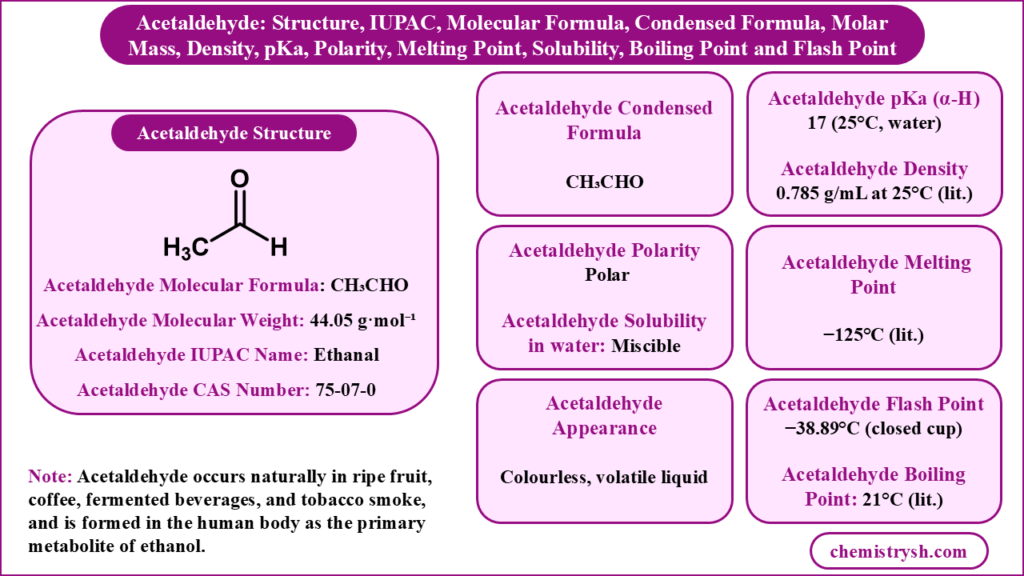
- Molecular Formula (CH₃CHO · C₂H₄O) · Molecular Weight (44.05 g·mol⁻¹) · IUPAC Name (Ethanal) · Common Name (Acetaldehyde) · Other Names (Ethyl aldehyde · Acetic aldehyde) · Abbreviation (MeCHO) · Appearance (colourless, volatile liquid with pungent, fruity odour) · Boiling Point (21°C) · Melting Point (−125°C) · Density (0.785 g/mL at 25°C) · Solubility (fully miscible with water, ethanol) · Flash Point (−38.89°C) · CAS Number (75-07-0) · Acid/Base Nature (neutral) · Polarity (polar) · pKa α-H (17 at 25°C)
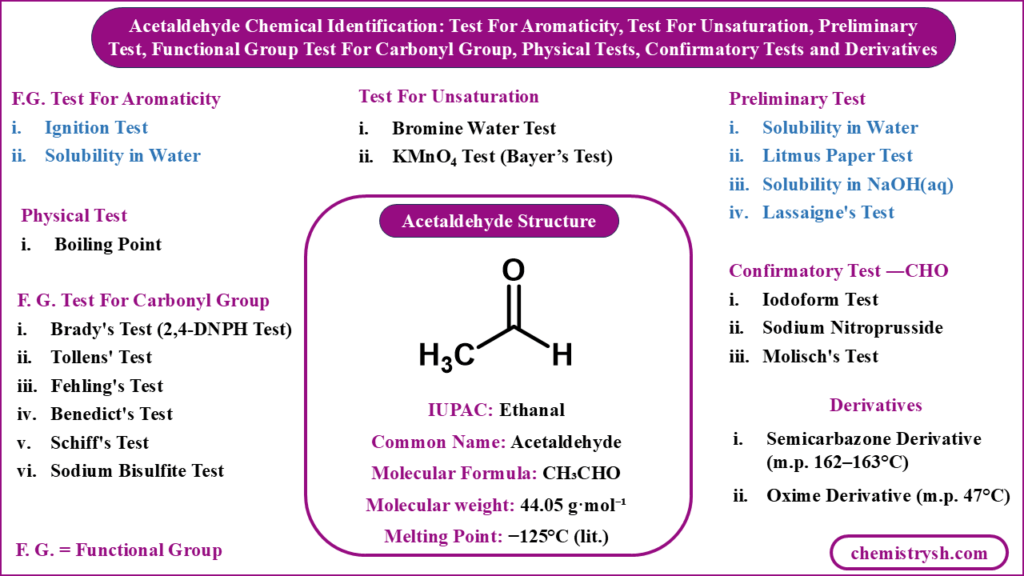
- Physical Appearance Test · Solubility Test · Ignition / Flame Test · Litmus Test · Lassaigne’s Test · Brady’s Test (2,4-DNPH — yellow-orange precipitate) · Tollens’ Test (positive — silver mirror) · Fehling’s Test (positive — brick-red precipitate) · Benedict’s Test (positive — brick-red precipitate) · Schiff’s Test (positive — magenta colour) · Sodium Bisulfite Test (positive — white crystalline adduct) · Iodoform Test (positive — yellow CHI₃ precipitate) · Legal’s Test (positive — red colour) · Molisch’s Test (negative — carbohydrates absent) · Semicarbazone (m.p. 162–163°C) · Oxime (m.p. 47°C) · 2,4-DNPH Hydrazone (m.p. 168°C)
§1 — What Is Acetaldehyde? Introduction and Background
Acetaldehyde (ethanal) is the simplest aliphatic aldehyde — molecular formula CH₃CHO (C₂H₄O), CAS number 75-07-0. The acetaldehyde IUPAC name is ethanal, from the two-carbon chain eth- and the aldehyde suffix -al. It is also known as ethyl aldehyde and acetic aldehyde — abbreviated MeCHO (Me = methyl).
The acetaldehyde pronunciation is a-SÉT-al-duh-hyd; the IUPAC name ethanal is pronounced ETH-uh-nal. Both names — acetaldehyde and ethanal — refer to the same compound. It is the simplest member of the aldehyde family, where the general formula is R–CHO and R = CH₃.
Acetaldehyde occurs naturally in ripe fruit, coffee, fermented beverages, and tobacco smoke, and is formed in the human body as the primary metabolite of ethanol. Industrially, it is produced by Wacker oxidation of ethylene and is a key raw material for acetic acid, acetic anhydride, and ethyl acetate.
§2 — Physical Constants of Acetaldehyde (Ethanal)
The acetaldehyde molecular formula is CH₃CHO — also written as C₂H₄O — a colourless, volatile liquid with an acetaldehyde molecular weight of 44.05 g·mol⁻¹ (CAS 75-07-0). The acetaldehyde boiling point is 21°C (lit.) — critically low, reflecting high volatility — fume cupboard handling is mandatory. The acetaldehyde melting point is −125°C (lit.), confirming it remains liquid under all normal laboratory conditions. The acetaldehyde density is 0.785 g/mL at 25°C — lighter than water. Acetaldehyde solubility in water is complete — fully miscible. The acetaldehyde smell is pungent and fruity, detectable at concentrations as low as 0.0068 ppm. The acetaldehyde pKa of the α-hydrogen is 17 at 25°C. The acetaldehyde flash point is −38.89°C (closed cup) — extremely flammable even at sub-zero temperatures. Acetaldehyde is a polar compound, consistent with its complete miscibility in water and alcohols.
A complete reference table of physical constants and other properties of acetaldehyde for the Qualitative Identification of Acetaldehyde is given below.
|
Property |
Value (Sigma-Aldrich 402788) |
|
IUPAC Name |
Ethanal |
|
Common Name |
Acetaldehyde; Ethyl aldehyde; Acetic aldehyde |
|
Molecular Formula |
CH₃CHO (C₂H₄O) |
|
Condensed Formula |
CH₃CHO |
|
Molar Mass |
44.05 g·mol⁻¹ |
|
CAS Number |
75-07-0 |
|
EC number |
200-836-8 |
|
Appearance |
Colourless, volatile liquid |
|
Odour |
Pungent, fruity |
|
Boiling Point |
21°C (lit.) |
|
Melting Point |
−125°C (lit.) |
|
Density |
0.785 g/mL at 25°C (lit.) |
|
Refractive index |
n²⁰/D 1.332 (lit.) |
|
Solubility in Water |
Miscible |
|
Flash point |
−38.89°C (closed cup) |
|
Vapour pressure |
14.63 psi at 20°C |
|
pKa (α-H) |
17 (25°C, water) |
|
Polarity |
Polar |
|
GHS signal word |
DANGER |
|
Carcinogen class |
Carc. 1B (H350) |
|
Storage |
2–8°C |
§3 — Planning the Identification: Decode the Structure First 🔍
Every competent qualitative analysis begins not at the bench, but on paper. Before a single reagent is added, the acetaldehyde structure must be examined carefully — because the structure dictates the entire test panel.
Step 1 — Identify the Functional Groups in Acetaldehyde
- 🟠 –CHO group (aldehyde functional group) — the carbonyl carbon bonded directly to a hydrogen. This classifies acetaldehyde as an aldehyde, not a ketone.
- 🟡 CH₃C=O unit (methyl carbonyl) — the methyl group bonded directly to the carbonyl carbon. This identifies acetaldehyde as a methyl carbonyl compound.
- The acetaldehyde Lewis structure shows 18 valence electrons — C=O double bond with two lone pairs on the oxygen atom.
Step 2 — What Does the Structure Tell Us Before Any Test Is Run?
The acetaldehyde chemical structure contains a –CHO group, confirmed by Tollens’ Test, Fehling’s Test, Schiff’s Test, and Benedict’s Test. The CH₃C=O unit identifies it as a methyl carbonyl compound, confirmed by the Iodoform Test and Legal’s Test. The aliphatic character predicts a clean blue flame in the Ignition Test. The neutral, water-miscible structure predicts a negative Litmus Test and complete miscibility in the Solubility Test. The table below maps each structural clue to its predicted outcome.
|
Structural Clue |
Tests to Confirm It |
|
–CHO group (aldehyde) |
Positive Tollens’ · Fehling’s · Schiff’s · Benedict’s |
|
CH₃C=O unit (methyl carbonyl) |
Positive Iodoform Test · Legal’s Test |
|
Aliphatic character (no benzene ring) |
Clean blue flame — no soot (Ignition Test) |
|
Water miscibility |
Solubility Test — fully miscible |
|
Neutral compound (no –COOH, no –OH) |
Litmus Test — no colour change |
|
No C=C alkene |
Bromine water test excluded |
|
Whole compound (acetaldehyde) |
Semicarbazone · Oxime · Molisch’s (negative) |
§4 — Acetaldehyde Qualitative Tests: Complete Identification at a Glance
The confirmatory test for acetaldehyde is the Tollens’ Test — the silver mirror that distinguishes it from all ketones — supported by the Iodoform Test and Legal’s Test. The colourless appearance of acetaldehyde immediately eliminates all coloured compounds from consideration — see [Colour of Organic Compounds].
Full procedural details for each test are available on this website: [Solubility Test] · [Litmus Test] · [Brady’s Test] · [Tollens’ Test] · [Fehling’s Test] · [Benedict’s Test] · [Iodoform Test] · [Molisch’s Test] · [Melting Point Determination].
|
# |
Test |
What It Establishes |
What It Rules Out |
|
Preliminary Tests |
|
1 |
Physical Appearance |
Colourless, volatile liquid; pungent, fruity odour |
Coloured compounds — absent |
|
2 |
Solubility Test |
Polar compound; fully miscible with water |
Non-polar compounds — absent |
|
3 |
Ignition / Flame Test |
Clean, non-sooty blue flame — aliphatic character |
Aromatic compounds — absent |
|
4 |
Litmus Test |
Neutral compound |
Carboxylic acids — absent · Phenols — absent · Amines — absent |
|
5 |
Lassaigne’s Test |
No nitrogen, sulfur, or halogens present |
Amines — absent · Amides — absent · Halogenated compounds — absent |
|
Functional Group Tests |
|
6 |
Brady’s Test (2,4-DNPH Test) |
Carbonyl group (C=O) confirmed |
Non-carbonyl compounds — absent |
|
7 |
Tollens’ Test |
Positive — silver mirror — aldehyde confirmed |
Ketones — absent |
|
8 |
Fehling’s Test |
Positive — brick-red precipitate — aliphatic aldehyde confirmed |
Ketones — absent · Aromatic aldehydes — absent |
|
9 |
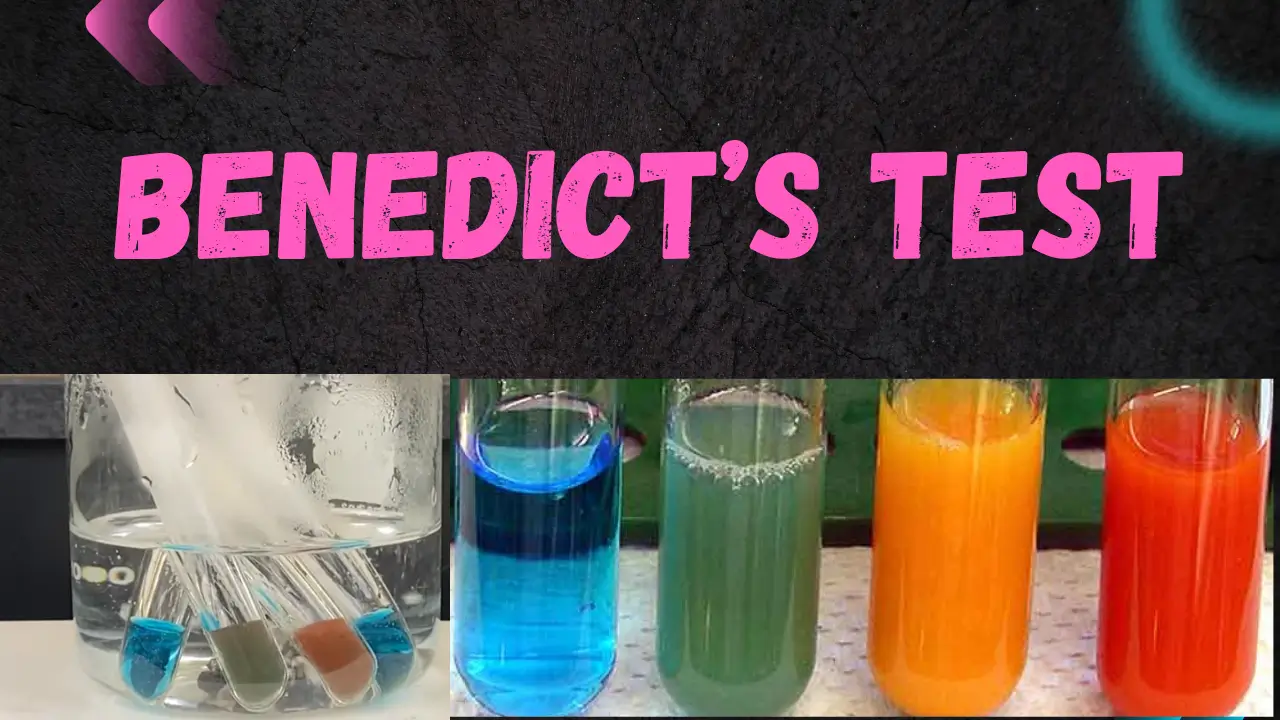
Benedict’s Test |
Positive — brick-red precipitate — corroborating Fehling’s |
Ketones — absent |
|
10 |
Schiff’s Test |
Positive — magenta colour — aldehyde confirmed |
Ketones — absent |
|
11 |
Sodium Bisulfite Test |
Positive — aldehyde or methyl ketone confirmed |
Non-reactive carbonyls — absent |
|
Confirmatory Tests |
|
12 |
Iodoform Test |
Yellow precipitate (CHI₃) — CH₃CHO unit confirmed |
Non-methyl carbonyls — absent |
|
13 |
Legal’s Test (Sodium Nitroprusside) |
Red colour — methyl carbonyl unit confirmed |
Non-methyl carbonyls — absent |
|
14 |
Molisch’s Test |
Negative — carbohydrate class excluded |
Carbohydrates — absent |
|
15 |
Semicarbazone Derivative |
m.p. 162–163°C — confirms acetaldehyde specifically |
Other aldehydes — absent |
|
16 |
Oxime Derivative |
m.p. 47°C — independent m.p. confirmation |
Other aldehydes — absent |
§5 — Materials and Reagents
Safety note: Acetaldehyde is stored at 2–8°C, flash point −38.89°C — handle in a fume cupboard only; keep away from all ignition sources.
Full details of each reagent are available on this website: [Solubility Test] · [Litmus Test] · [Brady’s Test] · [Tollens’ Test] · [Fehling’s Test] · [Benedict’s Test] · [Iodoform Test].
|
# |
Reagent |
Composition / Preparation |
Purpose in Identification |
|
1 |
Acetaldehyde sample (unknown) |
Stored at 2–8°C; handle in fume cupboard only |
Test compound |
|
2 |
Distilled water |
— |
Solubility test; reagent preparation |
|
3 |
Brady’s Reagent (2,4-DNPH) |
2,4-Dinitrophenylhydrazine dissolved in methanol and dilute H₂SO₄ |
Detects carbonyl group (C=O) — Brady’s Test |
|
4 |
Tollens’ Reagent |
AgNO₃ in water + NaOH (Ag₂O ppt) + dilute NH₃ dropwise until clear [Ag(NH₃)₂]OH — prepare freshly; never store |
Distinguishes aldehyde from ketone — positive for acetaldehyde |
|
5 |
Fehling’s Solution |
Fehling’s A: CuSO₄ in water · Fehling’s B: sodium potassium tartrate + NaOH — mix equal volumes before use |
Detects aliphatic aldehydes — positive for acetaldehyde |
|
6 |
Benedict’s Reagent |
CuSO₄ + sodium carbonate + sodium citrate in distilled water — stable single solution |
Corroborates Fehling’s — positive for acetaldehyde |
|
7 |
Schiff’s Reagent |
Basic fuchsin (1 g) + sodium metabisulfite (Na₂S₂O₅, 1.9 g) + 0.15N HCl (100 mL) — shake, decolourise with activated charcoal, filter to colourless; prepare freshly; store in dark |
Detects aldehydes — positive for acetaldehyde |
|
8 |
Saturated Sodium Bisulfite |
Saturated aqueous NaHSO₃ — prepare freshly |
Detects aldehydes and methyl ketones |
|
9 |
Iodine Solution (Lugol’s) |
I₂ dissolved in aqueous KI |
Used with NaOH in Iodoform Test |
|
10 |
Sodium Hydroxide (NaOH) |
10% aqueous solution |
Required for Iodoform Test and Tollens’ preparation |
|
11 |
Sodium Nitroprusside |
Na₂[Fe(CN)₅NO] in distilled water |
Legal’s Test — methyl carbonyl detection |
|
12 |
Molisch’s Reagent |
α-Naphthol (5–10%) dissolved in 95% ethanol — prepare freshly, protect from light |
Molisch’s Test — carbohydrate exclusion |
|
12a |
Conc. Sulphuric Acid (H₂SO₄) |
Added separately during Molisch’s Test — layered carefully down tube wall; never mixed with Molisch’s reagent |
Dehydrates carbohydrates to furfural — produces purple ring at interface |
|
13 |
Semicarbazide hydrochloride |
sodium acetate in water |
Semicarbazone derivative — m.p. 162–163°C |
|
14 |
Hydroxylamine hydrochloride |
sodium acetate in water |
Oxime derivative — m.p. 47°C |
|
15 |
Authentic acetaldehyde sample |
Known compound — same source |
Control test — comparison with authentic sample |
|
16 |
Blue and red litmus paper |
— |
Litmus Test — acid/base character |
§6 — Preliminary Tests for Acetaldehyde Identification
In qualitative analysis, a single preliminary observation can eliminate multiple compound classes at once. A neutral litmus result rules out all acidic and basic compounds together.
A clean, non-sooty flame rules out all aromatic compounds in one step. This is the power of preliminary testing — systematic elimination before a single chemical reagent is used.ll
6.i — Physical Appearance
6.ii — Solubility Test
Reagents: Distilled water · Ethanol · Dilute NaOH solution
6.iii — Ignition / Flame Test
Reagent: Bunsen burner (Caution: flash point −38.89°C — fume cupboard mandatory; keep away from all other reagents)
6.iv — Litmus Test
6.v — Lassaigne’s Test (Elemental Detection)
Reagents: Sodium metal · Glucose · Distilled water · FeSO₄ solution · FeCl₃ solution · Sodium nitroprusside solution · AgNO₃ solution · Dilute HNO₃
Preparation of Lassaigne’s Extract: Place sodium metal in the ignition tube, add a small quantity of acetaldehyde carefully, then fill the remaining space with glucose — glucose contains no nitrogen, sulfur, or halogens and does not interfere with any detection test; it reduces vapour escape and makes the fusion safer. Heat the ignition tube until red hot, cool cautiously, add distilled water carefully, boil, and filter to obtain the Lassaigne’s extract.
Preliminary Test Results — Identifying the Compound Class of Acetaldehyde
|
Group |
Compound Class |
Characteristic Tests (exact) |
Our Observation |
Verdict |
|
A |
Carboxylic Acids |
(i) Litmus test (ii) Sodium bicarbonate test (iii) Ferric chloride test (iv) Esterification test (v) Sodium hydroxide solubility test (vi) Flame test (vii) Sublimation test (viii) Melting point / mixed melting point (ix) Solid derivative — amide (x) Solid derivative — anilide |
Litmus neutral · No CO₂ with NaHCO₃ · No clean dissolution in NaOH |
Ruled out |
|
B |
Phenols |
(i) Litmus test (ii) Ferric chloride test (iii) Bromine water test (iv) Liebermann’s nitroso test (v) Phthalein dye test (vi) Azo dye test (vii) Millon’s test (viii) Sodium hydroxide solubility test (ix) Sodium bicarbonate test (negative) (x) Melting point / mixed melting point (xi) Solid derivative — tribromophenol |
Litmus neutral · Clean blue flame · Gelatinous ppt with NaOH |
Ruled out |
|
D |
Amines |
(i) Litmus test (ii) Carbylamine test (iii) Nitrous acid test (iv) Hinsberg test (v) Azo dye test (vi) Acetylation test (vii) Benzoylation test (Schotten–Baumann) (viii) Lassaigne’s test (ix) Solid derivative — acetyl / benzoyl |
Litmus neutral · Nitrogen absent (Lassaigne’s) |
Ruled out |
|
E |
Aromatic Hydrocarbons |
(i) Baeyer’s test (negative) (ii) Bromine water test (substitution) (iii) Nitration test (iv) Sulfonation test (v) Friedel–Crafts test (vi) Combustion / flame test (sooty flame) (vii) Lassaigne’s test (viii) Melting point / mixed melting point (ix) Solid derivative — picrate (x) Solid derivative — charge transfer complex |
Clean non-sooty blue flame · No heteroatoms (Lassaigne’s) |
Ruled out |
|
C |
Aldehydes · Ketones · Carbohydrates |
(i) Brady’s test (ii) Tollens’ test (iii) Fehling’s test (iv) Benedict’s test (v) Schiff’s test (vi) Sodium bisulfite addition test (vii) Iodoform test (viii) Molisch’s test (ix) Seliwanoff’s test (x) Barfoed’s test (xi) Osazone formation test (xii) 2,4-DNPH derivative melting point |
Neutral · Polar · Aliphatic · No heteroatoms · Gelatinous ppt with NaOH |
Indicated ✅ |
§7 — Functional Group Tests: Carbonyl Detection in Acetaldehyde
The preliminary tests confirmed acetaldehyde is neutral, aliphatic, polar, and contains only carbon, hydrogen, and oxygen. The functional group tests below determine which specific compound it is.
Step 1 — Confirm carbonyl group: Brady’s Test (2,4-DNPH Test) → reacts with both aldehydes and ketones → immediate orange/yellow crystalline precipitate → carbonyl group (C=O) confirmed · carbohydrates eliminated.
Step 2 — Aldehyde or ketone? Tollens’ Test → silver mirror · Fehling’s Test → brick-red precipitate · Benedict’s Test → brick-red precipitate · Schiff’s Test → magenta colour → all four positive → aldehyde confirmed · ketones eliminated.
Step 3 — Which aldehyde? Sodium Bisulfite Test → white crystalline adduct · Iodoform Test → yellow precipitate (CHI₃) → CH₃CHO unit confirmed · Legal’s Test → red colour → methyl carbonyl unit confirmed → acetaldehyde specifically indicated.
|
§ |
Test |
Result for Acetaldehyde |
|
§8 |
Brady’s Test (2,4-DNPH Test) |
Positive — carbonyl confirmed |
|
§9 |
Tollens’ Test |
Positive — silver mirror — aldehyde confirmed |
|
§10 |
Fehling’s |
Positive — brick-red precipitate |
|
§11 |
Benedict’s Test |
Positive — brick-red precipitate |
|
§12 |
Schiff’s Test |
Positive — magenta colour — aldehyde confirmed |
|
§13 |
Sodium Bisulfite Test |
Positive — CH₃CHO adduct confirmed |
|
§14 |
Iodoform Test |
Positive — yellow CHI₃ precipitate — CH₃CHO confirmed |
|
§15 |
Legal’s Test |
Positive — red colour — methyl carbonyl confirmed |
|
§16 |
Molisch’s Test |
Negative — carbohydrates excluded |
§8 — Test 1: Brady’s Test (2,4-DNPH Test)
Brady’s Test (2,4-DNPH Test) detects the carbonyl group (C=O) in aldehydes and ketones. A positive result confirms a carbonyl compound is present — it does not yet distinguish aldehyde from ketone. For acetaldehyde, the expected result is a yellow crystalline precipitate.
Full details of Brady’s Test — including its mechanism, derivative melting points, and applications — are available at [Brady’s Test — chemistrysh.com].
|
Test |
Reagent |
Procedure |
Positive Result |
Inference |
|
Brady’s Test (2,4-DNPH Test) |
2,4-Dinitrophenylhydrazine (0.5 g) dissolved in concentrated H₂SO₄ (10 mL), then added to ethanol (15 mL) and distilled water (5 mL) — Brady’s reagent. Prepare freshly or use within 10 days. |
Add 3–4 drops of acetaldehyde to 2 mL of Brady’s reagent in a clean test tube. Shake well and allow to stand for 2–3 minutes at room temperature. |
Yellow crystalline precipitate — aliphatic aldehyde or ketone · Orange precipitate — α,β-unsaturated carbonyls · Red precipitate — aromatic aldehydes and ketones |
Carbonyl group (C=O) confirmed. Acetaldehyde is an aldehyde or ketone. Alcohols, carboxylic acids, and esters give no precipitate. |
§9 — Test 2: Tollens’ Test (Silver Mirror Test)
Tollens’ Test uses [Ag(NH₃)₂]OH — the diamminesilver(I) complex — to distinguish aldehydes from ketones. Acetaldehyde gives a positive Tollens’ test — confirming an aldehyde, not a ketone.
Full details of Tollens’ Test are available at [Tollens’ Test — chemistrysh.com].
|
Test |
Reagent |
Procedure |
Positive Result |
Inference |
|
Tollens’ Test (Silver Mirror Test) |
Freshly prepared Tollens’ reagent — AgNO₃ + dilute NaOH → Ag₂O precipitate → add dilute NH₃ dropwise → clear [Ag(NH₃)₂]OH solution. Never store. |
Add 2–3 drops of acetaldehyde to 2 mL of Tollens’ reagent. Warm in water bath at 60°C for 5 minutes. Observe inner walls of test tube. |
Bright silver mirror on inner walls of test tube — positive result for acetaldehyde. (No mirror = ketone — negative result) |
Aldehyde confirmed. Ag⁺ reduced to Ag metal by the aldehyde. Ketones give no mirror. |
§10 — Test 3: Fehling’s Test and Benedict’s Test
Fehling’s Test and Benedict’s Test detect reducing aldehydes using Cu²⁺ ions — producing a brick-red precipitate of Cu₂O on positive result. Acetaldehyde gives a positive result in both — confirming an aliphatic aldehyde. Aromatic aldehydes (e.g. benzaldehyde) give a negative Fehling’s test.
Full details are available at [Fehling’s Test — chemistrysh.com] and [Benedict’s Test — chemistrysh.com].
|
Test |
Reagent |
Procedure |
Positive Result |
Inference |
|
Fehling’s Test |
Fehling’s A (CuSO₄ solution) + Fehling’s B (sodium potassium tartrate + NaOH) — mix equal volumes immediately before use |
Add 1 mL of acetaldehyde to 2 mL of freshly mixed Fehling’s solution. Heat in boiling water bath for 5 minutes. Observe. |
Brick-red Cu₂O precipitate — positive result for acetaldehyde |
Aliphatic aldehyde confirmed. Ketones and aromatic aldehydes give no precipitate. |
|
Benedict’s Test |
Benedict’s reagent — CuSO₄ + sodium carbonate + sodium citrate in water — stable single solution |
Add 1 mL of acetaldehyde to 2 mL of Benedict’s reagent. Heat in boiling water bath for 5 minutes. Observe. |
Brick-red precipitate — positive result for acetaldehyde |
Corroborates Fehling’s result. Reducing aldehyde confirmed. |
§11 — Test 4: Schiff’s Test
Schiff’s reagent — a decolourised solution of fuchsin dye — is restored to its pink/magenta colour by aldehydes. Ketones do not respond under normal conditions. Acetaldehyde gives a positive Schiff’s test — confirming an aldehyde, not a ketone.
Full details of Schiff’s Test are available at [Schiff’s Test — chemistrysh.com].
|
Test |
Reagent |
Procedure |
Positive Result |
Inference |
|
Schiff’s Test |
Schiff’s reagent — basic fuchsin (1 g) + sodium metabisulfite (Na₂S₂O₅, 1.9 g) + 0.15N HCl (100 mL) — decolourise with activated charcoal, filter to colourless; prepare freshly; store in dark. |
Add 2–3 drops of acetaldehyde to 2 mL of Schiff’s reagent in a clean test tube. Allow to stand at room temperature for 5 minutes. Do not heat. Observe colour change. |
Immediate pink/magenta colour — positive result for acetaldehyde |
Aldehyde confirmed. Ketones give no colour change under normal conditions. |
§12 — Test 5: Sodium Bisulfite Test
The sodium bisulfite test detects aldehydes and methyl ketones by nucleophilic addition of HSO₃⁻ to the carbonyl carbon — forming a white crystalline bisulfite adduct. Acetaldehyde gives a positive result — confirming an aldehyde or methyl ketone is present.
|
Test |
Reagent |
Procedure |
Positive Result |
Inference |
|
Sodium Bisulfite Test |
Saturated aqueous NaHSO₃ solution — prepare freshly before use |
Add 1 mL of acetaldehyde to 2 mL of saturated sodium bisulfite solution in a clean test tube. Shake well and allow to stand for 15–20 minutes. Observe. |
White crystalline precipitate (CH₃CH(OH)SO₃Na) forms — positive result for acetaldehyde |
Aldehyde or methyl ketone confirmed. Sterically hindered ketones give no precipitate. |
§13 — Test 6: Iodoform Test
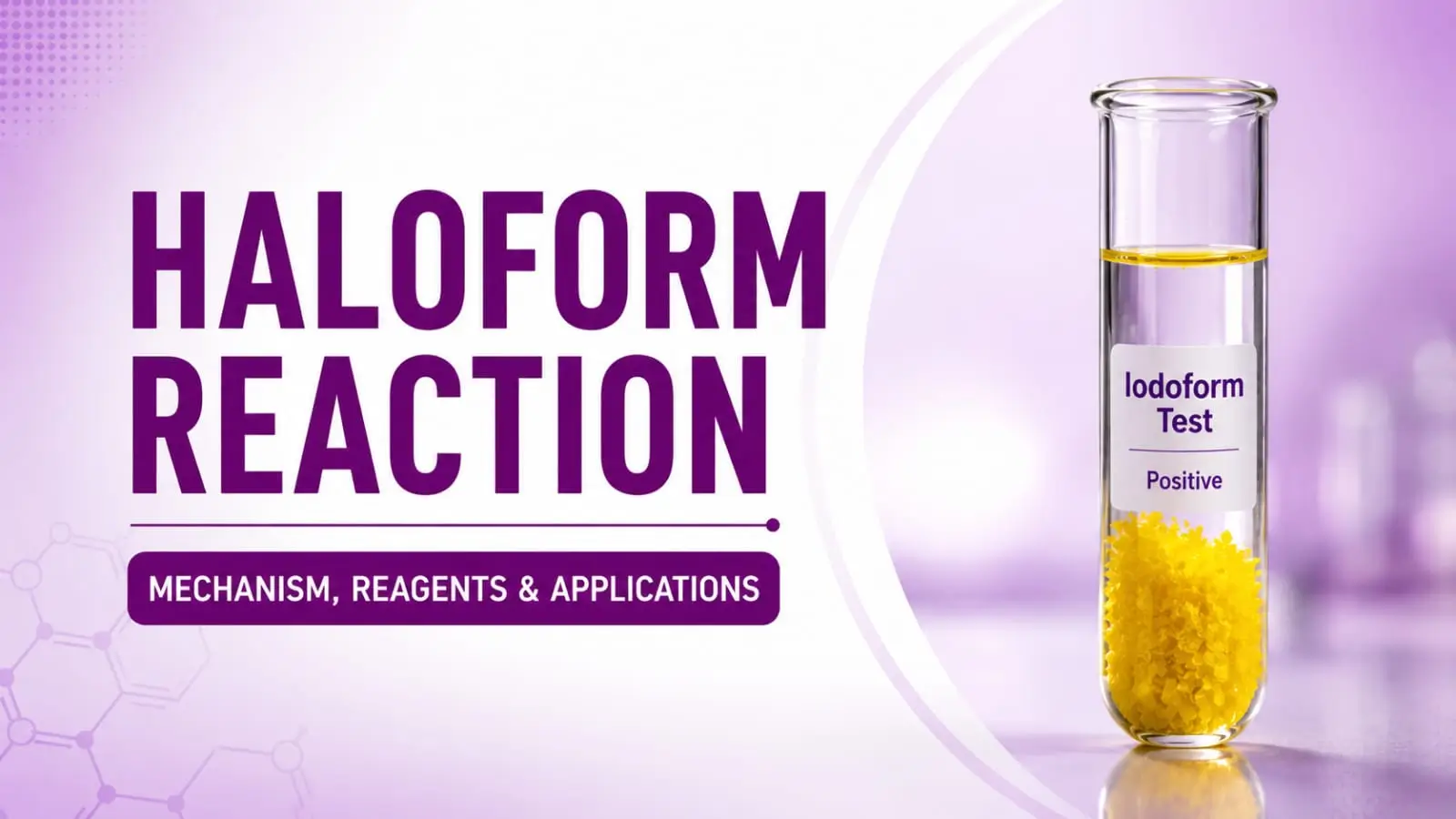
The Iodoform Test is a key confirmatory test for the CH₃CHO unit. Acetaldehyde reacts with iodine (I₂) and sodium hydroxide (NaOH) to produce iodoform (CHI₃) — a yellow crystalline precipitate with a characteristic antiseptic odour. A positive iodoform test confirms the CH₃CHO group is present.
Full details of the Iodoform Test are available at [Iodoform Test — chemistrysh.com].
|
Test |
Reagent |
Procedure |
Positive Result |
Inference |
|
Iodoform Test |
Iodine solution (I₂ in aqueous KI) + sodium hydroxide solution (10% NaOH) |
Add 1 mL of acetaldehyde to 2 mL of NaOH solution in a clean test tube. Add iodine solution dropwise with shaking until a faint permanent yellow colour persists. Warm gently if no precipitate forms. Observe. |
Yellow crystalline precipitate of iodoform (CHI₃) with characteristic antiseptic odour — positive result for acetaldehyde |
CH₃CHO unit confirmed. CH₃CHO + 3I₂ + 4NaOH → CHI₃↓ + HCOONa + 3NaI + 3H₂O |
§14 — Test 7: Legal’s Test (Sodium Nitroprusside Test)
Legal’s Test is specific to compounds containing the CH₃C=O unit — methyl ketones and acetaldehyde. Acetaldehyde gives a positive Legal’s Test — producing a red colour in alkaline medium. This is a special case: most aldehydes give a negative Legal’s Test, but acetaldehyde gives a positive result because it contains the CH₃CHO unit, which behaves analogously to a methyl ketone in this reaction.
|
Test |
Reagent |
Procedure |
Positive Result |
Inference |
|
Legal’s Test (Sodium Nitroprusside Test) |
Freshly prepared sodium nitroprusside solution — Na₂[Fe(CN)₅NO] dissolved in distilled water + sodium hydroxide solution (10% NaOH). Prepare freshly before use. |
1. Dissolve sodium nitroprusside in 2 mL distilled water in a clean test tube. 2. Add 1 mL of acetaldehyde. Shake gently. 3. Add 10% NaOH solution dropwise. 4. Observe colour change immediately. |
Red colour — positive result for acetaldehyde. Colour may shift to yellow on prolonged standing. Note: colour variation is normal — exact shade depends on concentration of sodium nitroprusside and alkalinity of the medium. |
CH₃CHO unit confirmed. Acetaldehyde gives a positive Legal’s Test — a special case among aldehydes. Most aldehydes give no colour — negative result. |
§15 — Test 8: Molisch’s Test
Molisch’s Test is a general test for carbohydrates. Acetaldehyde gives a negative Molisch’s Test — confirming it is not a carbohydrate. This negative result eliminates glucose, fructose, and all other reducing sugars from consideration.
|
Test |
Reagent |
Procedure |
Positive Result |
Inference |
|
Molisch’s Test |
Molisch’s reagent — α-naphthol (5–10%) in 95% ethanol (prepare freshly, protect from light) · Conc. H₂SO₄ added separately during test |
Add 2–3 drops of acetaldehyde to 2 mL of distilled water. Add 2 drops of Molisch’s reagent. Shake gently. Tilt the test tube and carefully layer 1 mL of conc. H₂SO₄ down the tube wall. Do not mix. Observe the interface. |
No purple ring at interface — negative result for acetaldehyde |
Carbohydrate class absent — acetaldehyde is not a sugar. Positive result (purple ring) would indicate carbohydrate. |
§16 — Solid Derivatives of Acetaldehyde and Their Melting Points
Solid derivatives provide the final confirmatory test for acetaldehyde through melting point determination. The melting point of acetaldehyde derivatives — particularly the semicarbazone (162–163°C) and oxime (47°C) — acts as a fingerprint that distinguishes acetaldehyde from other aldehydes sharing positive test results.
Three standard derivatives are prepared:
|
# |
Derivative |
Reagent |
Appearance |
Melting Point |
CAS |
|
1 |
2,4-Dinitrophenylhydrazone (2,4-DNPH hydrazone) |
Brady’s reagent — 2,4-DNPH in methanol/H₂SO₄ |
Yellow-orange crystalline solid |
168°C |
1019-57-4 |
|
2 |
Semicarbazone |
Semicarbazide hydrochloride + sodium acetate in water |
White crystalline solid |
162–163°C |
— |
|
3 |
Oxime (Acetaldoxime) |
Hydroxylamine hydrochloride + sodium acetate in water |
White crystalline solid |
47°C |
— |
How to Prepare Acetaldehyde Derivatives in the Laboratory
This procedure is a standard organic chemistry practical carried out in any laboratory experiment involving carbonyl compound identification.
- Dissolve acetaldehyde in the minimum volume of ethanol or water as appropriate. (Caution: flash point −38.89°C — work in fume cupboard only)
- Add the reagent solution.
- Allow to stand or warm gently until crystallisation occurs.
- Filter and wash with cold solvent.
- Recrystallise to obtain a pure sample.
- Determine the melting point of the acetaldehyde derivative and compare with the tabulated values above.
Note: The 2,4-DNPH hydrazone melting point is sensitive to traces of acid in the crystals. Wash with dilute sodium bicarbonate solution before recrystallisation to obtain a sharp, reproducible value. The semicarbazone derivative (m.p. 162–163°C) is the preferred confirmatory derivative — it gives a sharp, reproducible melting point and is stable at room temperature.
§17 — Chemical Reactions Involved in the Identification of Acetaldehyde
The identification tests performed on acetaldehyde involve distinct chemical reactions. For each test, the chemical reaction, type of reaction, and observation are given below.
17.i — Brady’s Test (2,4-DNPH Test)
Chemical Reaction:
CH₃CHO + (O₂N)₂C₆H₃NHNH₂ → CH₃CH=NNH·C₆H₃(NO₂)₂ + H₂O
Type of Reaction: Condensation reaction (nucleophilic addition-elimination) — the 2,4-DNPH adds across the C=O double bond, followed by elimination of water to form the hydrazone.
Observation: Yellow-orange crystalline precipitate — acetaldehyde 2,4-dinitrophenylhydrazone (m.p. 168°C).
17.ii — Tollens’ Test
Chemical Reaction:
CH₃CHO + 2[Ag(NH₃)₂]⁺ + 2OH⁻ → CH₃COO⁻ + 2Ag↓ + 4NH₃ + H₂O
Type of Reaction: Oxidation-reduction — acetaldehyde is oxidised to acetate; silver ion (Ag⁺) is reduced to silver metal (Ag↓), depositing as a mirror on the inner walls of the test tube.
Observation: Bright silver mirror on inner walls of test tube — positive result.
17.iii — Fehling’s Test and Benedict’s Test
Chemical Reaction:
CH₃CHO + 2Cu²⁺ + 5OH⁻ → CH₃COO⁻ + Cu₂O↓ + 3H₂O
Type of Reaction: Oxidation-reduction — acetaldehyde is oxidised to acetate; copper(II) ions (Cu²⁺, blue) are reduced to copper(I) oxide (Cu₂O, brick-red precipitate).
Observation: Brick-red Cu₂O precipitate — positive result for both Fehling’s and Benedict’s tests.
17.iv — Schiff’s Test
Chemical Reaction:
CH₃CHO + Schiff’s reagent → magenta colour restored
Type of Reaction: The aldehyde group reacts with the decolourised fuchsin-bisulfite complex, regenerating the chromophore and restoring the magenta colour.
Observation: Immediate pink/magenta colour — positive result.
17.v — Sodium Bisulfite Test
Chemical Reaction:
CH₃CHO + NaHSO₃ → CH₃CH(OH)SO₃Na
Type of Reaction: Nucleophilic addition — the bisulfite ion (HSO₃⁻) acts as a nucleophile and adds to the carbonyl carbon to form the crystalline bisulfite adduct.
Observation: White crystalline precipitate of sodium acetaldehyde bisulfite adduct — positive result.
17.vi — Iodoform Test
Chemical Reaction:
CH₃CHO + 3I₂ + 4NaOH → CHI₃↓ + HCOONa + 3NaI + 3H₂O
Type of Reaction: Halogenation followed by nucleophilic cleavage — hydroxide ion acts as a base to allow successive iodination of the methyl group, then cleaves the C–C bond to release iodoform (CHI₃) and sodium formate (HCOONa).
Observation: Yellow crystalline precipitate of iodoform (CHI₃) with characteristic antiseptic odour — positive result.
17.vii — Legal’s Test (Sodium Nitroprusside Test)
Chemical Reaction:
CH₃CHO + Na₂[Fe(CN)₅NO] + NaOH → red/pink complex
Type of Reaction: Coordination complex formation — the methyl carbonyl unit of acetaldehyde reacts with sodium nitroprusside in alkaline conditions to form a red-coloured iron coordination complex.
Observation: Red colour in alkaline medium — positive result. Colour may shift to yellow on prolonged standing.
17.viii — Semicarbazone Formation
Chemical Reaction:
CH₃CHO + NH₂NHCONH₂ → CH₃CH=NNHCONH₂ + H₂O (m.p. 162–163°C)
Type of Reaction: Condensation reaction — nucleophilic addition of semicarbazide to the carbonyl group, followed by elimination of water.
Observation: White crystalline solid — semicarbazone derivative, m.p. 162–163°C.
17.ix — Oxime Formation
Chemical Reaction:
CH₃CHO + NH₂OH → CH₃CH=NOH + H₂O (m.p. 47°C)
Type of Reaction: Condensation reaction — hydroxylamine adds to the carbonyl group, followed by elimination of water to form acetaldoxime.
Observation: White crystalline solid — oxime derivative (acetaldoxime), m.p. 47°C.
§18 — Acetaldehyde Test Results: Qualitative Identification of Acetaldehyde
The qualitative identification of acetaldehyde — the acetaldehyde test sequence — was carried out systematically through preliminary tests (Physical Appearance · Solubility Test · Ignition Test · Litmus Test · Lassaigne’s Test), functional group tests (Brady’s Test · Tollens’ Test · Fehling’s Test · Benedict’s Test · Schiff’s Test · Sodium Bisulfite Test), and confirmatory tests (Iodoform Test · Legal’s Test · Molisch’s Test · Semicarbazone Derivative · Oxime Derivative) following standard organic qualitative analysis protocol. The results of all tests are summarised in the table below.
|
Qualitative Test for Acetaldehyde — Summary of All Test Results |
|
# |
Test |
Observation |
Conclusion |
|
1 |
Physical Appearance |
Colourless, volatile liquid; pungent, fruity odour |
Coloured compounds — absent |
|
2 |
Solubility Test |
Completely miscible with water and ethanol; gelatinous precipitate with NaOH |
Polar compound — aromatic hydrocarbons absent · aldehyde character with α-hydrogen indicated |
|
3 |
Ignition / Flame Test |
Clean, non-sooty blue flame |
Aromatic compounds and phenols — absent |
|
4 |
Litmus Test |
Neutral — no colour change |
Carboxylic acids, phenols, amines — absent |
|
5 |
Lassaigne’s Test |
N, S, halogens all absent |
Amines, amides, halogenated compounds — absent |
|
6 |
Brady’s Test (2,4-DNPH Test) |
Yellow-orange crystalline precipitate |
Carbonyl group (C=O) — confirmed |
|
7 |
Tollens’ Test |
Bright silver mirror — positive |
Aldehyde confirmed · ketones — absent |
|
8 |
Fehling’s Test |
Brick-red Cu₂O precipitate — positive |
Aliphatic aldehyde confirmed · aromatic aldehydes — absent |
|
9 |
Benedict’s Test |
Brick-red precipitate — positive |
Reducing aldehyde — confirmed |
|
10 |
Schiff’s Test |
Immediate pink/magenta colour — positive |
Aldehyde confirmed · ketones — absent |
|
11 |
Sodium Bisulfite Test |
White crystalline precipitate — positive |
Aldehyde or methyl ketone — confirmed |
|
12 |
Iodoform Test |
Yellow precipitate (CHI₃), antiseptic odour — positive |
CH₃CHO unit — confirmed |
|
13 |
Legal’s Test (Sodium Nitroprusside) |
Red colour — positive |
Methyl carbonyl unit — confirmed |
|
14 |
Molisch’s Test |
No purple ring — negative |
Carbohydrates — absent |
|
15 |
Semicarbazone Derivative |
White crystalline solid — m.p. 162–163°C |
Matches reported literature value — confirmed |
|
16 |
Oxime Derivative |
White crystalline solid — m.p. 47°C |
Independent m.p. confirmation |
Confirming Acetaldehyde as an Aliphatic Aldehyde — Test Result Interpretation
The compound does not turn blue litmus red — carboxylic acids, phenols, and sulfonic acids eliminated. It does not turn red litmus blue — amines and anilines eliminated. The ignition test produces a clean, non-sooty blue flame — aromatic hydrocarbons, benzene, toluene, phenol, and cresol eliminated. Lassaigne’s test shows no nitrogen, sulfur, or halogens — amines, amides, and halogenated compounds eliminated. Brady’s Test produces a yellow-orange precipitate — carbonyl group (C=O) confirmed, alcohols, carboxylic acids, and esters eliminated. Tollens’, Fehling’s, Benedict’s, and Schiff’s tests all give positive results — aldehyde confirmed, ketones eliminated. The Iodoform Test and Legal’s Test are both positive — CH₃CHO unit confirmed, non-methyl carbonyls eliminated. The semicarbazone derivative melting point is 162–163°C, matching the reported literature value — the compound is therefore identified as acetaldehyde (ethanal).
Identification Flowchart
§19 — Conclusion
The unknown compound is not aromatic — clean blue flame confirmed. It is not acidic — blue litmus unchanged. It is not basic — red litmus unchanged. It is not a carbohydrate — Molisch’s Test negative. It is not a ketone — Tollens’, Fehling’s, Benedict’s, and Schiff’s tests all positive, ruling out all ketones. It is not a non-methyl aldehyde — Iodoform Test and Legal’s Test both positive, confirming the CH₃CHO unit.
The compound gives a positive Tollens’ Test (silver mirror), a positive Iodoform Test (yellow CHI₃ precipitate), and a positive Legal’s Test (red colour) — all three confirmatory tests consistent with acetaldehyde and acetaldehyde alone.
The semicarbazone derivative melting point (162–163°C) matches the reported literature value for acetaldehyde semicarbazone.
The unknown compound is therefore conclusively identified as acetaldehyde (ethanal) — molecular formula CH₃CHO (C₂H₄O) · molar mass 44.05 g·mol⁻¹ · boiling point 21°C · melting point −125°C · density 0.785 g/mL at 25°C · CAS 75-07-0.
§20 — Acetaldehyde Chemistry — Key Terms and Definitions for Qualitative Identification
α-Hydrogen
Any carbon atom directly bonded to a functional group is called the α-carbon. A hydrogen atom bonded to the α-carbon is called the α-hydrogen.
- In acetaldehyde: The CH₃ carbon is directly bonded to the –CHO group → CH₃ is the α-carbon → the three H atoms on CH₃ are the α-hydrogens
- pKa of acetaldehyde α-H: 17 — more acidic than acetone (pKa = 20) because the aldehyde carbonyl is more electron-withdrawing than the ketone carbonyl
Nucleophilic Addition
A reaction in which a nucleophile — an electron-rich species — attacks the electrophilic carbonyl carbon and adds across the C=O bond.
- Nucleophile: The attacking species (e.g. HSO₃⁻ in Bisulfite Test · OH⁻ in Iodoform Test)
- Electrophile: The carbonyl carbon of acetaldehyde (C=O)
- Product: A new C–Nu bond forms at the carbonyl carbon
Bisulfite Adduct
A white crystalline addition product formed when sodium bisulfite (NaHSO₃) reacts with an aldehyde or methyl ketone by nucleophilic addition.
- Nucleophile: HSO₃⁻ (bisulfite ion)
- Electrophile: Carbonyl carbon of acetaldehyde
- Product: CH₃CH(OH)SO₃Na — white crystalline solid
- Reversibility: Dissolves on addition of dilute acid or dilute alkali
Condensation Reaction
A reaction in which two molecules combine to form a larger product with simultaneous elimination of a small molecule — usually water.
- In Brady’s Test: Acetaldehyde + 2,4-DNPH → yellow-orange hydrazone + H₂O (m.p. 168°C)
- In semicarbazone formation: Acetaldehyde + semicarbazide → semicarbazone + H₂O (m.p. 162–163°C)
- In oxime formation: Acetaldehyde + hydroxylamine → acetaldoxime + H₂O (m.p. 47°C)
Oxidising Agent
A substance that accepts electrons from another substance is called an oxidising agent. The oxidising agent is always reduced in the reaction.
- In Brady’s Test: Acetaldehyde + 2,4-DNPH → yellow-orange hydrazone + H₂O (m.p. 168°C)
- In semicarbazone formation: Acetaldehyde + semicarbazide → semicarbazone + H₂O (m.p. 162–163°C)
- In oxime formation: Acetaldehyde + hydroxylamine → acetaldoxime + H₂O (m.p. 47°C)
Reducing Agent
A substance that provides electrons to another substance is called a reducing agent. The reducing agent is always oxidised in the reaction.
- Tollens’ Test: Acetaldehyde provides electrons to Ag⁺ → acetaldehyde is oxidised to acetate and acts as the reducing agent · Ag⁺ accepts electrons → Ag⁺ is reduced to Ag↓ and acts as the oxidising agent
- Fehling’s Test: Acetaldehyde provides electrons to Cu²⁺ → acetaldehyde is oxidised to acetate and acts as the reducing agent · Cu²⁺ accepts electrons → Cu²⁺ is reduced to Cu⁺ and acts as the oxidising agent
- Benedict’s Test: Acetaldehyde provides electrons to Cu²⁺ → acetaldehyde is oxidised to acetate and acts as the reducing agent · Cu²⁺ accepts electrons → Cu²⁺ is reduced to Cu⁺ and acts as the oxidising agent
- Note: Acetone does not provide electrons → gives negative Tollens’, Fehling’s, and Benedict’s → acetone does not act as a reducing agent
Oxidation-Reduction (Redox)
A reaction involving simultaneous transfer of electrons — one species loses electrons (oxidation) and another gains electrons (reduction).
- Oxidation: Loss of electrons — acetaldehyde loses electrons → oxidised to acetate
- Reduction: Gain of electrons — Ag⁺ gains electrons → reduced to Ag↓ (Tollens’) · Cu²⁺ gains electrons → reduced to Cu⁺ (Fehling’s/Benedict’s)
- Memory aid: OIL RIG — Oxidation Is Loss · Reduction Is Gain
Example — Benedict’s Test (balanced equation):
CH₃CHO + 2Cu²⁺ + 5OH⁻ → CH₃COO⁻ + Cu₂O↓ + 3H₂O
- Oxidised: CH₃CHO (acetaldehyde) → CH₃COO⁻ (acetate) — acetaldehyde is the reducing agent
- Reduced: Cu²⁺ → Cu⁺ (Cu₂O, brick-red precipitate) — Cu²⁺ is the oxidising agent
Base
A substance that accepts a proton (H⁺) from another substance is called a base.
- In Iodoform Test: NaOH acts as a base — abstracts the α-hydrogen from CH₃CHO to form an enolate, enabling successive iodination of the methyl group (intermediate: CI₃CHO) → final cleavage releases CHI₃↓
- Note: In the Iodoform Test, OH⁻ acts as both a base (abstracts α-H) and a nucleophile (cleaves C–C bond) — two different roles in the same reaction
Nucleophile
An electron-rich species that donates an electron pair to an electrophilic centre is called a nucleophile.
- In Iodoform Test: OH⁻ acts as a nucleophile — attacks the carbonyl carbon of the triiodinated intermediate (CI₃CHO), cleaving the C–C bond and releasing CHI₃↓
- In Bisulfite Test: HSO₃⁻ acts as a nucleophile — attacks the carbonyl carbon of acetaldehyde to form the bisulfite adduct (CH₃CH(OH)SO₃Na)
- Note: OH⁻ acts as both a base (abstracts α-H) and a nucleophile (cleaves C–C bond) in the Iodoform Test — two different roles in the same reaction
Oxidation of Acetaldehyde
Acetaldehyde is readily oxidised to acetic acid (ethanoic acid) — or acetate in alkaline medium.
|
Reaction |
Oxidising Agent |
Reduced to |
Product from Acetaldehyde |
|
Tollens’ Test |
Ag⁺ (silver ion) |
Ag↓ (silver mirror) |
CH₃COO⁻ (acetate) |
|
Fehling’s Test |
Cu²⁺ (copper II) |
Cu⁺ (Cu₂O↓) |
CH₃COO⁻ (acetate) |
|
Benedict’s Test |
Cu²⁺ (copper II) |
Cu⁺ (Cu₂O↓) |
CH₃COO⁻ (acetate) |
|
Industrial |
O₂ (oxygen) |
H₂O |
CH₃COOH (acetic acid) |
In every case, acetaldehyde is the reducing agent — it donates electrons and is converted to acetate/acetic acid.
§21 — Real-Case Problems: Distinguishing Acetaldehyde from Similar Compounds
The Tollens’ Test, Iodoform Test, and Brady’s Test are powerful tools — but several compounds share identical results in one or more of these tests. Correct identification of acetaldehyde requires knowing which single test resolves each ambiguity. Three real-case diagnostic problems are presented below:
Problem (a): Acetone vs Acetaldehyde
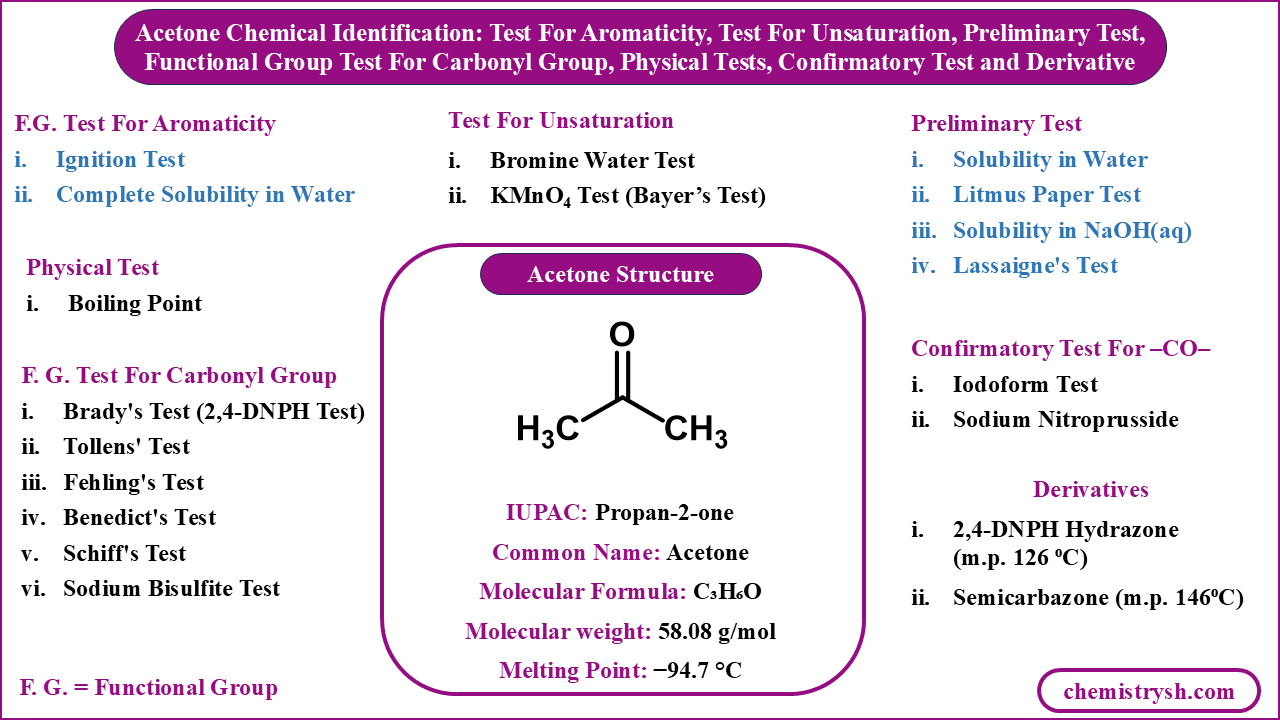
Acetaldehyde and acetone share identical observations in the Litmus Test, Brady’s Test, Iodoform Test, and Sodium Bisulfite Test. What is the chemical test to distinguish between acetaldehyde and acetone?
Although acetaldehyde and acetone respond identically to all four tests above, none of these tests can serve as the basis for differentiation.
Tollens’ Test resolves the ambiguity — acetaldehyde reduces Tollens’ reagent to give a silver mirror (positive), while acetone gives no silver mirror (negative).
|
Test |
Acetone |
Acetaldehyde |
Conclusion |
|
Tollens’ Test |
No silver mirror — negative |
Silver mirror formed — positive |
Acetaldehyde is an aldehyde — acetone is a ketone |
Problem (b): Acetone vs Acetophenone
Acetaldehyde and benzaldehyde share identical observations in Brady’s Test and Tollens’ Test. How can these two compounds be differentiated?
Fehling’s Test resolves the ambiguity — acetaldehyde (aliphatic aldehyde) gives a brick-red Cu₂O precipitate (positive), while benzaldehyde (aromatic aldehyde) gives no precipitate (negative).
|
Test |
Acetaldehyde |
Benzaldehyde |
Conclusion |
|
Fehling’s Test |
Brick-red precipitate — positive |
No precipitate — negative |
Acetaldehyde is aliphatic · benzaldehyde is aromatic |
|
Ignition / Flame Test |
Clean blue flame — no soot |
Sooty flame |
Aliphatic vs aromatic character confirmed |
|
Iodoform Test |
Yellow CHI₃ precipitate — positive |
No precipitate — negative |
CH₃CHO unit confirmed in acetaldehyde only |
Problem (c): Acetaldehyde vs Formaldehyde
Acetaldehyde and formaldehyde share identical observations in Brady’s Test, Tollens’ Test, Fehling’s Test, and Benedict’s Test. How can these two compounds be differentiated?
Iodoform Test resolves the ambiguity — acetaldehyde gives a yellow CHI₃ precipitate (positive) because it contains the CH₃CHO unit, while formaldehyde gives no precipitate (negative) because it has no methyl group.
|
Test |
Acetaldehyde |
Formaldehyde |
Conclusion |
|
Iodoform Test |
Yellow CHI₃ precipitate — positive |
No precipitate — negative |
CH₃CHO unit present in acetaldehyde — absent in formaldehyde |
|
Schiff’s Test |
Magenta colour — positive |
Magenta colour — positive |
No differentiation — both positive |
|
Legal’s Test |
Red colour — positive |
No colour — negative |
Methyl carbonyl unit in acetaldehyde only |
§24 — Practice Exercise
Test your understanding of the qualitative identification of acetaldehyde with the two exercises below. Part A tests recall — Part B tests reasoning.
Part A — Complete the Summary Table
The table below is partially completed. Fill in the missing observations and conclusions based on what you have learned in this article.
|
# |
Test |
Observation |
Conclusion |
|
1 |
Physical Appearance |
|
Coloured compounds — absent |
|
2 |
Litmus Test |
Neutral — no colour change |
|
|
3 |
Brady’s Test (2,4-DNPH) |
|
Carbonyl group (C=O) — confirmed |
|
4 |
Tollens’ Test |
|
Aldehyde confirmed · ketones absent |
|
5 |
Fehling’s Test |
Brick-red precipitate — positive |
|
|
6 |
Schiff’s Test |
|
Aldehyde confirmed · ketones absent |
|
7 |
Iodoform Test |
Yellow precipitate, antiseptic odour |
|
|
8 |
Legal’s Test |
|
Methyl ketone — confirmed |
|
9 |
Molisch’s Test |
No purple ring — negative |
|
|
10 |
Semicarbazone derivative |
m.p. 162–163°C |
|
Part B — Identify the Unknown
- Litmus Test → neutral
- Ignition Test → clean, non-sooty blue flame
- Lassaigne’s Test → nitrogen, sulfur, and halogens all absent
- Brady’s Test (2,4-DNPH) → yellow-orange crystalline precipitate
- Tollens’ Test → bright silver mirror — positive
- Fehling’s Test → brick-red precipitate — positive
- Iodoform Test → yellow CHI₃ precipitate — positive
- Semicarbazone derivative → m.p. 162–163°C
Question: What is the unknown compound? Which single test distinguishes it from acetone? Which single test distinguishes it from benzaldehyde? Which single test distinguishes it from formaldehyde?
Answer: The unknown compound is acetaldehyde (ethanal). Tollens’ Test distinguishes it from acetone — silver mirror positive for acetaldehyde, negative for acetone. Fehling’s Test distinguishes it from benzaldehyde — positive for acetaldehyde, negative for benzaldehyde. Iodoform Test distinguishes it from formaldehyde — positive for acetaldehyde, negative for formaldehyde.
§25 — Acetaldehyde Questions and Answers: Viva Questions on Qualitative Identification of Acetaldehyde
§26 — Multiple Choice Questions on the Qualitative Identification of Acetaldehyde
MCQ 1
1. The acetaldehyde IUPAC name is:
A. Ethanone
B. Methanal
C. Ethanal ✓
D. Propanal
MCQ 2
2. The acetaldehyde molecular formula is:
A. CH₃COCH₃
B. CH₃CHO ✓
C. HCHO
D. C₂H₅OH
MCQ 3
3. The confirmatory test for acetaldehyde that distinguishes it from all ketones is:
A. Brady’s Test
B. Sodium Bisulfite Test
C. Tollens’ Test ✓
D. Litmus Test
MCQ 4
4. Acetaldehyde gives a positive iodoform test because it contains:
A. A benzene ring
B. A hydroxyl group (–OH)
C. The CH₃CHO unit ✓
D. A carboxylic acid group (–COOH)
MCQ 5
5. The acetaldehyde boiling point is 21°C. This low value indicates:
A. Acetaldehyde is a solid at room temperature
B. Acetaldehyde forms strong hydrogen bonds between its own molecules
C. Acetaldehyde is extremely volatile — fume cupboard handling is mandatory ✓
D. Acetaldehyde is ionic in nature
MCQ 6
6. Which test distinguishes acetaldehyde from benzaldehyde?
A. Tollens’ Test — both give positive results
B. Fehling’s Test — acetaldehyde positive, benzaldehyde negative ✓
C. Brady’s Test — both give positive results
D. Litmus Test — both are neutral
MCQ 7
7. Which test distinguishes acetaldehyde from formaldehyde?
A. Tollens’ Test — both give positive results
B. Fehling’s Test — both give positive results
C. Iodoform Test — acetaldehyde positive, formaldehyde negative ✓
D. Schiff’s Test — both give positive results
MCQ 8
8. In Tollens’ Test, acetaldehyde acts as:
A. An oxidising agent
B. A reducing agent ✓
C. A nucleophile
D. A catalyst
MCQ 9
9. Can acetaldehyde give the Cannizzaro reaction?
A. No — acetaldehyde has α-hydrogens and undergoes aldol condensation instead ✓
B. Yes — all aldehydes give the Cannizzaro reaction
C. IYes — but only in dilute NaOH
D. No — because acetaldehyde is a liquid
MCQ 10
10. The acetaldehyde smell is best described as:
A. Sweet, floral odour similar to roses
B. Sharp, vinegar-like odour
C. Pungent, fruity odour detectable at 0.0068 ppm ✓
D. Odourless
MCQ 11
11. What colour precipitate does acetaldehyde produce in Fehling’s Test?
A. White precipitate
B. Yellow precipitate
C. Blue precipitate
D. Brick-red precipitate ✓
MCQ 12
12. The acetaldehyde pKa of the α-hydrogen is:
A. 10 — same as phenol
B. 20 — same as acetone
C. 17 — more acidic than acetone ✓
D. 25 — same as terminal alkynes
MCQ 13
13. In Legal’s Test, acetaldehyde gives a positive result because it contains:
A. A benzene ring
B. A carboxylic acid group
C. The methyl carbonyl unit (CH₃C=O) ✓
D. A hydroxyl group
MCQ 14
14. Acetaldehyde is classified as which GHS hazard?
A. WARNING — irritant only
B. CAUTION — low flammability
C. DANGER — extremely flammable, suspected carcinogen (Carc. 1B) ✓
D. No GHS classification required
§27 — Further Readings and References
[1] Carey, F. A., & Sundberg, R. J. (2007). Advanced organic chemistry, Part A: Structure and mechanisms (5th ed., p. 607). Springer.
[2] chemistrysh.com. (2024). Iodoform test: Procedure, mechanism, and applications. https://chemistrysh.com/iodoform-test/
[3] Shriner, R. L., Hermann, C. K. F., Morrill, T. C., Curtin, D. Y., & Fuson, R. C. (2004). The systematic identification of organic compounds (8th ed.). Wiley.
[4] Sigma-Aldrich. (n.d.). Acetaldehyde, ACS reagent, ≥99.5% (Product No. 402788). MilliporeSigma. https://www.sigmaaldrich.com/catalog/product/sigma/402788
[5] Vogel, A. I., Tatchell, A. R., Furnis, B. S., Hannaford, A. J., & Smith, P. W. G. (1989). Vogel’s textbook of practical organic chemistry (5th ed.). Longman.
Suggestions for Further Readings
THE ODOROUS CONSTITUENTS OF APPLES. EMANATION OF ACETALDEHYDE FROM THE RIPE FRUIT.