
Identification Summary — Acetophenone
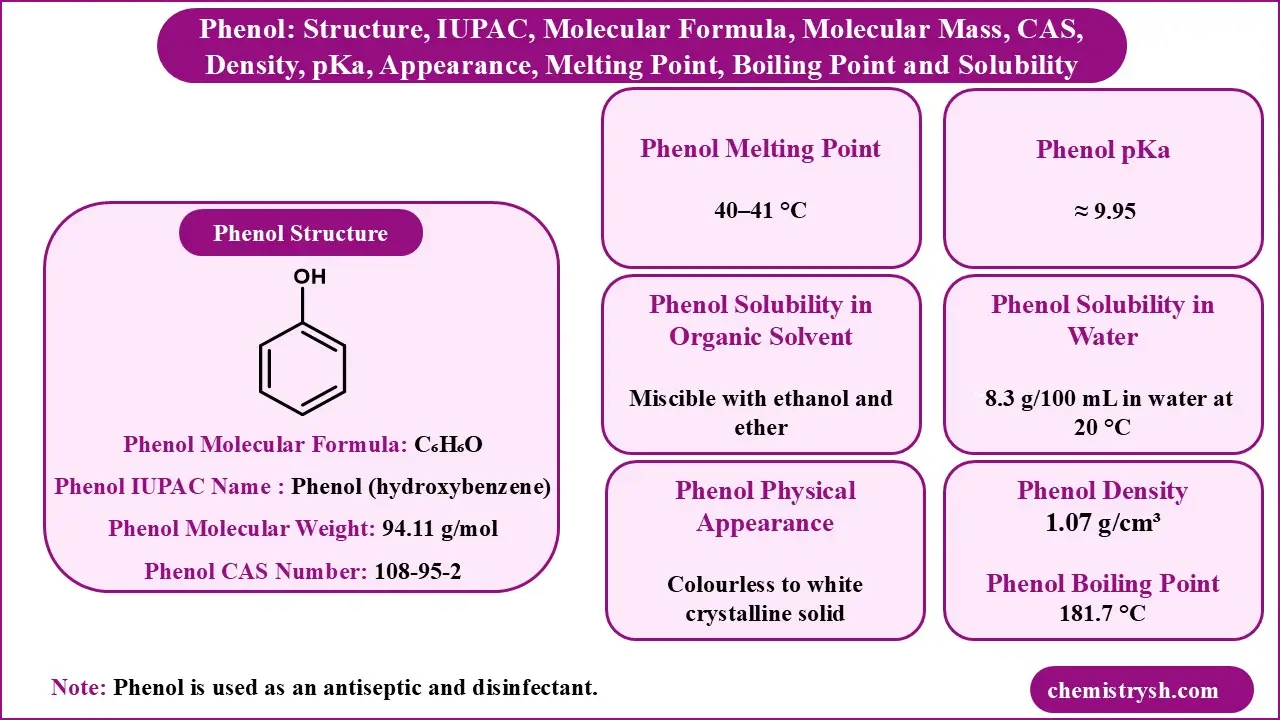
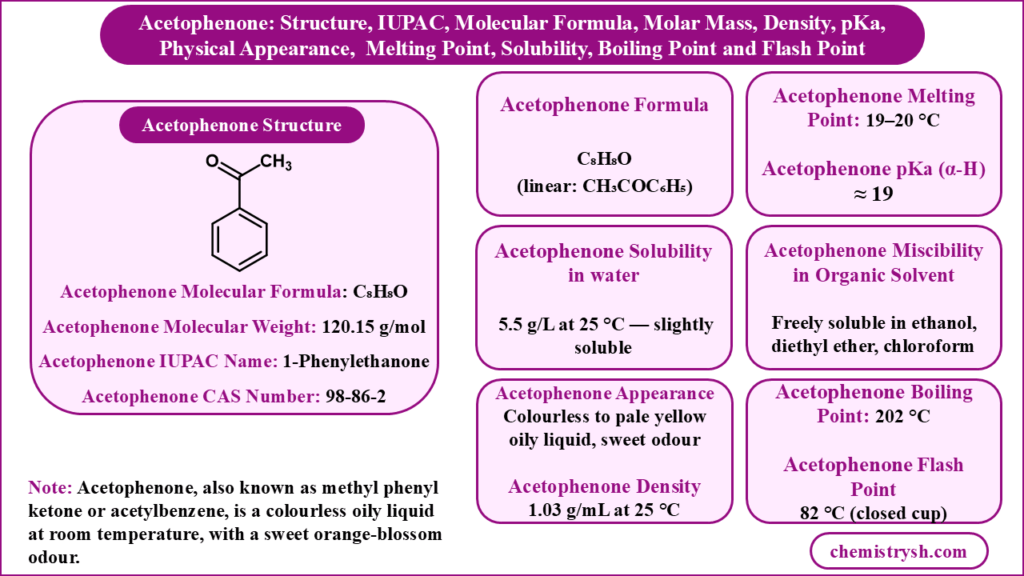
- Acetophenone Molecular Formula (C₈H₈O) · Molecular Weight (120.15 g/mol) · IUPAC Name (1-Phenylethanone) · Common Name (acetophenone, methyl phenyl ketone) · Appearance (colourless to pale yellow oily liquid) · Odour (sweet, orange-blossom-like) · Melting Point (19–20 °C) · Boiling Point (202 °C) · Density (1.03 g/mL at 25 °C) · Refractive Index (n²⁰/D 1.534) · Solubility (slightly soluble in water; freely soluble in ethanol) · Flash Point (82 °C) · CAS Number (98-86-2) · Functional Group (ketone >C=O attached to benzene ring and methyl group)
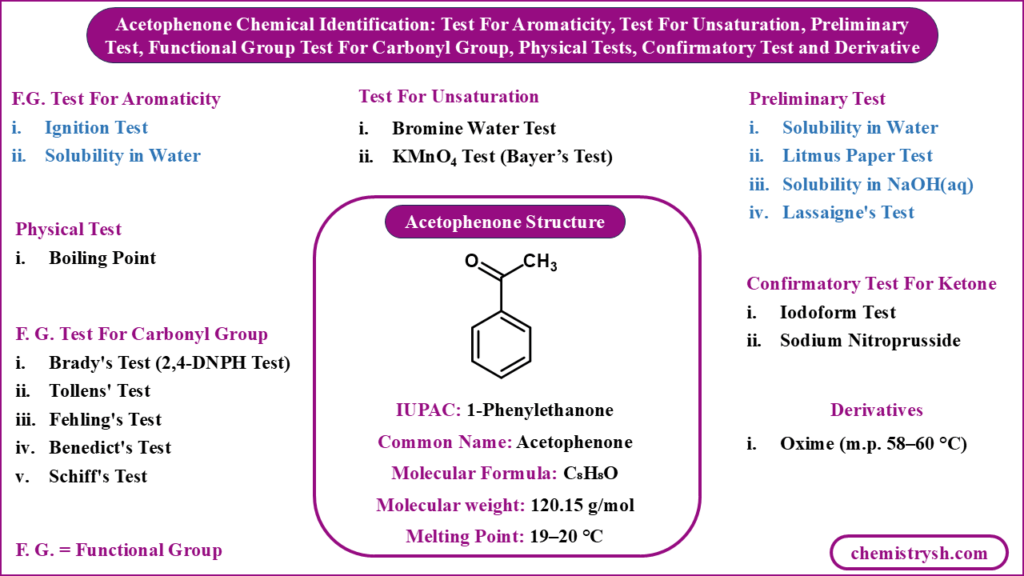
- Physical Appearance · Solubility Test · Ignition Test · Litmus Test · 2,4-DNPH (Brady’s) Test · Iodoform Test · Sodium Nitroprusside Test · Tollens’ Test · Fehling’s Test · Schiff’s Test · Oxime · Semicarbazone · Phenylhydrazone · Chemical Structure · Chemical Reactions · Identification Flowchart · Applications · FAQs · MCQs · Results & Discussion · Conclusion
What is Acetophenone?
Acetophenone (molecular formula C₈H₈O; molecular weight 120.15 g/mol; CAS 98-86-2) is the simplest aromatic ketone. The acetophenone structure C₆H₅–CO–CH₃ places an aryl group and a methyl group on either side of the carbonyl, making it a mixed ketone. It is a colourless oily liquid at room temperature, with a sweet orange-blossom odour.
Physical Constants of Acetophenone (Molecular Formula, Molecular Weight, Melting Point, Boiling Point & Density)
Acetophenone, also known as methyl phenyl ketone, acetylbenzene, or 1-phenylethanone, has the acetophenone CAS number 98-86-2 and is the simplest aromatic ketone. The acetophenone molecular formula is C₈H₈O, written in linear form as CH₃COC₆H₅, and the acetophenone molecular weight is 120.15 g/mol. Its acetophenone IUPAC name is 1-phenylethanone.
The acetophenone melting point is 19–20 °C and the acetophenone boiling point is 202 °C — the low melting point means acetophenone is a liquid at ordinary room temperature but may solidify on a cold laboratory bench, an observation of practical importance during identification. The acetophenone density is 1.03 g/mL at 25 °C. It is a colourless to pale yellow oily liquid with a sweet, characteristic orange-blossom or hawthorn-like odour.
Acetophenone is only slightly soluble in water but freely soluble in ethanol, diethyl ether, and chloroform. Its degree of unsaturation is 5 — four from the benzene ring and one from the carbonyl group. Acetophenone is neutral in acid–base character, carrying no ionisable proton on oxygen. The acetophenone common name used most frequently in laboratory and industrial contexts is methyl phenyl ketone.
|
Property |
Value |
|---|---|
|
IUPAC Name |
1-Phenylethanone |
|
Common Name |
Acetophenone |
|
Synonyms |
Methyl phenyl ketone · Acetylbenzene · Phenyl methyl ketone · Hypnone |
|
Molecular Formula |
C₈H₈O (linear: CH₃COC₆H₅) |
|
Molecular Weight |
120.15 g/mol |
|
CAS Number |
98-86-2 |
|
EC Number |
202-708-7 |
|
Appearance |
Colourless to pale yellow oily liquid |
|
Odour |
Sweet, characteristic orange-blossom / hawthorn-like |
|
Melting point |
19–20 °C |
|
Boiling point |
202 °C |
|
Density |
1.03 g/mL at 25 °C |
|
Refractive Index |
n²⁰/D 1.534 |
|
Flash Point |
82 °C (closed cup) |
|
Vapour Density |
4.1 (vs air) |
|
Solubility in Water |
5.5 g/L at 25 °C — slightly soluble |
|
Miscibility |
Freely soluble in ethanol, diethyl ether, chloroform |
|
pKa (α-hydrogen) |
≈ 19 |
|
Functional Groups |
Ketone (>C=O) · Aromatic ring · Methyl group (–CH₃) |
|
Degree of Unsaturation |
5 (benzene ring = 4, C=O = 1) |
|
Acid/Base Nature |
Neutral |
Because acetophenone melts at 19–20 °C, it may be encountered as a liquid, a solid, or a partly solidified melt depending on laboratory temperature. This does not indicate impurity, and the sample should be warmed gently to a uniform liquid before solubility and chemical tests are performed.
Source: Sigma-Aldrich (CAS 98-86-2, ReagentPlus® ≥99%, product A10701) for all physical constants except water solubility; water solubility from PubChem CID 7410; verified August 2026.
Acetophenone Structure, Bonding and α-Hydrogen Reactivity
Acetophenone’s formula, C₈H₈O, describes a benzene ring bonded directly to a carbonyl group, which in turn carries a methyl group. This arrangement — aryl on one side of the C=O, methyl on the other — determines every result in the test panel that follows.
I. Structure of Acetophenone
The acetophenone structure consists of three connected parts. The benzene ring and the carbonyl carbon are both sp² hybridised and lie in the same plane, allowing the ring’s π system to conjugate with the C=O group. The methyl carbon is sp³ hybridised and carries three hydrogen atoms.Conclusion:
Those three hydrogens are the α-hydrogens — hydrogens on the carbon immediately adjacent to the carbonyl group. Acetophenone has exactly three, and they are all on the methyl side. The other side of the carbonyl is the benzene ring, whose carbons are aromatic and carry no α-hydrogen at all.
II. Why the Methyl Group Makes Acetophenone Reactive
The α-hydrogens are weakly acidic (pKa ≈ 19) because removing one produces the acetophenone enolate ion, in which the negative charge is delocalised onto the electronegative oxygen atom rather than left on carbon. This delocalisation is what makes the α-hydrogen ionisable at all — ordinary C–H bonds have pKa values around 50.
Two consequences follow, and both are visible in the laboratory:
- Acetophenone is neutral to litmus. The α-hydrogen is not acidic in the ordinary sense; it ionises only under strongly basic conditions. There is no O–H group, so acetophenone does not behave like a phenol or a carboxylic acid.
- Acetophenone’s α-hydrogen is slightly more acidic than acetone’s, because the adjacent benzene ring assists in stabilising the enolate — an assistance acetone’s second methyl group cannot provide.
III. Predicting the Test Results from the Structure
Before performing a single test, the structure already predicts the outcome:
- No hydrogen on the carbonyl carbon → acetophenone is a ketone, not an aldehyde → it cannot be oxidised easily → Tollens’, Fehling’s and Schiff’s tests will all be negative.
- A carbonyl group is present → 2,4-DNPH (Brady’s) test will be positive.
- A methyl group attached directly to the carbonyl → acetophenone is a methyl ketone → the iodoform test will be positive.
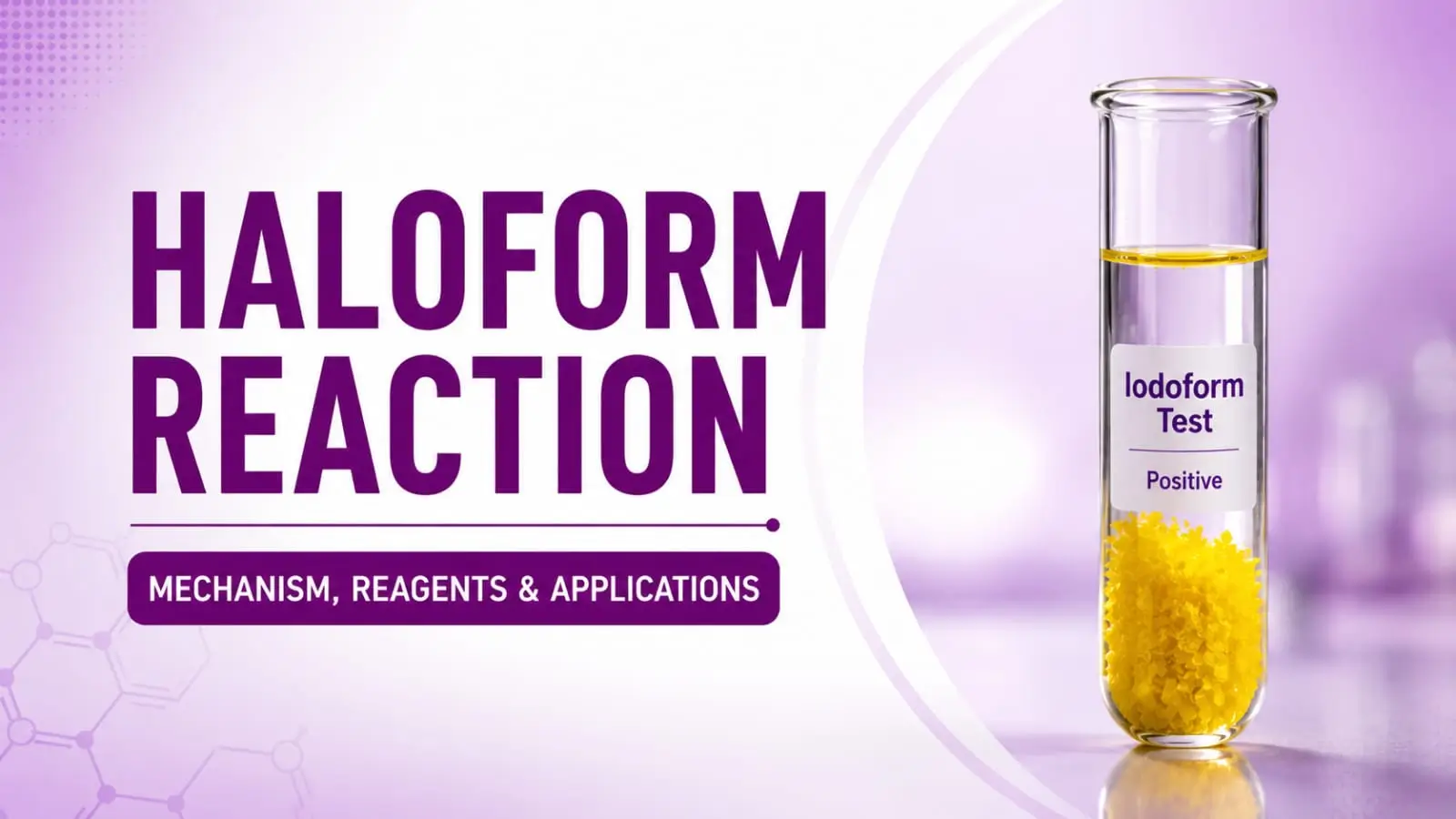
The iodoform test is therefore not just one test among many. It is the single test that detects the CH₃CO– unit specifically, and it is confirmed in the laboratory in the chemical tests.
How to Identify Acetophenone: Decode the Structure First
Acetophenone’s formula, C₈H₈O — a benzene ring bonded to a carbonyl group that carries a methyl group — dictates almost the entire test panel ahead. Because the carbonyl carbon holds no hydrogen of its own, acetophenone behaves as a ketone rather than an aldehyde, a distinction the Tollens’, Fehling’s and Schiff’s tests confirm below. The question this article answers: does this compound behave as a ketone specifically, and does it behave as an aromatic methyl ketone specifically, rather than as an aldehyde or as some other ketone?
I. What Functional Groups Are Present in Acetophenone?
- Benzene ring — aromatic character; high C:H ratio; sooty flame on ignition
- Carbonyl group (>C=O) — neutral; reacts with hydrazine and hydroxylamine reagents; no hydrogen on the carbonyl carbon
- Methyl group (–CH₃) bonded to the carbonyl — the CH₃CO– unit; carries three α-hydrogens; the specific feature that iodoform detects
- Neutral character — no O–H group; no ionisable proton on oxygen
II. Which Confirmatory Tests Identify Acetophenone?
Each test in the acetophenone qualitative analysis panel targets one specific structural feature. The table below maps each structural clue to the tests that confirm it.
|
Structural Clue |
Tests to Confirm It |
|---|---|
|
Benzene ring (aromatic) |
Ignition Test · Solubility pattern |
|
C=O (carbonyl — aldehyde or ketone) |
2,4-DNPH (Brady’s) Test |
|
CH₃CO– (methyl ketone specifically) |
Iodoform Test · Sodium Nitroprusside Test |
|
Ketone, not aldehyde |
Tollens’ Test (negative) · Fehling’s Test (negative) · Schiff’s Test (negative) |
|
Neutral character |
Litmus Test · NaOH Test |
A positive iodoform result confirms the CH₃CO– group but does not by itself exclude an aldehyde — acetaldehyde also gives this test. The Tollens’, Fehling’s and Schiff’s tests complete the identification by establishing that the compound is a ketone.
The iodoform test is the decisive test in this panel — it is the only test that detects the CH₃CO– unit specifically, and it separates acetophenone from benzaldehyde, benzophenone and cyclohexanone in a single observation.
The sodium nitroprusside test is also positive for methyl ketones, but it cannot distinguish acetophenone from acetone. It supports the iodoform result rather than replacing it — the ignition test and boiling point are needed to complete that separation.
Acetophenone Identification Tests — Complete Testing Sequence
The qualitative identification of acetophenone uses the following tests: Physical Appearance, Solubility Test, Ignition Test, Litmus Test, NaOH Test, 2,4-DNPH (Brady’s) Test, Iodoform Test, Sodium Nitroprusside Test, Tollens’ Test, Fehling’s Test, Schiff’s Test, and derivative preparation. The conclusion established by each test is given below.
Group A — Preliminary Tests
|
Test |
What It Establishes |
|
|---|---|---|
|
1 |
Physical Appearance |
Colourless to pale yellow oily liquid; sweet orange-blossom odour; may solidify below 19 °C |
|
2 |
Solubility Test |
Large non-polar benzene ring limits water solubility; free solubility in ethanol confirms a polar carbonyl group is present |
|
3 |
Ignition / Flame Test |
Benzene ring present — sooty, luminous flame confirms aromatic character |
|
4 |
Litmus Test |
Compound is neutral — carboxylic acids, phenols and amines ruled out |
|
5 |
NaOH Test |
Does not dissolve — confirms absence of an acidic O–H group |
|
6 |
Lassaigne’s Test |
No nitrogen, sulfur or halogens — amines, amides and halogenated compounds ruled out |
Group B — Chemical Identification Tests
|
Test |
What It Establishes |
|
|---|---|---|
|
7 |
2,4-DNPH (Brady’s) Test |
Carbonyl group confirmed — orange-yellow precipitate |
|
8 |
Iodoform Test |
Positive — yellow CHI₃ precipitate; methyl ketone (CH₃CO–) confirmed |
|
9 |
Sodium Nitroprusside Test |
Positive for ketones with α-hydrogens; aldehydes give no colour |
|
10 |
Tollens’ Test |
Negative — no silver mirror; aldehyde excluded |
|
11 |
Fehling’s Test |
Negative — solution remains blue; aldehyde excluded |
|
12 |
Benedict’s Test |
Negative — solution remains blue; confirms the Fehling’s result |
|
13 |
Schiff’s Test |
Negative — no pink colour; aldehyde excluded |
|
14 |
Boiling Point |
202 °C — matches acetophenone literature value |
|
15 |
Derivative Preparation |
Oxime (m.p. 58–60 °C) — recommended derivative. The 2,4-DNPH derivative, semicarbazone and phenylhydrazone may also be prepared; compare melting points with literature values |
Preliminary Tests for Acetophenone (Ignition, Solubility, Litmus, NaOH, Lassaigne’s)
The Four Compound Classes
In systematic qualitative analysis, an unknown organic compound is first assigned to one of four broad classes. This assignment is made using the preliminary tests alone — before any specific chemical test is performed. Each class is identified by a distinct pattern of acid–base behaviour and elemental composition, and each leads to a different set of confirmatory tests.
|
List |
Class |
Preliminary Test Pattern |
|---|---|---|
|
A |
Carboxylic acids |
Acidic to litmus · dissolves in NaOH · effervescence with NaHCO₃ |
|
B |
Phenols |
Acidic to litmus · dissolves in NaOH · no effervescence with NaHCO₃ |
|
C |
Aldehydes, ketones and carbohydrates |
Neutral to litmus · does not dissolve in NaOH · no heteroatoms |
|
D |
Amines and amides |
Basic to litmus, or nitrogen detected in Lassaigne’s test |
Read the table by pattern rather than by memorising it. Litmus separates the four lists into three groups — acidic (A and B), neutral (C), and basic (D). The NaHCO₃ test then separates A from B, because a carboxylic acid is acidic enough to displace carbon dioxide from bicarbonate while a phenol is not. Lassaigne’s test confirms List D by detecting nitrogen.
Once the class is assigned, the confirmatory tests follow from it:
|
List |
Class |
Confirmatory tests that follow |
|---|---|---|
|
A |
Carboxylic acids |
(i) Litmus test (ii) Sodium bicarbonate test (iii) Ferric chloride test (iv) Esterification test (v) Sodium hydroxide solubility test (vi) Flame test (vii) Sublimation test (viii) Melting point / mixed melting point (ix) Solid derivative — amide (x) Solid derivative — anilide |
|
B |
Phenols |
(i) Litmus test (ii) Ferric chloride test (iii) Bromine water test (iv) Liebermann’s nitroso test (v) Phthalein dye test (vi) Azo dye test (vii) Millon’s test (viii) Sodium hydroxide solubility test (ix) Sodium bicarbonate test (negative) (x) Melting point / mixed melting point (xi) Solid derivative — tribromophenol |
|
C |
Aldehydes, ketones and carbohydrates |
(i) Brady’s test (ii) Tollens’ test (iii) Fehling’s test (iv) Benedict’s test (v) Schiff’s test (vi) Iodoform test (vii) Molisch’s test (ix) Seliwanoff’s test (x) Barfoed’s test (xi) Osazone formation test (xii) 2,4-DNPH derivative melting point |
|
D |
Amines and amides |
(i) Litmus test (ii) Carbylamine test (iii) Nitrous acid test (iv) Hinsberg test (v) Azo dye test (vi) Acetylation test (vii) Benzoylation test (Schotten–Baumann) (viii) Lassaigne’s test (ix) Solid derivative — acetyl / benzoyl |
Acetophenone is neutral to litmus, does not dissolve in NaOH, and contains no heteroatoms — placing it in List C. The preliminary tests below establish this, and the chemical tests then identify which member of List C it is.
Order of Preliminary Tests
When an unknown organic compound is provided, preliminary tests are performed in the following order:
- Ignition Test — to determine aromatic or aliphatic character.
- Solubility Test (water, ethanol, ether) — to determine polar or non-polar nature.
- Litmus Test — to determine acidic, basic or neutral character.
- NaOH Test — to confirm the absence of an acidic O–H group.
- Lassaigne’s Test — to detect heteroatoms (nitrogen, sulfur and halogens).
These parameters together define the compound class before specific chemical tests are applied.
(i) Ignition / Flame Test
|
Test |
Reagent |
Procedure |
Positive Observation |
Inference |
|---|---|---|---|---|
|
Ignition (Flame) Test |
None (direct flame) |
Place a small amount of the compound on a spatula and ignite in a Bunsen flame |
Burns with a sooty, luminous yellow flame |
High carbon-to-hydrogen ratio confirms aromatic character — a benzene ring is present |
(ii) Solubility Test
|
Test |
Reagent |
Procedure |
Positive Observation |
Inference |
|---|---|---|---|---|
|
Solubility Test |
Water, ethanol, diethyl ether |
Add a few drops of the compound separately to water, ethanol and diethyl ether; shake each |
Only slightly soluble in water (turbid mixture); freely soluble in ethanol and ether; sweet orange-blossom odour noted |
A polar group is present, but the bulky non-polar benzene ring limits water solubility; free solubility in ethanol confirms a polar carbonyl group alongside a large aromatic system |
(iii) Litmus Test
|
Test |
Reagent |
Procedure |
Positive Observation |
Inference |
|---|---|---|---|---|
|
Litmus Test |
Moist blue and red litmus paper |
Place a drop of the compound on blue litmus paper and on red litmus paper |
No change in either paper |
The compound is neutral — carboxylic acids, phenols and amines are ruled out |
(iv) NaOH Test
|
Test |
Reagent |
Procedure |
Positive Observation |
Inference |
|---|---|---|---|---|
|
Solubility in NaOH |
Aqueous NaOH (10%) |
Add the compound to aqueous NaOH solution and shake |
Does not dissolve; two layers persist |
Confirms the absence of an acidic O–H group. Acetophenone’s only acidic hydrogen is the α-hydrogen (pKa ≈ 19), which is far too weakly acidic to be removed by aqueous NaOH — phenols and carboxylic acids are excluded |
(v) Lassaigne’s Test (Elementary Detection)
|
Test |
Reagent |
Procedure |
Positive Observation |
Inference |
|---|---|---|---|---|
|
Lassaigne’s Test |
Sodium metal; then FeSO₄, lead acetate, AgNO₃ |
Fuse a small amount of the compound with sodium metal. Dissolve the fused mass in distilled water and filter. Test the filtrate for nitrogen, sulfur and halogens |
No Prussian blue (N absent); no black precipitate (S absent); no precipitate with AgNO₃ (halogens absent) |
No heteroatoms detected — amines, amides and halogenated compounds are ruled out |
|
Element |
Result for Acetophenone |
Conclusion |
|---|---|---|
|
Nitrogen |
Absent (no Prussian blue) |
Amines and amides ruled out |
|
Sulfur |
Absent (no black precipitate) |
Sulfur compounds ruled out |
|
Halogens |
Absent (no AgCl/AgBr precipitate) |
Halogenated compounds ruled out |
Elimination and Conclusion
|
Class |
Eliminated? |
Reason |
|---|---|---|
|
Carboxylic Acids |
Eliminated |
Litmus neutral; does not dissolve in NaOH |
|
Phenols |
Eliminated |
Litmus neutral; does not dissolve in NaOH — no phenolic O–H |
|
Amines |
Eliminated |
Litmus neutral; nitrogen absent in Lassaigne’s test |
|
Aldehydes, Ketones & Carbohydrates |
Proceed |
Only List C remains |
Concluding Remarks — Preliminary Tests
The preliminary tests establish the following:
- Aromatic — sooty flame; slightly soluble in water, freely soluble in ethanol
- Sweet orange-blossom odour noted — characteristic of acetophenone
- Neutral — no litmus change; does not dissolve in NaOH; carboxylic acids and phenols ruled out
- No heteroatoms — nitrogen, sulfur and halogens absent; amines and amides ruled out
Conclusion: Carboxylic acids, phenols, amines and amides are absent. Only aldehydes, ketones and carbohydrates remain as the possible compound class. Chemical tests confirming the presence of a carbonyl group are now applied.
Chemical Tests for Acetophenone
Stage 1 — Confirm the Carbonyl Group
The preliminary tests placed the compound in List C — aldehydes, ketones and carbohydrates. The first chemical test establishes whether a carbonyl group is in fact present.
Test 1 — 2,4-DNPH Test (Brady’s Test)
|
Test |
Reagent |
Procedure |
Positive Observation |
Inference |
|---|---|---|---|---|
|
2,4-DNPH (Brady’s) Test |
2,4-Dinitrophenylhydrazine in ethanol and dilute H₂SO₄ (Brady’s reagent) |
Add a few drops of the compound to Brady’s reagent in a test tube. Shake and allow to stand |
Orange to yellow crystalline precipitate forms |
Carbonyl group (>C=O) confirmed. The compound is an aldehyde or a ketone |
The precipitate is acetophenone 2,4-dinitrophenylhydrazone, formed by nucleophilic addition of the hydrazine nitrogen to the carbonyl carbon, followed by elimination of water. This same solid is isolated and purified as the oxime derivative, where its melting point provides independent physical confirmation of identity.
Stage 1 conclusion: A carbonyl group is present. The compound is an aldehyde or a ketone. Stage 2 now establishes whether that carbonyl carries a methyl group.
Stage 2 — Confirm the Methyl Ketone (CH₃CO–)
Stage 1 established that a carbonyl group is present. The compound is an aldehyde or a ketone. The tests in this stage determine whether that carbonyl carries a methyl group — the CH₃CO– unit that defines a methyl ketone.
Iodoform Test for Acetophenone
Test 3 — Iodoform Test (Haloform Test)
|
Test |
Reagent |
Procedure |
Positive Observation |
Inference |
|---|---|---|---|---|
|
Iodoform Test |
Iodine solution (I₂ in KI) and 10% NaOH — or sodium hypoiodite (NaOI) prepared in situ |
Dissolve a few drops of the compound in a little ethanol or dioxane. Add 10% NaOH, then add iodine solution dropwise with shaking until a faint iodine colour persists. Warm gently in a water bath at 60 °C for 2–3 minutes |
A pale yellow crystalline precipitate of iodoform (CHI₃) separates, with a characteristic antiseptic (hospital) odour. m.p. 119–123 °C |
Positive. The CH₃CO– group (methyl ketone) is confirmed. Acetophenone is an aromatic methyl ketone |
Why acetophenone gives a positive iodoform test
- The methyl group supplies three α-hydrogens; hydroxide removes them one at a time, and iodine replaces each in turn — giving C₆H₅CO–CI₃ (2,2,2-triiodoacetophenone — the three atoms after the dash are iodine, not chlorine).
- The –CI₃ group is a good leaving group. Hydroxide attacks the carbonyl carbon and the C–C bond breaks.
- Products: iodoform (CHI₃, the yellow precipitate) and benzoate ion.
- Acetophenone’s methyl group is therefore the sole reason the test works. A ketone without it — benzophenone — gives no precipitate.
The balanced equation and reaction type for this test are given in the chemical reactions section.
Which compounds give a positive iodoform test?
|
Class |
Examples |
Result |
|---|---|---|
|
Methyl ketones (CH₃CO–) |
Acetophenone · Acetone · Butan-2-one |
Positive ✓ |
|
Acetaldehyde (the only aldehyde) |
CH₃CHO |
Positive ✓ |
|
CH₃CH(OH)– alcohols |
Ethanol · Propan-2-ol · 1-Phenylethanol |
Positive ✓ (oxidised in situ) |
|
Ketones without a methyl group |
Benzophenone · Diethyl ketone |
Negative ✗ |
|
Other aldehydes |
Benzaldehyde · Formaldehyde |
Negative ✗ |
Test 4 — Sodium Nitroprusside Test
|
Test |
Reagent |
Procedure |
Positive Observation |
Inference |
|---|---|---|---|---|
|
Sodium Nitroprusside Test |
Freshly prepared sodium nitroprusside solution, Na₂[Fe(CN)₅NO]; dilute NaOH |
Dissolve sodium nitroprusside in distilled water. Add a few drops of the compound and shake. Add NaOH dropwise |
Red to reddish-brown colouration develops |
Positive. Confirms a ketone. Aldehydes do not form a stable coloured complex under these conditions |
- Alkali first generates the enolate — the same species formed in the iodoform reaction — which then reacts with the nitroprusside ion, giving the red complex.
- The test does double duty: it confirms the α-hydrogen (Stage 2) and simultaneously excludes the aldehyde class (Stage 3), because aldehydes give no colour.
- Benzophenone, which has no α-hydrogen, gives a negative result — a useful contrast with acetophenone.
Balanced equation and reaction type: see the Sodium Nitroprusside Reaction in the chemical reactions section.
Consolidated Carbonyl Test Results for Acetophenone
The table below gathers every carbonyl test in the panel — those acetophenone answers positively and those it answers negatively — with the structural reason for each result.
|
Test |
Observation with Acetophenone |
Result |
Structural Reason |
|
|---|---|---|---|---|
|
1 |
2,4-DNPH (Brady’s) Test |
Orange-yellow crystalline precipitate |
Positive ✓ |
Carbonyl group present |
|
2 |
Iodoform Test |
Pale yellow CHI₃ precipitate; antiseptic odour |
Positive ✓ |
CH₃CO– group present — methyl ketone |
|
3 |
Sodium Nitroprusside Test |
Red to reddish-brown colouration |
Positive ✓ |
Ketone with α-hydrogens; enolate forms |
|
4 |
Tollens’ Test (Silver Mirror) |
No silver mirror; solution unchanged |
Negative ✗ |
No hydrogen on the carbonyl carbon |
|
5 |
Fehling’s Test |
No brick-red precipitate; remains blue |
Negative ✗ |
Ketone has no reducing power toward Cu²⁺ |
|
6 |
Benedict’s Test |
No brick-red precipitate; remains blue |
Negative ✗ |
Not a reducing carbonyl |
|
7 |
Schiff’s Test |
No pink or magenta colour restored |
Negative ✗ |
Schiff’s reagent responds to aldehydes only |
Reading the table: tests 1–3 establish what acetophenone is — a methyl ketone with an accessible carbonyl and acidic α-hydrogens. Tests 4–7 establish what it is not — an aldehyde. Both halves are necessary. A compound giving the 2,4-DNPH and iodoform tests positive but all four aldehyde tests (Tollens’, Fehling’s, Benedict’s and Schiff’s) also positive would be acetaldehyde, not acetophenone.
Stage 2 conclusion: The CH₃CO– unit is confirmed. The compound is a methyl ketone.
Stage 2 — Confirm the Methyl Ketone (CH₃CO–)
Stage 2 confirmed the CH₃CO– unit. But this group is shared by acetophenone and acetaldehyde alike — a methyl ketone and a methyl aldehyde both give iodoform. The tests in this stage settle which of the two is present, and they do so entirely through negative results.
This places a demand on laboratory practice: a negative result is evidence only if the test was performed correctly. Reagents must be freshly prepared, heating must be adequate, and a known aldehyde should be run alongside as a control. A negative obtained from stale Tollens’ reagent proves nothing. A negative obtained beside a control that gave a clear silver mirror proves a great deal.
Test 5 — Tollens’ Test (Silver Mirror Test)
|
Test |
Reagent |
Procedure |
Positive Observation |
Inference |
|---|---|---|---|---|
|
Tollens’ Test |
Freshly prepared ammoniacal silver nitrate, [Ag(NH₃)₂]⁺OH⁻ |
Add freshly prepared Tollens’ reagent to the compound in a clean test tube. Warm in a water bath at 60–70 °C for 5 minutes |
No silver mirror forms; solution remains unchanged |
Negative. The carbonyl carbon bears no hydrogen and cannot be oxidised to a carboxylate by mild reagents. Aldehydes are excluded |
Test 6 — Fehling’s Test
|
Test |
Reagent |
Procedure |
Positive Observation |
Inference |
|---|---|---|---|---|
|
Fehling’s Test |
Fehling’s A (copper(II) sulfate) + Fehling’s B (NaOH and Rochelle salt), mixed in equal volumes |
Add the compound to freshly mixed Fehling’s solution. Heat in a boiling water bath for 5 minutes |
No brick-red precipitate of Cu₂O; solution remains deep blue |
Negative. Acetophenone has no reducing power toward Cu²⁺. Aliphatic aldehydes give a brick-red precipitate |
Test 7 — Benedict’s Test
|
Test |
Reagent |
Procedure |
Positive Observation |
Inference |
|---|---|---|---|---|
|
Benedict’s Test |
Benedict’s solution (copper(II) sulfate, sodium citrate, sodium carbonate) |
Add the compound to Benedict’s solution. Heat in a boiling water bath for 3–5 minutes |
No colour change through green, yellow or red; solution remains blue |
Negative. Confirms the Fehling’s result using a milder, more stable reagent. Reducing sugars and aliphatic aldehydes give a positive result |
Test 8 — Schiff’s Test
|
Test |
Reagent |
Procedure |
Positive Observation |
Inference |
|---|---|---|---|---|
|
Schiff’s Test |
Schiff’s reagent — fuchsin (magenta dye) decolourised by sulphur dioxide |
Add a few drops of the compound to Schiff’s reagent in a test tube. Allow to stand at room temperature. Do not warm |
No pink or magenta colour is restored; reagent remains colourless |
Negative. Schiff’s reagent responds to aldehydes only. Ketones do not restore the dye |
Stage 3 Conclusion
|
Test |
Acetophenone |
Acetaldehyde |
|---|---|---|
|
Iodoform |
Positive ✓ |
Positive ✓ |
|
Sodium nitroprusside |
Positive ✓ |
Negative ✗ |
|
Tollens’ |
Negative ✗ |
Positive ✓ |
|
Fehling’s / Benedict’s |
Negative ✗ |
Positive ✓ |
|
Schiff’s |
Negative ✗ |
Positive ✓ |
|
Ignition test |
Sooty flame (aromatic) |
Clean flame (aliphatic) |
The question opened at the end of Stage 2 is now closed. Both compounds carry the CH₃CO– unit, but only acetophenone fails every aldehyde test while giving a positive nitroprusside result. Taken with the sooty ignition flame from the preliminary tests, the compound is an aromatic methyl ketone.
Stage 4 — Physical Confirmation
The chemical tests have established that the compound is an aromatic methyl ketone. Stage 4 provides physical evidence independent of any colour change or precipitate.
Test 9 — Boiling Point Determination
|
Test |
Reagent |
Procedure |
Positive Observation |
Inference |
|---|---|---|---|---|
|
Boiling Point |
None (distillation or micro boiling point apparatus) |
Acetophenone is a liquid at ordinary room temperature. Determine the boiling point by simple distillation, or by the micro (Siwoloboff) method using a capillary tube in a heating bath |
Boils at 201–203 °C |
Matches the literature value for acetophenone (202 °C). Independent physical confirmation of identity |
Test 10 — Melting Point (Why It Is Not Used Here)
Acetophenone melts at 19–20 °C — within the range of ordinary room temperature. A melting point determination is therefore neither practical nor diagnostic: the sample may already be liquid before the apparatus is started, and a value so close to ambient temperature cannot be measured with the precision needed for identification.
This is why a solid derivative is prepared. Converting the liquid ketone into a crystalline solid produces a compound with a sharp, high melting point that can be measured accurately and compared against literature. Derivative preparation is covered in the derivatives section.
Stage 4 Conclusion
|
Physical Constant |
Observed |
Literature |
Agreement |
|---|---|---|---|
|
Boiling point |
201–203 °C |
202 °C |
✓ |
|
Density |
1.03 g/mL at 25 °C |
1.03 g/mL at 25 °C |
✓ |
|
Refractive index |
n²⁰/D 1.534 |
n²⁰/D 1.534 |
✓ |
|
Appearance |
Colourless to pale yellow oily liquid |
As literature |
✓ |
|
Odour |
Sweet, orange-blossom-like |
As literature |
✓ |
The physical constants agree with the literature values for acetophenone. Combined with the chemical evidence of Stages 1–3, the identification is essentially complete — and is placed beyond doubt by the derivative melting point in the derivatives section.
Derivatives of Acetophenone
Acetophenone melts at 19–20 °C, so a melting point cannot be determined on the compound itself. A solid derivative is therefore prepared, and the melting point of that derivative is compared with the value reported in the literature. Agreement confirms identity.
Recommended Derivative — Oxime (Acetophenone oxime)
The oxime is the derivative of choice for this identification. It is a stable crystalline solid with a sharp, well-established melting point, and it is commercially available as a reference compound (CAS 613-91-2).
|
Reagent |
Procedure |
Observation |
Melting Point |
|---|---|---|---|
|
Hydroxylamine hydrochloride (NH₂OH·HCl) with sodium hydroxide or sodium acetate |
Dissolve hydroxylamine hydrochloride and base in aqueous ethanol. Add the compound, reflux briefly, cool, acidify, filter, wash and dry |
White to cream crystalline solid |
58–60 °C |
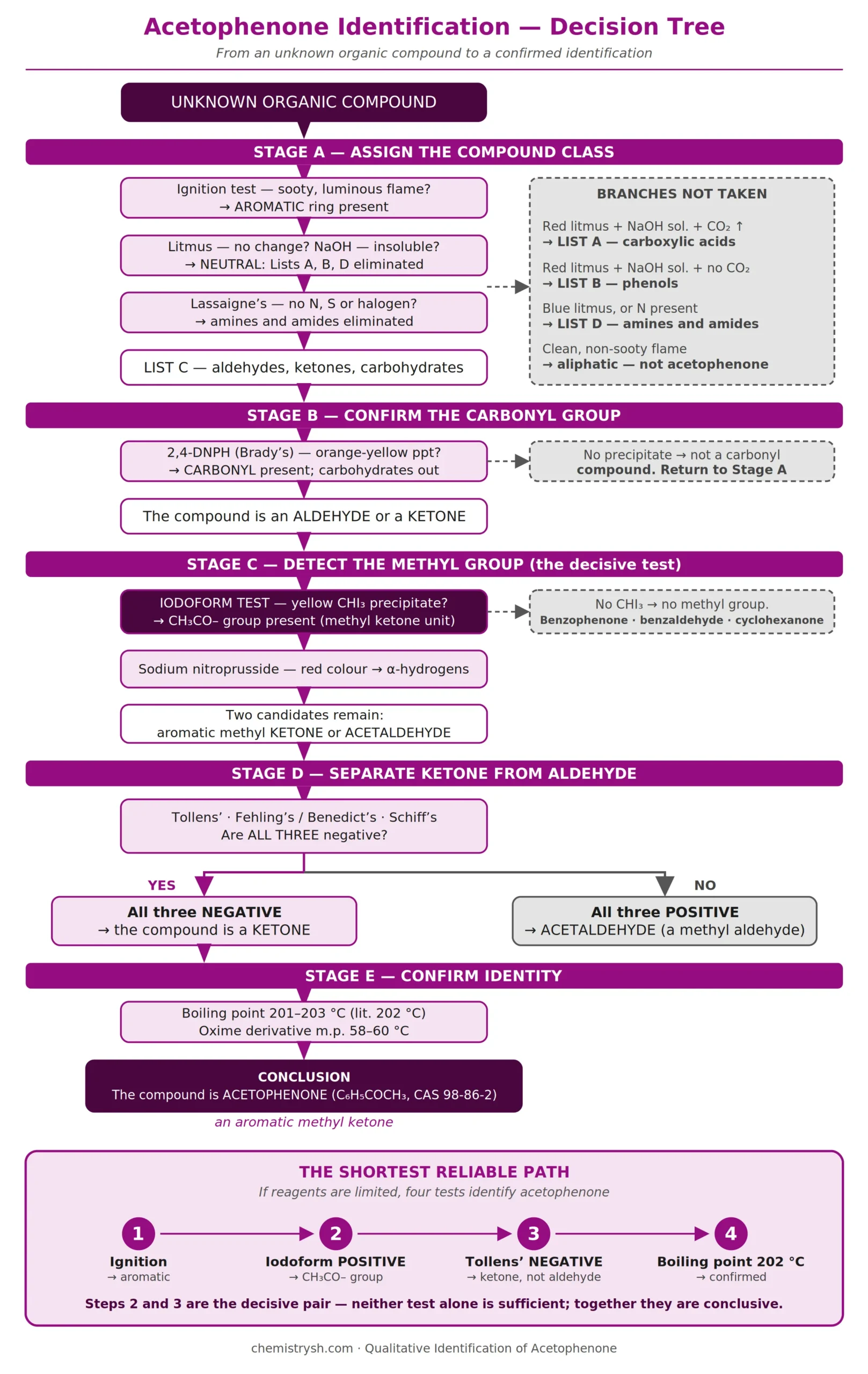
Acetophenone Identification Flowchart: Decision Tree for an Unknown Compound
The flowchart below traces the complete path from an unidentified organic compound to a confirmed identification of acetophenone. Each step is a single decision, and each decision eliminates whole classes of compounds.
Stage A — Assign the Compound Class
|
Step |
Test |
Result |
Conclusion |
|---|---|---|---|
|
A1 |
Ignition |
Sooty, luminous flame |
Aromatic — a clean flame would indicate aliphatic |
|
A2 |
Litmus |
No change |
Neutral — Lists A, B and D eliminated |
|
A3 |
Solubility in NaOH |
Does not dissolve |
No acidic O–H — confirms A2 |
|
A4 |
Lassaigne’s |
No N, S or halogen |
Amines, amides and halogen compounds eliminated |
Stage B — Confirm the Carbonyl Group
|
Step |
Test |
Result |
Conclusion |
|---|---|---|---|
|
B1 |
2,4-DNPH (Brady’s) |
Orange-yellow precipitate |
Carbonyl present — compound is an aldehyde or a ketone |
Stage C — Detect the Methyl Group
|
Step |
Test |
Result |
Conclusion |
|---|---|---|---|
|
C1 |
Iodoform |
Yellow CHI₃ precipitate |
CH₃CO– group present |
|
C2 |
Sodium nitroprusside |
Red colouration |
Ketone with α-hydrogens |
Stage D — Separate Ketone from Aldehyde
|
Step |
Test |
Result |
Conclusion |
|---|---|---|---|
|
D1 |
Tollens’ |
No silver mirror ✗ |
Silver mirror ✓ |
|
D2 |
Fehling’s / Benedict’s |
Remains blue ✗ |
Brick-red precipitate ✓ |
|
D3 |
Schiff’s |
No colour ✗ |
Pink/magenta ✓ |
Stage E — Confirm Identity
|
Step |
Test |
Result |
|---|---|---|
|
E1 |
Boiling point |
201–203 °C (lit. 202 °C) |
|
E2 |
Derivative — oxime |
m.p. 58–60 °C, matches literature |
The Shortest Reliable Path
If reagents are limited, four tests identify acetophenone:
- Ignition → aromatic
- Iodoform positive → CH₃CO– group present
- Tollens’ negative → ketone, not aldehyde
- Boiling point 202 °C → acetophenone confirmed
If reagents are limited, four tests identify acetophenone:
Chemical Reactions of Acetophenone in the Identification Tests
The equations below correspond to the tests performed in the chemical tests and the derivatives prepared in the derivatives section. Each is classified by reaction type, and the observation links it back to the test.
I. Reaction with 2,4-DNPH (Brady’s Test)
Type: Condensation reaction — nucleophilic addition followed by elimination of water
C₆H₅COCH₃ + C₆H₃(NO₂)₂NHNH₂ → C₆H₅C(CH₃)=N–NH–C₆H₃(NO₂)₂ + H₂O
Observation: Orange-yellow crystalline precipitate of acetophenone 2,4-dinitrophenylhydrazone. The hydrazine nitrogen attacks the carbonyl carbon; water is then eliminated to form the C=N bond.
II. Iodoform Test (Haloform Reaction)
Step 1 — triple iodination:
C₆H₅COCH₃ + 3I₂ + 3NaOH → C₆H₅CO–CI₃ + 3NaI + 3H₂O
C₆H₅CO–CI₃ = 2,2,2-triiodoacetophenone (the triiodomethyl ketone). The three atoms written after the dash are iodine, not chlorine.
Step 2 — cleavage:
C₆H₅CO–CI₃ + NaOH → CHI₃↓ + C₆H₅COONa
Overall:
C₆H₅COCH₃ + 3I₂ + 4NaOH → CHI₃↓ + C₆H₅COONa + 3NaI + 3H₂O
Observation: Pale yellow precipitate of iodoform with a characteristic antiseptic odour. Note the second product — sodium benzoate, the salt of benzoic acid.
III. Reaction with Sodium Nitroprusside
Type: Enolate formation followed by complex (coordination) formation
Step 1 — enolate formation:
C₆H₅COCH₃ + OH⁻ → C₆H₅COCH₂⁻ + H₂O
Step 2 — complex formation:
C₆H₅COCH₂⁻ + [Fe(CN)₅NO]²⁻ → [Fe(CN)₅NO·CH₂COC₆H₅]³⁻
Observation: Red to reddish-brown coloured complex. Aldehydes give no colour under these conditions.
IV. Formation of Benzoic Acid — Two Routes
Two reactions in this identification panel convert acetophenone to the benzoic acid fragment. Both cleave the same carbon–carbon bond.
Route 1 — via the iodoform reaction (alkaline hypoiodite):
C₆H₅COCH₃ + 3I₂ + 4NaOH → CHI₃↓ + C₆H₅COONa + 3NaI + 3H₂O
Route 2 — via vigorous oxidation:
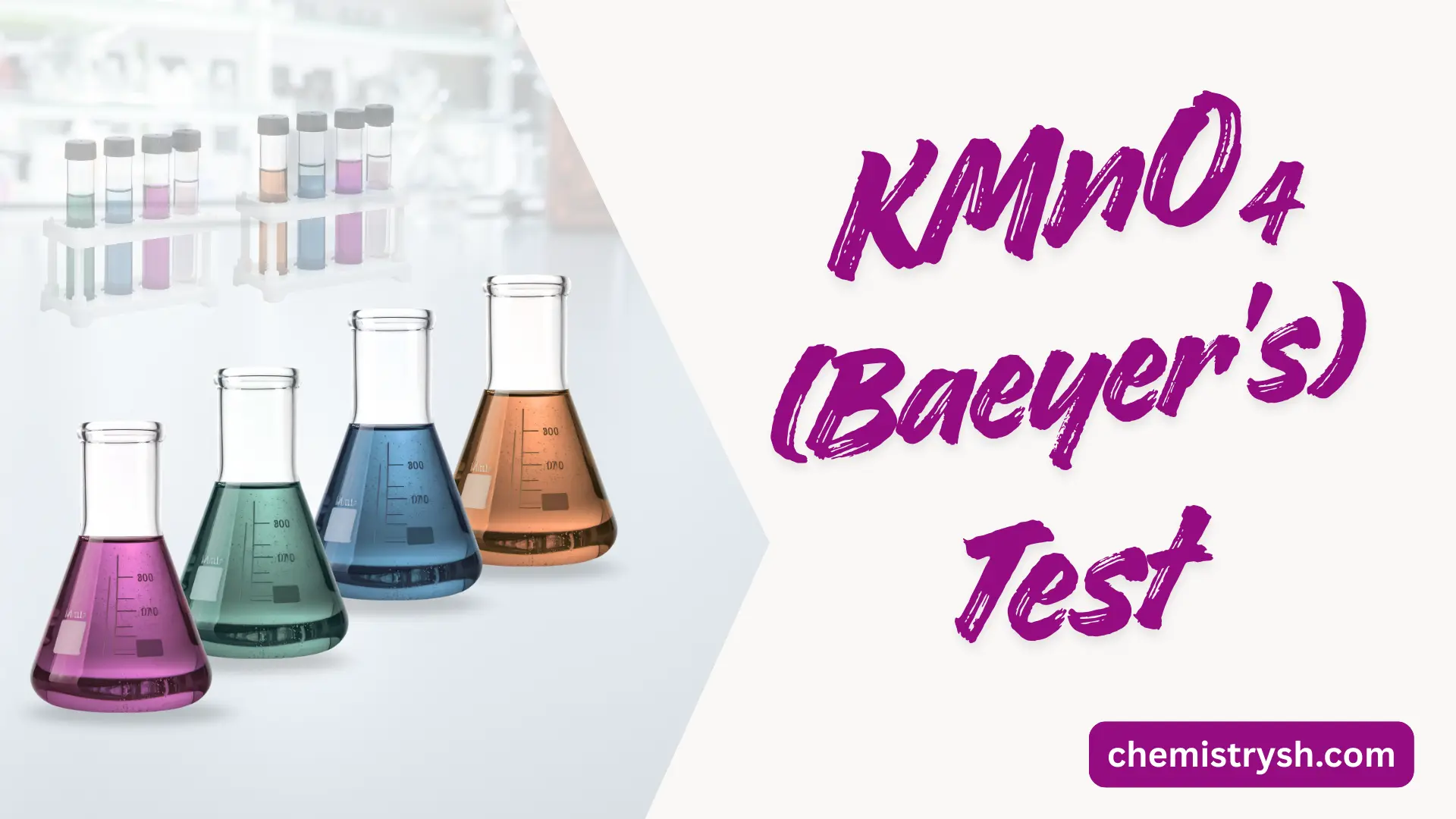
C₆H₅COCH₃ + 4[O] → C₆H₅COOH + CO₂ + H₂O
Reagents: Route 1 — I₂ / NaOH. Route 2 — hot acidified or alkaline KMnO₄, or chromic acid.
Observation: Route 1 gives the pale yellow iodoform precipitate with sodium benzoate in solution. Route 2 decolourises the purple KMnO₄; benzoic acid is isolated on acidification (m.p. 121–122 °C).
Difference: the methyl carbon leaves as CHI₃ in Route 1 and as CO₂ in Route 2.
V. Oxime Formation
Type: Condensation reaction — nucleophilic addition–elimination
C₆H₅COCH₃ + NH₂OH → C₆H₅C(CH₃)=NOH + H₂O
Observation: White to cream crystalline acetophenone oxime, m.p. 58–60 °C.
VI. Semicarbazone Formation
Type: Condensation reaction — nucleophilic addition–elimination
C₆H₅COCH₃ + H₂NNHCONH₂ → C₆H₅C(CH₃)=N–NHCONH₂ + H₂O
Observation: White crystalline acetophenone semicarbazone.
VII. Phenylhydrazone Formation
Type: Condensation reaction — nucleophilic addition–elimination
C₆H₅COCH₃ + C₆H₅NHNH₂ → C₆H₅C(CH₃)=N–NHC₆H₅ + H₂O
Observation: Colourless crystalline acetophenone phenylhydrazone. Measure the melting point promptly after recrystallisation — phenylhydrazones darken on standing in air and light.
VIII. The Negative Tests — Why No Reaction Occurs
|
Test |
Reaction |
Reason |
|---|---|---|
|
Tollens’ |
No reaction |
Oxidation of a carbonyl to a carboxylate requires a hydrogen on the carbonyl carbon. Acetophenone’s carbonyl carbon carries a phenyl group and a methyl group — no hydrogen is available |
|
Fehling’s / Benedict’s |
No reaction |
Cu²⁺ is a mild oxidising agent and cannot break the C–C bond that oxidation of a ketone would require |
|
Schiff’s |
No reaction |
Schiff’s reagent restores its magenta colour by reacting with the aldehyde group specifically; a ketone carbonyl does not react |
Results and Discussion: Qualitative Identification of Acetophenone
The systematic application of preliminary tests and chemical identification tests to the unknown compound yielded the following results.
Results Summary Table
|
Test |
Observation |
Conclusion |
|
|---|---|---|---|
|
1 |
Physical Appearance |
Colourless to pale yellow oily liquid; sweet orange-blossom odour |
Consistent with an aromatic ketone |
|
2 |
Solubility Test |
Slightly soluble in water; freely soluble in ethanol and ether |
Polar carbonyl present; bulky benzene ring limits water solubility |
|
3 |
Ignition / Flame Test |
Sooty, luminous yellow flame |
Aromatic character indicated |
|
4 |
Litmus Test |
No change in blue or red litmus |
Compound is neutral |
|
5 |
NaOH Test |
Does not dissolve; two layers persist |
No acidic O–H group; phenols and carboxylic acids excluded |
|
6 |
Lassaigne’s Test |
No Prussian blue; no black ppt; no AgCl/AgBr |
No heteroatoms — N, S, halogens absent |
|
7 |
2,4-DNPH (Brady’s) Test |
Orange-yellow crystalline precipitate ✓ |
Carbonyl group (>C=O) confirmed |
|
8 |
Iodoform Test |
Pale yellow CHI₃ precipitate; antiseptic odour ✓ |
CH₃CO– group confirmed — methyl ketone |
|
9 |
Sodium Nitroprusside Test |
Red to reddish-brown colouration ✓ |
Ketone bearing α-hydrogens |
|
10 |
Tollens’ Test |
No silver mirror ✗ |
Aldehyde excluded |
|
11 |
Fehling’s Test |
Solution remains blue ✗ |
Aldehyde excluded |
|
12 |
Benedict’s Test |
Solution remains blue ✗ |
Confirms the Fehling’s result |
|
13 |
Schiff’s Test |
No pink or magenta colour ✗ |
Aldehyde excluded |
|
14 |
Boiling Point |
201–203 °C |
Matches literature value for acetophenone |
|
15 |
Derivative — Oxime |
m.p. 58–60 °C |
Matches literature — identity confirmed |
Key: ✓ = positive result · ✗ = negative result
Discussion
The compound is aromatic (ignition test — sooty flame; solubility test — slightly soluble in water, freely soluble in ethanol) and neutral (litmus test — no change; NaOH test — does not dissolve, no acidic O–H group). No heteroatoms are present (Lassaigne’s test — nitrogen, sulfur and halogens absent). These preliminary results eliminate carboxylic acids, phenols, amines and amides, leaving aldehydes, ketones and carbohydrates as the only remaining compound class.
A carbonyl group is confirmed (2,4-DNPH test — orange-yellow precipitate). The carbonyl carries a methyl group (iodoform test — yellow CHI₃ precipitate), establishing the CH₃CO– unit, and the compound possesses α-hydrogens (sodium nitroprusside test — red colouration).
At this point two candidates remain, since the CH₃CO– group is shared by acetophenone and acetaldehyde. The three negative results resolve the question: the compound is a ketone, not an aldehyde (Tollens’ test — no silver mirror; Fehling’s and Benedict’s tests — solution remains blue; Schiff’s test — no colour restored). The negative Tollens’ result is the key distinguishing observation, confirming that the carbonyl carbon bears no hydrogen and therefore cannot be oxidised by mild reagents. Taken with the sooty ignition flame, the compound is an aromatic methyl ketone.
The boiling point (201–203 °C) and the oxime derivative melting point (58–60 °C) both match literature values, providing independent physical confirmation of identity.
The given compound is Acetophenone (C₆H₅COCH₃) — an aromatic methyl ketone characterised by: aromatic ring · ketonic carbonyl group · methyl group bearing three α-hydrogens · neutral nature · no hydrogen on the carbonyl carbon · no heteroatoms.
Conclusion: Identification of Acetophenone Confirmed
The systematic qualitative analysis of the unknown compound, using preliminary tests and a defined series of chemical identification tests, leads to the following confirmed conclusion:
The unknown compound is acetophenone (C₆H₅COCH₃; CAS 98-86-2) — the simplest aromatic ketone, with a boiling point of 202 °C and a molar mass of 120.15 g/mol.
The identification rests on three independent lines of evidence:
- Preliminary tests — The compound is aromatic, neutral, and free of heteroatoms. These results eliminated carboxylic acids, phenols, amines, amides and halogenated compounds at the outset, placing the compound in List C.
- Functional group tests — The 2,4-DNPH test confirmed the carbonyl group. The iodoform test confirmed the CH₃CO– unit, establishing a methyl ketone. The negative Tollens’, Fehling’s, Benedict’s and Schiff’s tests confirmed a ketone rather than an aldehyde — distinguishing acetophenone from acetaldehyde, which shares the same CH₃CO– group.
- Physical constants — Boiling point 201–203 °C, matching the literature value of 202 °C. Oxime derivative melting point 58–60 °C, matching literature.
Acetophenone’s structure accounts for every result in this article. The benzene ring produces the sooty flame and limits water solubility. The carbonyl group gives the positive 2,4-DNPH and derivative reactions. The methyl group — three α-hydrogens on the carbon adjacent to the carbonyl — is the sole reason the iodoform test is positive. And the absence of any hydrogen on the carbonyl carbon is the sole reason Tollens’, Fehling’s, Benedict’s and Schiff’s tests are all negative.
The decisive pair is therefore iodoform positive together with Tollens’ negative. Neither observation identifies acetophenone alone: iodoform is also given by acetaldehyde, and a negative Tollens’ is also given by benzophenone and cyclohexanone. Together, they are conclusive.
With identity confirmed, the sections that follow move beyond the test panel — covering how acetophenone is distinguished from structurally related carbonyl compounds, and its practical applications.
Acetophenone vs Benzaldehyde, Benzophenone, Acetone and Acetaldehyde
Acetophenone is most often confused with structurally related carbonyl compounds. The table below compares their key identification test results.
|
Compound |
Structure |
Iodoform |
Tollens’ |
Fehling’s |
Schiff’s |
Nitroprusside |
Ignition |
|---|---|---|---|---|---|---|---|
|
Acetophenone |
C₆H₅COCH₃ |
Positive ✓ |
Negative ✗ |
Negative ✗ |
Negative ✗ |
Positive ✓ |
Sooty |
|
Benzaldehyde |
C₆H₅CHO |
Negative ✗ |
Positive ✓ |
Negative ✗ |
Positive ✓ |
Negative ✗ |
Sooty |
|
Benzophenone |
C₆H₅COC₆H₅ |
Negative ✗ |
Negative ✗ |
Negative ✗ |
Negative ✗ |
Negative ✗ |
Sooty |
|
Acetone |
CH₃COCH₃ |
Positive ✓ |
Negative ✗ |
Negative ✗ |
Negative ✗ |
Positive ✓ |
Clean |
|
Acetaldehyde |
CH₃CHO |
Positive ✓ |
Positive ✓ |
Positive ✓ |
Positive ✓ |
Negative ✗ |
Clean |
How Each Compound Is Distinguished from Acetophenone
|
Compound |
Single distinguishing test |
Reason |
|---|---|---|
|
Benzaldehyde |
Tollens’ — positive for benzaldehyde, negative for acetophenone |
Benzaldehyde has a hydrogen on the carbonyl carbon and is oxidised to benzoate; acetophenone has none |
|
Benzophenone |
Iodoform — positive for acetophenone, negative for benzophenone |
Benzophenone is a diaryl ketone with no methyl group and no α-hydrogen |
|
Acetone |
Ignition — sooty flame for acetophenone, clean flame for acetone |
Both are methyl ketones and both give iodoform; only acetophenone is aromatic |
|
Acetaldehyde |
Tollens’ — positive for acetaldehyde, negative for acetophenone |
Both give iodoform, but acetaldehyde is an aldehyde and reduces Tollens’ reagent |
Reading the Table
Acetone is the hardest case. It matches acetophenone on every chemical test in the panel — iodoform positive, nitroprusside positive, all aldehyde tests negative. Only the ignition test separates them chemically, and the physical constants separate them decisively: acetone boils at 56 °C, acetophenone at 202 °C.
Benzophenone is the cleanest contrast. It fails every test in the panel. Being a diaryl ketone with no α-hydrogen at all, it gives neither iodoform nor nitroprusside, and having no carbonyl hydrogen it gives no aldehyde reaction either. Only 2,4-DNPH is positive, confirming the carbonyl and nothing more.
No single test identifies acetophenone. Iodoform alone admits acetone and acetaldehyde. Tollens’-negative alone admits benzophenone and cyclohexanone. The combination of iodoform positive, Tollens’ negative, and a sooty flame is unique to acetophenone among these six.
Applications of Acetophenone
The uses of acetophenone span the fragrance industry, pharmaceutical synthesis, polymer chemistry and the laboratory.
- Fragrance and flavouring — acetophenone’s sweet orange-blossom odour makes it a fragrance ingredient in soaps, detergents, creams and perfumes, and a flavouring agent in foods, beverages and tobacco. It occurs naturally in apple, apricot, banana and several essential oils, and holds FEMA number 2009.
- Pharmaceutical intermediate — a starting material in the synthesis of several pharmaceuticals, and an approved excipient. Catalytic hydrogenation gives 1-phenylethanol, itself a fragrance compound and synthetic intermediate.
- Resin manufacture — reaction with formaldehyde produces acetophenone-formaldehyde synthetic resins.
- Photoinitiator and photosensitiser — used as a photoinitiator for specialty printing plates and as a photosensitiser in organic synthesis.
- Industrial solvent — a specialty solvent for cellulose ethers, cellulose esters and resins, and a plasticiser.
- Laboratory use — the standard compound for demonstrating the iodoform test for methyl ketones, and for demonstrating negative Tollens’ and Fehling’s results in aldehyde-versus-ketone comparisons.
Is Acetophenone the Same as Paracetamol or a Painkiller?
No. Acetophenone is frequently confused with acetaminophen (paracetamol, sold as Tylenol) because the two names look similar. They are entirely different compounds:
|
Acetophenone |
Acetaminophen (Paracetamol) |
|
|---|---|---|
|
Formula |
C₈H₈O |
C₈H₉NO₂ |
|
Class |
Aromatic ketone |
Substituted phenol / amide |
|
CAS |
98-86-2 |
103-90-2 |
|
Physical state |
Liquid (m.p. 19–20 °C) |
White crystalline solid (m.p. 168–172 °C) |
|
Contains nitrogen? |
No |
Yes |
|
Use |
Fragrance, solvent, synthetic intermediate |
Analgesic and antipyretic drug |
Acetophenone is not a painkiller and not an NSAID. It is not used as a medicine. In identification terms the two are easy to separate: acetaminophen contains nitrogen and gives a positive Lassaigne’s test, while acetophenone gives no nitrogen at all — which places it in List C, whereas acetaminophen would not reach that branch.
Key Terms and Definitions — Qualitative Identification of Acetophenone
α-Halogenation
Substitution of a hydrogen atom on the α-carbon — the carbon directly adjacent to a carbonyl group — by a halogen atom, brought about under basic conditions via enolate formation.
Example: When acetophenone reacts with iodine and sodium hydroxide, all three hydrogen atoms on the methyl group are replaced one by one by iodine atoms, giving 2,2,2-triiodoacetophenone (C₆H₅CO–CI₃). This is α-halogenation repeated three times.
Aromatic Character
The property of a cyclic compound possessing a continuous ring of delocalised π electrons, giving it high stability and a high carbon-to-hydrogen ratio. In qualitative analysis, aromatic character is detected by the sooty, luminous flame produced when the compound burns.
Example: Acetophenone contains a benzene ring. When ignited, it burns with a sooty, luminous flame — the high carbon-to-hydrogen ratio of the ring produces incomplete combustion and visible soot, distinguishing it from aliphatic compounds, which burn with a clean blue flame.
Diagnostic Test
A test specific enough to identify a particular functional group or compound class, and whose result directly determines the next step in a systematic identification scheme.
Example: The iodoform test is a diagnostic test for methyl ketones. A positive result — a pale yellow crystalline precipitate of iodoform (CHI₃) with a characteristic antiseptic odour — confirms that the compound contains the CH₃CO– group. Benzaldehyde, benzophenone and cyclohexanone all give a negative iodoform test.
Leaving Group
An atom or group that departs from a molecule during a chemical reaction, carrying its bonding electrons with it. A good leaving group stabilises the negative charge it acquires on departure, making the reaction proceed readily.
Example: In the second step of the iodoform reaction, the –CI₃ group acts as a leaving group. The three iodine atoms stabilise the negative charge, allowing hydroxide to attack the carbonyl carbon and the C–CI₃ bond to break, releasing iodoform (CHI₃) and a carboxylate ion.
Oxime
A solid derivative formed when a carbonyl compound reacts with hydroxylamine (NH₂OH). The carbonyl oxygen (C=O) is replaced by an =NOH group, giving a crystalline solid with a sharp melting point used to confirm the identity of the original compound.
Example: Acetophenone reacts with hydroxylamine hydrochloride in the presence of a base to give acetophenone oxime — a white crystalline solid melting at 58–60 °C. Since acetophenone itself is a liquid at room temperature and has no usable melting point, the oxime is prepared as a solid derivative for identification.
Oxidative Carbon–Carbon Cleavage
A reaction in which a carbon–carbon bond is broken by an oxidising agent. One fragment is converted to a carboxylic acid or carboxylate; the other is converted to a smaller oxidised product such as carbon dioxide
Example: When acetophenone is heated with acidified potassium permanganate (KMnO₄), the bond between the carbonyl carbon and the methyl carbon is cleaved. The aryl fragment gives benzoic acid (C₆H₅COOH, m.p. 121–122 °C) and the methyl carbon is released as carbon dioxide.
Photoinitiator
A compound that absorbs light — typically ultraviolet radiation — and generates reactive free radicals or ions that start a chemical reaction, most commonly the polymerisation of a monomer.
Example: Acetophenone absorbs ultraviolet light and generates free radicals that initiate polymerisation reactions. It is used as a photoinitiator in the manufacture of specialty printing plates, where UV exposure causes the coating to cure and harden in the exposed areas.
Recrystallisation
A technique for purifying a solid compound. The impure solid is dissolved in a minimum volume of hot solvent; on cooling, the pure compound crystallises out because its solubility decreases with temperature, while impurities remain dissolved. The crystals are then filtered and dried.
Example: After the 2,4-dinitrophenylhydrazone of acetophenone forms as an orange-yellow precipitate in Brady’s test, it is dissolved in hot ethanol and allowed to cool slowly. Pure crystals form on cooling and are filtered. The melting point of these purified crystals is then measured and compared with the literature value.
Semicarbazone
A solid derivative formed when a carbonyl compound reacts with semicarbazide (H₂NNHCONH₂) in the presence of a mild acid catalyst. The carbonyl oxygen is replaced by =N–NHCONH₂, giving a white crystalline solid with a characteristic melting point used for identification.
Example: Acetophenone reacts with semicarbazide hydrochloride and sodium acetate in aqueous solution to give acetophenone semicarbazone — a white crystalline solid. Its melting point is determined after recrystallisation and compared with the value reported in Vogel’s Practical Organic Chemistry or Shriner’s Systematic Identification of Organic Compounds.
Systematic Qualitative Analysis
A step-by-step laboratory method for identifying an unknown organic compound. Preliminary tests are applied first to assign the compound to a broad class. Confirmatory tests are then applied within that class to identify the specific compound.
Example: An unknown colourless liquid burns with a sooty flame, is neutral to litmus, and gives no heteroatom reaction in Lassaigne’s test — placing it in List C. The iodoform test is positive and Tollens’ test is negative — confirming a methyl ketone. The boiling point of 202 °C identifies it as acetophenone.
Acetophenone Chemical Tests — Identification Questions Answers which can enhance the learning capacity
Multiple Choice Questions: Identification of Acetophenone
MCQ 1
1. The degree of unsaturation indicated by the acetophenone chemical structure and bond-line structure is:
A. 3
B. 4
C. 5 ✓
D. 6
MCQ 2
2. Both acetophenone and benzophenone give a positive 2,4-DNPH test. The single test that distinguishes acetophenone from benzophenone is:
A. Tollens’ test
B. Fehling’s test
C. Iodoform test ✓
D. Schiff’s test
MCQ 3
3. Acetophenone gives a negative Tollens’ test. This confirms that it is:
A. Insoluble in ammoniacal silver nitrate
B. An aldehyde with a blocked carbonyl
C. A ketone whose carbonyl carbon carries no hydrogen ✓
D. A compound containing no carbonyl group
MCQ 4
4. The 2,4-DNPH (Brady’s) test with acetophenone produces:
A. A pale yellow crystalline precipitate
B. A white crystalline adduct
C. An orange-yellow crystalline precipitate ✓
D. No visible change
MCQ 5
5. The iodoform test is positive for acetophenone because it reacts through its:
A. Benzene ring
B. Enol form / enolate — the α-hydrogens on the methyl group ✓
C. Carbonyl carbon directly
D. Phenyl group
MCQ 6
6. In the preliminary tests, acetophenone is placed in List C because it is:
A. Acidic to litmus and dissolves in NaOH
B. Basic to litmus and contains nitrogen
C. Neutral to litmus, insoluble in NaOH, no heteroatoms ✓
D. Acidic to litmus but insoluble in NaHCO₃
MCQ 7
7. The IUPAC chemical name of acetophenone is:
A. Phenyl methyl ether
B. Acetylbenzene
C. 1-Phenylethanone ✓
D. Methyl phenyl carbinol
MCQ 8
8. The recommended solid derivative of acetophenone for identification is:
A. Semicarbazone
B. 2,4-Dinitrophenylhydrazone
C. Oxime (m.p. 58–60 °C) ✓
D. Phenylhydrazone
MCQ 9
9. Which pair of tests together uniquely identifies acetophenone among acetone, benzophenone, benzaldehyde, and acetaldehyde?
A. 2,4-DNPH positive + Fehling’s positive
B. Iodoform positive + Tollens’ positive
C. Iodoform positive + Tollens’ negative + sooty ignition flame ✓
D. Schiff’s positive + Iodoform negative
Suggested Reading
- Vogel, A.I. Vogel’s Textbook of Practical Organic Chemistry. 5th ed. Longman, 1989.
- Shriner, R.L.; Hermann, C.K.F.; Morrill, T.C.; Curtin, D.Y.; Fuson, R.C. The Systematic Identification of Organic Compounds. 8th ed. Wiley, 2004.
- Mann, F.G.; Saunders, B.C. Practical Organic Chemistry. 4th ed. Longman, 1960.