
🔥Introduction
The ignition test, also called the flame test in organic qualitative analysis, is a simple preliminary test used to study the combustion behavior of organic compounds. It helps in the initial classification of organic compounds by observing flame nature, soot formation, bubbling, charring, and residue.
This test is especially useful for distinguishing aromatic and non-aromatic compounds and for recognizing compounds that contain oxygen-rich functional groups, particularly those containing hydroxyl (–OH) groups, including carbohydrates and aliphatic hydroxy carboxylic acids.
Principle of the Ignition Test
The ignition test is based on the behavior of organic compounds when heated strongly in a flame. The observed behavior depends mainly on:
- Carbon content
- Degree of unsaturation
- Presence of oxygen-containing functional groups
Compounds with high carbon content burn with incomplete combustion and produce a sooty flame, while compounds rich in oxygen often show dehydration, bubbling, and charring rather than clean burning.
Objective of the Ignition Test
The ignition test is based on the behavior of organic compounds when heated strongly in a The ignition test is used to:
Materials Required
Procedure
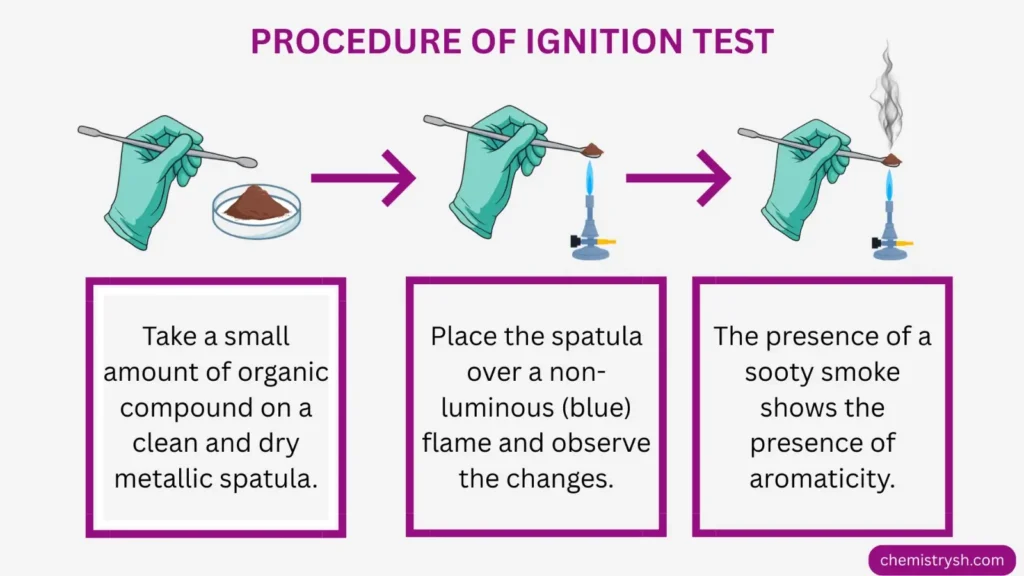
Clean the metallic spatula or wire loop thoroughly.
Take a very small amount of the organic compound.
Heat the sample gently at first, then place it in the non-luminous (blue) flame.
Carefully observe:
Nature of the flame
Presence of soot
Bubbling or frothing
Charring or residue formation
Observations and Interpretation
1. Nature of Flame
- Sooty or smoky flame
Indicates aromatic or highly unsaturated compounds due to high carbon-to-hydrogen ratio and incomplete combustion. - Non-sooty flame
Suggests aliphatic compounds with relatively complete combustion.

Bubbling During Heating or Burning
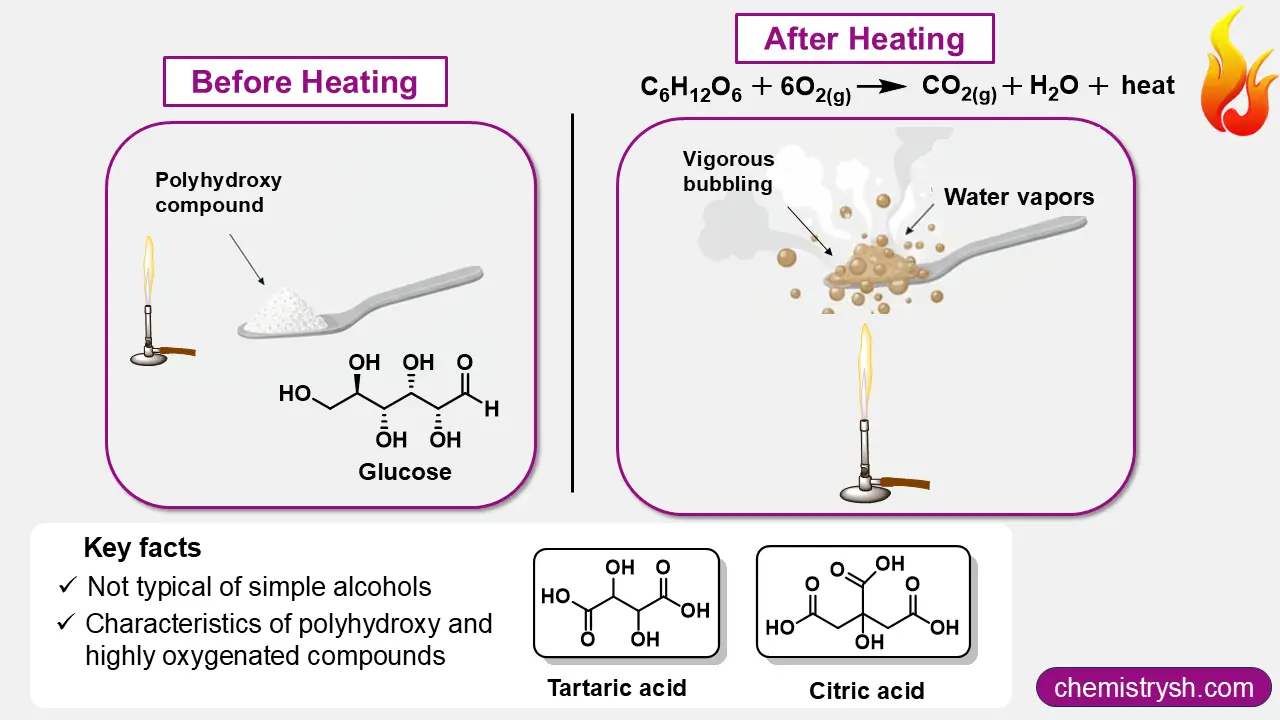
A distinct bubbling or frothing at the tip of the spatula is observed for compounds containing multiple –OH groups.
Reason:
- On heating, these compounds undergo internal dehydration.
- Water vapor and gaseous products are released.
- The escape of these vapors produces visible bubbles.
This behavior is not typical of simple alcohols, but is characteristic of polyhydroxy and highly oxygenated compounds.
3. Behavior of Aliphatic Hydroxy Carboxylic Acids
Aliphatic carboxylic acids containing –OH groups, such as citric acid and tartaric acid, show:
4. Behavior of Carbohydrates
Carbohydrates contain multiple –OH groups and high oxygen content. On heating:
Residue or Ash Formation
Presence of ash suggests inorganic impurities or metal salts
|
Observation |
Inference |
Examples |
|
Sooty, smoky flame |
Aromatic / unsaturated compound |
Benzene, Toluene, Aniline, Naphthalene |
|
Clean, non-sooty flame |
Aliphatic compound |
n-Hexane, Cyclohexane, Acetic acid |
|
Bubbling during heating |
Multiple –OH groups |
Glycerol, Sorbitol |
|
Bubbling with charring |
Carbohydrates |
Glucose, Sucrose, Fructose |
|
Bubbling with acidic fumes |
Hydroxy carboxylic acids |
Citric acid, Tartaric acid |
|
Charring without flame |
Highly oxygenated compounds |
Starch, Cellulose |
|
Ash residue |
Inorganic content |
Sodium acetate, Calcium citrate |
Limitations of the Ignition Test
Multiple Choice Questions
MCQ 1
1.The ignition test is mainly used for:
A. Determining molecular weight
B. Identifying functional groups
C. Preliminary classification of organic compounds
D. Quantitative analysis
MCQ 2
2. A sooty flame in the ignition test indicates:
A. Saturated compound
B. Oxygen-rich compound
C. Aromatic compound
D. Ionic compound
MCQ 3
3. Bubbling during heating is mainly due to:
A. Combustion
B. Oxidation
C. Dehydration
D. Reduction
MCQ 4
4. Which compound shows bubbling and charring?
A. n-Hexane
B. Benzene
C. Glucose
D. Cyclohexane
MCQ 5
5. Ash formation after burning indicates:
A. Unsaturation
B. Presence of –OH group
C. Inorganic matter
D. Aromaticity
MCQ 6
6. Which type of esterification is considered eco-friendly and uses enzymes?
A. Fischer esterification
B. Transesterification
C. Enzymatic esterification
D. Saponification
A. Fischer esterification
B. Transesterification
C. Enzymatic esterification
D. Saponification
Viva questions
- What is the ignition test?
- Why do aromatic compounds burn with a sooty flame?
- What causes bubbling during the ignition test?
- Why do carbohydrates char on heating?
- Name two hydroxy carboxylic acids showing bubbling.
- Is the ignition test preliminary or confirmatory?
FAQ’s
References
- Vogel, A. I. (1989). Vogel’s textbook of practical organic chemistry (5th ed., pp. 110–115, 118–120). Longman Scientific & Technical.
- Shriner, R. L., Fuson, R. C., Curtin, D. Y., & Morrill, T. C. (2004). The systematic identification of organic compounds (8th ed., pp. 1–8, 23–27). John Wiley & Sons.
- Furniss, B. S., Hannaford, A. J., Smith, P. W. G., & Tatchell, A. R. (1989). Vogel’s textbook of practical organic chemistry (5th ed., pp. 105–112). Pearson Education.
- Morrison, R. T., & Boyd, R. N. (2010). Organic chemistry (7th ed., pp. 45–48, 84–86). Prentice Hall.
- Solomons, T. W. G., Fryhle, C. B., & Snyder, S. A. (2016). Organic chemistry (12th ed., pp. 27–30, 65–67). John Wiley & Sons.